



Indian teen discovers cheap way to make saltwater drinkable

February 5, 2017

San Francisco, Feb 5: An Indian-American student has found a cheaper and easier method to turn salt water into drinkable fresh water and his research has caught the attention of major technology firms and universities.
saltwater

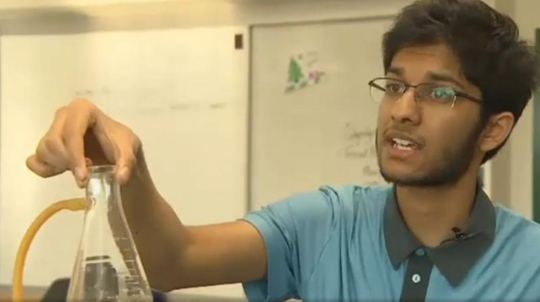
Chaitanya Karamchedu from Portland, Oregon, is turning heads across the country all because of a science experiment that began in his high school classroom.

The Jesuit High School Senior told KPTV that he has big plans of changing the world.

"1 in 8 people do not have access to clean water, it's a crying issue that needs to be addressed," said Karamchedu.

He made up his mind to address the matter himself.

"The best access for water is the sea, so 70 per cent of the planet is covered in water and almost all of that is the ocean, but the problem is that's salt water," said Karamchedu.

Isolating drinkable water from the ocean in a cost effective way is a problem that has stumped scientists for years.

"Scientists looked at desalination, but it's all still inaccessible to places and it would cost too much to implement on a large scale," Karamchedu said.

Karamchedu figured it out, on his own, in a high school lab.

"The real genesis of the idea was realising that sea water is not fully saturated with salt," he was quoted as saying.

By experimenting with a highly absorbent polymer, the teen discovered a cost effective way to remove salt from ocean water and turn it into fresh water.

"It's not bonding with water molecules, it's bonding to the salt," said Karamchedu.

"People have been looking at the problem from one view point, how do we break those bonds between salt and the water? Chai came in and thought about it from a completely different angle," said Jesuit High School Biology Teacher Dr. Lara Shamieh.

"People were concentrated on that 10 per cent of water that's bonded to the salt in the sea and no one looked at the 90 per cent that was free. Chai just looked at it and said if 10 per cent is bonded and 90 per cent is free, then why are we so focused on this 10 per cent, let's ignore it and focus on the 90," Shamieh said.

It is a breakthrough that is estimated to impact millions of lives if ever implemented on a mass scale.

"What this is compared to current techniques, is that it's cheap and accessible to everyone, everyone can use it," said Shamieh.

Scientists across the country are taking note. He won a USD 10,000 award from the US Agency for International Global Development at Intel's International Science Fair and second place at MIT's TechCon Conference where he won more money to continue his research.

"They were very encouraging, they could see things into it that I couldn't, because they've been working their whole lives on this," said Karamchedu.

Back in January, Karamchedu was also named one of 300 Regeneron Science Talent Search Semifinalists. The STS is thought to be one of the most prestigious competitions in the country for high school seniors.

Comments

James Freeman
 - 
Monday, 6 Feb 2017

Nestle (Pepsi, Coca Cola, etc.) certainly won't like this! It was Nestle Chairman, Peter Brabeck-Letmathe, who said '?ccess to water is not a public right.'?

I expect this breakthrough discovery will 'somehow' go nowhere, and this smart young man probably needs to start watching his back. Too much profit stands to be lost with this....

Add new comment

  • Coastaldigest.com reserves the right to delete or block any comments.
  • Coastaldigset.com is not responsible for its readers’ comments.
  • Comments that are abusive, incendiary or irrelevant are strictly prohibited.
  • Please use a genuine email ID and provide your name to avoid reject.
Agencies
March 12,2020

Thiruvananthapuram, Mar 12: In the wake of COVID-19 outbreak, Internet service providers in Kerala have agreed to step up the network capacity by 30 to 40 per cent of the present capacity to meet the demand, especially in view of the spurt in work-at-home mode.

"The decision was made at a meeting of representatives of various telecom service providers in Kerala circle and officials of the Telecommunication Department convened by the Secretary, Electronics and IT, following a direction by Chief Minister Pinarayi Vijayan to look into the issue," said a press release by the IT Department.

The decision will be beneficial for those working in IT institutions. The government has come out with a set of suggestions to avoid social gatherings at public places in view of coronavirus spread. Telecom service providers have assured the government that they are well equipped to face the current situation.

The major part of Internet consumption in Kerala is made available through local servers. Moreover, global Internet traffic is very low as compared to the overall consumption. So, increasing the capacity won't be difficult, service providers informed.

"Complaints regarding the low availability of the Internet due to the spurt in consumption of the Internet can be made to the service providers to their complaint redressal number or inform state government call centre (155300). But complaints regarding the insufficiency in the current network infrastructure should be strictly avoided," said the release.

The IT Department will also demand daily reports from various telecom service providers. By analysing these reports, steps for remedies will be taken after bringing the sudden increase in consumption to the service providers.

Comments

Add new comment

  • Coastaldigest.com reserves the right to delete or block any comments.
  • Coastaldigset.com is not responsible for its readers’ comments.
  • Comments that are abusive, incendiary or irrelevant are strictly prohibited.
  • Please use a genuine email ID and provide your name to avoid reject.
Agencies
May 10,2020

In the wake of the gas leak at a factory in Visakhapatnam, the National Disaster Management Authority (NDMA) has issued detailed guidelines for restarting industries after the lockdown and the precautions to be taken for the safety of the plants as well as the workers.

In a communication to all states and union territories, the NDMA said due to several weeks of lockdown and the closure of industrial units, it is possible that some of the operators might not have followed the established standard operating procedures.

As a result, some of the manufacturing facilities, pipelines, valves may have residual chemicals, which may pose risk. The same is true for the storage facilities with hazardous chemicals and flammable materials, it said.

The NDMA guidelines said while restarting a unit, the first week should be considered as the trial or test run period after ensuring all safety protocols.

Companies should not try to achieve high production targets. There should be 24-hour sanitisation of the factory premises, it said.

The factories need to maintain a sanitisation routine every two-three hours especially in the common areas that include lunch rooms and common tables which will have to be wiped clean with disinfectants after every single use, it added.

For accommodation, the NDMA said, sanitisation needs to be performed regularly to ensure worker safety and reduce the spread of contamination.

To minimise the risk, it is important that employees who work on specific equipment are sensitised and made aware of the need to identify abnormalities like strange sounds or smell, exposed wires, vibrations, leaks, smoke, abnormal wobbling, irregular grinding or other potentially hazardous signs which indicate the need for immediate maintenance or if required shutdown, it said.

At least 11 people lost their lives and about 1,000 others were exposed to a gas leak at a factory in Andhra Pradesh''s Visakhapatnam on May 7.

The incident took place after it restarted operations when the government allowed industrial activities in certain sectors following several weeks of lockdown.

The lockdown was first announced by Prime Minister Narendra Modi on March 24 for 21 days in a bid to combat the coronavirus threat. The lockdown was then extended till May 3 and again till May 17.

Comments

Add new comment

  • Coastaldigest.com reserves the right to delete or block any comments.
  • Coastaldigset.com is not responsible for its readers’ comments.
  • Comments that are abusive, incendiary or irrelevant are strictly prohibited.
  • Please use a genuine email ID and provide your name to avoid reject.
News Network
April 17,2020

Paris, Apr 17: Even as virologists zero in on the virus that causes COVID-19, a very basic question remains unanswered: do those who recover from the disease have immunity?

There is no clear answer to this question, experts say, even if many have assumed that contracting the potentially deadly disease confers immunity, at least for a while.

"Being immunised means that you have developed an immune response against a virus such that you can repulse it," explained Eric Vivier, a professor of immunology in the public hospital system in Marseilles.

"Our immune systems remember, which normally prevents you from being infected by the same virus later on."

For some viral diseases such a measles, overcoming the sickness confers immunity for life.

But for RNA-based viruses such as Sars-Cov-2 -- the scientific name for the bug that causes the COVID-19 disease -- it takes about three weeks to build up a sufficient quantity of antibodies, and even then they may provide protection for only a few months, Vivier told AFP.

At least that is the theory. In reality, the new coronavirus has thrown up one surprise after another, to the point where virologists and epidemiologists are sure of very little.

"We do not have the answers to that -- it's an unknown," Michael Ryan, executive director of the World Health Organization's Emergencies Programme said in a press conference this week when asked how long a recovered COVID-19 patient would have immunity.

"We would expect that to be a reasonable period of protection, but it is very difficult to say with a new virus -- we can only extrapolate from other coronaviruses, and even that data is quite limited."

For SARS, which killed about 800 people across the world in 2002 and 2003, recovered patients remained protected "for about three years, on average," Francois Balloux director of the Genetics Institute at University College London, said.

"One can certainly get reinfected, but after how much time? We'll only know retroactively."

A recent study from China that has not gone through peer review reported on rhesus monkeys that recovered from Sars-Cov-2 and did not get reinfected when exposed once again to the virus.

"But that doesn't really reveal anything," said Pasteur Institute researcher Frederic Tangy, noting that the experiment unfolded over only a month.

Indeed,several cases from South Korea -- one of the first countries hit by the new coronavirus -- found that patients who recovered from COVID-19 later tested positive for the virus.

But there are several ways to explain that outcome, scientists cautioned.

While it is not impossible that these individuals became infected a second time, there is little evidence this is what happened.

More likely, said Balloux, is that the virus never completely disappeared in the first place and remains -- dormant and asymptomatic -- as a "chronic infection", like herpes.

As tests for live virus and antibodies have not yet been perfected, it is also possible that these patients at some point tested "false negative" when in fact they had not rid themselves of the pathogen.

"That suggests that people remain infected for a long time -- several weeks," Balloux added. "That is not ideal."

Another pre-publication study that looked at 175 recovered patients in Shanghai showed different concentrations of protective antibodies 10 to 15 days after the onset of symptoms.

"But whether that antibody response actually means immunity is a separate question," commented Maria Van Kerhove, Technical Lead of the WHO Emergencies Programme.

"That's something we really need to better understand -- what does that antibody response look like in terms of immunity."

Indeed, a host of questions remain.

"We are at the stage of asking whether someone who has overcome COVID-19 is really that protected," said Jean-Francois Delfraissy, president of France's official science advisory board.

For Tangy, an even grimmer reality cannot be excluded.

"It is possible that the antibodies that someone develops against the virus could actually increase the risk of the disease becoming worse," he said, noting that the most serious symptoms come later, after the patient had formed antibodies.

For the moment, it is also unclear whose antibodies are more potent in beating back the disease: someone who nearly died, or someone with only light symptoms or even no symptoms at all. And does age make a difference?

Faced with all these uncertainties, some experts have doubts about the wisdom of persuing a "herd immunity" strategy such that the virus -- unable to find new victims -- peters out by itself when a majority of the population is immune.

"The only real solution for now is a vaccine," Archie Clements, a professor at Curtin University in Perth Australia, told AFP.

At the same time, laboratories are developing a slew of antibody tests to see what proportion of the population in different countries and regions have been contaminated.

Such an approach has been favoured in Britain and Finland, while in Germany some experts have floated the idea of an "immunity passport" that would allow people to go back to work.

"It's too premature at this point," said Saad Omer, a professor of infectious diseases at the Yale School of Medicine.

"We should be able to get clearer data very quickly -- in a couple of months -- when there will be reliable antibody tests with sensitivity and specificity."

One concern is "false positives" caused by the tests detecting antibodies unrelated to COVID-19.

The idea of immunity passports or certificates also raises ethical questions, researchers say.

"People who absolutely need to work -- to feed their families, for example -- could try to get infected," Balloux.

Comments

Add new comment

  • Coastaldigest.com reserves the right to delete or block any comments.
  • Coastaldigset.com is not responsible for its readers’ comments.
  • Comments that are abusive, incendiary or irrelevant are strictly prohibited.
  • Please use a genuine email ID and provide your name to avoid reject.