


Indian teen discovers cheap way to make saltwater drinkable

February 5, 2017

San Francisco, Feb 5: An Indian-American student has found a cheaper and easier method to turn salt water into drinkable fresh water and his research has caught the attention of major technology firms and universities.
saltwater

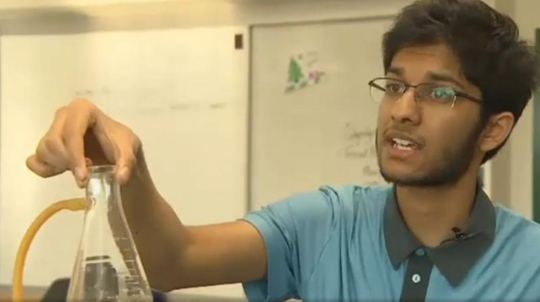
Chaitanya Karamchedu from Portland, Oregon, is turning heads across the country all because of a science experiment that began in his high school classroom.

The Jesuit High School Senior told KPTV that he has big plans of changing the world.

"1 in 8 people do not have access to clean water, it's a crying issue that needs to be addressed," said Karamchedu.

He made up his mind to address the matter himself.

"The best access for water is the sea, so 70 per cent of the planet is covered in water and almost all of that is the ocean, but the problem is that's salt water," said Karamchedu.

Isolating drinkable water from the ocean in a cost effective way is a problem that has stumped scientists for years.

"Scientists looked at desalination, but it's all still inaccessible to places and it would cost too much to implement on a large scale," Karamchedu said.

Karamchedu figured it out, on his own, in a high school lab.

"The real genesis of the idea was realising that sea water is not fully saturated with salt," he was quoted as saying.

By experimenting with a highly absorbent polymer, the teen discovered a cost effective way to remove salt from ocean water and turn it into fresh water.

"It's not bonding with water molecules, it's bonding to the salt," said Karamchedu.

"People have been looking at the problem from one view point, how do we break those bonds between salt and the water? Chai came in and thought about it from a completely different angle," said Jesuit High School Biology Teacher Dr. Lara Shamieh.

"People were concentrated on that 10 per cent of water that's bonded to the salt in the sea and no one looked at the 90 per cent that was free. Chai just looked at it and said if 10 per cent is bonded and 90 per cent is free, then why are we so focused on this 10 per cent, let's ignore it and focus on the 90," Shamieh said.

It is a breakthrough that is estimated to impact millions of lives if ever implemented on a mass scale.

"What this is compared to current techniques, is that it's cheap and accessible to everyone, everyone can use it," said Shamieh.

Scientists across the country are taking note. He won a USD 10,000 award from the US Agency for International Global Development at Intel's International Science Fair and second place at MIT's TechCon Conference where he won more money to continue his research.

"They were very encouraging, they could see things into it that I couldn't, because they've been working their whole lives on this," said Karamchedu.

Back in January, Karamchedu was also named one of 300 Regeneron Science Talent Search Semifinalists. The STS is thought to be one of the most prestigious competitions in the country for high school seniors.

Comments

James Freeman
 - 
Monday, 6 Feb 2017

Nestle (Pepsi, Coca Cola, etc.) certainly won't like this! It was Nestle Chairman, Peter Brabeck-Letmathe, who said '?ccess to water is not a public right.'?

I expect this breakthrough discovery will 'somehow' go nowhere, and this smart young man probably needs to start watching his back. Too much profit stands to be lost with this....

Add new comment

  • Coastaldigest.com reserves the right to delete or block any comments.
  • Coastaldigset.com is not responsible for its readers’ comments.
  • Comments that are abusive, incendiary or irrelevant are strictly prohibited.
  • Please use a genuine email ID and provide your name to avoid reject.
Agencies
July 2,2020

Leiden, Jul 2: Astronomers have discovered a luminous galaxy caught in the act of reionizing its surrounding gas only 800 million years after the Big Bang.

The research, led by Romain Meyer, PhD student at UCL in London, UK, has been presented at the virtual annual meeting of the European Astronomical Society (EAS).

Studying the first galaxies that formed 13 billion years ago is essential to understanding our cosmic origins. One of the current hot topics in extragalactic astronomy is 'cosmic reionization,' the process in which the intergalactic gas was ionized (atoms stripped of their electrons).

Cosmic reionization is similar to an unsolved murder: We have clear evidence for it, but who did it, how and when? We now have strong evidence that hydrogen reionization was completed about 13 billion years ago, in the first billion years of the universe, with bubbles of ionized gas slowly growing and overlapping.

The objects capable of creating such ionized hydrogen bubbles have however remained mysterious until now: the discovery of a luminous galaxy in which 60-100 percent of ionizing photons escape, is likely responsible for ionizing its local bubble. This suggests the case is closer to being solved.

The two main suspects for cosmic reionization are usually 1) a population of numerous faint galaxies leaking ~10 percent of their energetic photons, and 2) an 'oligarchy' of luminous galaxies with a much larger percentage (>50 percent) of photons escaping each galaxy.

In either case, these first galaxies were very different from those today: galaxies in the local universe are very inefficient leakers, with only <2-3 percent of ionizing photons escaping their host. To understand which galaxies governed cosmic reionization, astronomers must measure the so-called escape fractions of galaxies in the reionization era.

The detection of light from excited hydrogen atoms (the so-called Lyman-alpha line) can be used to infer the fraction of escaping photons. On the one hand, such detections are rare because reionization-era galaxies are surrounded by neutral gas which absorbs that signature hydrogen emission.

On the other hand, if this hydrogen signal is detected it represents a 'smoking gun' for a large ionized bubble, meaning we have caught a galaxy reionizing its surroundings. The size of the bubble and the galaxy's luminosity determines whether it is solely responsible for creating this ionized bubble or if unseen accomplices are necessary.

The discovery of a luminous galaxy 800 million years after the Big Bang supports the scenario where an 'oligarchy' of bright leakers emits most of the ionizing photons.

"It is the first time we can point to an object responsible for creating an ionized bubble, without the need for a contribution from unseen galaxies.

Additional observations with the upcoming James Webb Space Telescope will enable us to study further what is likely one of the best suspects for the unsolved case of cosmic reionization," said Meyer.

Comments

Add new comment

  • Coastaldigest.com reserves the right to delete or block any comments.
  • Coastaldigset.com is not responsible for its readers’ comments.
  • Comments that are abusive, incendiary or irrelevant are strictly prohibited.
  • Please use a genuine email ID and provide your name to avoid reject.
Agencies
May 14,2020

Social media platform WhatsApp assured the Supreme Court on Wednesday that it will not roll out its payment services without complying with all payment regulations and norms in the country.

A bench headed by Chief Justice S.A. Bobde and comprising Justices Indu Malhotra and Hrishikesh Roy took up the matter through video conferencing. Senior advocate Kapil Sibal, representing the social media platform, said "WhatsApp Inc makes a statement on behalf of his client that they will not go ahead with the payments' scheme without complying with all the regulations in force."

The statement was made during the hearing of a petition seeking a ban on payment through WhatsApp, as it does not conform to the data localization norms. The top court took the assurance made by WhatsApp on record.

WhatsApp made the statement during the hearing of a plea seeking a ban on its payment service, for not being in line with data localization norms.

In 2018, WhatsApp was granted a beta licence to launch its payment service, but a dedicated and separate app is yet to be launched. A petition was moved in the apex court that WhatsApp's existing model for its payments service should be declared inconsistent with the Unified Payment Interface (UPI) Scheme, as a separate dedicated app has not been offered by the company.

The petitioner NGO, Good Governance Chambers, argued that the National Payments Corporation of India (NPCI) and the Reserve Bank of India (RBI) must change its model on the lines of the UPI payment scheme, and its operations may be suspended until these conditions are met.

The apex court today asked the Centre, Facebook and WhatsApp to file their replies within three weeks and it will take up the matter thereafter. The court noted that the government may process the applications filed by WhatsApp in accordance with the law and there is no stay on the same. Facebook was represented by senior advocate Arvind Datar.

The petitioner argued that lapses have been found in relation to WhatsApp's claims of having a secure and safe technological interface for securing sensitive user data.

Comments

Add new comment

  • Coastaldigest.com reserves the right to delete or block any comments.
  • Coastaldigset.com is not responsible for its readers’ comments.
  • Comments that are abusive, incendiary or irrelevant are strictly prohibited.
  • Please use a genuine email ID and provide your name to avoid reject.
News Network
July 24,2020

Melbourne, Jul 24: Home-made cloth face masks may need a minimum of two layers, and preferably three, to prevent the dispersal of viral droplets associated with Covid-19, according to a study.

Researchers, including those from the University of New South Wales in Australia, noted that viral droplets are generated by those infected with the novel coronavirus when they cough, sneeze, or speak.

As face masks have been proven to protect healthy people from inhaling infectious droplets as well as reducing the spread from those who are already infected, several types of material have been suggested for these, but based on little or no evidence of how well they work, the scientists said.

In the current study, published in the journal Thorax, the researchers compared the effectiveness of single and double-layer cloth face coverings with a surgical face mask (Bao Thach) at reducing droplet spread.

They said the single layer covering was made from a folded piece of cotton T shirt and hair ties, and the double layer covering was made using the sew method described by the US Centers for Disease Control and Prevention (CDC).

The scientists used a tailored LED lighting system and a high-speed camera to film the dispersal of airborne droplets produced by a healthy person with no respiratory infection, during speaking, coughing, and sneezing while wearing each type of mask.

Their analysis showed that the surgical face mask was the most effective at reducing airborne droplet dispersal, although even a single layer cloth face covering reduced the droplet spread from speaking.

But the study noted that a double layer covering was better than a single layer in reducing the droplet spread from coughing and sneezing.

According to the researchers, the effectiveness of cloth face masks is dependent on the number of layers of the covering, the type of material used, design, fit as well as the frequency of washing.

Based on their observations, they said a home made cloth mask with at least two layers is preferable to a single layer mask.

"Guidelines on home-made cloth masks should stipulate multiple layers," the scientists said, adding that there is a need for more research to inform safer cloth mask design.

Comments

Add new comment

  • Coastaldigest.com reserves the right to delete or block any comments.
  • Coastaldigset.com is not responsible for its readers’ comments.
  • Comments that are abusive, incendiary or irrelevant are strictly prohibited.
  • Please use a genuine email ID and provide your name to avoid reject.