


Indian teen discovers cheap way to make saltwater drinkable

February 5, 2017

San Francisco, Feb 5: An Indian-American student has found a cheaper and easier method to turn salt water into drinkable fresh water and his research has caught the attention of major technology firms and universities.
saltwater

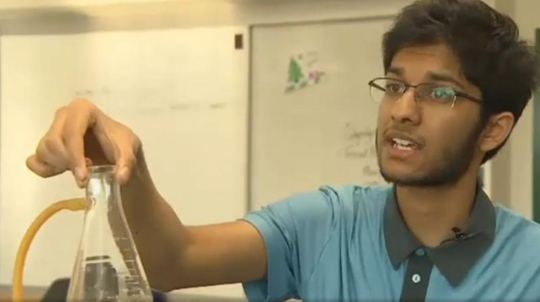
Chaitanya Karamchedu from Portland, Oregon, is turning heads across the country all because of a science experiment that began in his high school classroom.

The Jesuit High School Senior told KPTV that he has big plans of changing the world.

"1 in 8 people do not have access to clean water, it's a crying issue that needs to be addressed," said Karamchedu.

He made up his mind to address the matter himself.

"The best access for water is the sea, so 70 per cent of the planet is covered in water and almost all of that is the ocean, but the problem is that's salt water," said Karamchedu.

Isolating drinkable water from the ocean in a cost effective way is a problem that has stumped scientists for years.

"Scientists looked at desalination, but it's all still inaccessible to places and it would cost too much to implement on a large scale," Karamchedu said.

Karamchedu figured it out, on his own, in a high school lab.

"The real genesis of the idea was realising that sea water is not fully saturated with salt," he was quoted as saying.

By experimenting with a highly absorbent polymer, the teen discovered a cost effective way to remove salt from ocean water and turn it into fresh water.

"It's not bonding with water molecules, it's bonding to the salt," said Karamchedu.

"People have been looking at the problem from one view point, how do we break those bonds between salt and the water? Chai came in and thought about it from a completely different angle," said Jesuit High School Biology Teacher Dr. Lara Shamieh.

"People were concentrated on that 10 per cent of water that's bonded to the salt in the sea and no one looked at the 90 per cent that was free. Chai just looked at it and said if 10 per cent is bonded and 90 per cent is free, then why are we so focused on this 10 per cent, let's ignore it and focus on the 90," Shamieh said.

It is a breakthrough that is estimated to impact millions of lives if ever implemented on a mass scale.

"What this is compared to current techniques, is that it's cheap and accessible to everyone, everyone can use it," said Shamieh.

Scientists across the country are taking note. He won a USD 10,000 award from the US Agency for International Global Development at Intel's International Science Fair and second place at MIT's TechCon Conference where he won more money to continue his research.

"They were very encouraging, they could see things into it that I couldn't, because they've been working their whole lives on this," said Karamchedu.

Back in January, Karamchedu was also named one of 300 Regeneron Science Talent Search Semifinalists. The STS is thought to be one of the most prestigious competitions in the country for high school seniors.

Comments

James Freeman
 - 
Monday, 6 Feb 2017

Nestle (Pepsi, Coca Cola, etc.) certainly won't like this! It was Nestle Chairman, Peter Brabeck-Letmathe, who said '?ccess to water is not a public right.'?

I expect this breakthrough discovery will 'somehow' go nowhere, and this smart young man probably needs to start watching his back. Too much profit stands to be lost with this....

Add new comment

  • Coastaldigest.com reserves the right to delete or block any comments.
  • Coastaldigset.com is not responsible for its readers’ comments.
  • Comments that are abusive, incendiary or irrelevant are strictly prohibited.
  • Please use a genuine email ID and provide your name to avoid reject.
News Network
January 17,2020

New Delhi, Jan 17: E-commerce major Amazon on Friday said it plans to create one million new jobs in India over the next five years through investments in technology, infrastructure and its logistics network.

These jobs are in addition to the seven lakh jobs Amazon's investments have enabled over the last six years in the country.

"Amazon plans to create one million new jobs in India by 2025," the company said in a statement, adding that the jobs - created both directly and indirectly - will be across industries, including information technology, skill development, content creation, retail, logistics, and manufacturing.

Amazon.com Inc chief Jeff Bezos had on Wednesday announced USD 1 billion (over Rs 7,000 crore) investment in India to help bring small and medium businesses online and committed to exporting USD 10 billion worth of India-made goods by 2025.

"We are investing to create a million new jobs here in India over the next five years," Bezos said.

"We’ve seen huge contributions from our employees, extraordinary creativity from the small businesses we've partnered with, and great enthusiasm from the customers who shop with us—and we’re excited about what lies ahead," Bezos added.

India has prioritised job creation and skilling initiatives – including the training of more than 400 million people by 2022 – in rural and urban areas.

"Amazon’s job creation commitment and investment in traders and micro, small and medium enterprises (MSMEs) complement this social inclusion and social mobility efforts by creating more opportunities for people in India to find employment, build skills, and expand entrepreneurship opportunities," the statement said.

The new investments will help to hire talent to fill roles across Amazon in India, including software development engineering, cloud computing, content creation, and customer support.

Since 2014, Amazon has grown its employee base more than four times, and last year inaugurated its new campus building in Hyderabad – Amazon’s first fully-owned campus outside the United States and the largest building globally in terms of employees (15,000) and space (9.5 acres).

The investments will also help in expanding growth opportunities for the more than 5,50,000 traders and micro, small, and medium-sized businesses – including local shops – through programs like Saheli, Karigar, and “I Have Space”.

Comments

Add new comment

  • Coastaldigest.com reserves the right to delete or block any comments.
  • Coastaldigset.com is not responsible for its readers’ comments.
  • Comments that are abusive, incendiary or irrelevant are strictly prohibited.
  • Please use a genuine email ID and provide your name to avoid reject.
Agencies
July 4,2020

The Mars Colour Camera (MCC) onboard ISRO's Mars Orbiter Mission has captured the image of Phobos, the closest and biggest moon of Mars.

The image was taken on July 1 when MOM was about 7,200 km from Mars and 4,200 km from Phobos.

"Spatial resolution of the image is 210 m.

This is a composite image generated from 6 MCC frames and has been color corrected," ISRO said in an update along with the image.

Phobos is largely believed to be made up of carbonaceous chondrites.

According to ISRO, "the violent phase that Phobos has encountered is seen in the large section gouged out from a past collision (Stickney crater) and bouncing ejecta."

"Stickney, the largest crater on Phobos along with the other craters (Shklovsky, Roche & Grildrig) are also seen in this image," it said.

The mission also known as Mangalyaan was initially meant to last six months, but subsequently ISRO had said it had enough fuel for it to last "many years."

The country had on September 24, 2014 successfully placed the Mars Orbiter Mission spacecraft in orbit around the red planet, in its very first attempt, thus breaking into an elite club.

ISRO had launched the spacecraft on its nine-month- long odyssey on a homegrown PSLV rocket from Sriharikota in Andhra Pradesh on November 5, 2013.

It had escaped the earth's gravitational field on December 1, 2013.

The Rs 450-crore MOM mission aims at studying the Martian surface and mineral composition as well as scan its atmosphere for methane (an indicator of life on Mars).

The Mars Orbiter has five scientific instruments - Lyman Alpha Photometer (LAP), Methane Sensor for Mars (MSM), Mars Exospheric Neutral Composition Analyser (MENCA), Mars Colour Camera (MCC) and Thermal Infrared Imaging Spectrometer

Comments

Add new comment

  • Coastaldigest.com reserves the right to delete or block any comments.
  • Coastaldigset.com is not responsible for its readers’ comments.
  • Comments that are abusive, incendiary or irrelevant are strictly prohibited.
  • Please use a genuine email ID and provide your name to avoid reject.
Agencies
June 28,2020

The US space agency has thrown open a challenge to win over Rs 26 lakh, calling the global community to send novel design concepts for compact toilets that can operate in both microgravity and lunar gravity.

NASA is preparing for return to the Moon and innumerable activities to equip, shelter, and otherwise support future astronauts are underway.

The astronauts will be eating and drinking, and subsequently urinating and defecating in microgravity and lunar gravity.

NASA said that while astronauts are in the cabin and out of their spacesuits, they will need a toilet that has all the same capabilities as ones here on Earth.

The public designs for space toilet may be adapted for use in the Artemis lunar landers that take humans back to the Moon.

"Although space toilets already exist and are in use (at the International Space Station, for example), they are designed for microgravity only," the US space agency said in a statement.

NASA's Human Landing System Programme is looking for a next-generation device that is smaller, more efficient, and capable of working in both microgravity and lunar gravity.

The new NASA challenge includes a Technical category and Junior category and the last date to send designs is August 17.

NASA's Artemis Moon mission will land the first woman and next man on the lunar surface by 2024.

The Artemis programme is part of America's broader Moon to Mars exploration approach, in which astronauts will explore the Moon and experience gained there to enable humanity's next giant leap, sending humans to Mars.

Comments

Add new comment

  • Coastaldigest.com reserves the right to delete or block any comments.
  • Coastaldigset.com is not responsible for its readers’ comments.
  • Comments that are abusive, incendiary or irrelevant are strictly prohibited.
  • Please use a genuine email ID and provide your name to avoid reject.