



Indian teen discovers cheap way to make saltwater drinkable

February 5, 2017

San Francisco, Feb 5: An Indian-American student has found a cheaper and easier method to turn salt water into drinkable fresh water and his research has caught the attention of major technology firms and universities.
saltwater

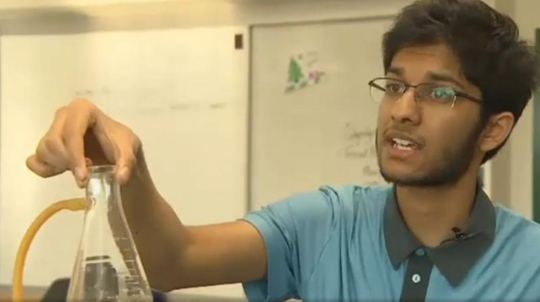
Chaitanya Karamchedu from Portland, Oregon, is turning heads across the country all because of a science experiment that began in his high school classroom.

The Jesuit High School Senior told KPTV that he has big plans of changing the world.

"1 in 8 people do not have access to clean water, it's a crying issue that needs to be addressed," said Karamchedu.

He made up his mind to address the matter himself.

"The best access for water is the sea, so 70 per cent of the planet is covered in water and almost all of that is the ocean, but the problem is that's salt water," said Karamchedu.

Isolating drinkable water from the ocean in a cost effective way is a problem that has stumped scientists for years.

"Scientists looked at desalination, but it's all still inaccessible to places and it would cost too much to implement on a large scale," Karamchedu said.

Karamchedu figured it out, on his own, in a high school lab.

"The real genesis of the idea was realising that sea water is not fully saturated with salt," he was quoted as saying.

By experimenting with a highly absorbent polymer, the teen discovered a cost effective way to remove salt from ocean water and turn it into fresh water.

"It's not bonding with water molecules, it's bonding to the salt," said Karamchedu.

"People have been looking at the problem from one view point, how do we break those bonds between salt and the water? Chai came in and thought about it from a completely different angle," said Jesuit High School Biology Teacher Dr. Lara Shamieh.

"People were concentrated on that 10 per cent of water that's bonded to the salt in the sea and no one looked at the 90 per cent that was free. Chai just looked at it and said if 10 per cent is bonded and 90 per cent is free, then why are we so focused on this 10 per cent, let's ignore it and focus on the 90," Shamieh said.

It is a breakthrough that is estimated to impact millions of lives if ever implemented on a mass scale.

"What this is compared to current techniques, is that it's cheap and accessible to everyone, everyone can use it," said Shamieh.

Scientists across the country are taking note. He won a USD 10,000 award from the US Agency for International Global Development at Intel's International Science Fair and second place at MIT's TechCon Conference where he won more money to continue his research.

"They were very encouraging, they could see things into it that I couldn't, because they've been working their whole lives on this," said Karamchedu.

Back in January, Karamchedu was also named one of 300 Regeneron Science Talent Search Semifinalists. The STS is thought to be one of the most prestigious competitions in the country for high school seniors.

Comments

James Freeman
 - 
Monday, 6 Feb 2017

Nestle (Pepsi, Coca Cola, etc.) certainly won't like this! It was Nestle Chairman, Peter Brabeck-Letmathe, who said '?ccess to water is not a public right.'?

I expect this breakthrough discovery will 'somehow' go nowhere, and this smart young man probably needs to start watching his back. Too much profit stands to be lost with this....

Add new comment

  • Coastaldigest.com reserves the right to delete or block any comments.
  • Coastaldigset.com is not responsible for its readers’ comments.
  • Comments that are abusive, incendiary or irrelevant are strictly prohibited.
  • Please use a genuine email ID and provide your name to avoid reject.
Agencies
July 4,2020

Twitter has joined efforts to do away with racially loaded terms such as master, slave and blacklist from its coding language in the wake of the death of African-American George Floyd and ensuing Black Lives Matter protests.

The project started even before the current movement for racial justice escalated following the death of 46-year-old George Floyd in police custody in May.

The use of terms such as "master" and "slave" in programming language originated decades ago. While "master" is used to refer to the primary version of a code, "slave" refers to the replicas. Similarly, the term "Blacklist" is used to refer to items which are meant to be automatically denied.

The efforts to change these terms in favour of more inclusive language at Twitter were initiated by Regynald Augustin and Kevin Oliver and the microblogging platform is now backing their efforts.

"Inclusive language plays a critical role in fostering an environment where everyone belongs. At Twitter, the language we have been using in our code does not reflect our values as a company or represent the people we serve. We want to change that. #WordsMatter," Twitter's engineering team said in a post on Thursday.

As per the recommendations from the team, the term "whitelist" could be replaced by "allowlist" and "blacklist" by "denylist".

Similarly, "master/slave" could be replaced by "leader/follower", "primary/replica" or "primary/standby".

Twitter, however, is not the first to start a project to bring inclusivity in programming language.

According to a report in CNET, the team behind the Drupal online publishing software started using "primary/replica" in place of "master/slave" as early as in 2014.

The use of the terms "master/slave" was also dropped by developers of the Python programming language in 2018.

Now similar efforts are underway at Microsoft's Github and LinkedIn divisions as well, said the report.

Comments

Add new comment

  • Coastaldigest.com reserves the right to delete or block any comments.
  • Coastaldigset.com is not responsible for its readers’ comments.
  • Comments that are abusive, incendiary or irrelevant are strictly prohibited.
  • Please use a genuine email ID and provide your name to avoid reject.
Agencies
July 24,2020

Pune, Jul 24: Agile and dexterous, 85-year-old Shantabai Pawar wields sticks with absolute ease as she displays 'lathi-kathi' on the streets of Pune.

A video of her, displaying her skills in the Indian martial art form for livelihood, has gone viral on social media.

Pawar told media persons that she learnt the art form when she was only eight and has been practising it since then. The ancient martial art s believed to be linked to Dombari community, a nomadic tribe in Maharashtra.

"I have been pursuing the art of lathi-kathi since I was eight. I have never left it. It is part of me and it is an honour to practice it. My father taught me this. He taught me to work hard," Pawar told media persons.

In the video, the sari-clad octogenarian takes a warrior-like stride and effortlessly rotates a stick several times in a second in her hand and around her head and then does it with two sticks together with a smile on her face. She also tosses a stick in the air and catches it with ease.

The assembled gathering is impressed and enthused.

"People come and say, 'Well done Daadi!' I practice it to earn money for my children and grandchildren," she said.

Pawar leaves her home in the morning in the conditions created by coronavirus and performs the art form on roads and streets.

"I go to various areas to perform the art form and people give money," she said.

The artiste also uses thali and stick to gather the attention of people as most of them are indoors due to conditions created by COVID-19.

Senior citizens have been advised against venturing out due to their greater susceptibility to coronavirus but Pawar said she is not afraid to step out.

"People do advise me to not go out due to fear of COVID-19 but I am not scared. Whenever I step out, I pray to my God and he has kept me safe so far," she said.

Aishwarya Kale, a dancer and the person who uploaded the video on social media, said that it is "only an artist who can understand what help another artist needs".

"I was in that area shopping for some items and it was then I saw her performing and thought that I should film her and upload her video on social media. But I never thought that the video would go viral and she would receive financial help not just from people in the country but overseas as well," Kale told media persons.

"She is now getting honour for her craft that she couldn't get in the last 85 years. I feel good that through my small video, her art form has become viral," she added. 

Comments

Add new comment

  • Coastaldigest.com reserves the right to delete or block any comments.
  • Coastaldigset.com is not responsible for its readers’ comments.
  • Comments that are abusive, incendiary or irrelevant are strictly prohibited.
  • Please use a genuine email ID and provide your name to avoid reject.
Agencies
March 8,2020

New Delhi, Mar 8: In order to spread awareness, a special COVID-19 mobile phone caller tune was launched by all telecom operators with basic infection prevention messages played when a caller dials-out, Ministry of Health and Family Welfare said on Saturday.

"In order to spread awareness about COVID-19, a special COVID-19 mobile phone caller tune was launched by all telecom operators. Over 117.2 crore subscribers of BSNL, MTNL Reliance Jio, Airtel and Vodafone-Idea are being progressively reached out to through SMSs and Call Backs," Ministry of Health and Family Welfare said in a press statement.

"As many as 52 laboratories are now operational across the country for testing the COVID-19 virus. An additional 57 laboratories have been provided with Viral Transport Media and swabs for sample collection," the statement added.

India has 39 confirmed cases of deadly coronavirus so far. The disease has caused deaths of 3200 people globally. 

Comments

Add new comment

  • Coastaldigest.com reserves the right to delete or block any comments.
  • Coastaldigset.com is not responsible for its readers’ comments.
  • Comments that are abusive, incendiary or irrelevant are strictly prohibited.
  • Please use a genuine email ID and provide your name to avoid reject.