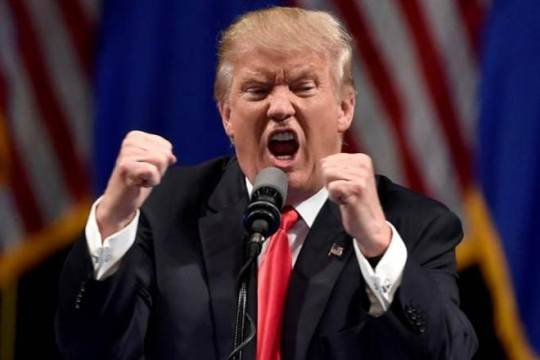
Trump blasts courts for blocking travel ban, warns of 'peril'

February 6, 2017

Palm Beach(US), Feb 6: President Donald Trump blasted the federal courts for a second day in a row after his efforts to implement a travel ban were suspended and warned that the judiciary could be placing Americans in "peril."

trump-R

"Just cannot believe a judge would put our country in such peril. If something happens blame him and court system. People pouring in. Bad!" the president tweeted yesterday, after uncharacteristically taking a nearly day-long break from Twitter.

"I have instructed Homeland Security to check people coming into our country VERY CAREFULLY. The courts are making the job very difficult!"

The saga began on January 27 when Trump issued a blanket ban on all refugees, as well as on travellers from Iran, Iraq, Libya, Somalia, Sudan, Syria and Yemen.

That sparked a worldwide furor, prompting protest marches and demonstrations in cities and at airports across the United States.

On Friday, a federal judge in Seattle, James Robart, blocked the ban nationwide pending a wider legal review.

On Saturday Trump angrily fired off multiple tweets on the matter, stating that the "so-called judge" was "ridiculous" -- and drawing criticism from Democrats and others who said the president was dangerously close to interfering with the judicial branch of government.

A leading Democratic senator, Patrick Leahy of Vermont, said Trump seemed "intent on precipitating a constitutional crisis."

Then early yesterday, a US appeals court rejected an urgent government request to reinstate Trump's controversial ban.

Comments

shaji
 - 
Monday, 6 Feb 2017

He is a hate monger and hope american public will discard him soon. I hope there will be more demonstration in US and other nations against inappropriae/unjust policy of this hate monger

Add new comment

  • Coastaldigest.com reserves the right to delete or block any comments.
  • Coastaldigset.com is not responsible for its readers’ comments.
  • Comments that are abusive, incendiary or irrelevant are strictly prohibited.
  • Please use a genuine email ID and provide your name to avoid reject.
News Network
February 22,2020

Johannesburg, Feb 22: To meet shortage of skilled nursing staff, private hospitals in South Africa are recruiting senior Indian nurses for their good work ethics and ability to become efficient trainers for the local staff, according to a media report.

A report at a 2018 jobs summit indicated that the country had a shortage of more than 47,000 nurses.

The shortage of the skilled nursing staff has been attributed to several factors, including preference of highly qualified nurses to emigrate or take up contract employment in countries such as the UK, the United Aarb Emirates, Saudi Arabia or New Zealand for want of higher salaries, a report in the weekly Business Times said.

Mediclinic, one of South Africa's largest private hospital groups, confirmed that it is recruiting 150 nurses from India this year.

“To supplement our training, as an internal strategy, we will continue to recruit senior registered nurses from India,” a Mediclinic spokesperson told the Business Times.

Mediclinic started recruiting nurses from India in 2005 but could not provide details about how many among the more than 8,800 nurses it employs at its hospitals are from India.

Another company, Life Healthcare SA, said it employed 135 Indian nurses between 2008 and 2014.

Top managements at the hospital groups lauded senior Indian nurses as being very efficient trainers for local staff.

“But we find that many of them prefer coming here on short-term contracts due to family commitments," a hospital executive said on the basis of anonymity.

The official said that the few who apply for long-term positions are usually young newly-qualified nurses, which is not the group in demand.

“They work hard, with a patient-oriented work ethic, and do not have the nine-to-five approach of many local nurses, especially those who are unionised," the official said.

“We would be very happy to take in more nursing staff from India," the official added.

Comments

Add new comment

  • Coastaldigest.com reserves the right to delete or block any comments.
  • Coastaldigset.com is not responsible for its readers’ comments.
  • Comments that are abusive, incendiary or irrelevant are strictly prohibited.
  • Please use a genuine email ID and provide your name to avoid reject.
News Network
April 2,2020

United Nations, Apr 2: The global economy could shrink by up to one per cent in 2020 due to the coronavirus pandemic, a reversal from the previous forecast of 2.5 per cent growth, the UN has said, warning that it may contract even further if restrictions on the economic activities are extended without adequate fiscal responses.

The analysis by the UN Department of Economic and Social Affairs (DESA) said the COVID-19 pandemic is disrupting global supply chains and international trade. With nearly 100 countries closing national borders during the past month, the movement of people and tourism flows have come to a screeching halt.

"Millions of workers in these countries are facing the bleak prospect of losing their jobs. Governments are considering and rolling out large stimulus packages to avert a sharp downturn of their economies which could potentially plunge the global economy into a deep recession. In the worst-case scenario, the world economy could contract by 0.9 per cent in 2020," the DESA said, adding that the world economy had contracted by 1.7 per cent during the global financial crisis in 2009.

It added that the contraction could be even higher if governments fail to provide income support and help boost consumer spending.

The analysis noted that before the outbreak of the COVID-19, world output was expected to expand at a modest pace of 2.5 per cent in 2020, as reported in the World Economic Situation and Prospects 2020.

Taking into account rapidly changing economic conditions, the UN DESA's World Economic Forecasting Model has estimated best and worst-case scenarios for global growth in 2020.

In the best-case scenario with moderate declines in private consumption, investment and exports and offsetting increases in government spending in the G-7 countries and China global growth would fall to 1.2 per cent in 2020.

"In the worst-case scenario, the global output would contract by 0.9 per cent instead of growing by 2.5 per cent in 2020," it said, adding that the scenario is based on demand-side shocks of different magnitudes to China, Japan, South Korea, the US and the EU, as well as an oil price decline of 50 per cent against our baseline of USD 61 per barrel.

The severity of the economic impact will largely depend on two factors - the duration of restrictions on the movement of people and economic activities in major economies; and the actual size and efficacy of fiscal responses to the crisis.

A well-designed fiscal stimulus package, prioritising health spending to contain the spread of the virus and providing income support to households most affected by the pandemic would help to minimise the likelihood of a deep economic recession, it said.

According to the forecast, lockdowns in Europe and North America are hitting the service sector hard, particularly industries that involve physical interactions such as retail trade, leisure and hospitality, recreation and transportation services. Collectively, such industries account for more than a quarter of all jobs in these economies.

The DESA said as businesses lose revenue, unemployment is likely to increase sharply, transforming a supply-side shock to a wider demand-side shock for the economy.

Against this backdrop, the UN-DESA is joining a chorus of voices across the UN system calling for well-designed fiscal stimulus packages which prioritize health spending and support households most affected by the pandemic.

Urgent and bold policy measures are needed, not only to contain the pandemic and save lives, but also to protect the most vulnerable in our societies from economic ruin and to sustain economic growth and financial stability, Under-Secretary-General for Economic and Social Affairs Liu Zhenmin said.

The analysis also warns that the adverse effects of prolonged economic restrictions in developed economies will soon spill over to developing countries via trade and investment channels.

A sharp decline in consumer spending in the European Union and the United States will reduce imports of consumer goods from developing countries.

Developing countries, particularly those dependent on tourism and commodity exports, face heightened economic risks. Global manufacturing production could contract significantly, and the plummeting number of travellers is likely to hurt the tourism sector in small island developing States, which employs millions of low-skilled workers, it said.

Meanwhile, the decline in commodity-related revenues and a reversal of capital flows are increasing the likelihood of debt distress for many nations. Governments may be forced to curtail public expenditure at a time when they need to ramp up spending to contain the pandemic and support consumption and investment.

UN Chief Economist and Assistant Secretary-General for Economic Development Elliot Harris said the collective goal must be a resilient recovery which puts the planet back on a sustainable track. We must not lose sight how it is affecting the most vulnerable population and what that means for sustainable development, he said.

The alarms raised by UN-DESA echo another report, released on March 31, in which UN experts issued a broad appeal for a large-scale, coordinated, comprehensive multilateral response amounting to at least 10 per cent of global gross domestic product (GDP).

According to estimates by the Johns Hopkins University, confirmed coronavirus cases across the world now stand at over 932,600 and over 42,000 deaths.


Comments

Add new comment

  • Coastaldigest.com reserves the right to delete or block any comments.
  • Coastaldigset.com is not responsible for its readers’ comments.
  • Comments that are abusive, incendiary or irrelevant are strictly prohibited.
  • Please use a genuine email ID and provide your name to avoid reject.
News Network
February 18,2020

Washington, Feb 18: The upcoming visit of President Donald Trump to India later this month has the potential to usher in a new era of bilateral ties between the two countries, a top American business advocacy group has said.

President Trump will pay a state visit to India on February 24 and 25 at the invitation of Prime Minister Narendra Modi. He would be accompanied by First Lady Melania Trump.

This would be the president's first bilateral visit in the third decade of the 21st century and also the first after his acquittal by the Senate in the impeachment trial.

"I believe President Trump's upcoming visit to India has the potential to usher in a new era of our bilateral ties," Mukesh Aghi, President of the US India Strategic and Partnership Forum (USISPF) said in a statement on Monday.

On the sidelines of the visit, the USISPF, in collaboration with the Federation of Indian Chambers of Commerce and Industry (FICCI) and the ORF, has announced to organise a program entitled "US-India Forum: Partners for Growth".

The full-day discussion will focus on the key pillars defining India and the US' strategic, economic, and cultural partnership over the next decade.

"We have an opportunity before us to make real progress on multiple aspects of the relationship— whether it is upholding peace and security in the Indo-Pacific region; building upon an already strong energy partnership; developing co-production and co-development opportunities in the defense space; or strengthening bilateral trade," Aghi said.

"We look forward to an extremely successful visit and some concrete outcomes from the visit," he said.

The day-long programme on February 25 in New Delhi, will bring together over 500 senior business executives, members of the US-India think tank community and leading figures of the Indian diaspora to set the agenda for this strategic partnership.

Discussions during the day will touch upon areas, including the Indo-Pacific Strategy and Maritime Security; the US-India Defence Partnership, the US-India Energy Partnership, Elevating US-India Trade and Investment and Role of the Indian Diaspora in US-India Relations.

Comments

Add new comment

  • Coastaldigest.com reserves the right to delete or block any comments.
  • Coastaldigset.com is not responsible for its readers’ comments.
  • Comments that are abusive, incendiary or irrelevant are strictly prohibited.
  • Please use a genuine email ID and provide your name to avoid reject.