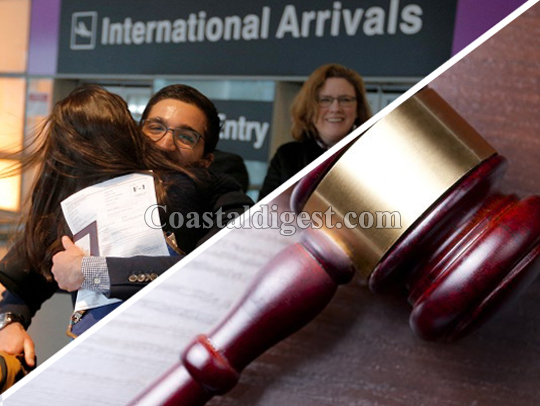
Judges hammer attorneys on both sides of travel ban case

February 8, 2017

San Francisco, Feb 8: President Donald Trump's travel ban faced its toughest test as a panel of appeals court judges hammered away at the government's arguments that the ban was motivated by terrorism fears but also directed pointed questions to an attorney who claimed it unconstitutionally targeted Muslims.

travelban

The contentious hearing before three judges on the San Francisco-based 9th Circuit Court of Appeals yesterday focused narrowly on whether a restraining order issued by a lower court should remain in effect while a challenge to the ban proceeds.

But the judges also jumped into the larger constitutional questions surrounding Trump's order, which temporarily suspended the nation's refugee program and immigration from seven mostly Muslim countries that have raised terrorism concerns.

The hearing was conducted by phone an unusual step and broadcast live from the court's website to a record audience. Judge Richard Clifton, a George W Bush nominee, asked an attorney representing Washington state and Minnesota, which are challenging the ban, what evidence he had that the ban was motivated by religion.

"I have trouble understanding why we're supposed to infer religious animus when in fact the vast majority of Muslims would not be affected." Only 15 per cent of the world's Muslims were affected, the judge said, citing his own calculations. He added that the "concern for terrorism from those connected to radical Islamic sects is hard to deny."

Noah Purcell, Washington state's solicitor general, cited public statements by Trump calling for a ban on the entry of Muslims to the US. He said the states did not have to show every Muslim is harmed, only that the ban was motivated by religious discrimination.

Clifton also went after the government's attorney, asking whether he denied statements by Trump and former New York City Mayor Rudolph Giuliani, who said recently that Trump asked him to create a plan for a Muslim ban.

"We're not saying the case shouldn't proceed, but we are saying that it is extraordinary for a court to enjoin the president's national security decision based on some newspaper articles," said August Flentje, who argued the case for the Justice Department.

Under questioning from Clifton, Flentje did not dispute that Trump and Giuliani made the statements. Judge Michelle T Friedland, who was appointed by President Barack Obama, asked whether the government has any evidence connecting the seven nations to terrorism.

Flentje told the judges that the case was moving fast and the government had not yet included evidence to support the ban. Flentje cited a number of Somalis in the U.S. who, he said, had been connected to the al-Shabab terrorist group.

Comments

Skazi
 - 
Wednesday, 8 Feb 2017

Judges should hammer on the head of racist TRUMP....

Add new comment

  • Coastaldigest.com reserves the right to delete or block any comments.
  • Coastaldigset.com is not responsible for its readers’ comments.
  • Comments that are abusive, incendiary or irrelevant are strictly prohibited.
  • Please use a genuine email ID and provide your name to avoid reject.
News Network
May 15,2020

May 15: Global tensions simmered over the race for a coronavirus vaccine Thursday, as the United States and China traded jabs, and France slammed pharmaceuticals giant Sanofi for suggesting the US would get any eventual vaccine first.

Scientists are working at breakneck speed to develop a vaccine for COVID-19, the disease caused by the virus, which has killed more than 300,000 people worldwide and pummelled economies.

From the US to Europe to Asia, national and local governments are easing lockdown orders to get people back to work -- while fretting over a possible second wave of infections.

Increased freedom of movement means an increased risk of contracting the virus, and so national labs and private firms are labouring to find the right formula for a vaccine.

The European Union's medicines agency offered some hope when it said one could be ready in a year, based on data from clinical trials already underway.

But Marco Cavaleri, the EMA's head of vaccines strategy, acknowledged that timeline was a "best-case scenario," and cautioned that "there may be delays."

The race for a vaccine has exposed a raw nerve in relations between the United States and China, where the virus was first detected late last year in the central city of Wuhan.

Two US agencies warned Wednesday that Chinese hackers were trying to steal COVID-19 vaccine research -- a claim Beijing rejected as "smearing" its reputation.

US President Donald Trump, who has ratcheted up the rhetoric against China, said he doesn't even want to engage with Chinese leader Xi Jinping -- potentially imperilling a trade deal between the world's top two economies.

"I'm very disappointed in China. I will tell you that right now," he said in an interview with Fox Business.

"There are many things we could do. We could do things. We could cut off the whole relationship."

On Capitol Hill, an ousted US health official told Congress that the Trump government had no strategy in place to find and distribute a vaccine to millions of Americans, warning of the "darkest winter" ahead.

"We don't have a single point of leadership right now for this response, and we don't have a master plan," said Rick Bright, who was removed last month as head of the US agency charged with developing a coronavirus vaccine.

The United States has registered nearly 86,000 deaths linked to COVID-19 -- the highest toll of any nation.

World leaders were among 140 signatories to a letter published Thursday saying any vaccine should not be patented and that the science should be shared among nations.

"Governments and international partners must unite around a global guarantee which ensures that, when a safe and effective vaccine is developed, it is produced rapidly at scale and made available for all people, in all countries, free of charge," it said.

But a row erupted in France after drugmaker Sanofi said it would reserve first shipments of any vaccine it discovered to the United States.

The comments prompted a swift rebuke from the French government -- President Emmanuel Macron's office said any vaccine should be treated as "a global public good, which is not submitted to market forces."

Sanofi chief executive Paul Hudson said the US had a risk-sharing model that allowed for manufacturing to start before a vaccine had been finally approved -- while Europe did not.

"The US government has the right to the largest pre-order because it's invested in taking the risk," Hudson told Bloomberg News.

Macron's top officials are scheduled to meet with Sanofi executives about the issue next week.

The search for a vaccine became even more urgent after the World Health Organization said the disease may never go away and the world would have to learn to live with it for good.

"This virus may become just another endemic virus in our communities and this virus may never go away," said Michael Ryan, the UN body's emergencies director.

The prospect of the disease lingering leaves governments facing a delicate balancing act between suppressing the pathogen and getting their economies up and running.

In the US, more grim economic data emerged Thursday, with nearly three million more Americans applying for unemployment benefits.

That takes the overall total to 36.5 million -- more than 10 percent of the US population.

Further signs of the damage to businesses emerged when Lloyd's of London forecast the pandemic will cost the global insurance industry about $203 billion.

European markets closed down, but Wall Street rallied despite the new jobless claims. In a sign of progress, the New York Stock Exchange trading floor was due to reopen on May 26.

The reopening of economies continued in earnest across Europe, where the EU has set out proposals for a phased restart of travel and the eventual lifting of border controls.

"Maybe it's a mistake, but we have no choice. Without tourists, we won't get by!" Enrico Facchetti, a 61-year-old former goldsmith, said of Venice's reopening.

Japan -- the world's third largest economy -- lifted a state of emergency across most of the country except for Tokyo and Osaka.

And Canadian Prime Minister Justin Trudeau said national parks would partially reopen on June 1.

But in Latin America, the virus continued to surge, with a 60 percent leap in cases in the Chilean capital of Santiago.

Authorities said 2,000 new graves were being dug at the main cemetery.

South Sudan reported its first COVID-19 death on Thursday.

And in Bangladesh, the first case was confirmed in the teeming Rohingya refugee camps in Bangladesh, which are home to nearly one million people.


Comments

Add new comment

  • Coastaldigest.com reserves the right to delete or block any comments.
  • Coastaldigset.com is not responsible for its readers’ comments.
  • Comments that are abusive, incendiary or irrelevant are strictly prohibited.
  • Please use a genuine email ID and provide your name to avoid reject.
News Network
May 30,2020

Washington, May 30: The United States will end its relationship with the World Health Organization over the body’s handling of the coronavirus pandemic, U.S. President Donald Trump said on Friday, accusing the U.N. agency of becoming a puppet of China.

The move to quit the Geneva-based body, which the United States formally joined in 1948, comes amid growing tensions between Washington and Beijing over the coronavirus outbreak. The virus first emerged in China’s Wuhan city late last year.

Speaking in the White House Rose Garden, Trump said Chinese officials “ignored their reporting obligations” to the WHO about the virus - that has killed hundreds of thousands of people globally - and pressured the agency to “mislead the world.”

“China has total control over the World Health Organization despite only paying $40 million per year compared to what the United States has been paying which is approximately $450 million a year,” he said.

Trump’s decision follows a pledge last week by Chinese President Xi Jinping to give $2 billion to the WHO over the next two years to help combat the coronavirus. The amount almost matches the WHO’s entire annual program budget for last year.

Trump last month halted funding for the 194-member organization, then in a May 18 letter gave the WHO 30 days to commit to reforms.

“Because they have failed to make the requested and greatly needed reforms, we will be today terminating our relationship with the World Health Organization and redirecting those funds to other worldwide and deserving urgent global public health needs,” Trump said on Friday.

It was not immediately clear when his decision would come into effect. A 1948 joint resolution of Congress on U.S. membership of the WHO said the country “reserves its right to withdraw from the organization on a one-year notice.”

The World Health Organization did not immediately respond to a request for comment on Trump’s announcement. It has previously denied Trump’s assertions that it promoted Chinese “disinformation” about the virus.

“It’s important to remember that the WHO is a platform for cooperation among countries,” said Donna McKay, executive director of Physicians for Human Rights. “Walking away from this critical institution in the midst of an historic pandemic will hurt people both in the United States and around the world.”

‘ABSOLUTELY CRITICAL’

The United States currently owes the WHO more than $200 million in assessed contributions, according to the WHO website. Washington also gives several hundred million dollars annually in voluntary funding tied to specific WHO programs such as polio eradication, HIV, hepatitis and tuberculosis.

Amesh A. Adalja, a senior scholar at Johns Hopkins Center for Health Security, said that in practice Trump’s decision was unlikely to change the operations of the WHO.

“From a symbolic or moral standpoint it’s the wrong type of action to be taking in the middle of a pandemic and seems to deflect responsibility for what we in the U.S. failed to do and blame the WHO,” said Adalja.

When Trump halted funding to the WHO last month, two Western diplomats said the U.S. suspension was more harmful politically to the WHO than to the agency’s current programs, which are funded for now.

The WHO is an independent international body that works with the United Nations. U.N. Secretary-General Antonio Guterres said last month that the WHO is “absolutely critical to the world’s efforts to win the war against COVID-19.”

When asked about Trump’s decision, a U.N. spokesman said: “We have consistently called for all states to support WHO.”

Trump has long scorned multilateralism as he focuses on an “America First” agenda. Since taking office, he has quit the U.N. Human Rights Council, the U.N. cultural agency, a global accord to tackle climate change and the Iran nuclear deal. He has also cut funding for the U.N. population fund and the U.N. agency that aids Palestinian refugees.

“The WHO is the world’s early warning system for infectious diseases,” said U.S. Representative Nita Lowey, a Democrat who chairs the House Committee on Appropriations. “Now, during a global pandemic that has cost over 100,000 American lives, is not the time to put the country further at risk.”

Comments

Add new comment

  • Coastaldigest.com reserves the right to delete or block any comments.
  • Coastaldigset.com is not responsible for its readers’ comments.
  • Comments that are abusive, incendiary or irrelevant are strictly prohibited.
  • Please use a genuine email ID and provide your name to avoid reject.
News Network
May 15,2020

Washington, May 15: A top US senator has unveiled an 18-point plan, including enhancing military ties with India, to hold the Chinese government accountable for its "lies, deception, and cover-ups" that ultimately led to the global COVID-19 pandemic.

The prominent suggestions are moving manufacturing chain from China and deepening military-strategic ties with India, Vietnam and Taiwan.

"The Chinese government maliciously covered up and enabled a global pandemic that has caused misery for so many Americans. This is the same regime that locks up its own citizens in labour camps, steals America's technology and jobs, and threatens the sovereignty of our allies,” said Senator Thom Tillis, presenting his detailed, 18-point plan on Thursday.

"This is a major wake-up call to the United States and the rest of the free world. My plan of action will hold the Chinese government accountable for lying about COVID-19; sanctioning the Chinese government while protecting America's economy, public health, and national security," he said.

The plan seeking to create a Pacific Deterrence Initiative and immediately approve the military's request for USD 20 billion in funding. It also calls for deepening military ties with regional allies and expand equipment sales to India, Taiwan and Vietnam.

Encourage Japan to rebuild its military and offer Japan and South Korea sales of offensive military equipment, it said.

"Move manufacturing back to the US from China and gradually eliminate our supply chain dependency on China. Stop China from stealing our technology and provide incentives to American companies to regain our technological advantage. Strengthen cybersecurity against Chinese hacks and sabotage," the plan stated.

"Prevent American taxpayer money from being used by the Chinese government to pay off their debt. Implement the US ban on (Chinese technology company) Huawei and coordinate with our allies to implement similar bans,” it added.

The plan seeks restitution from the Chinese government and imposition of sanctions for lying about the virus. It further said China should be sanctioned for their atrocious human rights record.

Senator Tillis' plan urges the Trump Administration to formally request the International Olympic Committee to withdraw the 2022 Winter Olympics from Beijing.

"Stop China's propaganda campaign inside the United States. Treat Chinese government-run media outlets as the propaganda proxies that they are," the plan stated.

Urging the government to investigate the Chinese government's cover-up of the spread of COVID-19, the plan also seeks to investigate America's reliance on China's supply chains and threats to public safety and national security.

"Ensure the independence of the WHO through investigations and reform. Expose and counter China's predatory debt-trap diplomacy targeting developing countries. Increase intelligence sharing on potential pandemics and lead the creation of a watchdog organization to monitor foreign governments' handling of deadly viruses," Tillis said in his suggestions.

The coronavirus, which first emerged in China's Wuhan city in December last, has killed over 3,00,000 people with 4.3 million confirmed cases across the world. More than a quarter of all confirmed COVID-19 cases are from the US.

There has been increasing pressure on the President Trump, in the last several weeks, to take action against China as lawmakers and opinion-makers feel that the COVID-19 spread across the world from Wuhan because of Chinese inaction.

Meanwhile, Senator John Barrasso, in a speech on the Senate floor on Thursday, highlighted the need to update the Foreign Intelligence Surveillance Act (FISA) legislation that was put on hold by the coronavirus pandemic.

"The virus could have been contained had it not been for the Chinese Government's unscrupulous cover-up. China knew the risk months before the rest of the world; yet Chinese communist leaders destroyed key evidence, they under-reported the number of coronavirus cases, and they misled the world about its deadly, rapid spread," he said.

Asserting that the virus should have been contained in Wuhan, he said tens and tens of thousands of Americans and hundreds of thousands of people worldwide have died as a result of China's failure.

Barrasso said the US should encourage its companies to create American and western supply chains. "That way our frontline workers have what they need in the time of crisis," he said.

"Not again, not ever will we be exclusively sourced for critical drugs from China. We should diversify supply and bring home as much of our supply chain as possible," he added.

Congressman Troy Balderson introduced bicameral legislation with Congressman Doug Collins and Senator Lindsey Graham that will hold China accountable for deceptive actions taken by its leaders that led to the spread and subsequent global pandemic.

The COVID-19 Accountability Act authorises president Donald Trump to impose sanctions on China if it fails to cooperate with a full investigation led by the US or its allies into the events that lead to the COVID-19 outbreak.

"The number of Ohioan lives needlessly claimed by this pandemic could have been significantly reduced had China taken appropriate measures to control the virus' spread and disclose its severity," said Balderson.

"The United States can't look the other way when China so recklessly compromised worldwide health and the global economy. China and its Communist Party leadership must be held accountable," he said.

Comments

WHO
 - 
Monday, 18 May 2020

Hahah LOL..


go back to past 20 year...from 2000 to 2020..all your sins are boiling now.


millions of innocent life has been taking by so called AMERICA in middle east.


now come to the point

The great GOD Vs USA

GOD: 4 Million+

USA and allied : 0


throw your nuke weapon to sea...no use

you cant fight God s tiny microorganisms...humans are just a thing.


USA will get 0.5 million death and 10 million infection...20 years of  sin must be given with interest

Add new comment

  • Coastaldigest.com reserves the right to delete or block any comments.
  • Coastaldigset.com is not responsible for its readers’ comments.
  • Comments that are abusive, incendiary or irrelevant are strictly prohibited.
  • Please use a genuine email ID and provide your name to avoid reject.