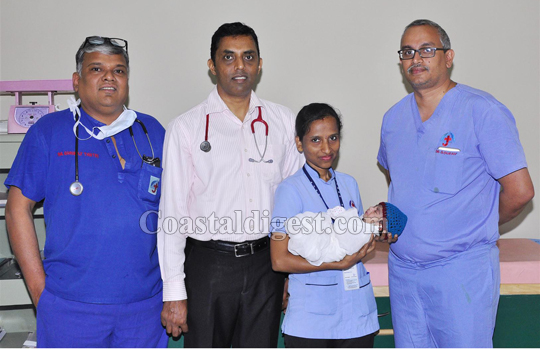
2-day-old baby operated for complex heart problem in Mangaluru

[email protected] (CD Network)
February 8, 2017

Managluru, Feb 8: A 2-days old baby weighing 2.3 kgs was admitted to the NICU at A.J. Hospital & Research Centre in the city in Jan 2017. The baby was diagnosed with transposition of great arteries in the 5th month of pregnancy when a foetal Echo was performed by Dr Prem Alva, Children's Heart Specialist at AJ hospital, Mangaluru.

aj copy

This is a condition where the 2 major blood vessels leaving the heart are connected to the wrong chambers of the heart thus the blood containing oxygen which is required to nourish the body goes back into the lungs instead, requiring urgent surgery.

Even though this condition accounts for approximately 5% of all children born with heart diseases, it is one of the few conditions that require surgery immediately after birth.

The parents counseled by Dr Gourav S Shetty Children's Heart Surgeon at AJ Hospital, Mangalore who has performed more than 200 surgeries of children over a period of 2 years in AJ Hospital explained why this procedure was complex and needed expertise.

It was carried out on a heart smaller than an egg, the 2 major arteries smaller than a little finger and the vessels supplying blood to the heart smaller than ball point refill, all these abnormally coming from the heart needed to be corrected.

After a successful surgery by Dr Gourav S Shetty & his team, Dr Gururaj Tantry,Chief Cardiac Anesthetist & Intensivist, Dr Suhas Anesthetist and his team then successfully managed the baby in ITU.

The baby was discharged on the 7th day from hospital. Follow up was a week later with a healthy baby and very happy parents.

A.J. Hospital & Research Centre is the only Centre in coastal region which has the expertise to conduct such complex surgeries even on the new borns.

Comments

Nawaz.g.h/bantwal
 - 
Thursday, 9 Feb 2017

Congratulation dr prem alwa.and dr gourav shetty..every one pray for him..allah bless u.

Dr.Shafeeq
 - 
Wednesday, 8 Feb 2017

Dr.Gourav, I am proud to be your classmate
Congratulations

B.M.IQBAL
 - 
Wednesday, 8 Feb 2017

Congratulation Dr. Gourav S Shetty.
You Gave a New life to a new born Baby.
We wish you all the best.

Add new comment

  • Coastaldigest.com reserves the right to delete or block any comments.
  • Coastaldigset.com is not responsible for its readers’ comments.
  • Comments that are abusive, incendiary or irrelevant are strictly prohibited.
  • Please use a genuine email ID and provide your name to avoid reject.
News Network
July 17,2020

Bengaluru, Jul 17: A total of 3,693 new COVID-19 positive cases and 115 deaths were reported in Karnataka on Friday, said the state health department.

The total number of COVID-19 cases in the state is presently at 55,115, including 33,205 active cases. While there are 20,757 recoveries, the death toll stands at 1,147.

With the highest single-day spike of 34,956 cases and 687 deaths, India's COVID-19 positive cases crossed the 10 lakh mark on Friday, according to the Union Ministry of Health and Family Welfare.

The total positive cases stand at 10,03,832 including 3,42,473 active cases, 6,35,757 cured/discharged/migrated and 25,602 deaths, according to the ministry.

Comments

Add new comment

  • Coastaldigest.com reserves the right to delete or block any comments.
  • Coastaldigset.com is not responsible for its readers’ comments.
  • Comments that are abusive, incendiary or irrelevant are strictly prohibited.
  • Please use a genuine email ID and provide your name to avoid reject.
Agencies
February 18,2020

New Delhi, Feb 18: The Rashtriya Swayamsevak Sangh is holding a daylong meeting with 70 columnists from across India on Tuesday in an effort to clear misconceptions about the organisation, sources said.

RSS chief Bhagwat, who last year met representatives of international media organisations posted in India, is expected to deliver a keynote address that will be followed by a free-flowing conversation, they said.

The 70 columnists attending Tuesday's meeting write in different languages.

The meeting, in Chhattarpur in New Delhi, is a closed-door meeting and the proceedings are "strictly confidential", the sources said

Comments

sharief
 - 
Wednesday, 19 Feb 2020

You do whatever circus,  false will never be truth.


First of all know what is your VEDA and set as example by following.


No need to do any false circus.


Add new comment

  • Coastaldigest.com reserves the right to delete or block any comments.
  • Coastaldigset.com is not responsible for its readers’ comments.
  • Comments that are abusive, incendiary or irrelevant are strictly prohibited.
  • Please use a genuine email ID and provide your name to avoid reject.
Agencies
May 8,2020

Washington D.C., May 8: The prime time for brain development in a child's life is the first year, where the infant spends most of the time asleep. It is the time when neural connections form and sensory memories are encoded.

However, when sleep is disrupted, as occurs more often among children with autism, brain development may be affected, too.

New research led by the University of Washington finds that sleep problems in a baby's first 12 months may not only precede an autism diagnosis but also may be associated with altered growth trajectory in a key part of the brain, the hippocampus.

The study, which was published in the American Journal of Psychiatry, researchers report that in a sample of more than 400 taken of 6- to 12-month-old infants, those who were later diagnosed with autism were more likely to have had difficulty falling asleep.

It also states that this sleep difficulty was associated with altered growth trajectories in the hippocampus.

"The hippocampus is critical for learning and memory, and changes in the size of the hippocampus have been associated with poor sleep in adults and older children.

As many as 80 per cent of the children with autism spectrum disorder have sleep problems," said Annette Estes, director of the UW Autism Center and senior author of the study.

"In our clinical experience, parents have a lot of concerns about their children's sleep, and in our work on early autism intervention, we observed that sleep problems were holding children and families back," added Estes, who is also a UW professor of speech and hearing sciences.

"It could be that altered sleep is part-and-parcel of autism for some children. One clue is that behavioural interventions to improve sleep don't work for all children with autism, even when their parents are doing everything just right. This suggests that there may be a biological component to sleep problems for some children with autism," said Estes.

To consider links among sleep, brain development, and autism, researchers at the IBIS Network looked at MRI scans of 432 infants, surveyed parents about sleep patterns, and measured cognitive functioning using a standardized assessment.

At the outset of the study, infants were classified according to their risk for developing autism: Those who were at higher risk of developing autism -- about two-thirds of the study sample -- had an older sibling who had already been diagnosed.

Infant siblings of children with autism have a 20 per cent chance of developing autism spectrum disorder -- a much higher risk than children in the general population.

In the current study, 127 of the 432 infants were identified as "low risk" at the time the MRI scans were taken because they had no family history of autism.

They later evaluated all the participants at 24 months of age to determine whether they had developed autism. Of the roughly 300 children originally considered "high familial risk," 71 were diagnosed with autism spectrum disorder at that age.

Problems with sleep were more common among the infants later diagnosed with an autism spectrum disorder, as were larger hippocampi. No other subcortical brain structures were affected, including the amygdala, which is responsible for certain emotions and aspects of memory, or the thalamus, a signal transmitter from the spinal cord to the cerebral cortex.

The authors note that while parents reported more sleep difficulties among infants who developed autism compared to those who did not, the differences were very subtle and only observed when looking at group averages across hundreds of infants.

Sleep patterns in the first years of life change rapidly as infants transition from sleeping around the clock to a more adult-like sleep/wake cycle. Until further research is completed, Estes said, it is not possible to interpret challenges with sleep as an early sign of increased risk for autism.


Comments

Add new comment

  • Coastaldigest.com reserves the right to delete or block any comments.
  • Coastaldigset.com is not responsible for its readers’ comments.
  • Comments that are abusive, incendiary or irrelevant are strictly prohibited.
  • Please use a genuine email ID and provide your name to avoid reject.