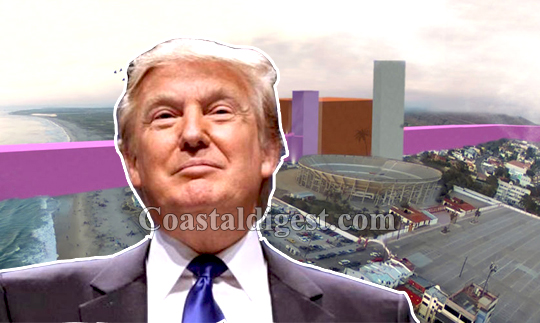
'Wasn't kidding,' says Trump as US begins designing Mexican border wall

February 9, 2017

Washington, Feb 9: President Donald Trump on Wednesday said that the US is in the process of designing the wall on its southern border with Mexico.

trumpwall

“The wall is getting designed right now. A lot of people say, ‘Oh, oh, Trump was only kidding with the wall.' I wasn't kidding. I don't kid. I don't kid,” Trump told conference of County Sheriffs at the White House.

The wall, a major poll promise, is essential to stop the flow of illegal immigrants and drug pouring into the country from across the border, he said.

“I watch this, and they say I was kidding. Nah, I don't kid. I don't kid about things like that, I can tell you. No, we will have a wall. It will be a great wall and it will do a lot of – it'll be a big help,” he said.

“Just ask Israel about walls. Do walls work? Just ask Israel. They work, if it's properly done. It's time to dismantle the gangs terrorising our citizens. It is time to ensure every young American can be raised in an environment of decency, dignity, love and support,” he said.

Comments

shaji
 - 
Thursday, 9 Feb 2017

Its shame that Trump is appreciating terror policy of Israel. The Wall construction by Terrorist state of Israel is illegal. It is built on occupied territory. Instead of denouncing atrocities and terror by terrorist state of Israel, Trump is appreciating it. Its really shame. This shows how much this hate monger loves terror.

Add new comment

  • Coastaldigest.com reserves the right to delete or block any comments.
  • Coastaldigset.com is not responsible for its readers’ comments.
  • Comments that are abusive, incendiary or irrelevant are strictly prohibited.
  • Please use a genuine email ID and provide your name to avoid reject.
News Network
January 7,2020

Dubai/Washington, Jan 7: Iran's Supreme Leader Ayatollah Ali Khamenei wept in grief with hundreds of thousands of mourners thronging Tehran's streets on Monday for the funeral of military commander Qassem Soleimani, killed by a U.S. drone on U.S. President Donald Trump's orders.

The coffins of General Qassem Soleimani and Iraqi militia leader Abu Mahdi al-Muhandis, who also died in Friday's attack in Baghdad, were draped in their national flags and passed from hand to hand over the heads of mourners in central Tehran.

Responding to Trump's threats to hit 52 Iranian sites if Tehran retaliates for the drone strike, Iran's President Hassan Rouhani pointedly wrote on Twitter: "Never threaten the Iranian nation." And Soleimani's successor vowed to expel U.S. forces from the Middle East in revenge.

Khamenei, 80, led prayers at the funeral, pausing as his voice cracked with emotion. Soleimani, 62, was a national hero in Iran, even to many who do not consider themselves supporters of Iran's clerical rulers.

Aerial footage showed people, many clad in black, packing thoroughfares and side streets in the Iranian capital, chanting "Death to America!" - a show of national unity after anti-government protests in November in which many demonstrators were killed.

The crowd, which state media said numbered in the millions, recalled the masses of people that gathered in 1989 for the funeral of the Islamic Republic's founder, Ayatollah Ruhollah Khomeini. Soleimani, architect of Iran's drive to extend its influence across the Middle East, was widely seen as Iran's second most powerful figure behind Khamenei.

His killing of Soleimani has prompted concern around the world that a broader regional conflict could flare.

Trump on Saturday vowed to strike 52 Iranian targets, including cultural sites, if Iran retaliates with attacks on Americans or U.S. assets, and stood by his threat on Sunday, though American officials sought to downplay his reference to cultural targets. The 52 figure, Trump noted, matched the number of U.S. Embassy hostages held for 444 days after the 1979 Iranian Revolution.

Rouhani, regarded as a moderate, responded to Trump on Twitter.

"Those who refer to the number 52 should also remember the number 290. #IR655," Rouhani wrote, referring to the 1988 shooting down of an Iranian airline by a U.S. warship in which 290 were killed.

Trump also took to Twitter to reiterate the White House stance that "Iran will never have a nuclear weapon" but gave no other details.

'ACTIONS WILL BE TAKEN'

General Esmail Ghaani, Soleimani's successor as commander of the Quds Force, the elite unit of Iran's Revolutionary Guards charged with overseas operations, promised to "continue martyr Soleimani's cause as firmly as before with the help of God, and in return for his martyrdom we aim to rid the region of America."

"God the Almighty has promised to take martyr Soleimani's revenge," he told state television. "Certainly, actions will be taken."

Other political and military leaders have made similar, unspecific threats. Iran, which lies at the mouth of the key Gulf oil shipping route, has a range of proxy forces in the region through which it could act.

Iran's demand for U.S. forces to withdraw from the region gained traction on Sunday when Iraq's parliament passed a resolution calling for all foreign troops to leave the country.

Iraqi caretaker Prime Minister Abdel Abdul Mahdi told the U.S. ambassador to Baghdad on Monday that both nations needed to implement the resolution, the premier's office said in a statement. It did not give a timeline.

The United States has about 5,000 troops in Iraq.

Soleimani built a network of proxy militia that formed a crescent of influence - and a direct challenge to the United States and its regional allies led by Saudi Arabia - stretching from Lebanon through Syria and Iraq to Iran. Outside the crescent, Iran nurtured allied Palestinian and Yemeni groups.

He notably mobilised Shi'ite Muslim militia forces in Iraq that helped to crush ISIS, the Sunni militant group that had seized control of swathes of Syria and Iraq in 2014.

Washington, however, blames Soleimani for attacks on U.S. forces and their allies.

The funeral moves to Soleimani's southern home city of Kerman on Tuesday. Zeinab Soleimani, his daughter, told mourners in Tehran that the United States would face a "dark day" for her father's death, adding, "Crazy Trump, don't think that everything is over with my father's martyrdom."

NUCLEAR DEAL

Iran stoked tensions on Sunday by dropping all limitations on its uranium enrichment, another step back from commitments under a landmark deal with major powers in 2015 to curtail its nuclear programme that Trump abandoned in 2018.

In response, European signatories may launch a dispute resolution process against Iran this week that could lead to a renewal of the United Nations sanctions that were lifted as part of the deal, European diplomats said on Monday.

Diplomats said France, Britain and Germany could make a decision ahead of an EU foreign ministers' meeting on Friday that would assess whether there were any ways to salvage the deal.

After quitting the deal, the United States imposed new sanctions on Iran, saying it wanted to halt Iranian oil exports, the main source of government revenues. Iran's economy has been in freefall as the currency has plunged.

Trump adviser Kellyanne Conway said on Monday that he was still confident he could renegotiate a new nuclear agreement "if Iran wants to start behaving like a normal country."

Tehran has said Washington must return to the existing nuclear pact and lift sanctions before any talks can take place.

The United States advised American citizens in Israel and the Palestinian territories to be vigilant, citing the risk of rocket fire amid heightened tensions. As a U.S. ally against Iran, Israel is concerned about possible rocket attacks from Gaza, ruled by Iranian-backed Palestinian Islamists, or major Iran proxy Hezbollah in Lebanon.

Democratic critics of Trump have said the Republican president was reckless in authorising the strike, with some saying his threat to hit cultural sites amounted to a vow to commit war crimes. Trump also threatened sanctions against Iraq and said Baghdad would have to pay Washington for an air base in Iraq if U.S. troops were required to leave.


Comments

Add new comment

  • Coastaldigest.com reserves the right to delete or block any comments.
  • Coastaldigset.com is not responsible for its readers’ comments.
  • Comments that are abusive, incendiary or irrelevant are strictly prohibited.
  • Please use a genuine email ID and provide your name to avoid reject.
News Network
July 3,2020

Jul 3: China under President Xi Jinping has stepped up its "aggressive" foreign policy toward India and "resisted" efforts to clarify the Line of Actual Control that prevented a lasting peace from being realised, according to a report released by a US Congress appointed commission.

The armies of India and China have been locked in a bitter standoff at multiple locations in eastern Ladakh for the last seven weeks, and the tension escalated after 20 Indian soldiers were killed in a violent clash in the Galwan Valley on June 15.

“Under General Secretary of the Chinese Communist Party (CCP) Xi Jinping, Beijing has stepped up its aggressive foreign policy toward New Delhi. Since 2013, China has engaged in five major altercations with India along the Line of Actual Control (LAC),” said a brief issued by US-China Economic and Security Review Commission.

"Beijing and New Delhi have signed a series of agreements and committed to confidence-building measures to stabilise their border, but China has resisted efforts to clarify the LAC, preventing a lasting peace from being realised,” said the report and was prepared at the request of the Commission to support its deliberations.

Authored by Will Green, a Policy Analyst on the Security and Foreign Affairs Team at the Commission, the report says that the Chinese government is particularly fearful of India’s growing relationship with the United States and its allies and partners.

“The latest border clash is part of a broader pattern in which Beijing seeks to warn New Delhi against aligning with Washington,” it said.

After Xi assumed power in 2012, there was a significant increase in clashes, despite the fact that he met Prime Minister Narendra Modi several times and Beijing and New Delhi have agreed to a series of confidence-building mechanisms designed to mitigate tensions.

Prior to 2013, the last major border clash was in 1987. The 1950s and 1960s were a particularly tense period, culminating in 1962 with a war that left thousands of soldiers dead on both sides, according to the records of China's People's Liberation Army, the report said.

“The 2020 skirmish is in line with Beijing’s increasingly assertive foreign policy. The clash came as Beijing was aggressively pressing its other expansive sovereignty claims in the Indo-Pacific region, such as over Taiwan and in the South and East China seas,” it said.

China is engaged in hotly contested territorial disputes in both the South China Sea and the East China Sea. Beijing has built up and militarised many of the islands and reefs it controls in the region. Both areas are stated to be rich in minerals, oil and other natural resources and are vital to global trade.

China claims almost all of the South China Sea. Vietnam, the Philippines, Malaysia, Brunei and Taiwan have counter claims over the area.

Several weeks before the clash in the Galwan Valley, Chinese Defence Minister Wei Fenghe called on Beijing to “use fighting to promote stability” as the country’s external security environment worsened, a potential indication of China’s intent to proactively initiate military tensions with its neighbours to project an image of strength, the report said.

Comments

Add new comment

  • Coastaldigest.com reserves the right to delete or block any comments.
  • Coastaldigset.com is not responsible for its readers’ comments.
  • Comments that are abusive, incendiary or irrelevant are strictly prohibited.
  • Please use a genuine email ID and provide your name to avoid reject.
News Network
June 30,2020

Six months since the new coronavirus outbreak, the pandemic is still far from over, the World Health Organization said Monday, warning that "the worst is yet to come".

Reaching the half-year milestone just as the death toll surpassed 500,000 and the number of confirmed infections topped 10 million, the WHO said it was a moment to recommit to the fight to save lives.

"Six months ago, none of us could have imagined how our world -- and our lives -- would be thrown into turmoil by this new virus," WHO chief Tedros Adhanom Ghebreyesus told a virtual briefing.

"We all want this to be over. We all want to get on with our lives. But the hard reality is this is not even close to being over.

"Although many countries have made some progress, globally the pandemic is actually speeding up.

"We're all in this together, and we're all in this for the long haul.

"We will need even greater stores of resilience, patience, humility and generosity in the months ahead.

"We have already lost so much -- but we cannot lose hope."

Tedros also said that the pandemic had brought out the best and worst humanity, citing acts of kindness and solidarity, but also misinformation and the politicisation of the virus.

In an atmosphere of global political division and fractures on a national level, "the worst is yet to come. I'm sorry to say that," he said.

"With this kind of environment and condition, we fear the worst."

Comments

Add new comment

  • Coastaldigest.com reserves the right to delete or block any comments.
  • Coastaldigset.com is not responsible for its readers’ comments.
  • Comments that are abusive, incendiary or irrelevant are strictly prohibited.
  • Please use a genuine email ID and provide your name to avoid reject.