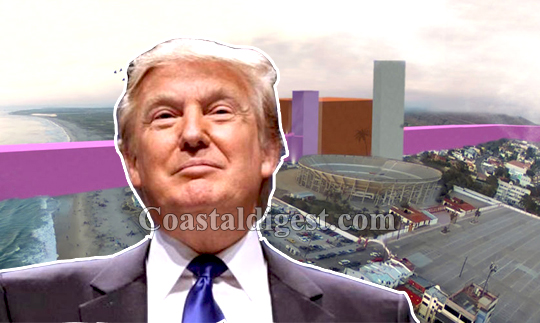
'Wasn't kidding,' says Trump as US begins designing Mexican border wall

February 9, 2017

Washington, Feb 9: President Donald Trump on Wednesday said that the US is in the process of designing the wall on its southern border with Mexico.

trumpwall

“The wall is getting designed right now. A lot of people say, ‘Oh, oh, Trump was only kidding with the wall.' I wasn't kidding. I don't kid. I don't kid,” Trump told conference of County Sheriffs at the White House.

The wall, a major poll promise, is essential to stop the flow of illegal immigrants and drug pouring into the country from across the border, he said.

“I watch this, and they say I was kidding. Nah, I don't kid. I don't kid about things like that, I can tell you. No, we will have a wall. It will be a great wall and it will do a lot of – it'll be a big help,” he said.

“Just ask Israel about walls. Do walls work? Just ask Israel. They work, if it's properly done. It's time to dismantle the gangs terrorising our citizens. It is time to ensure every young American can be raised in an environment of decency, dignity, love and support,” he said.

Comments

shaji
 - 
Thursday, 9 Feb 2017

Its shame that Trump is appreciating terror policy of Israel. The Wall construction by Terrorist state of Israel is illegal. It is built on occupied territory. Instead of denouncing atrocities and terror by terrorist state of Israel, Trump is appreciating it. Its really shame. This shows how much this hate monger loves terror.

Add new comment

  • Coastaldigest.com reserves the right to delete or block any comments.
  • Coastaldigset.com is not responsible for its readers’ comments.
  • Comments that are abusive, incendiary or irrelevant are strictly prohibited.
  • Please use a genuine email ID and provide your name to avoid reject.
Agencies
June 27,2020

Washington, Jun 27: Facebook has said that it will flag all "newsworthy" posts from politicians that break its rules, including those from President Donald Trump.

Separately, Facebook's stock dropped more than 8 per cent, erasing roughly USD 50 billion from its market valuation, after the European company behind brands such as Ben & Jerry's and Dove announced it would boycott Facebook ads through the end of the year over the amount of hate speech and divisive rhetoric on its platform.

Later in the day, Coca-Cola also announced it joined the boycott for at least 30 days.

CEO Mark Zuckerberg had previously refused to take action against Trump posts suggesting that mail-in ballots will lead to voter fraud, saying that people deserved to hear unfiltered statements from political leaders.

Twitter, by contrast, slapped a "get the facts" label on them.

Until Friday, Trump's posts with identical wording to those labelled on Twitter remained untouched on Facebook, sparking criticism from Trump's opponents as well as current and former Facebook employees.

Now, Facebook is all but certain to face off with the president the next time he posts something the company deems to be violating its rules.

"The policies we're implementing today are designed to address the reality of the challenges our country is facing and how they're showing up across our community," Zuckerberg wrote on his Facebook page announcing the changes.

Zuckerberg said the social network is taking additional steps to counter election-related misinformation.

In particular, the social network will begin adding new labels to all posts about voting that will direct users to authoritative information from state and local election officials.

Facebook is also banning false claims intended to discourage voting, such as stories about federal agents checking legal status at polling places.

The company also said it is increasing its enforcement capacity to remove false claims about local polling conditions in the 72 hours before the US election.

Ethan Zuckerman, director of the Massachusetts Institute of Technology's Center for Civic Media, said the changes are a "reminder of how powerful Facebook may be in terms of spreading disinformation during the upcoming election".

He said the voting labels will depend on how good Facebook's artificial intelligence is at identifying posts to label.

"If every post that mentions voting links, people will start ignoring those links. If they're targeted to posts that say things like 'Police will be checking warrants and unpaid traffic tickets at polls' a classic voter suppression disinfo tactic and clearly mark posts as disinfo, they might be useful," he said.

But Zuckerman noted that Facebook "has a history of trying hard not to alienate right-leaning users, and given how tightly President Trump has aligned himself with voter-suppressing misinfo, it seems likely that Facebook will err on the side of non-intrusive and ignorable labels, which would minimize impact of the campaign."

Earlier in the day, shares of Facebook and Twitter dropped sharply after consumer-product maker Unilever announced a new ad boycott on Facebook, Twitter and Instagram through at least the end of the year.

The European company said it took the move to protest the amount of hate speech online.

Unilever said the polarised atmosphere in the United States ahead of November's presidential election placed responsibility on brands to act.

In addition to the decline in Facebook shares, Twitter ended the day more than 7 per cent lower.

Unilever, which is based in the Netherlands and Britain, joins a raft of other advertisers pulling back from online platforms.

Facebook in particular has been the target of an escalating movement to withhold advertising dollars to pressure it to do more to prevent racist and violent content from being shared on its platform.

"We have decided that starting now through at least the end of the year, we will not run brand advertising in social media newsfeed platforms Facebook, Instagram and Twitter in the U.S.," Unilever said.

"Continuing to advertise on these platforms at this time would not add value to people and society."

Facebook did not immediately respond to a request for comment. On Thursday, Verizon joined others in the Facebook boycott.

Unilever "has enough influence to persuade other brand advertisers to follow its lead," said eMarketer analyst Nicole Perrin.

She noted that Unilever pulled back spending "for longer, on more platforms (including Twitter) and for more expansive reasons" in particular, by citing problems with "divisiveness" as well as hate speech.

Sarah Personette, vice president of global client solutions at Twitter, said the company's "mission is to serve the public conversation and ensure Twitter is a place where people can make human connections, seek and receive authentic and credible information, and express themselves freely and safely."

She added that Twitter is "respectful of our partners' decisions and will continue to work and communicate closely with them during this time."

Comments

Add new comment

  • Coastaldigest.com reserves the right to delete or block any comments.
  • Coastaldigset.com is not responsible for its readers’ comments.
  • Comments that are abusive, incendiary or irrelevant are strictly prohibited.
  • Please use a genuine email ID and provide your name to avoid reject.
News Network
May 6,2020

Washington, May 6: At a time when the coronavirus pandemic has squeezed them, multi-national companies in America are laying off workers while paying cash dividends to their shareholders. Thus making the workers bear the brunt of the sacrifices while the shareholders continue to collect.

The Washington Post said in one of its reports that five big American companies have paid a combined USD 700 million to shareholders while cutting jobs, closing plants and leaving thousands of their workers filing for unemployment benefits.

Since the pandemic was declared an emergency, Caterpillar has suspended operations at two plants and a foundry, Levi Strauss has closed stores, and toolmaker Stanley Black & Decker has been planning layoffs and furloughs.

Steelcase, an office furniture manufacturer, and World Wrestling Entertainment have also shed employees.

Executives of those companies told the Post that the layoffs support the long-term health of their companies, and often the executives are giving up a piece of their salaries. Furloughed workers can apply for unemployment benefits.

But distributing millions of dollars to shareholders while leaving many workers without a paycheck is unfair, critics argue, and belies the repeated statements from executives about their concern for employees' welfare during the coronavirus crisis.

Caterpillar, for example, announced a USD 500 million distribution to shareholders April 8, about two weeks after indicating that operations at some plants would stop. The company however declined to divulge how many workers are affected.

"We are taking a variety of actions globally, but we aren't going to discuss the number of impacted people," spokeswoman of the company, Kate Kenny, said in a reply to an email by the Post.

This spate of dividends is also likely to revive long-standing debates about economic rewards.

"There are no hard-and-fast rules about this," said Amy Borrus, deputy director of the Council of Institutional Investors, a group that argues for shareholder rights and represents pension funds and other long-term investors.

Many large US companies choose to issue a regular, quarterly dividend to shareholders, often increasing it, and they boast about these payments because they help keep the share price higher than it might otherwise be. Those companies might be reluctant to announce that they are cutting or suspending their dividend during a crisis, Borrus was further quoted as saying.

But "companies have to be mindful of the optics of paying dividends if they're laying off thousands of workers," she added.

On March 26, Caterpillar had announced that because of the pandemic, it was "temporarily suspending operations at certain facilities." Two plants, in East Peoria, Ill., and Lafayette, Ind., were coming to a halt, as well as a foundry in Mapleton, Ill., according to news reports.

"We are taking a variety of actions at our global facilities to reduce production due to weaker customer demand, potential supply constraints and the spread of the covid-19 pandemic and related government actions," Kenny said via email.

"These actions include temporary facility shutdowns, indefinite or temporary layoffs," she added.

Similarly, Levi Strauss announced April 7 that the company would stop paying store workers, and about 4,000 are now on furlough. On the same day, the company announced that it was returning USD 32 million to shareholders.

"As this human and economic tragedy unfolds globally over the coming months, we are taking swift and decisive action that will ensure we remain a winner in our industry," Chip Bergh, president and chief executive of the company, also told the Post.

Stanley Black & Decker announced on April 2 that it was planning furloughs and layoffs because of the pandemic. Two weeks later, it issued a dividend to shareholders of about USD 106 million.

The notion that a company's primary purpose is to serve shareholders gained prominence in the 1980s but has come under attack in recent years, even from business executives, the newspaper reported.

Corporate decisions to suspend dividends and buybacks are complex, however, and it is difficult to know whether these suspensions of dividend and buyback programs were motivated by a desire to conserve cash in anticipation of bad times, and how much they are prompted by a sense of obligation to employees.

Over recent decades, the mandate to "maximize shareholder value" has become orthodoxy, for many, and it is often unclear what motivates companies to pare dividends or buybacks for shareholders, said William Lazonick, an emeritus economics professor at the University of Massachusetts at Lowell, who has been one of the leading critics of companies that distribute cash to shareholders through stock buybacks and dividends rather than reinvesting the profits into employees, innovation and production.


Comments

Add new comment

  • Coastaldigest.com reserves the right to delete or block any comments.
  • Coastaldigset.com is not responsible for its readers’ comments.
  • Comments that are abusive, incendiary or irrelevant are strictly prohibited.
  • Please use a genuine email ID and provide your name to avoid reject.
Agencies
January 6,2020

The Cambridge Analytica scandal is far from over. New explosive details leaked by a whistleblower shows that the extent of the rot is far deeper than previously thought.

An anonymous Twitter account, @HindsightFiles, has started releasing the documents, apparently on behalf of Brittany Kaiser, a former employee of the now defunct British data analytics and consulting company Cambridge Analytica.

"Democracies around the world are being auctioned to the highest bidder. We release the documents that explain how," reads the biography of the @HindsightFiles.

The document will reveal previously unreleased emails, project plans, case studies, negotiations and more spanning over 60 countries.

"Over the past two years I have given evidence to investigators, journalists and academics to analyse what happened at Cambridge Analytica, and how our data was used to influence democracies around the world. In the name of shedding light on these dark practices, I am releasing documents and emails in full for the public good," Kaiser, who worked with Cambridge Analytica from 2014 to 208, was quoted as saying.

"I do this to strengthen the case for data rights and enforcement of our electoral laws online globally. We should all be seeking more ethical digital future for ourselves and our children," added Kaiser who starred in the Oscar-shortlisted Netflix documentary "The Great Hack".

The details released so far includes links to material on the firm's activities in Malaysia, Kenya, Brazil and Iran, an addition to the John Bolton archive.

Over the next months, more than 100,000 documents relating to work in 68 countries are set to be released, according to a report in The Guardian.

More than one and a half year after the Cambridge Analytica scandal first became public, US regulators last month said that the now-defunct British data analytics and consulting company engaged in deceptive practices to harvest personal information from tens of millions of Facebook users for voter profiling and targeting.

According to Kaiser, the Facebook data scandal was part of a much bigger global operation designed to manipulate people in collaboration with governments, intelligence agencies, commercial companies and political campaigns.

The unpublished documents contain material that suggests the firm collaborated with a political party in Ukraine in 2017 even while under investigation as part of Robert Mueller's investigation into Russian interference in the 2016 US presidential election, said The Guardian report.

"There are emails between these major Trump donors discussing ways of obscuring the source of their donations through a series of different financial vehicles. These documents expose the entire dark money machinery behind US politics," Kaiser was quoted as saying.

Similar tactics were deployed in other countries that Cambridge Analytica operated in, including Britain, she claimed.

The files released by Kaiser suggest that Cambridge Analytica offered to help United Malays National Organisation (Umno), the party of Malaysia's Former Prime Minister Najib Razak, to influence the voting of 40 parliamentary constituencies in the 14th General Election (GE14) in 2013.

Umno, according to the leaks, requested the company to prepare a proposal to regain 13 seats, The South China Morning Post reported on Saturday.

In 2018, Razak claimed that he had never engaged Cambridge Analytica in any way.

Comments

Add new comment

  • Coastaldigest.com reserves the right to delete or block any comments.
  • Coastaldigset.com is not responsible for its readers’ comments.
  • Comments that are abusive, incendiary or irrelevant are strictly prohibited.
  • Please use a genuine email ID and provide your name to avoid reject.