'Wasn't kidding,' says Trump as US begins designing Mexican border wall

February 9, 2017

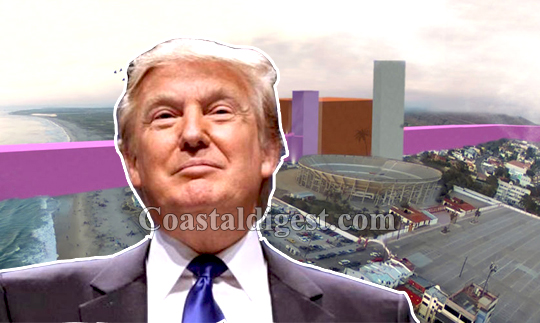
Washington, Feb 9: President Donald Trump on Wednesday said that the US is in the process of designing the wall on its southern border with Mexico.

trumpwall

“The wall is getting designed right now. A lot of people say, ‘Oh, oh, Trump was only kidding with the wall.' I wasn't kidding. I don't kid. I don't kid,” Trump told conference of County Sheriffs at the White House.

The wall, a major poll promise, is essential to stop the flow of illegal immigrants and drug pouring into the country from across the border, he said.

“I watch this, and they say I was kidding. Nah, I don't kid. I don't kid about things like that, I can tell you. No, we will have a wall. It will be a great wall and it will do a lot of – it'll be a big help,” he said.

“Just ask Israel about walls. Do walls work? Just ask Israel. They work, if it's properly done. It's time to dismantle the gangs terrorising our citizens. It is time to ensure every young American can be raised in an environment of decency, dignity, love and support,” he said.

Comments

shaji
 - 
Thursday, 9 Feb 2017

Its shame that Trump is appreciating terror policy of Israel. The Wall construction by Terrorist state of Israel is illegal. It is built on occupied territory. Instead of denouncing atrocities and terror by terrorist state of Israel, Trump is appreciating it. Its really shame. This shows how much this hate monger loves terror.

Add new comment

  • Coastaldigest.com reserves the right to delete or block any comments.
  • Coastaldigset.com is not responsible for its readers’ comments.
  • Comments that are abusive, incendiary or irrelevant are strictly prohibited.
  • Please use a genuine email ID and provide your name to avoid reject.
Agencies
June 26,2020

Scientists predict the world may have a COVID-19 vaccine within one year or even a few months earlier, said the Director-General of the World Health Organisation even as he underlined the importance of global cooperation to develop, manufacture and distribute vaccines.

However, making the vaccine available and distributing it to all will be a challenge and requires political will, Tedros Adhanom Ghebreyesus said on Thursday during a meeting with the European Parliament's Committee for Environment, Public Health and Food Safety.

One option would be to give the vaccine only to those that are most vulnerable to the virus.

There are currently over 100 COVID-19 vaccine candidates in various stages of development.

Adhanom Ghebreyesus said the pandemic has highlighted the importance of global solidarity and that health should not be seen as a cost but an investment.

He added that all countries in the world must strengthen primary health care and crisis preparedness and stressed the need for EU leadership globally.

While the Director-General said the situation in the EU has improved significantly, he underlined that COVID-19 is very much still circulating globally, with more than four million new cases in the last month.

Many Members of European Parliament said that the global community must cooperate including in developing, manufacturing and distributing vaccines against COVID-19 and asked when a safe vaccine could be available.

Several Members of European Parliament underlined the importance of the WHO but also said it has made mistakes in its response to the pandemic.

The Director-General admitted everyone makes mistakes and informed the members that an independent panel will evaluate the WHO response to the pandemic to learn from any mistakes made.

It will start its work soon, he said.

Comments

Add new comment

  • Coastaldigest.com reserves the right to delete or block any comments.
  • Coastaldigset.com is not responsible for its readers’ comments.
  • Comments that are abusive, incendiary or irrelevant are strictly prohibited.
  • Please use a genuine email ID and provide your name to avoid reject.
News Network
April 16,2020

Brussels/Amsterdam, Apr 16: As the novel coronavirus continues to wreak havoc in the western world since its outbreak in Wuhan last December, researchers believe that the Chinese leadership is trying to absolve President Xi Jinping by using a section of the western media to influence public opinion globally.

"There are clear indications that China is conducting activities in a persistent and systematic manner to influence public opinion-making, academia, think tanks and political decision-making among the member states of the Belt and Road Initiative (BRI) in general and western capital cities in particular," Siegfried O Wolf, Director of Research at Brussels-based think tank South Asia Democratic Front, said.

Some western media say some Chinese officials were secretly aware that they were facing a pandemic from the new coronavirus but allowed Wuhan to host a mass banquet for tens of thousands of people and millions began their annual trip home for the Lunar New Year celebrations.

The pandemic has since then affected 210 countries and territories around the world. Over 2 million people have been declared positive in which over 134,000 lost their lives.

"The frequency and extra-ordinary large scale of Chinese sponsored events in European political hubs, like in Brussels, and the subsequent media coverage can be seen as evidence for Beijing's public diplomacy efforts. However, the rising skepticism within the EU regarding Xi Jinping's development projects and the emerging questioning of Chinese sources funding Free Universities, like the one in Berlin, shows that this strategy produced mixed results so far," Wolf said.

He added, "However, one must also state that these efforts helped China to gain certain leverage among many non-Chinese media, western as well as non-western ones. Today, we can observe that China's political leadership tries to instrumentalise this influence for a major image campaign to distract from the fact that it carries the initial responsibility for the dramatic spread of COVID-19 by holding back key information."

Wolf also said that the current internal dynamics in China, like the shirking of responsibilities by the local authorities, are most-likely part of a twofold strategy. Firstly, there is the strategic component - namely, to reaffirm to the general public that the Communist Party of China is still in full control of the situation. The second strategic pillar is one of 'whitewashing'.

"Concretely, Beijing's obvious aim is to distract the domestic and international attention from the real, but hidden causes of the Coronavirus outbreak and its potential reputational and political consequences for Xi Jinping and his BRI," he stated.

Yoana Barakova, a Research Analyst at European Foundation for South Asian Studies (EFSAS), an Amsterdam-based think-tank, said, "The death of Dr. Li Wenliang, one of the very few medical professionals who tried to warn the world in December 2019 about the looming threat, sparked widespread condemnation around the international community in early February. Yet, little did he know that his legacy would continue much later after his demise, with the emboldened Chinese government trying to cover up its missteps through hardcore censorship after being exposed for undermining and underestimating the initial danger."

The researchers believe that the deterioration in press freedom under Jinping's regime has become more evident in recent days, with local authorities trying to control the state narrative by cosmetically placing media's focus on government's superficial attempts to tackle the crisis.

Comments

Add new comment

  • Coastaldigest.com reserves the right to delete or block any comments.
  • Coastaldigset.com is not responsible for its readers’ comments.
  • Comments that are abusive, incendiary or irrelevant are strictly prohibited.
  • Please use a genuine email ID and provide your name to avoid reject.
News Network
July 27,2020

Tokyo, Jul 27: Gold hit an all-time high on Monday as tit-for-tat consulate closures in China and the United States rattled investors, boosting the allure of safe-haven assets, although sentiment was mixed with tech gains supporting some Asian stocks.

MSCI's ex-Japan Asia-Pacific index rose 1.3 percent as Taiwan's TSMC, Asia's third-largest company by market capitalisation, rose almost 10 percent.

The chipmaker's gains boosted other tech stocks in the region and came after rival Intel signalled it may give up manufacturing its own components due to delays in new 7-nanometer chip technology.

Also soothing sentiment, Chinese shares eked out gains after big falls late last week, with CSI300 index rising 0.5 percent.

S&P500 futures were last up 0.4 percent in choppy trade while Japan's Nikkei fell 0.5 percent, resuming trade after a long weekend and catching up with falls in global shares late last week.

Global shares had lost steam last week after Washington ordered China's consulate in Houston to close, prompting Beijing to react in kind by closing the US consulate in Chengdu.

US Secretary of State Mike Pompeo took fresh aim at China last week, saying Washington and its allies must use "more creative and assertive ways" to press the Chinese Communist Party to change its ways.

"US President (Donald) Trump used to say China's President Xi Jinping is a great leader. But now Pompeo's wording is becoming so aggressive that markets are starting to worry about further escalation," said Norihiro Fujito, chief investment strategist at Mitsubishi Securities.

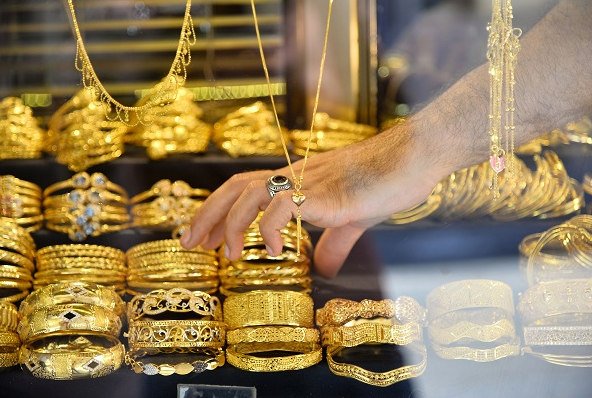
Gold rose 1.0 percent to a record high of $1,920.9 per ounce, surpassing a peak touched in September 2011, as Sino-US tensions boosted the allure of safe-haven assets, especially those not tied to any specific country.

The yellow metal is also helped by aggressive monetary easing adopted by many central banks around the world since the pandemic plunged the global economy into a recession.

Some investors fret such an unprecedented level of money-printing could eventually lead to inflation.

MORE STIMULUS

Hopes of a quick US economic recovery are fading as coronavirus infections showed few signs of slowing.

That means the economy could capitulate without fresh support from the government, with some of earlier steps such as enhanced jobless benefits due to expire this month.

Investors hope US Congress will agree on a deal before its summer recess but there are some sticking points including the size of the stimulus and enhanced unemployment benefits.

US Treasury Secretary Steve Mnuchin said the package will contain extended unemployment benefits with 70 percent "wage replacement".

Democrats, who control the House of Representatives, want enhanced benefits of $600 per week to be extended and look to much bigger stimulus compared with the Republicans' $1 trillion plan.

Investors are looking to corporate earnings from around the world for hints on the pace of recovery in the global economy.

"It looks like rising coronavirus cases are starting to slow down recovery in many countries," said Masahiro Ichikawa, senior strategist at Sumitomo Mitsui DS Asset Management.

Concerns about the US economic outlook started to weigh on the dollar, reversing its inverse correlation with the economic well-being over the past few months.

The dollar index dropped 0.3 percent to its lowest level in nearly two years.

The euro gained 0.3 percent to $1.1693, hitting a 22-month high of $1.16590 as sentiment on the common currency improved after European leaders reached a deal on a recovery fund in a major step towards more fiscal co-operation.

Against the yen, the dollar slipped 0.5 percent to 105.605 yen, a four-month low while the British pound hit a 4 1/2-month high of $1.2832.

Oil prices dipped on worries about the worsening Sino-US relations.

Brent futures fell 0.46 percent to $43.14 per barrel while US crude futures lost 0.44 percent to $41.11.


Comments

Add new comment

  • Coastaldigest.com reserves the right to delete or block any comments.
  • Coastaldigset.com is not responsible for its readers’ comments.
  • Comments that are abusive, incendiary or irrelevant are strictly prohibited.
  • Please use a genuine email ID and provide your name to avoid reject.