UN chief ‘deeply' regrets veto of Palestinian ex-PM as envoy

February 14, 2017

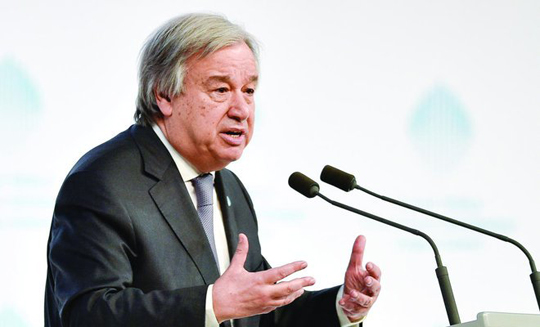
Dubai, Feb 14: UN chief Antonio Guterres on Monday said he “deeply” regretted opposition to former Palestinian Premier Salam Fayyad as the organization's peace envoy to Libya, days after Washington vetoed the appointment.

antonio

“I deeply regret this opposition and I do not see any reason for it,” Guterres said at the annual World Government Summit hosted by Dubai.

Guterres described Fayyad, a former World Bank official with a track record of fighting corruption, as “the right person for the right job at the right moment.”

“It's a loss for the Libyan peace process and the Libyan people,” he said, adding that the UN “needs to be able to act with impartiality.”

The UN leader on Wednesday had informed the Security Council of his intention to appoint Fayyad as a replacement for German Martin Kobler to conflict-torn Libya.

But US ambassador Nikki Haley vetoed the appointment, saying Washington did not support the message the move would send.

Israeli Prime Minister Benjamin Netanyahu hailed the US veto of Fayyad as counter to the “free gifts constantly given to the Palestinian side.”

Israeli media has meanwhile reported that the Jewish state could accept Fayyad's appointment if Tzipi Livni, a former Israeli foreign minister, were offered the position of UN deputy secretary general.

The head of the UN requires the unanimous support of all 15 Security Council members for appointments of special representatives to conflict areas.

Guterres also addressed the upcoming UN-sponsored peace talks on Syria, scheduled for Feb. 20 in Geneva. “There is no solution for the Syrian people without a comprehensive solution in which all Syrians feel they are properly represented,” he said. The Geneva talks “are a first step for serious progress in finding a transition that allows for a political solution in which all Syrians feel represented,” Guterres added.

Guterres also condemned North Korea's latest ballistic missile test and called for a united international response to the “further troubling violation” of UN resolutions.

His statement came ahead of an urgent UN Security Council meeting called to discuss Sunday's missile test.

Comments

shaji
 - 
Tuesday, 14 Feb 2017

US and Isratel are two faces of Devil and live together. There will be no peace in the world unless and untill these two Devil nations are removed from UN.

Add new comment

  • Coastaldigest.com reserves the right to delete or block any comments.
  • Coastaldigset.com is not responsible for its readers’ comments.
  • Comments that are abusive, incendiary or irrelevant are strictly prohibited.
  • Please use a genuine email ID and provide your name to avoid reject.
News Network
February 27,2020

Washington, Feb 27: President Donald Trump has said that the US' relationship with India is "extraordinary" right now and a lot of progress was made in bilateral ties during his maiden official visit to the country where America will be doing a lot of business.

Talking to reporters, after his return from India on Wednesday, Trump said, "He (Prime Minister Narendra Modi) is a great gentleman, a great leader. It's an incredible country."

President Trump visited India from February 24 to 25. He was accompanied by first lady Melania Trump, daughter Ivanka Trump, son-in-law Jared Kushner and the top brass of his administration, including national security advisor Robert O'Brien.

They visited Ahmedabad, Agra and New Delhi before leaving for Washington on Tuesday.

During his stay, he addressed a massive rally in Ahmedabad, visited Agra and held official meetings in New Delhi.

The US President was feted at the world's largest cricket stadium in the "Namaste Trump" event in Ahmedabad and was cheered by tens of thousands of people.

"We were treated very, very well and we really enjoyed it. A lot of tremendous progress was made in terms of relationship - our relationship with India is extraordinary right now," he said.

"We are going to be doing a lot of business with India, they are sending billions and billions of dollars now to the United States," Trump said in response to a question.

In a tweet, his daughter Ivanka said that, Trump announced that US international development finance corporation "will establish a permanent presence in India to strengthen our economic ties, improve development plus further women's economic empowerment through WGDP (Women's Global Development and Prosperity Initiative)!"

On her arrival from India, she thanked PM Modi for "your warm hospitality as we visited your beautiful country and celebrated the strength, spirit and unity of the US and India!"

"Throughout our visit we saw monumental achievements of human creativity and proof of the infinite capacity of the human heart!" she said.

The first lady tweeted two pictures of her with Trump facing the Taj Mahal in Agra.

"One of the Seven Wonders of the World, the breathtaking Taj Mahal!" she said.

President Trump "reaffirmed the strong strategic partnership, vibrant economic ties and expanding security relationship between our two countries. Wonderful trip, but glad to be home! Thank you India!" said White House press secretary Stephanie Grisham.

During the visit, India and the US on Tuesday finalised defence deals worth $3 billion under which 30 military helicopters will be procured from two American defence majors for Indian armed forces.

The deals will include procurement of 24 MH-60 Romeo helicopters by India from the US at a cost of $2.6 billion. Another contract to acquire six AH-64E Apache helicopters for $800 million from the US is also on the table.

Comments

Add new comment

  • Coastaldigest.com reserves the right to delete or block any comments.
  • Coastaldigset.com is not responsible for its readers’ comments.
  • Comments that are abusive, incendiary or irrelevant are strictly prohibited.
  • Please use a genuine email ID and provide your name to avoid reject.
News Network
June 20,2020

Sao Paulo, June 20: Brazil’s government confirmed on Friday that the country has risen above 1 million confirmed coronavirus cases, second only to the United States.

The country’s health ministry said that the total now stood at 10,32,913, up more than 50,000 from Thursday. The ministry said the sharp increase was due to corrections of previous days’ underreported numbers.

Brazilian President Jair Bolsonaro still downplays the risks of the virus after nearly 50,000 deaths from COVID-19 in three months, saying the impact of social isolation measures on the economy could be worse than the disease itself.

Specialists believe the actual number of cases in Brazil could be up to seven times higher than the official statistic. Johns Hopkins University says Brazil is performing an average of 14 tests per 1,00,000 people each day, and health experts say that number is up to 20 times less than needed to track the virus.

Official data show a downward trend of the virus in Brazil’s north, including the hard-hit region of the Amazon, a plateau in cases and deaths in the countries’ biggest cities near the Atlantic coast, but a rising curve in the south.

In the Brazilian countryside, which is much less prepared to handle a crisis, the pandemic is clearly growing. Many smaller cities have weaker health care systems and basic sanitation that’s insufficient to prevent contagion.

“There is a lot of regional inequality in our public health system and a shortage of professionals in the interior,” said Miguel Lago, executive director of Brazil’s Institute for Health Policy Studies, which advises public health officials.

That creates many health care deserts, with people going long distances to get attention. When they leave the hospital, the virus can go with them.

The cattle-producing state of Mato Grosso was barely touched by the virus when it hit the nation’s biggest cities in March. Sitting far from the coast, between the Bolivian border and Brazil’s capital of Brasilia, its 33 lakh residents led a mostly normal life until May. But now its people live under lockdown and meat producers have dozens of infected workers.

In Tangará da Serra, a city of 1,03,000 people in Mato Grosso, the mayor decided Friday to forbid the sale of alcoholic drinks for two weeks as an incentive for people to stay home.

Fᢩo Junqueira said the measure was needed after a spike in COVID-19 cases that filled 80% of the city’s 54 intensive care beds. The city has had nearly 300 cases of the disease, plus three fatalities.

In Rondonópolis, only 300 miles away from Tangará da Serra and home to a thriving economy, health authorities closed the local meatpacking industry after 92 cases were confirmed there. The city of 1,44,000 inhabitants counted 21 deaths from the virus and more than 600 cases. The mayor has also decided to limit sales of alcoholic beverages.

Even regions once considered examples of successful efforts against the virus are now struggling.

Porto Alegre, home to about 14 lakh people, had success in slowing the virus’ spread over the last three months. But now its mayor is considering increasing social isolation measures after ICU occupancy in the city jumped to 80% this month.

We were already making projections for schools to come back, Mayor Nelson Marchezan Jr. told The Associated Press. Now the trend is to impose more restrictions. Outside Sao Paulo city, five regions of the state’s countryside will have to close shops starting Monday due to a rise in coronavirus cases. Governor João Doria announced the decision Friday.

Dr. Mike Ryan, the World Health Organization’s executive director, said at a news conference that Brazil needs to increase its efforts to stop the spread of infections.

“The epidemic is still quite severe in Brazil. I believe health workers are working extremely hard and under pressure to be able to deal with the number of cases that they see on a daily basis,” Dr. Ryan said.

“Certainly the rise is not as exponential as it was previously, so there are some signs that the situation is stabilising. But we’ve seen this before in other epidemics in other countries.”

Margareth Dalcolmo, a clinical researcher and professor of respiratory medicine at the state-funded Oswaldo Cruz Foundation in Rio de Janeiro, believes the reopening in major cities and the virus traveling by road into Brazil’s heartland will keep the pressure on the country’s health system.

“The risk in the interior now is very big,” she said. “Our health system just can’t solve the most serious cases of COVID in many places of the countryside.”

Comments

Add new comment

  • Coastaldigest.com reserves the right to delete or block any comments.
  • Coastaldigset.com is not responsible for its readers’ comments.
  • Comments that are abusive, incendiary or irrelevant are strictly prohibited.
  • Please use a genuine email ID and provide your name to avoid reject.
News Network
May 15,2020

May 15: Global tensions simmered over the race for a coronavirus vaccine Thursday, as the United States and China traded jabs, and France slammed pharmaceuticals giant Sanofi for suggesting the US would get any eventual vaccine first.

Scientists are working at breakneck speed to develop a vaccine for COVID-19, the disease caused by the virus, which has killed more than 300,000 people worldwide and pummelled economies.

From the US to Europe to Asia, national and local governments are easing lockdown orders to get people back to work -- while fretting over a possible second wave of infections.

Increased freedom of movement means an increased risk of contracting the virus, and so national labs and private firms are labouring to find the right formula for a vaccine.

The European Union's medicines agency offered some hope when it said one could be ready in a year, based on data from clinical trials already underway.

But Marco Cavaleri, the EMA's head of vaccines strategy, acknowledged that timeline was a "best-case scenario," and cautioned that "there may be delays."

The race for a vaccine has exposed a raw nerve in relations between the United States and China, where the virus was first detected late last year in the central city of Wuhan.

Two US agencies warned Wednesday that Chinese hackers were trying to steal COVID-19 vaccine research -- a claim Beijing rejected as "smearing" its reputation.

US President Donald Trump, who has ratcheted up the rhetoric against China, said he doesn't even want to engage with Chinese leader Xi Jinping -- potentially imperilling a trade deal between the world's top two economies.

"I'm very disappointed in China. I will tell you that right now," he said in an interview with Fox Business.

"There are many things we could do. We could do things. We could cut off the whole relationship."

On Capitol Hill, an ousted US health official told Congress that the Trump government had no strategy in place to find and distribute a vaccine to millions of Americans, warning of the "darkest winter" ahead.

"We don't have a single point of leadership right now for this response, and we don't have a master plan," said Rick Bright, who was removed last month as head of the US agency charged with developing a coronavirus vaccine.

The United States has registered nearly 86,000 deaths linked to COVID-19 -- the highest toll of any nation.

World leaders were among 140 signatories to a letter published Thursday saying any vaccine should not be patented and that the science should be shared among nations.

"Governments and international partners must unite around a global guarantee which ensures that, when a safe and effective vaccine is developed, it is produced rapidly at scale and made available for all people, in all countries, free of charge," it said.

But a row erupted in France after drugmaker Sanofi said it would reserve first shipments of any vaccine it discovered to the United States.

The comments prompted a swift rebuke from the French government -- President Emmanuel Macron's office said any vaccine should be treated as "a global public good, which is not submitted to market forces."

Sanofi chief executive Paul Hudson said the US had a risk-sharing model that allowed for manufacturing to start before a vaccine had been finally approved -- while Europe did not.

"The US government has the right to the largest pre-order because it's invested in taking the risk," Hudson told Bloomberg News.

Macron's top officials are scheduled to meet with Sanofi executives about the issue next week.

The search for a vaccine became even more urgent after the World Health Organization said the disease may never go away and the world would have to learn to live with it for good.

"This virus may become just another endemic virus in our communities and this virus may never go away," said Michael Ryan, the UN body's emergencies director.

The prospect of the disease lingering leaves governments facing a delicate balancing act between suppressing the pathogen and getting their economies up and running.

In the US, more grim economic data emerged Thursday, with nearly three million more Americans applying for unemployment benefits.

That takes the overall total to 36.5 million -- more than 10 percent of the US population.

Further signs of the damage to businesses emerged when Lloyd's of London forecast the pandemic will cost the global insurance industry about $203 billion.

European markets closed down, but Wall Street rallied despite the new jobless claims. In a sign of progress, the New York Stock Exchange trading floor was due to reopen on May 26.

The reopening of economies continued in earnest across Europe, where the EU has set out proposals for a phased restart of travel and the eventual lifting of border controls.

"Maybe it's a mistake, but we have no choice. Without tourists, we won't get by!" Enrico Facchetti, a 61-year-old former goldsmith, said of Venice's reopening.

Japan -- the world's third largest economy -- lifted a state of emergency across most of the country except for Tokyo and Osaka.

And Canadian Prime Minister Justin Trudeau said national parks would partially reopen on June 1.

But in Latin America, the virus continued to surge, with a 60 percent leap in cases in the Chilean capital of Santiago.

Authorities said 2,000 new graves were being dug at the main cemetery.

South Sudan reported its first COVID-19 death on Thursday.

And in Bangladesh, the first case was confirmed in the teeming Rohingya refugee camps in Bangladesh, which are home to nearly one million people.


Comments

Add new comment

  • Coastaldigest.com reserves the right to delete or block any comments.
  • Coastaldigset.com is not responsible for its readers’ comments.
  • Comments that are abusive, incendiary or irrelevant are strictly prohibited.
  • Please use a genuine email ID and provide your name to avoid reject.