


College to jail in bomb case: How cops destroyed 12 yrs of his youth

February 18, 2017

New Delhi, Feb 18: Mohammad Rafiq Shah was a student of MA (final) at Shah-i-Hamadan, Institute of Islamic Studies, University of Kashmir, Srinagar, when on the midnight of November 21, 2005, his world plunged into darkness.
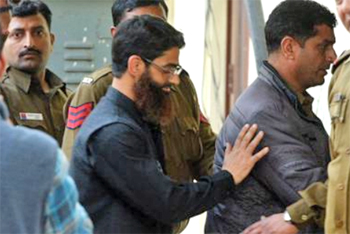
youthHe was picked up by officials of Delhi Police's special cell and Special Task Force (STF) of Kashmir Police.Two days later - after allegedly subjecting him to torture and humiliation at an STF camp - they brought him to Delhi. His crime: he was alleged to have planted a bomb in a DTC bus in Govindpuri on October 29, 2005, which injured many people.

Twelve years later, when he walked free on Thursday - after additional sessions judge Reetesh Singh acquitted him of all charges - the police were facing serious questions of credibility and human rights violations. Rafiq's claim that "he was made an accused to assuage the public perception that Delhi Police was incompetent to act against terrorism" and that "he was a vulnerable target... made a scapegoat" rang true. Police, it seems, deliberately ignored his alibi at every step to prove their case . They brushed aside his plea that it could be proved he was in his class on the day of the blast. It relied on dubious witness es who ended up contradicting themselves, exposed Rafiq to many people when he was in custody before a test identification parade (TIP) could be conducted and suppressed inconvenient facts.

TOI had as early as on February 12, 2006, raised the question whether it "could be a case of harried cops under pressure to show results, targeting an innocent boy?" In a front-page report, "Delhi bomber was in class on October 29", we had reported that Rafiq was actually attending his MA classes in his college in Srinagar. It was also reported that Rafiq had refused to appear for TIP as he had already been presented before some people, one of whom could be a witness in the Govindpuri blast.

The ground had been laid in Srinagar where Rafiq -according to his reply during framing of charges on January 21, 2008 which was cited by the judge - was allegedly forced to drink urine, kept naked and sexually abused, all in order to perhaps break his spirit. He had also alleged that rats were put in his trousers and attempts made to hurt his religious sentiments. "It seems I am being victimised only because I am a Kashmiri Muslim," he said, expressing his faith that justice would prevail and the police get exposed.

The court drew attention to Supreme Court's observation that when it comes to the notice of the investigating agency that a person accused of an offence has a good alibi, then it is the duty of that agency to investigate the genuineness of the plea of alibi and submit a report to the magistrate. "In the case of Manu Sharma versus the State (NCT) of Delhi....Supreme Court had observed that the criminal justice administration system in India places human rights and dignity for human life on a much higher pedestal. An accused is presumed to be innocent till proved guilty and is entitled to fairness and true investigation and a fair trial. The prosecution is expected to play a balanced role in the trial of crime and the investigation should be judicious, fair, transparent and expeditious to ensure compliance with the basic rule of law," the court asserted. Rafiq's case failed on all counts.

First Delhi Police produced a witness, Danbir Sharma, one of the passengers in the bus, on the basis of whose description, they got a portrait made. However, Sharma later couldn't identify Rafiq. The portrait then disappeared mysteriously - pointed out by the judge - even as another witness, Rajeev Sinha, surfaced.

His and Sharma's description of the bomber were at variance. Singh described the bomber as a young man, 22-24 years of age with a French-cut beard and prominent nose, who was wearing a cap with `New York' written on the right. He said he was wearing a white shirt with grey stripes and cotton trousers, either blue or black. Sharma, however, said the bomber was a boy of 5 feet, 10 inches height and had `sanwla' complexion. According to him, he was wearing a `coca cola' coloured shirt and white trousers.

The defence later claimed that Rafiq had a full-grown beard when he was arrested. It was alleged that on November 25, 2005, inspector Badrish Dutt brought a barber to the special cell office and got his beard trimmed to resemble a French cut. He then took a photo of his on his cellphone.

Significantly , Rafiq had refused to participate in a TIP on the ground that he had been exposed to many people while in custody at Lodi Colony and his photographs taken. He particularly mentioned a man wearing spectacles with his lawyers later alleging in court that it was Sinha, a planted witness. Sinha later accepted that he wore spectacles.

Sinha had produced a ticket to prove his presence on the bus that day . This had been left unverified by the police for long though it could have checked its authenticity with the depot manager and the registers he maintained quite easily. It chose not to do so.

The police wrote to the Registrar, University of Kashmir, on February 17, 2006, regarding verification of admission and attendance of Rafiq but chose to forget about it in court. Later, it was claimed that because of vacations, the information could not be procured from the university . However, the judge saw through the charade. DCP S K Tewari had on February 27 - just 10 days after writing the first letter - asked the Registrar "Whether " A" or "P" is marked in the attendance register of the class?" The court said this question could not have been put to the Registrar unless Tewari had access to the attendance records - the ones later produced by the defence and seen by the court - and hence the vacation plea for not being able to verify Rafiq's presence "seems to be false".The court said that in all probability the records had been collected by the police.

The police claimed the other accused, Mohammad Hussain Fazili - who too was acquitted - had led them to Rafiq. Rafiq, however, told the court that he met Fazili for the first time on November 21, 2005, at the STF camp. Fazili, too, denied taking the cops to Rafiq and claimed he was himself misled into believing by inspector Badrish Dutt that he was wanted in connection with an inquiry in a case under the Wildlife Protection Act. He too ended up in jail for 12 years.

Comments

Abdul Aziz
 - 
Saturday, 18 Feb 2017

No need to worry
Allah Almighty has his own plans to deal with injustice people
that day no one can rescue from the everlasting pain and torture

its true
since Truth will prevail and evil will perish

TRUTH
 - 
Saturday, 18 Feb 2017

The evil authorities or those authorities who do such evil acts think that they will getaway from their evil crimes... We Muslims believe, if we dont get justice here... We will surely get the justice in the Court of the lord of the worlds... Allah is just and he will give justice one day... That day the evil people will REGRET and their punishment will be permanent unless they REPENT in this world and help the society to become and stand with the TRUTH...

Shaad
 - 
Saturday, 18 Feb 2017

Without proof and knowingly they kept youth in jail for nothing and with all the proof and clear cut of involvement of Prajna singh, she gets bail.

Waav, incredible law, handler and our ruler.

Add new comment

  • Coastaldigest.com reserves the right to delete or block any comments.
  • Coastaldigset.com is not responsible for its readers’ comments.
  • Comments that are abusive, incendiary or irrelevant are strictly prohibited.
  • Please use a genuine email ID and provide your name to avoid reject.
News Network
June 16,2020

Kalaburagi, Jun 16: Stones were pelted by villagers at an ambulance and a vehicle of health department at Tanda village here, which was fetching 15 people who had tested positive for COVID-19 to a hospital for treatment.

"A medical team along with some police personnel had gone to the Tanda village to bring 15 people who had tested positive for COVID-19 to a hospital for treatment on Monday," Lada Martin Marbaniang, Superintendent of Police (SP) Kalaburagi said.

"The medical team had an argument with villagers, which turned violent and those people started pelting stones at the ambulance and a vehicle of the health department," the SP said.

"On getting information, we rushed more security forces to the village. I visited the spot and spoke to a few leaders. Subsequently, we were able to convince them and all of them were brought to the hospital. A case has been registered against violent offenders," he added.

Comments

Add new comment

  • Coastaldigest.com reserves the right to delete or block any comments.
  • Coastaldigset.com is not responsible for its readers’ comments.
  • Comments that are abusive, incendiary or irrelevant are strictly prohibited.
  • Please use a genuine email ID and provide your name to avoid reject.
News Network
June 5,2020

Newsroom, June 5: The union health ministry has announced new rules for shopping malls which have been permitted to open from June 8, except those falling in containment zones.

The guidelines will come into effect from Monday and cinema halls, gaming arcades and children play areas in these establishments will remain closed.

Here is the complete list of standard operating procedures issued by the ministry to be followed in shopping malls to contain the spread of COVID-19.

•   Thermal screening of all visitors mandatory at entry point, along with compulsory hand hygiene. Only asymptomatic visitors will be allowed to enter the shopping mall .

•  It will be mandatory for all visitors as well as workers to wear face masks at all times inside the mall. 

•  Posters and audio-visual media on preventive measures about COVID-19 should be displayed prominently.

•  Visitor entry to shopping malls should be allowed in a staggered manner and adequate manpower be deployed by mall management for ensuring social distancing norms.

•  All employees who are at higher risk like elderly, pregnant women and those having underlying medical conditions should take extra precautions. They should preferably not be exposed to any front-line work requiring direct contact with the public.

•   Proper crowd management in the parking lots and outside the premises – duly following social distancing norms shall be ensured. Preferably, separate entry and exits for visitors, workers and goods/supplies shall be organised.

•   The staff for home deliveries should be screened thermally by the shopping mall authorities prior to allowing home deliveries and required precautions while handling supplies, inventories and goods in the shopping mall must be ensured.

•   Physical distancing of a minimum of 6 feet, when queuing up for entry and inside the shopping mall should be maintained as far as feasible while the number of customers inside the shop should be kept at a minimum, so as to maintain the physical distancing norms.

•   The number of people in the elevators should be restricted and use of escalators with one person on alternate steps should be encouraged.

•   Number of people in the elevators shall be restricted, duly maintaining social distancing norms. Use of escalators with one person on alternate steps may be encouraged.

•   Effective and frequent sanitation within the premises shall be maintained with particular focus on lavatories, drinking and hand washing stations/areas

•   Cleaning and regular disinfection of frequently touched surfaces  to be made mandatory in all malls in common areas as well as inside shops, elevators, escalators etc.

•   In the food-courts, adequate crowd and queue management is to be ensured and not more than 50 per cent of seating capacity should be permitted.

•   Food court staff should wear mask and hand gloves and take other required precautionary measures, the seating arrangement should ensure adequate social distancing between patrons as far as feasible and tables should be sanitized each time a customer leaves.

•   Gaming arcades, children play areas and cinema halls inside shopping malls shall remain closed.

•   Spitting should be strictly prohibited and installation and use of Aarogya Setu App shall be advised to all.

•   The ministry advised persons aged above 65, those having comorbidities, pregnant women and children below the age of 10  to stay at home, except for essential and health purposes.

Comments

Add new comment

  • Coastaldigest.com reserves the right to delete or block any comments.
  • Coastaldigset.com is not responsible for its readers’ comments.
  • Comments that are abusive, incendiary or irrelevant are strictly prohibited.
  • Please use a genuine email ID and provide your name to avoid reject.
coastaldigest.com news network
May 10,2020

In a shocking incident, a pharmacist-cum-production manager of an Ayurvedic product company in Chennai’s T.Nagar died after drinking a chemical preparation he reportedly formulated for tackling the Coronavirus.

The managing director of the company, who is an ophthamologist by qualification, was hospitalised after he fainted soon after he ingested the chemical component.

The deceased, K.Sivanesan, 47, of Perungudi, was with Chennai-based Sujatha Biotech, an Ayurvedic and herbal products company which was founded 30 years ago. It has a plant in Kashipur, Uttarakhand, where Sivanesan was working. Sivanesan had devised formulas of various products and used to visit his managing director Dr. Rajkumar frequently in the city.

Due to the lockdown, Sivanesan came to Chennai and stayed with his family in Perungudi. On Thursday morning, he procured the chemical component from a market in Parry’s Corner.

First he gave a small amount powder he derived from the chemical to 67 years-old Rajkumar who fainted after tasting it.

Even as he was being resuscitated, Sivanesan went into the kitchen of the house and gulped it in liquid form after adding water to it. He could not be revived.

Deputy Commissioner of Police, T.Nagar, Ashok Kumar, said, “Our investigation revealed that Sivanesan died after drinking the preparation he claimed would help COVID-19 patients. His managing director fainted after tasting it initially. Further investigation is on.”

Sivanesan was rushed to a private hospital in T.Nagar and declared dead by the doctors there. Later his body was shifted to Government Royapettah Hospital for post-mortem. Teynampet police registered a case under section 174 of Criminal Procedure Code for unnatural death.

N.S.Vasan, designer-cum-media manager of the company said, “Due to the lockdown, Sivanesan stayed in the city and one day told us he heard of some medicine from U.S. President Donald Trump’s recent speech for curing Coronavirus. He said it would bring more immunity and help to prevent COVID-19. Deciding to test the effect of the medicine, he went to Parry’s Corner and bought the powder.” He added that Sivanesan must have taken a heavy dosage of the ‘drug’ and he was killed instantly.

Comments

Add new comment

  • Coastaldigest.com reserves the right to delete or block any comments.
  • Coastaldigset.com is not responsible for its readers’ comments.
  • Comments that are abusive, incendiary or irrelevant are strictly prohibited.
  • Please use a genuine email ID and provide your name to avoid reject.