


ABVP, AISA activists clash over blocking of Umar Khalid’s visit to Ramjas college

February 22, 2017

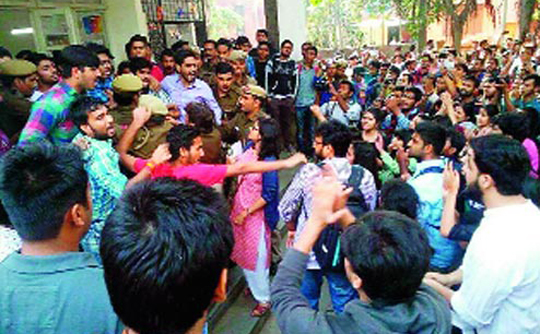
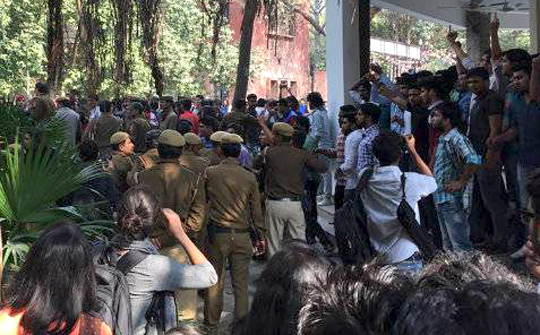
New Delhi, Feb 22: A clash broke out between activists of ABVP and AISA of Delhi University on Wednesday, a day after JNU student Umar Khalid’s visit to Ramjas College was cancelled following protests by students. The college authorities had to withdraw the invitation to Khalid, who was charged with sedition last year, and Shehla who was face of the movement demanding release of the students arrested in that case. According to reports, ABVP activists were staging a protest in the college on Wednesday, which led to a clash between them and AISA members. Both ABVP and AISA are student political groups representing divergent ideologies.
nat1

Umar Khalid and former JNUSU vice-president Shehla Rashid were invited to speak at a seminar in Ramjas College on Tuesday but their visit was cancelled after ABVP and DUSU members gathered outside the college gate and shouted slogans against them. There were also allegations of the protesters using violent methods like stone pelting.
ramjas

Meanwhile, there was a section of teachers, students and members of left- affiliated All India Students’ Association (AISA), who were agitated over the college’s decision to ‘bow down’ to “threat to freedom of speech” had decided to march to Maurice Nagar police station calling for action against ABVP members for resorting to vandalism.

During the clash, AISA members tried to barge inside the premises to ‘rescue the captives’. An AISA member said, “The students have been locked inside and those trying to come out were beaten up by ABVP goons. We tried to barge in inside the college to rescue the students but they are attacking us as well. They have come prepared with hockey sticks.”

After assessing the situation outside, Ramjas College Principal Rajender Prasad said he is in discussion with the teachers who were organisers of the event and requested both the groups to not disrupt the peace and harmony in the college.

The protesters also clashed with police personnel deployed at the scene. Umar Khalid was among JNU students who were charged with sedition after February 9 episode last year in which a group of students were seen shouting ‘anti-India’ slogans in mobile footage.

Comments

shaji
 - 
Wednesday, 22 Feb 2017

Its right time to declare ABVP a terrorist group and ban it. They came there with sticks / stones / sharp metals to attached AISA students and much to the strange police did not stop them from attacking AISA students. ABVP is fully supported by BJP and they are followign fool step of their masters in creating disturbance in the society.

Add new comment

  • Coastaldigest.com reserves the right to delete or block any comments.
  • Coastaldigset.com is not responsible for its readers’ comments.
  • Comments that are abusive, incendiary or irrelevant are strictly prohibited.
  • Please use a genuine email ID and provide your name to avoid reject.
News Network
March 25,2020

New Delhi, Mar 25: The government is likely to agree an economic stimulus package of more than Rs 1.5 lakh crore ($19.6 billion) to fight a downturn in the country that is currently locked down to stem the spread of coronavirus, two sources familiar with the matter told news agency.
The government has not yet finalised the package and discussions are ongoing between Prime Minister Narendra Modi's office, the finance ministry, and Reserve Bank of India (RBI), said both the sources, who asked not to be named as the matter was still under discussion.

One of the sources, a senior government official, said the stimulus plan could be as large as Rs 2.3 lakh crore, but final numbers were still in discussion.

The package could be announced by the end of the week, both sources added.

Comments

Add new comment

  • Coastaldigest.com reserves the right to delete or block any comments.
  • Coastaldigset.com is not responsible for its readers’ comments.
  • Comments that are abusive, incendiary or irrelevant are strictly prohibited.
  • Please use a genuine email ID and provide your name to avoid reject.
News Network
April 22,2020

New Delhi, Apr 22: The number of COVID-19 cases in India reached 20,471on Wednesday, with Maharashtra continuing to be the worst-hit state.

Out of the total number of cases, 15,859 are active cases, 3,959 cured or discharged and 652 deaths.

Maharashtra has reported the highest number of cases across the country, with the count at 5,221, followed by Delhi (2,156) and Gujarat (2,272). Maharashtra reported 251 deaths, the highest fatality rate than any other state.
Fresh cases were reported today from Kerala, Karnataka, Rajasthan and Kashmir among other states and UTs.

The Union Cabinet on Wednesday approved Rs 15,000 crore for 'India COVID-19 Emergency Response and Health System Preparedness Package'. The funds sanctioned will be utilised in three phases.

While Rs 7,774 crore has been provisioned for immediate COVID-19 emergency response, the rest would be used for medium-term support (1-4 years) to be provided under mission mode approach.

Briefing mediapersons about the package here on Wednesday, Union Minister Prakash Javadekar said the key objectives of the package include mounting emergency response to slow and limit COVID-19 in India through the development of diagnostics and COV1D-dedicated treatment facilities, centralised procurement of essential medical equipment and drugs required for treatment of infected patients, strengthen and build resilient national and state health systems to support prevention and preparedness for future disease outbreaks.

Javadekar said that no decision has been taken so far regarding the resumption of flight operations.

"No decision has been taken yet on the resumption of flight operations. An announcement will be made on time as to when it will resume," Javadekar told reporters.
Here's a quick read on the COVID-19 related updates:

1. Two Chinese manufactures of rapid antibody test, Guangzhou Wondfo Biotech Co. Ltd and Zhuhai Livzon Diagnostics Inc are now the subject of investigations by the Indian Council of Medical Research (ICMR) as the rapid testing antibody kits of these two companies delivered results with wide variations and low accuracy.

2. Rajasthan Health Minister Raghu Sharma said that 735 doctors have recently been recruited and posted to hospitals in the state.

3. The Employees Provident Fund Organisation (EPFO) has settled 10.02 lakh claims, including 6.06 lakh COVID-19 cases, under the Pradhan Mantri Garib Kalyan Yojana (PMGKY) in 15 working days.

4. Secretary of Overseas Indian Affairs in the Ministry of External Affairs, Vikas Swarup, interacted with envoys of nearly 30 Central European countries on Wednesday and shared thoughts on fighting COVID-19.

5. Taking cognisance of the need for essential services like plumbing during COVID 19 crisis, the Indian Plumbing Skills Council (IPSC) aligned to Skill India programme, under the aegis of the Ministry of Skill Development and Entrepreneurship (MSDE), has prepared a database of over 900 plumbers who are ready to provide their services during the lockdown period across the country.

6. Braving all odds, workers of the Accredited Social Health Activists (ASHA) are conducting door to door surveys in the Red Zones of Nagpur putting their lives at risk.

7. Aviation Minister Hardeep Puri on Wednesday said that Air India has lifted about 300 tonnes of essential medical cargo so far this month through China-India aerobridge. It is planned that Air India along with SpiceJet and Blue Dart will airlift another 220 tonnes of this critical cargo in the next three days.

8. Ministry of Railways has offered to supply 2.6 lakh meals daily from various railway kitchens wherever the district administration is willing and able to pick up cooked meals and distribute among the needy. This has been communicated to district authorities all over the country.

9. Uttarakhand Chief Minister Trivendra Singh Rawat on Wednesday said that the state's COVID-19 doubling rate stands at 26.6 days and Uttarakhand ranks third in preventing coronavirus infection.

10. The Central government has brought an ordinance to end violence against health workers, making it a cognizable, non-bailable offence with imprisonment up to seven years for those found guilty.

Comments

Add new comment

  • Coastaldigest.com reserves the right to delete or block any comments.
  • Coastaldigset.com is not responsible for its readers’ comments.
  • Comments that are abusive, incendiary or irrelevant are strictly prohibited.
  • Please use a genuine email ID and provide your name to avoid reject.
News Network
January 24,2020

New Delhi, Jan 24: Although India's Ujjwala programme encouraged adoption of liquefied petroleum gas (LPG) for cooking among the poor, households availing the scheme have not shifted away from using highly polluting fuels like firewood, a study reveals.

The researchers, including those from the University of British Columbia (UBC) in Canada, found that additional incentives to encourage regular use of cooking gas are necessary for a complete transition to clean cooking fuel among poor rural households.

They noted that about 2.9 billion people across Asia, Africa, and Latin America burn solid fuels like firewood to meet their cooking energy needs.

This has significant negative implications for public health, the environment, and societal development, according to the researchers.

Through the Pradhan Mantri Ujjwala Yojana (PMUY), India has provided capital cost subsidies to poor women to adopt a clean-burning cooking fuel or LPG.

The researchers explained that within the first 40 months of the scheme, more than 80 million households obtained LPG stoves.

However, the full benefits of LPG adoption depend on near complete replacement of polluting fuels with LPG, according to a research-based policy brief published in the journal Nature Energy.

The scientists said this cannot be assumed solely on the basis of LPG presence in the household.

"Our research shows that Ujjwala was able to attract new consumers rapidly, but those consumers did not start using LPG on a regular basis," Abhishek Kar, a postdoc at Columbia University in the US, told PTI.

The study analysed LPG sales data for over 25,000 consumers, including PMUY beneficiaries, as well as general rural LPG consumers in Koppal district of Karnataka.

The scientists employed data covering all LPG purchases of PMUY beneficiaries through their first year in the programme.

They also assessed the general rural population's purchases during their first five years as consumers to assess the effect of experience on use.

The findings estimate that an average rural family needs to purchase five 14.2 kilogramme-cylinders annually to meet half of their cooking needs.

However, the study said just seven per cent of PMUY beneficiaries in Koppal purchased five or more cylinders annually, suggesting that the beneficiaries seldom use LPG.

The general (nonPMUY) consumers in this region use on average two times more LPG cylinders than PMUY beneficiaries, the researchers noted.

Yet, only 45 per cent of nonPMUY consumers use five or more cylinders per year -- even after several years of experience with LPG, they said.

The team assessed price and seasonal factors affecting LPG use among the general population over a three-year period.

It found that LPG consumers are sensitive to price and seasonality -- LPG cylinder refill rates are lower in the summer when agricultural activity is limited, and cash is scarce.

"There was no scheme incentives to promote use, except general LPG subsidies which is available to all, including the urban middle class," said Kar, who was a Ph.D. scholar at UBC when the research was published.

"If there is no additional income, what cost would a poor family on an already tight budget cut to pay for an extra expense on a regular basis.

"Ujjwala has started the scheme of 5 kg-cylinder in response, but the impact of that on LPG sales is still publicly unknown," he said.

These findings, the researchers noted, suggest the need for additional measures to promote regular LPG use for all rural populations.

Although the finding come from a single district in Southern India, it may also apply to other areas with similar socio-economic conditions, they said.

A more expansive evaluation of PMUY would help design targeted incentives to transform infrequent users to regular users, according to the researchers.

Comments

Add new comment

  • Coastaldigest.com reserves the right to delete or block any comments.
  • Coastaldigset.com is not responsible for its readers’ comments.
  • Comments that are abusive, incendiary or irrelevant are strictly prohibited.
  • Please use a genuine email ID and provide your name to avoid reject.