ABVP, AISA activists clash over blocking of Umar Khalid’s visit to Ramjas college

February 22, 2017

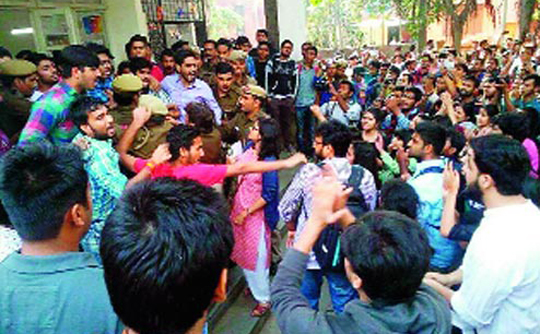
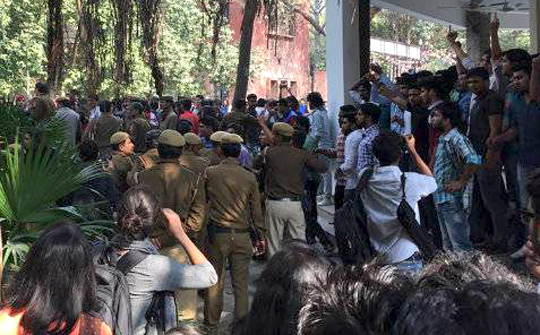
New Delhi, Feb 22: A clash broke out between activists of ABVP and AISA of Delhi University on Wednesday, a day after JNU student Umar Khalid’s visit to Ramjas College was cancelled following protests by students. The college authorities had to withdraw the invitation to Khalid, who was charged with sedition last year, and Shehla who was face of the movement demanding release of the students arrested in that case. According to reports, ABVP activists were staging a protest in the college on Wednesday, which led to a clash between them and AISA members. Both ABVP and AISA are student political groups representing divergent ideologies.

nat1

Umar Khalid and former JNUSU vice-president Shehla Rashid were invited to speak at a seminar in Ramjas College on Tuesday but their visit was cancelled after ABVP and DUSU members gathered outside the college gate and shouted slogans against them. There were also allegations of the protesters using violent methods like stone pelting.

ramjas

Meanwhile, there was a section of teachers, students and members of left- affiliated All India Students’ Association (AISA), who were agitated over the college’s decision to ‘bow down’ to “threat to freedom of speech” had decided to march to Maurice Nagar police station calling for action against ABVP members for resorting to vandalism.

During the clash, AISA members tried to barge inside the premises to ‘rescue the captives’. An AISA member said, “The students have been locked inside and those trying to come out were beaten up by ABVP goons. We tried to barge in inside the college to rescue the students but they are attacking us as well. They have come prepared with hockey sticks.”

After assessing the situation outside, Ramjas College Principal Rajender Prasad said he is in discussion with the teachers who were organisers of the event and requested both the groups to not disrupt the peace and harmony in the college.

The protesters also clashed with police personnel deployed at the scene. Umar Khalid was among JNU students who were charged with sedition after February 9 episode last year in which a group of students were seen shouting ‘anti-India’ slogans in mobile footage.

Comments

shaji
 - 
Wednesday, 22 Feb 2017

Its right time to declare ABVP a terrorist group and ban it. They came there with sticks / stones / sharp metals to attached AISA students and much to the strange police did not stop them from attacking AISA students. ABVP is fully supported by BJP and they are followign fool step of their masters in creating disturbance in the society.

Add new comment

  • Coastaldigest.com reserves the right to delete or block any comments.
  • Coastaldigset.com is not responsible for its readers’ comments.
  • Comments that are abusive, incendiary or irrelevant are strictly prohibited.
  • Please use a genuine email ID and provide your name to avoid reject.
News Network
January 28,2020

New Delhi, Jan 28: Stepping up attack on Chief Minister Arvind Kejriwal, Union Home Minister Amit Shah on Monday dared the AAP chief to visit the anti-CAA protest site at Shaheen Bagh so that the people of Delhi can decide whom to vote for in the assembly election.

Addressing a rally in Rithala in northwest Delhi, Shah said Kejriwal and Congress leader Rahul Gandhi were against the construction of Ram temple, the scrapping of provisions of Article 370 and not bothered about the country's image and soldiers.

The opposition fears that they will upset their vote bank, he said and asked, "Are you their vote bank? Where is their vote bank?" To this, the crowd replied, "Shaheen Bagh".

The BJP leader claimed that the Delhi Police has booked Sharjeel Imam, a JNU student, on the charge of sedition for his comment of "trying to cut chicken's neck" and breaking the North East from the rest of the country.

"I want to ask Kejriwal whether he is in favour of apprehending Sharjeel Imam or not? Whether you are with the people of Shaheen Bagh or not, please tell the people of Delhi," Shah said.

Imam was one of the initial organisers of the Shaheen Bagh protest.

Hitting back at the BJP, Kejriwal alleged that the saffron party does not want to open the Shaheen Bagh stretch of the Kalindi Kunj road as it is doing "dirty politics" over it.

He said law and order in the national capital lies entirely with the Centre and "if they are saying that they need permission from me, I am giving them permission, open the road in one hour".

"I can give it to you in writing, the BJP does not want to open the route in Shaheen Bagh. The Shaheen Bagh route will remain closed till February 8 (election day) and it will open February 9," Kejriwal told reporters.

Calling Kejriwal a member of the 'tukde tukde' gang, a term used by the BJP to attack groups it accuses of working to promote violent leftists and separatism, Shah sought to return fire and said the protesters of Shaheen Bagh will not listen to his party.

"They will not listen to us. You people (AAP leaders) say that you are with Shaheen Bagh, if you have the guts then go and sit with them and let Delhi decide," Shah said.

At another election rally in Janakpuri, Shah accused Gandhi and Kejriwal of doing politics of "vote bank" on national issues and "supporting" the protest at Shaheen Bagh while instigating riots and vandalism.

"The Modi government will not spare anti-national elements," he warned.

Upon mentioning the recent Supreme Court judgment on Ayodhya, Shah was greeted with cheers and chants of 'Jai Shri Ram'.

The home minister further said that this was the first Republic Day in Jammu and Kashmir after the abrogation of Article 370 and the tricolour was unfurled there with enthusiasm and without any bloodshed.

The former BJP president also attacked the Kejriwal government for not fulfilling promises like regularising temporary employees, providing free wifi, opening new schools and colleges, constructing roads and cleaning the Yamuna.

"Kejriwal government is in power since five years but till today there is no clean drinking water in the city. There are no good schools or hospitals as claimed by him. When I visited a Delhi government school, I saw that it was operating from a building that was illegally built and falls in the list of those that to be erased," Shah said.

He claimed that Kejriwal came to power with the help of Anna Hazare's anti-corruption movement but "completely changed" later on.

"He had said that he would not take any government accommodation or vehicles and other facilities but after becoming chief minister he availed all these facilities," Shah said.

He also slammed the Delhi government for not sanctioning the prosecution of former JNU students' union leader Kanhaiya Kumar in a sedition case.

Shah said if the national capital comes under the leadership of Modi, it will become the best city in the world.

The BJP has a vision for development of Delhi and cleaning the Yamuna river will be on top of our agenda, he said.

"Yamuna river is still dirty as against his (Kejriwal) claims of cleaning the river... Modi and Yogi (Adityanath) have cleaned Ganga river as promised. We will make Yamuna Riverfront like Sabarmati riverfront in Ahmedabad," Shah said.

However, a sizeable majority of those present at the public meeting was not convinced by the claims and promises made by Shah.

Bablu Yadav, a migrant and resident of Janakpuri said, "Shah and Modi can only talk but Kejriwal knows how to perform. They keep raking up issues like Ayodhya, Kashmir, Muslims and Pakistan... what are they waiting for if they want to attack Pakistan? They are in power, so why don't they destroy it instead of telling us how wrong Pakistan is?"

Another local Deepak Shrivastava who attended the Janakpuri meeting said, "All we hear from Modi and Shah are pep talks. I am an engineer from BHU and searching for a job. This government has failed the country's youth."

"Now, they have a problem with protests in universities but it is the same youth who brought them to power in 2014. The same youth will ensure their defeat," he added.

The public meeting in Janakpuri witnessed two incidents of pick-pocketing as the thieves managed to steal Rs 37,500 in cash and a mobile phone, police said.


Comments

Indian Soul
 - 
Tuesday, 28 Jan 2020

The biggest ANti-Nationals of INDIA are criminal Modi & AMith Shah Tadi PAAR...how long you will win by EVM...one day the people of indian will teach you a lesion of your life...

Add new comment

  • Coastaldigest.com reserves the right to delete or block any comments.
  • Coastaldigset.com is not responsible for its readers’ comments.
  • Comments that are abusive, incendiary or irrelevant are strictly prohibited.
  • Please use a genuine email ID and provide your name to avoid reject.
Agencies
February 11,2020

New Delhi, Feb 11: Delhi BJP chief Manoj Tiwari on Tuesday said the party will review why it failed to meet its own expectations in the Assembly polls and saw a moral victory in the fact that the party's vote share has increased since 2015.

"Delhi must have given mandate after careful thinking. Our vote percentage has increased from 32 per cent to around 38 per cent. Delhi did not reject us and the increase (in vote share) is a good sign for us," he told reporters.

He said the BJP hopes that there would be less blame game and more work in the national capital and congratulated Arvind Kejriwal on his party's victory in the polls.

After winning the Patparganj seat, AAP senior leader Manish Sisodia accused the BJP of indulging in the politics of hate.

"We indulge in politics of development not politics of hate. We're against the roadblock in Shaheen Bagh as we were earlier," he said.

Comments

Add new comment

  • Coastaldigest.com reserves the right to delete or block any comments.
  • Coastaldigset.com is not responsible for its readers’ comments.
  • Comments that are abusive, incendiary or irrelevant are strictly prohibited.
  • Please use a genuine email ID and provide your name to avoid reject.
News Network
January 13,2020

Jan 13: For the first time in years, the government of India’s Prime Minister Narendra Modi is playing defense. Protests have sprung up across the country against an amendment to India’s laws — which came into effect on Friday — that makes it easier for members of some religions to become citizens of India. The government claims this is simply an attempt to protect religious minorities in the Muslim-majority countries that border India; but protesters see it as the first step toward a formal repudiation of India’s constitutionally guaranteed secularism — and one that must be resisted.

Modi was re-elected prime minister last year with an enhanced majority; his hold over the country’s politics is absolute. The formal opposition is weak, discredited and disorganized. Yet, somehow, the anti-Citizenship Act protests have taken hold. No political party is behind them; they are generally arranged by student unions, neighborhood associations and the like.

Yet this aspect of their character is precisely what will worry Modi and his right-hand man, Home Minister Amit Shah. They know how to mock and delegitimize opposition parties with ruthless efficiency. Yet creating a narrative that paints large, flag-waving crowds as traitors is not quite that easy.

For that is how these protests look: large groups of young people, many carrying witty signs and the national flag. They meet and read the preamble to India’s Constitution, into which the promise of secularism was written in the 1970’s.

They carry photographs of the Constitution’s drafter, the Columbia University-trained economist and lawyer B. R. Ambedkar. These are not the mobs the government wanted. They hoped for angry Muslims rampaging through the streets of India’s cities, whom they could point to and say: “See? We must protect you from them.” But, in spite of sometimes brutal repression, the protests have largely been nonviolent.

One, in Shaheen Bagh in a Muslim-dominated sector of New Delhi, began simply as a set of local women in a square, armed with hot tea and blankets against the chill Delhi winter. It has now become the focal point of a very different sort of resistance than what the government expected. Nothing could cure the delusions of India’s Hindu middle class, trained to see India’s Muslims as dangerous threats, as effectively as a group of otherwise clearly apolitical women sipping sweet tea and sharing their fears and food with anyone who will listen.

Modi was re-elected less than a year ago; what could have changed in India since then? Not much, I suspect, in most places that voted for him and his party — particularly the vast rural hinterland of northern India. But urban India was also possibly never quite as content as electoral results suggested. India’s growth dipped below 5% in recent quarters; demand has crashed, and uncertainty about the future is widespread. Worse, the government’s response to the protests was clearly ill-judged. University campuses were attacked, in one case by the police and later by masked men almost certainly connected to the ruling party.

Protesters were harassed and detained with little cause. The courts seemed uninterested. And, slowly, anger began to grow on social media — not just on Twitter, but also on Instagram, previously the preserve of pretty bowls of salad. Instagram is the one social medium over which Modi’s party does not have a stranglehold; and it is where these protests, with their photogenic signs and flags, have found a natural home. As a result, people across urban India who would never previously have gone to a demonstration or a political rally have been slowly politicized.

India is, in fact, becoming more like a normal democracy. “Normal,” that is, for the 2020’s. Liberal democracies across the world are politically divided, often between more liberal urban centers and coasts, and angrier, “left-behind” hinterlands. Modi’s political secret was that he was that rare populist who could unite both the hopeful cities and the resentful countryside. Yet this once magic formula seems to have become ineffective. Five of India’s six largest cities are not ruled by Modi’s Bharatiya Janata Party in any case — the financial hub of Mumbai changed hands recently. The BJP has set its sights on winning state elections in Delhi in a few weeks. Which way the capital’s voters will go is uncertain. But that itself is revealing — last year, Modi swept all seven parliamentary seats in Delhi.

In the end, the Citizenship Amendment Act is now law, the BJP might manage to win Delhi, and the protests might die down as the days get unmanageably hot and state repression increases. But urban India has put Modi on notice. His days of being India’s unifier are over: From now on, like all the other populists, he will have to keep one eye on the streets of his country’s cities.

Comments

Add new comment

  • Coastaldigest.com reserves the right to delete or block any comments.
  • Coastaldigset.com is not responsible for its readers’ comments.
  • Comments that are abusive, incendiary or irrelevant are strictly prohibited.
  • Please use a genuine email ID and provide your name to avoid reject.