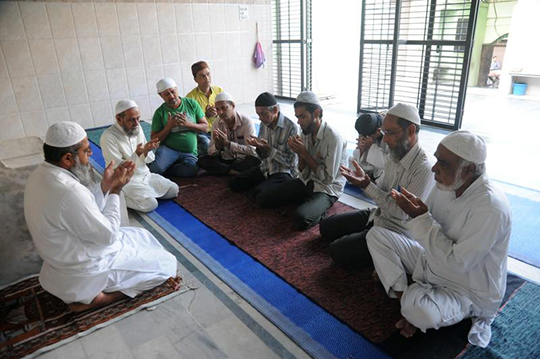
Gujarat: Hindus help reopen mosque after 30 yrs in riot hit locality

February 26, 2017

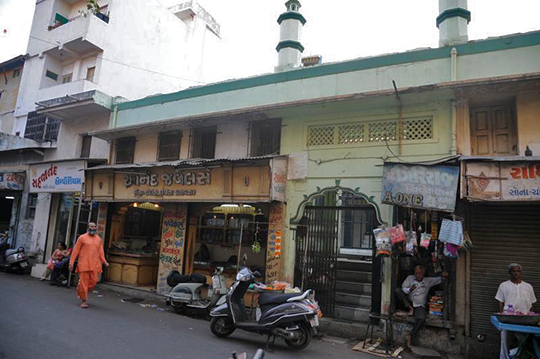
Ahmedabad, Feb 26: The call to prayer from the mosque near Bakri Pol in the communally sensitive Kalupur area is no ordinary azaan. Heard for the first time in 30 years in March 2016, it signifies the voice of compassion and respect drowning out hatred. Kalupur, a patchwork of Hindu and Muslim ghettos, was bloodied by communal riots in 1984. Since the nearly 100-year-old mosque is located in a Hindu locality — near Ramji, Nagdalla Hanuman, and Shesh Narayan temples — Muslims began to avoid it to avert troubles.
sec 1

Polarization intensified during the riots that broke out after the demolition of the Babri Masjid in 1993. By then the Kalupur mosque was overrun with foliage and had begun to crumble.

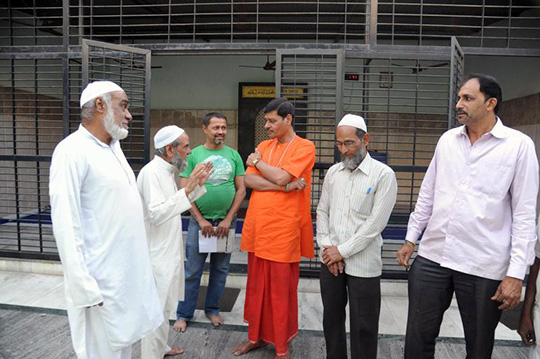
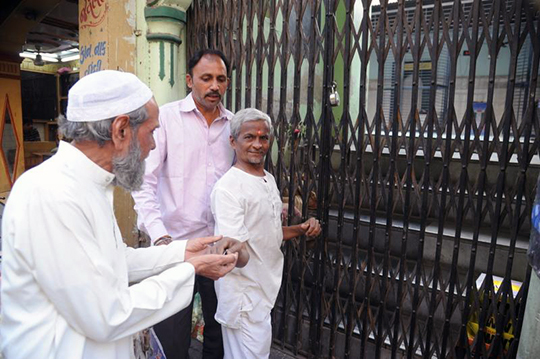
Paradoxically, after the communal riots of 2002, which had riven Gujarat, residents around the mosque were moved by a collective, voluntary desire to save it. Hindus reached out to their Muslim brethren, cleared the wild foliage, and contributed resources for repairs. The mosque reopened in March 2016. A year later, people in the neighbourhood affirm that the reconstruction effort has cemented bonds between communities. So much so, one set of keys to the mosque has been entrusted to Hindus.

"One set of keys is with Poonam Parekh and Kaushik Rami who sell flowers near the mosque," said Aziz Gandhi, social worker in Dariapur. Rami said he lights incense sticks twice a day near the mosque. "We are happy that the mosque that was closed for over three decades is now filled with devotees," he said. The priest of the Nagdalla Hanuman Temple, Chandrakant Sharma, said: "With Haji Usmangani Mansuri and other trustees of the mosque, we renovated the structure." He said that previously Muslim youths had to go to other mosques to offer namaaz. "Now, they they don't have to venture out of their locality," Sharma said. Hamidullah Shaikh, a Dariapur resident, said: "Our Hindu brothers helped us bring labourers to renovate the mosque." It appears a major breach in society has been lovingly repaired.
sec 2

sec 3

sec 4

Comments

Ajz
 - 
Monday, 27 Feb 2017

Better to send these coastal senseless goondas to Gujarat Kalupur..

saif
 - 
Monday, 27 Feb 2017

Real ACHE DIN not from BJP but from true Indian Hindus of Gujarat Kalupur...really everyone need to salute those Hindus....Its my India

Skazi
 - 
Monday, 27 Feb 2017

Masha Allah ..... But in coastal districts the senseless goondas are fighting each other .....

Add new comment

  • Coastaldigest.com reserves the right to delete or block any comments.
  • Coastaldigset.com is not responsible for its readers’ comments.
  • Comments that are abusive, incendiary or irrelevant are strictly prohibited.
  • Please use a genuine email ID and provide your name to avoid reject.
News Network
May 8,2020

New Delhi, May 8: After deadly styrene gas leak in Visakhapatnam, Union Chemicals and Fertilisers Minister D V Sadananda Gowda urged all public and private chemical makers to exercise caution and care while reopening their plants.

Union Environment Ministry and State Pollution Control Boards have also issued separate directives to all companies to take extreme precaution while restarting their units that remained suspended due to the lockdown imposed to contain the spread of COVID-19 in the country, he said.

There was a gas leak from LG Polymers plant at Visakhapatnam in the early hours on Thursday, causing 10 deaths and hundreds of people getting hospitalised.

"LG Polymers does not come under direct control of our ministry. However, we have asked all public and private chemicals manufacturers to exercise caution and care while reopening their plants," Gowda told PTI.

The minister said his officers are coordinating with the Andhra Pradesh government.

He further said LG Polymers, a multinational chemical company, had kept its unit ready for reopening after one and half month of lockdown. The unit started leaking at around 3.40 am on Thursday due to pressure.

"The toxic gas leak has affected both people and animals. Around 850 people have been hospitalised," Gowda said, adding that measures have been taken to control the situation at the plant site and final updates are awaited.

At present, Indian chemicals market size is about USD 163 billion, which is only three per cent of the global chemical industry of USD 5 trillion, as per the official data.

Comments

Add new comment

  • Coastaldigest.com reserves the right to delete or block any comments.
  • Coastaldigset.com is not responsible for its readers’ comments.
  • Comments that are abusive, incendiary or irrelevant are strictly prohibited.
  • Please use a genuine email ID and provide your name to avoid reject.
News Network
July 29,2020

Bengaluru Jul 29: There will be a centralised system in place in Karnataka to classify asymptomatic, symptomatic and mild symptomatic persons and recommend treatment based on the severity of the cases, said Medical Education Minister Dr K Sudhakar on Tuesday here.

"Various existing apps related to COVID-19 will be brought under one platform to get real-time information which will assist in strategising allocation of hospitals/beds to the needy. This will probably remove the delay in bed allocation and treatment which is being faced now. The patients will get all information in one phone call," Dr Sudhakar said.

Sudhakar spoke with a team of experts from the government and Infosys.

Referring to a company by name Step 1, which is providing such services in Delhi and Madhya Pradesh, the Minister said that a similar system will be implemented in the state as well.

"This company is having a team of doctors and nurses which is guiding the people whether they need hospital treatment or home isolation after they are tested positive for COVID-19. More than 70 per cent of the positive cases are being asymptomatic or mildly symptomatic and are advised to go for home isolation," the minister said.

"The load on the hospitals is reduced and severe cases can be administered proper treatment. Infosys co-ordinates with the government to provide technical support for this system," Dr Sudhakar added.

Earlier during the day, the minister held a video conference with the heads of private medical colleges to review COVID preparedness.
The government has already passed guidelines to allocate 50 per cent of hospital beds for COVID patients.

Comments

Add new comment

  • Coastaldigest.com reserves the right to delete or block any comments.
  • Coastaldigset.com is not responsible for its readers’ comments.
  • Comments that are abusive, incendiary or irrelevant are strictly prohibited.
  • Please use a genuine email ID and provide your name to avoid reject.
News Network
July 8,2020

Bengaluru, Jul 8: The expert committee constituted by the Karnataka government to look into imparting online education in the wake of the COVID-19 lockdown submitted its report on Tuesday to the Minister for Primary and Secondary Education, S Suresh Kumar.

Amid growing pressure by educational institutions to allow them to run online classes for the students, the government set up the committee headed by noted educationist M K Sridhar.

The Minister told reporters that some schools wanted to run online classes, including for LKG and UKG students. It had also come to the government's notice that schools were reportedly charging hefty fees in the name of online teaching, he added.

"To address the concerns of parents, schools, and the future of the children, the committee was formed,"Kumar said. He further said that the government would study the recommendations and hold discussions with officials and various stakeholders before arriving at a decision.

The Education Department said that the committee, in its report, titled "Continuation of Learning in School Education of Karnataka: Guidelines During COVID-19 Pandemic for Technology Enabled Education and Beyond", has recommended teaching online or by using printed material. The committee suggested that children in the age group of three to six be taught online by way of story-telling, rhymes and games strictly in the presence of parents thrice a week just for one session a day For students from class one to three, it advised two periods a day and three days a week for online teaching.

Students from class three to five would have classes five days a week and two classes for 30 minutes a day. For students from class six to eight, there could be three classes a day for a duration of 30 minutes to 45 minutes each, while for students of class nine and 10 there would be four sessions a day between 30 and 45 minutes each.

The committee also suggested usage of Doordarshan and Akashwani for the government school children. Suresh Kumar said there were a few petitions filed in the Karnataka High Court regarding online teaching to the children.

Comments

Add new comment

  • Coastaldigest.com reserves the right to delete or block any comments.
  • Coastaldigset.com is not responsible for its readers’ comments.
  • Comments that are abusive, incendiary or irrelevant are strictly prohibited.
  • Please use a genuine email ID and provide your name to avoid reject.