


Modi to get US President-like reception in Israel; terrorism, economic ties on agenda

Agencies
July 4, 2017

New Delhi, Jul 4: Prime Minister Narendra Modi's historic visit to Israel, beginning on Tuesday, will see discussions between him and his Israeli counterpart Benjamin Netanyahu exploring ways to enhance cooperation in key strategic areas.
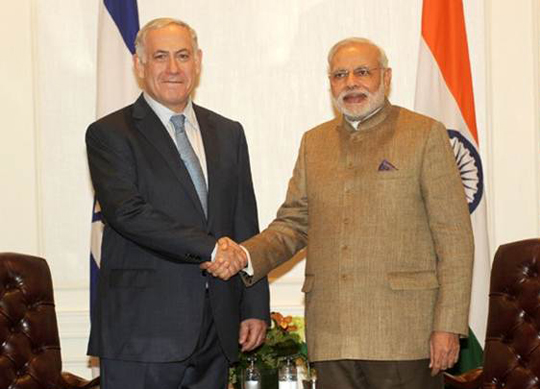
netanyahu

His visit will be the first by an Indian PM to Israel.

This year, India and Israel are marking 25 years of their diplomatic relations.

The two sides are expected to sign number of agreements in the field of innovation, development, science and technology and space.

Apart from boosting cooperation in the water and agriculture sectors, India and Israel will also discuss ways to strengthen people-to-people contact, air connectivity and investments.

During the visit, a deal with the Uttar Pradesh government is also likely to be signed to clean-up a patch of river Ganges apart from setting up of industrial research and development fund of USD 40 million.

Before the visit, the Ministry of External Affairs ministry in New Delhi said it will provide an impetus for deeper bilateral engagement in areas of mutual interest, as per news agency.

PM Modi's schedule:

PM Modi will be received by Netanyahu at the airport. This is a special gesture only accorded to the Pope or the US president.

The Israeli PM will also host a dinner for PM Modi.

Netanyahu will accompany him to most of the events, including the community reception on July 5.

PM Modi will pay homage to Indian soldiers at the Indian Cemetery in Haifa.

He will meet 26/11 Mumbai terror attack survivor Holtzberg Moshe, who was only two when he was saved by his Indian nanny Sandra Samuel.

Moshe's father Rabbi Gavriel and mother Rivkah were among eight Israeli nationals killed in the 2008 terror strike.

On the eve of his visit to Israel, PM Modi on Monday said he will discuss with Netanyahu common challenges like terrorism and ways to boost the economic ties.

"Tomorrow, I begin a historic visit to Israel, a very special partner of India's. As the first Indian PM to do so, I am greatly looking forward to this unprecedented visit that will bring our two countries and people closer," he said in a statement.

"I look forward to holding extensive talks with my friend, Israeli PM Netanyahu, who shares a commitment for vibrant India-Israel ties," he tweeted.

The PM said he will have 'in-depth talks' with Netanyahu "on the full spectrum of our partnership and strengthening it in diverse fields for mutual benefit. We will also have the chance to discuss major common challenges like terrorism."

"My programme during the visit gives me an opportunity to engage with a cross-section of Israeli society. I am particularly looking forward to interacting with the large vibrant Indian diaspora in Israel that represents an enduring link between our two peoples," PM Modi added.

On the economic side, he said, "I will join with leading Indian and Israeli CEOs and start-ups to discuss our shared priority of expanding business and investment collaboration on the ground."

In addition, he said, "I hope to get insights into Israel's accomplishments in technology and innovation through on-site visits."

On July 6, PM Modi will travel to Hamburg for the G-20 Summit being hosted by Germany on July 7-8.

Netanyahu hails PM Modi's visit to Israel as a 'very significant step'

Earlier, the Israeli premier had hailed PM Modi's visit as a "very significant step" in strengthening bilateral relations that are on a "constant upswing".

"Next week, the Indian Prime Minister, my friend, Narendra Modi will arrive in Israel, This is a historic visit to Israel. In the 70 years of the country's existence, no Indian Prime Minister has ever visited and this is further expression of the state of Israel's military, economic and diplomatic strength," Netanyahu had said.

"This is a very significant step in strengthening relations between the two countries," he had added.

The two leaders have already met twice on foreign soil on the sidelines of UN-related events and are said to be constantly in touch with each other over the phone.

PM Modi would also be meeting Israeli President Reuven Rivlin and the leader of Opposition Isaac Herzog on July 5.

He will not travelling to neighbouring Palestine during the visit, a clear signal of de-hyphenation of its ties with the two West Asian nations.

President Pranab Mukherjee in 2015 and External Affairs Minister Sushma Swaraj in 2016 visited both the countries.

Israeli Prime Minister Ariel Sharon and President Ezer Weizman visited India in 2003 and 1997 respectively.

Israeli President Reuven Rivlin had also paid a visit to India in November last year.

Comments

Muhammed Rafique
 - 
Friday, 7 Jul 2017

Viren, Your comments doesn't even deserve any response

but the matter of fact is you are such a sick and communal person who encourage riot and disrupt peace.The current situation in DK is bcos of people like u, instigated by Padil and Kalladka

Viren Kotian
 - 
Friday, 7 Jul 2017

RIP Sharat. Your blood will not be wasted. nationalist forces will soon eliminate anti-national forces, fanatics and terrorists.

Hara Hara Mahaadev!

Abdul
 - 
Friday, 7 Jul 2017

So called nationalists, breaking section , ohh DK & Udupi MPs spotted again , they will disappear when real culprits get caught ( like Karthik raj case)

Mohammad Beary
 - 
Tuesday, 4 Jul 2017

Lynchist with terrorist...

NOOR
 - 
Tuesday, 4 Jul 2017

For a muslims, Everything happens with the will of ALLAH...
ALLAH the creator of all that exists, Knows well of all that is happening around the globe...
ALLAH is the best of Planners...
ALhamudllillah.. Thanks to ALLAH for making us Muslims.

Fear ALLAH, the creator..
and Never Fear the Creations of ALLAH. U will be successful

abdul
 - 
Tuesday, 4 Jul 2017

both from the same creed & creature-anti human

Add new comment

  • Coastaldigest.com reserves the right to delete or block any comments.
  • Coastaldigset.com is not responsible for its readers’ comments.
  • Comments that are abusive, incendiary or irrelevant are strictly prohibited.
  • Please use a genuine email ID and provide your name to avoid reject.
Agencies
February 5,2020

New Delhi, Feb 5: Over five crore farmers were yet to get the third instalment of money under the Centre's ambitious PM-Kisan scheme, aimed at providing direct support of Rs 6,000 annually to them, according to the latest Ministry of Agriculture and Farmers' Welfare data.

The total amount of the scheme, which came into effect on December 1, 2018, is to be paid in three equal instalments of Rs 2,000 every four months.

The data showed about 2.51 crore farmers have not got even the second instalment and 5.16 crore of them were yet to get the third instalment.

Over 9 crore farmers have registered themselves under the scheme between December 2018 and November 2019, it said.

Of these, 7.62 crore or 84 per cent of farmers have received the first instalment.

The money through the second instalment was given to nearly 6.5 crore farmers and the amount under the third instalment was given to 3.85 crore beneficiaries, according to the data received in response to an RTI query filed by this PTI journalist.

The agriculture ministry, in its response, gave three sets of data mentioning the benefits given to farmers under the scheme between December 2018 and November 2019.

It said 4.74 crore farmers were registered between December 2018 and March 2019.

Of them, 4.22 crore received the first instalment, 4.02 crore the second and 3.85 crore the third.

There was no mention why nearly 50 lakh, 70 lakh and 90 lakh registered farmers during this period did not get the first, second and third instalment respectively.

There was no registered beneficiary in West Bengal and Sikkim, hence no amount was disbursed during this period, according to the data.

Giving details of the 3.08 crore farmers registered between April and July last year, it said 2.66 crore and 2.47 crore beneficiaries have got their first and second instalments respectively.

The RTI reply did no mention why around 40 lakh and 61 lakh registered farmers during this period did not get their first and second instalment respectively.

"The beneficiaries are eligible for the instalment for the period in which he/she gets registered and subsequent periods, thereafter. Therefore, the third instalment is not due for the beneficiaries registered in the period April 2019-July 2019," the ministry said.

There was no registered beneficiary during this period in West Bengal, Punjab and Chandigarh and therefore nobody was paid first and second instalments.

The ministry said around 1.19 crore beneficiaries were registered between August and November 30, 2019, of these nearly 73.66 lakh farmers have been given the first instalment.

There was no mention of payment of first instalment to over 45 lakh eligible beneficiaries during the period.

"The beneficiaries are eligible for the instalment for the period in which he/she gets registered and subsequent periods, thereafter. Therefore, the second and third instalments are not due for the beneficiaries registered in the period August 2019 to November 2019," it said.

The ministry was asked to provide the total number of farmers, state-wise, and the amount received by them under the Pradhan Mantri Kisan Samman Nidhi or PM-Kisan scheme.

"PM-Kisan Samman Nidhi scheme has been implemented from December 1, 2018. It is stated that PM-Kisan is a continuous and ongoing scheme, in which the financial benefits are transferred to the bank accounts of the identified beneficiaries as and when their correct and verified data is uploaded by the concerned states/union territories on PM-Kisan web portal," the ministry said in the RTI response vide its letter dated December 26, 2019.

The data of beneficiaries so uploaded by them undergoes a multi-level verification, including by banks, and only then the amount is released to the beneficiary, it said, adding that www.pmkisan.gov.in website can be accessed to get more details on the operational guidelines of the scheme.

According to the data updated on the website on February 3, around 8.82 crore farmers have been registered and 8.41 crore have received the first installment, 7.56 crore the second instalment, 6.19 crore the third and 3.03 crore have received the fourth installment.

In Assam, out of 16.97 lakh farmers registered during this period, 14.02 lakh got the first instalment, 13.72 lakh received the second and 9.87 lakh the third.

Of the 42.34 lakh registered beneficiaries in Maharashtra, 36.98 lakh got the first instalment, 31.53 lakh the second and 27.67 lakh got the third instalment.

As many as 23.83 lakh farmers in Kerala received their first instalment, 18.79 lakh got the second and 18.43 lakh the third. A total of 26.13 lakh beneficiaries were registered in the state between December 2018 and March 2019.

There was no beneficiary registered during the period from West Bengal, which has refused to implement the scheme, according to the ministry's response.

In Uttar Pradesh, nearly 9.57 lakh out of 19.64 lakh farmers have got the first instalment. In Gujarat, nearly 1.22 lakh out of 1.98 lakh registered farmers got the first instalment.

Around 9.78 lakh farmers out of the 17.18 lakh registered beneficiaries have received the first instalment in Madhya Pradesh. In Odisha, only 5,507 farmers out of 5.6 lakh registered farmers have got the first instalment, the ministry said.

None of the 7,326 farmers registered in Sikkim was paid the first instalment, according to the ministry's reply. In Delhi, 1,447 farmers out of 1,734 have got the first instalment.

Comments

Add new comment

  • Coastaldigest.com reserves the right to delete or block any comments.
  • Coastaldigset.com is not responsible for its readers’ comments.
  • Comments that are abusive, incendiary or irrelevant are strictly prohibited.
  • Please use a genuine email ID and provide your name to avoid reject.
News Network
July 4,2020

Pune, Jul 4: Now that wearing mask in public places has become the new normal, a resident of Pimpri-Chinchwad of Pune district, Shankar Kurade has got himself a mask made of gold worth Rs 2.89 lakhs amid the COVID-19 pandemic.

"It's a thin mask with minute holes so that there is no difficulty in breathing. I am not sure whether this mask will be effective," said Kurade.

Kurade loves wearing gold ornaments and his hands and neck are loaded with jewellery.

This unique idea struck him soon after he saw a man wearing a silver mask on social media.

"I saw a video on social media of a man in Kolhapur wearing a silver mask and then an idea struck me to have a mask of gold. I talked to a goldsmith and he gave me this five and a half pound gold mask in a week," said Kurade.

"All my family members love gold, if they too demand it, then I will get it designed for them too. I do not know if I will be infected with coronavirus wearing a gold mask or not, but following all the rules of the government can prevent the spread of virus," he added.

Since childhood, Shankar is very fond of gold ornaments, that is the reason he wears gold rings in all the fingers, gold bracelets on his wrist and huge gold chains around his neck.

Comments

Add new comment

  • Coastaldigest.com reserves the right to delete or block any comments.
  • Coastaldigset.com is not responsible for its readers’ comments.
  • Comments that are abusive, incendiary or irrelevant are strictly prohibited.
  • Please use a genuine email ID and provide your name to avoid reject.
Agencies
June 6,2020

United Nations, Jun 6: The coronavirus disease has not "exploded" in India, but the risk of that happening remains as the country moves towards unlocking its nationwide lockdown that was imposed in March to contain the Covid-19, according to a top WHO expert.

WHO Health Emergencies Programme Executive Director Michael Ryan on Friday said the doubling time of the coronavirus cases in India is about three weeks at this stage.

“So the direction of travel of the epidemic is not exponential but it is still growing,” he said, adding that the impact of the pandemic is different in different parts of India and varies between urban and rural settings.

“In South Asia, not just in India but in Bangladesh and...in Pakistan, other countries in South Asia, with large dense populations, the disease has not exploded. But there is always the risk of that happening,” Ryan said in Geneva.

He stressed that as the disease generates and creates a foothold in communities, it can accelerate at any time as has been seen in a number of settings.

Ryan noted that measures taken in India such as the nationwide lockdown have had an impact in slowing transmission but the risk of an increase in cases looms as the country opens up.

“The measures taken in India certainly had an impact in dampening transmission and as India, as in other large countries, open up and as people begin to move again, there's always a risk of the disease bouncing back up,” he said.

He added that there are specific issues in India regarding the large amount of migration, the dense populations in the urban environment and the fact that many workers have no choice but to go to work every day.

India went past Italy to become the sixth worst-hit nation by the COVID-19 pandemic.

India saw a record single-day jump of 9,887 coronavirus cases and 294 deaths on Saturday, pushing the nationwide infection tally to 2,36,657 and the death toll to 6,642, according to the health ministry.

The lockdown in India, was first clamped on March 25 and spanned for 21 days, while the second phase of the curbs began on April 15 and stretched for 19 days till May 3. The third phase of the lockdown was in effect for 14 days and ended on May 17. The fourth phase ended on May 31.

The country had registered 512 coronavirus infection cases till March 24.

The nation-wide lockdown in containment zones will continue till June 30 in India but extensive relaxations in a phased manner from June 8 are listed in the Union home ministry's fresh guidelines on tackling the Covid-19 pandemic issued last week.

WHO Chief Scientist Soumya Swaminathan said the over 200,000 current coronavirus cases in India, a country of over 1.3 billion people, "look big but for a country of this size, it's still modest.”

She stressed that it is important for India to keep track of the growth rate, the doubling time of the virus and to make sure that that number doesn't get worse.

She said that India is a “heterogeneous and huge country” with very densely populated cities and much lower density in some rural areas and varying health systems in different states and these offer challenges to the control of Covid-19.

Swaminathan added that as the lockdown and restrictions are lifted, it must be ensured that all precautions are taken by people.

“We've been making this point repeatedly that really if you want behaviour change at a large level, people need to understand the rationale for asking them to do certain things (such as) wearing masks,” she said.

In many urban areas in India, it's impossible to maintain physical distancing, she said adding that it then becomes very important for people to wear appropriate face coverings when they are out, in office settings, in public transport and educational institutions.

“As some states are thinking about opening, every institution, organisation, industry and sector needs to think about what are the measures that need to be put in place before you can allow a functioning and it may never be back to normal.”

She said that in many professions working from home can be encouraged but in several jobs, people have to go to work and in such cases measures must be put in place that allow people to protect themselves and others.

“I think communication and behaviour change is a very large part of this whole exercise,” she added.

Comments

Add new comment

  • Coastaldigest.com reserves the right to delete or block any comments.
  • Coastaldigset.com is not responsible for its readers’ comments.
  • Comments that are abusive, incendiary or irrelevant are strictly prohibited.
  • Please use a genuine email ID and provide your name to avoid reject.