


Modi to get US President-like reception in Israel; terrorism, economic ties on agenda

Agencies
July 4, 2017

New Delhi, Jul 4: Prime Minister Narendra Modi's historic visit to Israel, beginning on Tuesday, will see discussions between him and his Israeli counterpart Benjamin Netanyahu exploring ways to enhance cooperation in key strategic areas.
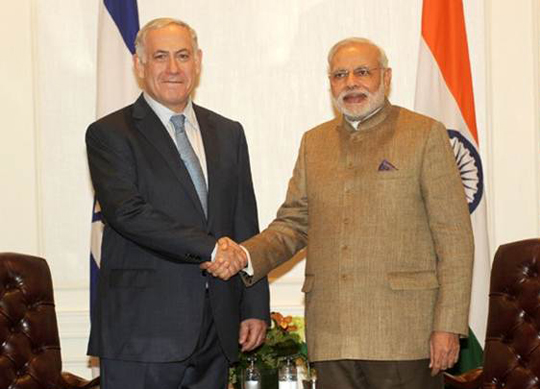
netanyahu

His visit will be the first by an Indian PM to Israel.

This year, India and Israel are marking 25 years of their diplomatic relations.

The two sides are expected to sign number of agreements in the field of innovation, development, science and technology and space.

Apart from boosting cooperation in the water and agriculture sectors, India and Israel will also discuss ways to strengthen people-to-people contact, air connectivity and investments.

During the visit, a deal with the Uttar Pradesh government is also likely to be signed to clean-up a patch of river Ganges apart from setting up of industrial research and development fund of USD 40 million.

Before the visit, the Ministry of External Affairs ministry in New Delhi said it will provide an impetus for deeper bilateral engagement in areas of mutual interest, as per news agency.

PM Modi's schedule:

PM Modi will be received by Netanyahu at the airport. This is a special gesture only accorded to the Pope or the US president.

The Israeli PM will also host a dinner for PM Modi.

Netanyahu will accompany him to most of the events, including the community reception on July 5.

PM Modi will pay homage to Indian soldiers at the Indian Cemetery in Haifa.

He will meet 26/11 Mumbai terror attack survivor Holtzberg Moshe, who was only two when he was saved by his Indian nanny Sandra Samuel.

Moshe's father Rabbi Gavriel and mother Rivkah were among eight Israeli nationals killed in the 2008 terror strike.

On the eve of his visit to Israel, PM Modi on Monday said he will discuss with Netanyahu common challenges like terrorism and ways to boost the economic ties.

"Tomorrow, I begin a historic visit to Israel, a very special partner of India's. As the first Indian PM to do so, I am greatly looking forward to this unprecedented visit that will bring our two countries and people closer," he said in a statement.

"I look forward to holding extensive talks with my friend, Israeli PM Netanyahu, who shares a commitment for vibrant India-Israel ties," he tweeted.

The PM said he will have 'in-depth talks' with Netanyahu "on the full spectrum of our partnership and strengthening it in diverse fields for mutual benefit. We will also have the chance to discuss major common challenges like terrorism."

"My programme during the visit gives me an opportunity to engage with a cross-section of Israeli society. I am particularly looking forward to interacting with the large vibrant Indian diaspora in Israel that represents an enduring link between our two peoples," PM Modi added.

On the economic side, he said, "I will join with leading Indian and Israeli CEOs and start-ups to discuss our shared priority of expanding business and investment collaboration on the ground."

In addition, he said, "I hope to get insights into Israel's accomplishments in technology and innovation through on-site visits."

On July 6, PM Modi will travel to Hamburg for the G-20 Summit being hosted by Germany on July 7-8.

Netanyahu hails PM Modi's visit to Israel as a 'very significant step'

Earlier, the Israeli premier had hailed PM Modi's visit as a "very significant step" in strengthening bilateral relations that are on a "constant upswing".

"Next week, the Indian Prime Minister, my friend, Narendra Modi will arrive in Israel, This is a historic visit to Israel. In the 70 years of the country's existence, no Indian Prime Minister has ever visited and this is further expression of the state of Israel's military, economic and diplomatic strength," Netanyahu had said.

"This is a very significant step in strengthening relations between the two countries," he had added.

The two leaders have already met twice on foreign soil on the sidelines of UN-related events and are said to be constantly in touch with each other over the phone.

PM Modi would also be meeting Israeli President Reuven Rivlin and the leader of Opposition Isaac Herzog on July 5.

He will not travelling to neighbouring Palestine during the visit, a clear signal of de-hyphenation of its ties with the two West Asian nations.

President Pranab Mukherjee in 2015 and External Affairs Minister Sushma Swaraj in 2016 visited both the countries.

Israeli Prime Minister Ariel Sharon and President Ezer Weizman visited India in 2003 and 1997 respectively.

Israeli President Reuven Rivlin had also paid a visit to India in November last year.

Comments

Muhammed Rafique
 - 
Friday, 7 Jul 2017

Viren, Your comments doesn't even deserve any response

but the matter of fact is you are such a sick and communal person who encourage riot and disrupt peace.The current situation in DK is bcos of people like u, instigated by Padil and Kalladka

Viren Kotian
 - 
Friday, 7 Jul 2017

RIP Sharat. Your blood will not be wasted. nationalist forces will soon eliminate anti-national forces, fanatics and terrorists.

Hara Hara Mahaadev!

Abdul
 - 
Friday, 7 Jul 2017

So called nationalists, breaking section , ohh DK & Udupi MPs spotted again , they will disappear when real culprits get caught ( like Karthik raj case)

Mohammad Beary
 - 
Tuesday, 4 Jul 2017

Lynchist with terrorist...

NOOR
 - 
Tuesday, 4 Jul 2017

For a muslims, Everything happens with the will of ALLAH...
ALLAH the creator of all that exists, Knows well of all that is happening around the globe...
ALLAH is the best of Planners...
ALhamudllillah.. Thanks to ALLAH for making us Muslims.

Fear ALLAH, the creator..
and Never Fear the Creations of ALLAH. U will be successful

abdul
 - 
Tuesday, 4 Jul 2017

both from the same creed & creature-anti human

Add new comment

  • Coastaldigest.com reserves the right to delete or block any comments.
  • Coastaldigset.com is not responsible for its readers’ comments.
  • Comments that are abusive, incendiary or irrelevant are strictly prohibited.
  • Please use a genuine email ID and provide your name to avoid reject.
News Network
March 29,2020

New Delhi, Mar 29: The battle against coronavirus is a tough one and it required harsh decisions to keep India safe, said Prime Minister Narendra Modi in his first Mann Ki Baat after the 21-day lockdown was imposed in the wake of COVID-19 outbreak.
"The battle against COVID-19 is a tough one and it did require such harsh decisions. It is important to keep the people of India safe. A disease must be dealt with at the very beginning as delay makes it incurable," said Prime Minister Modi.
He said that as the coronavirus has put the entire world in lockdown, so "India is doing the same."
"It is a challenge before everyone, science and knowledge, poor and rich, powerful and weak. It is neither restricted to a nation nor region or particular weather. This virus is bent upon killing human beings, eliminating them. Hence all of us, the entire humanity, must unite and resolve to eliminate it," he added.
Addressing the 63rd edition of his monthly radio programme 'Mann Ki Baat', the Prime Minister had sought forgiveness from all countrymen, and especially the poor, for the nationwide lockdown in the country in the view of the novel coronavirus.
During his address to the nation on March 24, the Prime Minister had announced a 21-day nationwide lockdown to contain the spread of the deadly virus. 

Comments

Add new comment

  • Coastaldigest.com reserves the right to delete or block any comments.
  • Coastaldigset.com is not responsible for its readers’ comments.
  • Comments that are abusive, incendiary or irrelevant are strictly prohibited.
  • Please use a genuine email ID and provide your name to avoid reject.
News Network
June 13,2020

Jun 13: The Congress on Saturday accused the BJP-led government of burdening the common man with high taxes on petrol and diesel and earning Rs 2.5 lakh crore since March 5.

Congress leader Kapil Sibal said while international crude oil prices have fallen and are at the lowest level in 15 years, yet petrol and diesel prices are skyrocketing and common people continue to suffer under the Modi dispensation.

He said instead of passing the benefit of lower crude prices to consumers, petrol and diesel prices were hiked for the seventh straight day on June 13.

"The government has earned as much as Rs 44,000 crore in the last six days due to hike in petrol, diesel prices. Since March 5, the government has earned as much as Rs 2.5 lakh crore by way of increasing petrol, diesel prices.

"If the government had even the slightest feelings for the common man, instead of benefitting the companies and the government, the prime minister would have helped the common man with reduced fuel prices," Sibal said at an online press conference.

According to a report by Care Ratings, he said the hike effectively meant that the Central government is collecting around 270 per cent taxes on the base price of petrol and 256 per cent in case of diesel.

The former union minister said petrol was selling at Rs 71.41 in Delhi on May 1, 2014, when international crude oil prices were USD 106.85, while on June 12, 2020, the price of petrol was Rs 75.16 when the crude oil was at USD 38.

He said central excise and VAT cumulatively account for 69 per cent of tax on fuel in India which is higher than anywhere else in the world. He said the tax of fuel in the US was 19 per cent, Japan 47 per cent, the UK 62 per cent, France 63 per cent and Germany 65 per cent.

Comments

Add new comment

  • Coastaldigest.com reserves the right to delete or block any comments.
  • Coastaldigset.com is not responsible for its readers’ comments.
  • Comments that are abusive, incendiary or irrelevant are strictly prohibited.
  • Please use a genuine email ID and provide your name to avoid reject.
News Network
June 18,2020

New Delhi, Jun 18: The border clash between Indian and Chinese soldiers in Ladakh broke the brittle quiet – and also the sense of security for anxious Chinese nationals in India who fear a backlash with anti-Chinese sentiment spiralling in the country.

With the high altitude violent face-off in eastern Ladakh’s Galwan Valley spurring hashtags such as “Boycott China” and “Teach Lesson to China” and leading to street protests, the undercurrents of tension were evident.

Wary of being identified, some said they had been reassured by their friends but were still apprehensive for themselves and their families.

"They (Chinese families) don''t want to speak to the media. They are not going out and are worried about their security and well being. Their families are also worried back home," Mohammed Saqib, secretary general of the India China Economic & Cultural Council, told PTI.

He added that his Chinese friends in India been calling him since they heard news about Monday night’s clashes in which 20 Indian soldiers were killed -- the worst military confrontation in five decades -- and expressed concern over growing anti-China sentiments.

A Chinese national from Beijing working in Gurgaon for a Chinese mobile firm initially refused to talk, saying he did not want to speak to the media and later shared his thoughts only on condition of anonymity.

"There is talk of border standoff and tensions, but we know Indians are very warm people and that is why I have told my family that all is fine here and they should not worry," he said.

Another Chinese national working in Gurgaon said he and his family are feeling the stress amid the spiralling conflict between India and China, but many friends have been reassuring him.

"They (Chinese in India) are under a lot of stress naturally. Such a conflict puts a lot of stress as they could bear the brunt and the same applies to Indians in China," B R Deepak, professor at the Centre for Chinese and South East Asian Studies of the Jawaharlal Nehru University said.

He said it was unfortunate that the border standoff derailed the commemorative programmes aimed at strengthening ties at a time the two countries were gearing to celebrate 70 years of establishment of diplomatic ties.

Experts also feel the border clash is likely to have a significant negative impact on the economic and people to people ties.

There are scores of Chinese in India working in various Chinese firms and also those who are studying in universities like JNU.

About 3,000 Chinese people, doing business or studying in big cities in India, were stranded in India at the start of the COVID-19 crisis, and about half of them returned to China before the lockdown began on March 25.

The Chinese Embassy in New Delhi announced on May 25 that they will arrange for flights to take back students, tourists and businesspersons to five Chinese cities, including Shanghai and Guangzhou.

"It will impact the psychology of the Chinese here. There are 2,000 Chinese firms in various sectors in India which are going to be impacted," Deepak said.

Future investments from the Chinese side could also be impacted, he said.

Moreover, as far as people-to-people contacts are concerned, the number of Chinese students choosing India as a preferred destination is likely to go down, Deepak said.

Alka Acharya, another China expert, said there are two kinds of impacts of such an incident -- short term and medium term.

Usually after the initial nationalistic reaction in the short term things tend to normalise in the medium term, but with such a border clash happening for the first time in decades clearly the resonance would be much more in both India and China, said Acharya, professor at the Centre for East Asian Studies, School of International Studies, in JNU.

“Due to the impact of the COVID-19 crisis on the economy, whether India can take a hardline in terms of economics towards China, is a tricky question,” she said.

In the immediate context, there may be a dip in economic ties with calls for boycott of Chinese goods and services, Acharya said.

The manner in which this crisis is resolved will affect how ties will be affected in the medium term, she said.

The headlines have added to the anxiety.

A group of ex-armymen gathered near the Chinese embassy to protest the killing of 20 Indian Army personnel in Ladakh’s Galwan Valley. And another group of around 10 protesters belonging to the Swadeshi Jagaran Manch protested near the Teen Murti roundabout in Central Delhi.

The anti-China sentiment prevalent among the common public is also finding a reflection in government policy with sources saying the Department of Telecom (DoT) is set to ask state-owned Bharat Sanchar Nigam Ltd (BSNL) not to use Chinese telecom gear in its 4G upgradation.

Trade bodies like CAIT are also calling for a boycott of Chinese products.

And Chinese handset maker Oppo cancelled the livestream launch of its flagship 5G smartphone in the country amid protests.

Monday night’s clashes between the Chinese and Indian troops in Galwan Valley significantly escalated the already volatile border standoff between the two countries.

The casualties on the Chinese side are not yet known. However, government sources, citing an American intelligence report, claimed the total number of soldiers killed and seriously wounded could be 35.

Comments

Add new comment

  • Coastaldigest.com reserves the right to delete or block any comments.
  • Coastaldigset.com is not responsible for its readers’ comments.
  • Comments that are abusive, incendiary or irrelevant are strictly prohibited.
  • Please use a genuine email ID and provide your name to avoid reject.