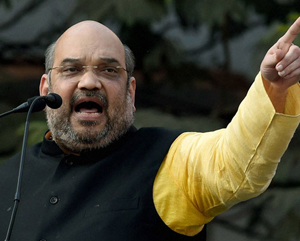
More lynching incidents happened under previous govts: Shah

Agencies
July 2, 2017

Panaji, Jul 2: BJP president Amit Shah has said that more incidents of lynching had occurred during the previous governments than during the three years of NDA rule, but no one had raised questions then.amitt

"I do not want to compare and undermine the current incidents of lynching. I am also serious about it. But there have been more lynching incidents in 2011, 2012 and 2013," Shah told a gathering of professionals in Goa last evening.

"There have been more lynchings each year in the past, compared to the total lynching incidents that have happened during our three-year-long tenure," the BJP leader said. The BJP-led government came to power at the Centre in May 2014.

Responding to a question about fears over the lynching incidents, he said there was no apprehension anywhere in the country.

"Do you know of any such incident where arrests have not been made? I do not have any answer to apprehensions. There is no apprehension anywhere in the country," he said.

Maintaining that law and order was a state subject, Shah said when Mohammad Akhlaq died, the Samajwadi Party-led government was in power in Uttar Pradesh, and it was its responsibility.

"But protests are held in Delhi in front of the Narendra Modi government. What is this fashion," he asked.

In September 2015, Akhlaq was dragged out of his house and killed by a mob at Dadri in UP on suspicion of storing and consuming beef.

Following several such lynching incidents, including those in Jharkhand, Haryana and UP, protests were held late last month at several cities across the country.

Comments

Ranjan shetty
 - 
Thursday, 6 Jul 2017

Chutiya bangladeshisare attacking Hindus in WB, where are those SOB's who did rally in the name of #notin my name ?

Umar Ashfaq
 - 
Thursday, 6 Jul 2017

Please qidmat k mauka de guzarish hogi

ABDUL AZIZ
 - 
Thursday, 6 Jul 2017

hang them till death , sharia law

Abdullah
 - 
Sunday, 2 Jul 2017

But who killed them????
You and your goons only.

Rikaz
 - 
Sunday, 2 Jul 2017

do not compare with previous government, it is your job to eliminate all sort of lynching around....take action on all who committed it as of now and make sure that it will not happen again....why it is happening only on muslims....there are people eating beef from other community.... and beef export factories exporting beef everyday basis with no problems...if you have guts stop it....

Thoushi
 - 
Sunday, 2 Jul 2017

True lynching was happening in previous government also and before since Gandhi's assassination , but Mr. Cha most all lynching was carried out by your OWN associated party(BJP) and wings (RSS)

Add new comment

  • Coastaldigest.com reserves the right to delete or block any comments.
  • Coastaldigset.com is not responsible for its readers’ comments.
  • Comments that are abusive, incendiary or irrelevant are strictly prohibited.
  • Please use a genuine email ID and provide your name to avoid reject.
News Network
January 13,2020

Jan 13: For the first time in years, the government of India’s Prime Minister Narendra Modi is playing defense. Protests have sprung up across the country against an amendment to India’s laws — which came into effect on Friday — that makes it easier for members of some religions to become citizens of India. The government claims this is simply an attempt to protect religious minorities in the Muslim-majority countries that border India; but protesters see it as the first step toward a formal repudiation of India’s constitutionally guaranteed secularism — and one that must be resisted.

Modi was re-elected prime minister last year with an enhanced majority; his hold over the country’s politics is absolute. The formal opposition is weak, discredited and disorganized. Yet, somehow, the anti-Citizenship Act protests have taken hold. No political party is behind them; they are generally arranged by student unions, neighborhood associations and the like.

Yet this aspect of their character is precisely what will worry Modi and his right-hand man, Home Minister Amit Shah. They know how to mock and delegitimize opposition parties with ruthless efficiency. Yet creating a narrative that paints large, flag-waving crowds as traitors is not quite that easy.

For that is how these protests look: large groups of young people, many carrying witty signs and the national flag. They meet and read the preamble to India’s Constitution, into which the promise of secularism was written in the 1970’s.

They carry photographs of the Constitution’s drafter, the Columbia University-trained economist and lawyer B. R. Ambedkar. These are not the mobs the government wanted. They hoped for angry Muslims rampaging through the streets of India’s cities, whom they could point to and say: “See? We must protect you from them.” But, in spite of sometimes brutal repression, the protests have largely been nonviolent.

One, in Shaheen Bagh in a Muslim-dominated sector of New Delhi, began simply as a set of local women in a square, armed with hot tea and blankets against the chill Delhi winter. It has now become the focal point of a very different sort of resistance than what the government expected. Nothing could cure the delusions of India’s Hindu middle class, trained to see India’s Muslims as dangerous threats, as effectively as a group of otherwise clearly apolitical women sipping sweet tea and sharing their fears and food with anyone who will listen.

Modi was re-elected less than a year ago; what could have changed in India since then? Not much, I suspect, in most places that voted for him and his party — particularly the vast rural hinterland of northern India. But urban India was also possibly never quite as content as electoral results suggested. India’s growth dipped below 5% in recent quarters; demand has crashed, and uncertainty about the future is widespread. Worse, the government’s response to the protests was clearly ill-judged. University campuses were attacked, in one case by the police and later by masked men almost certainly connected to the ruling party.

Protesters were harassed and detained with little cause. The courts seemed uninterested. And, slowly, anger began to grow on social media — not just on Twitter, but also on Instagram, previously the preserve of pretty bowls of salad. Instagram is the one social medium over which Modi’s party does not have a stranglehold; and it is where these protests, with their photogenic signs and flags, have found a natural home. As a result, people across urban India who would never previously have gone to a demonstration or a political rally have been slowly politicized.

India is, in fact, becoming more like a normal democracy. “Normal,” that is, for the 2020’s. Liberal democracies across the world are politically divided, often between more liberal urban centers and coasts, and angrier, “left-behind” hinterlands. Modi’s political secret was that he was that rare populist who could unite both the hopeful cities and the resentful countryside. Yet this once magic formula seems to have become ineffective. Five of India’s six largest cities are not ruled by Modi’s Bharatiya Janata Party in any case — the financial hub of Mumbai changed hands recently. The BJP has set its sights on winning state elections in Delhi in a few weeks. Which way the capital’s voters will go is uncertain. But that itself is revealing — last year, Modi swept all seven parliamentary seats in Delhi.

In the end, the Citizenship Amendment Act is now law, the BJP might manage to win Delhi, and the protests might die down as the days get unmanageably hot and state repression increases. But urban India has put Modi on notice. His days of being India’s unifier are over: From now on, like all the other populists, he will have to keep one eye on the streets of his country’s cities.

Comments

Add new comment

  • Coastaldigest.com reserves the right to delete or block any comments.
  • Coastaldigset.com is not responsible for its readers’ comments.
  • Comments that are abusive, incendiary or irrelevant are strictly prohibited.
  • Please use a genuine email ID and provide your name to avoid reject.
News Network
January 30,2020

New Delhi, Jan 30: Tension spiralled in Jamia Nagar on Thursday after a man fired a pistol at a group of anti-CAA protesters, injuring a Jamia Millia Islamia student before walking away while waving the firearm above his head and shouting "Yeh lo aazadi" amid heavy police presence in the area.

Massive protests erupted in the area after the incident with hundreds of agitated people gathering near the university, breaking barricades and clashing with police personnel.

The man, who identified himself as "Rambhakt Gopal", was subsequently overpowered by police and detained. He was taken into custody and was being interrogated, police said.

The entire drama, which triggered panic in the area, was captured by television cameras that showed the man in light coloured pants and a dark jacket, walking away on an empty road barricaded by police, turning around and shouting at the protesters in Hindi, "Here, take this freedom."

The gunman went live on Facebook before the brandishing the gun. Police said they were verifying whether it is his real name.

Before the attack, the man also put out messages on Facebook stating "Shaheen Bhag Khel Khatam" (Run Shaheen, the game is over). Another message stated, "Please wrap me in saffron in my last journey with slogans of Jai Shri Ram". His Facebook profile was deleted after screenshots of his posts were circulated widely on social media platforms.

Several students recapped how their peaceful march on Gandhi's death anniversary became violent.

"We were moving towards the Holy Family Hospital where the police had raised barricades. Suddenly, a gun-wielding man came out and opened fire. One bullet hit my friend's hand," Aamna Asif, a student of economics at the university, told PTI.

She said her friend, Shadab Farooq, a mass communication student, was trying to calm the attacker but he shot at him injuring his left hand.

Farooq, who belongs to Kashmir, was taken to the AIIMS Trauma Centre.

Ragibh Naushad, an LLB student at the university, said, "The Jamia Coordination Committee organised a march to pay homage to Gandhi ji on his death anniversary. It started at 12 noon from Gate number 7, but police denied the permission and stopped the march near the Holy Family hospital.

"A man named Gopal, came there and started brandishing a weapon and later shot a round. He was also chanting pro-CAA slogans."

The incident led to panic in the area.

Khalid Hassan, a JMI alumnus, said initially many were not sure whether it was a gunshot or a tyre burst.

There was heavy police and media presence when the incident took place.

The students were heading from Jamia to Mahatma Gandhi's memorial Rajghat. The march was stopped at the Holy Family Hospital near the university.

Chinmoy Biswal, DCP (southeast), said the students wanted to take out a march from Jamia to Rajghat but were denied permission.

"They were being repeatedly told that the protest should be carried out peacefully. We had barricaded the road just before the Holy Family hospital. Meanwhile, a person was seen in the crowd who waved something which appeared to be a weapon."

"We have detained him and are interrogating him. One person has also been injured," Biswal said.

Comments

Add new comment

  • Coastaldigest.com reserves the right to delete or block any comments.
  • Coastaldigset.com is not responsible for its readers’ comments.
  • Comments that are abusive, incendiary or irrelevant are strictly prohibited.
  • Please use a genuine email ID and provide your name to avoid reject.
Agencies
January 11,2020

New Delhi, Jan 11: Chief Minister of Kerala Pinarayi Vijayan on Saturday met JNU Students' Union (JNUSU) President Aishe Ghosh here at Kerala House on Saturday.

This meeting comes at the backdrop masked mob violence by miscreants who entered the university campus recently and attacked the students and professors with sticks and rods.

"I thank the Kerela government for standing by us and extending solidarity. Its fight Citizenship Amendment Act (CAA) shows how standing is standing for its secular ethos. Students Union takes the inspiration from this struggle," said Students' Union President in a statement after meeting Kerala CM.

She also thanked "the youth and comrades of Kerela" and quoted Pinarayi as saying, "go on we will take this fight ahead."

More than 30 students, including Ghosh, were taken to the AIIMS Trauma Centre.

The Delhi Police Crime Branch investigating the case of violence in JNU had identified and released photographs of nine suspects, including that of Aishe Ghosh.

Earlier on Monday, Kerala CM had said that the "Nazi-style attack" on the students and faculty is an appalling display of intolerance running amok.

Comments

Add new comment

  • Coastaldigest.com reserves the right to delete or block any comments.
  • Coastaldigset.com is not responsible for its readers’ comments.
  • Comments that are abusive, incendiary or irrelevant are strictly prohibited.
  • Please use a genuine email ID and provide your name to avoid reject.