


President, Sonia express concern over lynching incidents

Agencies
July 2, 2017

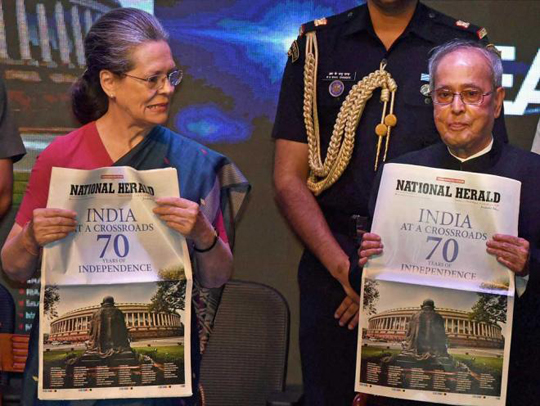
New Delhi, Jul 2: President Pranab Mukherjee joined Congress president Sonia Gandhi in expressing serious concern over growing number of mob lynching cases in India, wondering whether the society is vigilant enough to save the basic tenets of the country.
sonia

“When mob lynching becomes so high and uncontrollable, we have to pause and reflect, are we vigilant enough?,” Mukherjee said at the release of commemorative publication of relaunched National Herald here.

Sonia Gandhi, who spoke at the function, said, "It is being encouraged by a culture of vigilante violence, actively supported by those who are supposed to enforce the law."

Later, Priyanka Gandhi Vadra, daughter of the Congress president, told reporters that "It (incident of lynching) makes my blood boil. It should make blood of every Indian boil."

Mukherjee's comment and Sonia Gandhi's criticism came in the wake of reports about the spiralling violence over beef.

Mukherjee, who retires later this month, said, "When mob frenzy becomes so high, irrational and uncontrollable, we have to pause and reflect. I am not talking of vigilantism, I am talking of are we vigilant enough, proactively to save the basic tenets of our country.”

He said, "I do believe that citizens' and media vigilance can act as the biggest deterrent to forces of darkness and backwardness."

Congress president Sonia Gandhi said India is being marked by increasing threats of 'authoritarianism.'

She said, "Today the tried and tested idea of India has been thrown fundamentally into question by rising intolerance, by malevolent forces. It is being encouraged by a culture of vigilantive violence, actively supported by those who are supposed to enforce the law."

Gandhi further said that National Herald newspaper, which has been revived, is a testament to unity and justice and "not the division and hate that the present times are witnessing.

She said, "We are in a war of ideas, we have reached this war to preserve our ideas, which have built India as a model of democracy diversity and coexistence.if we don't raise our voices, if we do not speak up, our voices will be taken as consent."

A day after nationwide protests against lynchings spilt onto the streets, Modi had on Thursday broke his silence at Sabarmati Ashram in Gujarat and said killing people in the name of gau bhakti (devotion to the cow) is not acceptable.

The PM also said Mahatma Gandhi would not have approved of it and that no person in the country has the right to take the law into his own hands.

However, Modi's warning seemed to have had a little effect as just hours after his speech, Alimuddin, a meat trader, was lynched in Jharkhand’s Ramgarh.

Many cities witnessed protests across various locations under the tagline “Not in My Name” to protest against the lynching of 15-year-old Junaid Khan in a Mathura-bound train last week.

Comments

AK
 - 
Thursday, 6 Jul 2017

Thats VERY VERY GOOD .. Many families will give blessing to siddaramaiah...

Only Drunkards will not be happy with the closer.

Abdullah
 - 
Sunday, 2 Jul 2017

Worst President and opposition party ever faced in India.

Add new comment

  • Coastaldigest.com reserves the right to delete or block any comments.
  • Coastaldigset.com is not responsible for its readers’ comments.
  • Comments that are abusive, incendiary or irrelevant are strictly prohibited.
  • Please use a genuine email ID and provide your name to avoid reject.
News Network
April 1,2020

Thiruvananthapuram, Apr 1: A day after the Kerala Government issued orders to provide special alcohol passes on doctor's prescription to tipplers, who exhibit withdrawal symptoms, the Excise Department received 40 applications from across the state.

Speaking to ANI, a Senior Excise Official said, "Around 40 people approached us with doctor's prescriptions to get liquor passes across the State. We will forward it to Beverages Corporation and they will conduct home delivery of liquor."

Ernakulam topped the list with eight applications, while Kottayam Excise Office received four and Thiruvananthapuram office received three applications.

"As per the notification we received, a maximum of three litre of alcohol can be provided in a week for a person. For availing liquor again they will have to submit fresh application for the liquor pass," the official added.

An order in this regard was issued by the government on Monday night which outlines the necessary steps to be taken by a person with withdrawal symptoms to purchase alcohol.

As per the order, any individual with a prescription from a government doctor or a doctor from a Taluk hospital or government hospital, where the doctor mentions the patient's "Alcohol Withdrawal Symptoms" can submit the prescription for alcohol to the nearest Excise Range office.

A form also has been provided which should be duly filled to get the liquor pass. The Excise Department after the scrutiny may allow the person to buy Indian Made Foreign Liquor (IMFL) from the beverages corporation.

However, the Kerala Government Medical Officers Association (KGMOA) came out against the order, saying that doctors affiliated with the organisation will not give a prescription for liquor. Further, in a statement issued they said they are observing a 'black day' on Wednesday in protest against the government move.

The Indian Medical Association (IMA) also had termed the direction by the Kerala government 'unscientific' and said doctors had no legal obligation to prescribe alcohol.

After the liquor ban was enforced in view of the lockdown, Kerala has witnessed a number of suicide cases allegedly connected with withdrawal symptoms.

Announcing the decision Kerala Chief Minister Pinarayi Vijayan had also mentioned that the government was issuing such a direction following reports of people developing suicidal tendencies due to the unavailability of alcohol.

Comments

Add new comment

  • Coastaldigest.com reserves the right to delete or block any comments.
  • Coastaldigset.com is not responsible for its readers’ comments.
  • Comments that are abusive, incendiary or irrelevant are strictly prohibited.
  • Please use a genuine email ID and provide your name to avoid reject.
Agencies
May 23,2020

New Delhi, May 23: The nationwide lockdown will no longer help India in its fight against COVID-19, and in its place community-driven containment, isolation and quarantine strategies have to be brought into play, leading virologist Shahid Jameel said.

The recipient of Shanti Swarup Bhatnagar Prize for Science and Technology also stressed that testing should be carried out vigorously to identify coronavirus hotspots and isolate those areas.

"Our current testing rate at 1,744 tests per million population is one of the lowest in the world. We should deploy both antibody tests and confirmatory PCR tests. This will tell us about pockets of ongoing infection and past (recovered) infection. This will provide data to open up gradually and let economic activity resume," Jameel told PTI in an interview.

He stressed that testing has to be dynamic to continuously monitor red, orange and green zones and change these based on that data.

About community transmission of COVID-19 in India, Jameel said the country reached that stage long ago.

"We reached community transmission a long time ago. It's just that the health authorities are not admitting it. Even ICMR's own study of SARI (severe acute respiratory illness) showed that about 40 per cent of those who tested positive for SARS-CoV-2 did not have any history of overseas travel or contact to a known case. If this is not community transmission, then what is?" he posed.

Lockdown bought India time in its fight against coronavirus, but continuing it is unlikely to yield any further dividend, Jameel said.

"Instead, community-driven local lockdowns, isolations and quarantines have to come into play. Building trust is most important so that people follow rules. A public health problem cannot be dealt with as a law-and-order problem."

The nationwide lockdown, initially imposed from March 25 to April 14, has been extended thrice and will continue at least till May 31. The virus has claimed 3,720 lives and infected over 1.25 lakh people in the country so far.

Jameel has expertise in the fields of molecular biology, infectious diseases, and biotechnology. He is the CEO of Wellcome Trust/Department of Biotechnology's India Alliance and is best known for extensive research in Hepatitis E virus and HIV.

He said COVID-19 will eventually be controlled through herd immunity, which is acquired in two ways – when a sufficient fraction of the population gets infected and recovers, and with vaccination.

"It is estimated that for SARS-CoV-2 at least 60 per cent of the population would have to be infected and recovered, or vaccinated. This will happen over the course of the next few years," Jameel said.

Herd immunity is reached when the majority of a population becomes immune to an infectious disease, either because they have become infected and recovered, or through vaccination. When that happens, the disease is less likely to spread to people who aren't immune, because there just aren't enough infectious carriers.

"India has 1.38 billion people, a population density of about 400/sq km and a healthcare system ranked at 143 in the world. If we allow 60 per cent people to get infected quickly in the hopes of herd immunity, that would mean 830 million infections," Jameel said.

"If 15 per cent need hospitalization that means about 125 million isolation beds (we have 0.3 million). If five per cent need oxygen and ventilatory support, this amounts to about 42 million oxygen support and ICU beds; we have 0.1 million oxygen support beds and 34,000 ICU beds. This would overwhelm the healthcare system causing mayhem," he said.

Jameel said if the population level mortality is 0.5 per cent that would mean 40 lakh deaths. "Are we prepared to pay this price for herd immunity in the short term? Clearly not," he said.

He said it is unlikely that a vaccine would be available by the end of the year.

"Even then, we don't know yet how long it would give protection – weeks, months, one year, a few years? I don't think we will return to pre-coronavirus days for at least the next 3-5 years. This is also a chance to evaluate if we want to return to those unsustainable, environment-damaging ways. COVID-19 is a timely warning to reform our way of living," he said.

Jameel said it is hard to predict but plausible that COVID-19 would return in second or third wave.

"Later waves come when we don't understand the disease and become lax. A comparison to Spanish Flu is not entirely valid because in 1918 no one knew what caused it. No one had seen a virus till the mid-1930s as the electron microscope needed to view those was invented in 1931," he said.

"Today we know a lot more about the pathogen, its genetic makeup, how it transmits and how to prevent it. We need to be sensible and follow expert advice," he said.

If there is any scientific evidence linking deforestation, rapid urbanisation, climate change with pandemics like COVID-19, he said zoonotic viruses -- those that jump from animals to humans -- happen so when wild animal–human contacts increase.

"Deforestation destroys animal habitats bringing them closer to humans. When you cut forests, bats come to roost on trees closer to human habitations. Their viruses in secretions/stool get transmitted to domestic animals and on to humans. This happened clearly with Nipah virus outbreak in Malaysia in 1997-98 from fruit bats to pigs to humans," he said.

"COVID-19 possibly arose in wet animal markets due to dietary habits that bring all kinds of live and dead wild animals in close contact with humans," Jameel added.

Comments

Add new comment

  • Coastaldigest.com reserves the right to delete or block any comments.
  • Coastaldigset.com is not responsible for its readers’ comments.
  • Comments that are abusive, incendiary or irrelevant are strictly prohibited.
  • Please use a genuine email ID and provide your name to avoid reject.
News Network
February 28,2020

Patna, Feb 28: Social and cultural activists from far and wide converged here on Thursday to lend their support to a massive rally that marked the conclusion of Kanhaiya Kumar's 'Jan Gan Man Yatra' across Bihar to galvanise public opinion against CAA-NPR-NRC.

Medha Patkar of the Narmada Bachao Andolan fame, Mahatma Gandhi's grandson Tushar Gandhi and former IAS officer Kannan Gopinathan, who gave up his career at a young age in protest against abrogation of Article 370, shared the stage with the former JNU students' leader.

Shabnam Hashmi -- founder of socio-cultural organisation ANHAD and sister of slain Marxist playwright and director Safdar Hashmi -- also joined them.

Congress MLA Shakil Ahmed Khan, a former president of JNU students' union himself who accompanied Kanhaiya during his tour that commenced at Champaran on January 30, Mahatma Gandhi's death anniversary, and leaders of state units of CPI and CPI(M) also addressed the rally held at Gandhi Maidan.

Kanhaiya began his speech with a one-minute silence held in the memory of those who lost their lives in Delhi violence.

Defending his frequent use of the term "azadi" (freedom) which supporters of the Sangh Parivar hold to be tantamount to supporting secession, Kanhaiya said, "We must talk about the virtues of azadi here since today happens to be the day when legendary revolutionary Chandrashekhar Azad had given up his life fighting the British."

Charging the ruling BJP with pitting Hindus against Muslims, he said, "Let us resolve to defeat their agenda by emulating the fabled friendship of Ram Prasad Bismil and Ashfaqullah Khan."

The young CPI leader, who made an unsuccessful debut from his native Begusarai Lok Sabha constituency last year, seemed unimpressed with the resolution passed by the Bihar Assembly earlier this week against NRC and inclusion of contentious clauses in NPR forms.

"Both the government and the opposition are busy congratulating themselves. I extend my congratulations as well. But to all those who are present here, I would say it is a half-victory. We must not allow our movement to fizzle out and draw inspiration from Gandhi's model of civil disobedience when the NPR exercise gets underway," he said.

"Villagers should ask their respective panchayat heads to ensure that no NPR official is allowed to come knocking in their areas of jurisdiction when NPR is scheduled to be undertaken in May," the CPI leader said.

"We have to brace for a long and tough fight. We are living under a regime which sends conscientious professionals like Dr Kafeel Ahmed behind the bars and declares anybody questioning its actions as an anti-national," said Kanhaiya, who has himself been slapped with a sedition case.

Earlier, in his address, Tushar Gandhi likened CAA, NPR and NRC to the "three bullets that killed the Mahatma" and asserted that these measures would "harm the poor, belonging to all religious communities and not just the Muslims".

"If the government does not care about the poor, we must tell those in power -- 'chale jaao' (go away) just as we had done to the British colonisers... it is going to be a long fight. Independence was achieved five years after the call for Quit India Movement," he said.

"We need to keep repeating the importance of non-violence over and over again while those with other value systems simply have to utter inciting statements," he said, in an oblique reference to the controversial poll campaign of Union minister and BJP leader Anurag Thakur during the recently-held Delhi Assembly elections, which the party lost.

Kannan Gopinathan said, "The claim that CAA is all about granting citizenship and not taking it away is bunkum. Any law which seeks to favour one section of the society on the basis of religion can be tweaked to harm another social segment... people say this government is Fascist. I am not sure of that but it is certainly stupid."

"This government brought in demonetisation and wrecked the economy but failed to achieve its promise of eradicating black money. It abrogated Article 370 and now it is clueless as to what to do with the situation in Kashmir," he said.

"Union minister Amit Shah had declared in Parliament that NRC will be implemented. Faced with public resistance, Prime Minister Narendra Modi had to say he does not know what NRC is. Keep up the stir for a little longer, he will start saying he does not know Amit Shah," said Kannan, evoking peals of laughter.

In the course of his speech, Kanhaiya also made the crowds sing after him the National Anthem but skipped a few words towards the end. Participants at the rally were viciously trolled on social media for the slip-up.

Comments

Add new comment

  • Coastaldigest.com reserves the right to delete or block any comments.
  • Coastaldigset.com is not responsible for its readers’ comments.
  • Comments that are abusive, incendiary or irrelevant are strictly prohibited.
  • Please use a genuine email ID and provide your name to avoid reject.