President, Sonia express concern over lynching incidents

Agencies
July 2, 2017

New Delhi, Jul 2: President Pranab Mukherjee joined Congress president Sonia Gandhi in expressing serious concern over growing number of mob lynching cases in India, wondering whether the society is vigilant enough to save the basic tenets of the country.
sonia

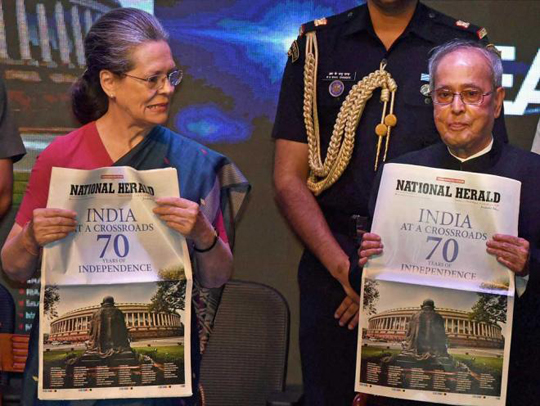
“When mob lynching becomes so high and uncontrollable, we have to pause and reflect, are we vigilant enough?,” Mukherjee said at the release of commemorative publication of relaunched National Herald here.

Sonia Gandhi, who spoke at the function, said, "It is being encouraged by a culture of vigilante violence, actively supported by those who are supposed to enforce the law."

Later, Priyanka Gandhi Vadra, daughter of the Congress president, told reporters that "It (incident of lynching) makes my blood boil. It should make blood of every Indian boil."

Mukherjee's comment and Sonia Gandhi's criticism came in the wake of reports about the spiralling violence over beef.

Mukherjee, who retires later this month, said, "When mob frenzy becomes so high, irrational and uncontrollable, we have to pause and reflect. I am not talking of vigilantism, I am talking of are we vigilant enough, proactively to save the basic tenets of our country.”

He said, "I do believe that citizens' and media vigilance can act as the biggest deterrent to forces of darkness and backwardness."

Congress president Sonia Gandhi said India is being marked by increasing threats of 'authoritarianism.'

She said, "Today the tried and tested idea of India has been thrown fundamentally into question by rising intolerance, by malevolent forces. It is being encouraged by a culture of vigilantive violence, actively supported by those who are supposed to enforce the law."

Gandhi further said that National Herald newspaper, which has been revived, is a testament to unity and justice and "not the division and hate that the present times are witnessing.

She said, "We are in a war of ideas, we have reached this war to preserve our ideas, which have built India as a model of democracy diversity and coexistence.if we don't raise our voices, if we do not speak up, our voices will be taken as consent."

A day after nationwide protests against lynchings spilt onto the streets, Modi had on Thursday broke his silence at Sabarmati Ashram in Gujarat and said killing people in the name of gau bhakti (devotion to the cow) is not acceptable.

The PM also said Mahatma Gandhi would not have approved of it and that no person in the country has the right to take the law into his own hands.

However, Modi's warning seemed to have had a little effect as just hours after his speech, Alimuddin, a meat trader, was lynched in Jharkhand’s Ramgarh.

Many cities witnessed protests across various locations under the tagline “Not in My Name” to protest against the lynching of 15-year-old Junaid Khan in a Mathura-bound train last week.

Comments

AK
 - 
Thursday, 6 Jul 2017

Thats VERY VERY GOOD .. Many families will give blessing to siddaramaiah...

Only Drunkards will not be happy with the closer.

Abdullah
 - 
Sunday, 2 Jul 2017

Worst President and opposition party ever faced in India.

Add new comment

  • Coastaldigest.com reserves the right to delete or block any comments.
  • Coastaldigset.com is not responsible for its readers’ comments.
  • Comments that are abusive, incendiary or irrelevant are strictly prohibited.
  • Please use a genuine email ID and provide your name to avoid reject.
News Network
May 21,2020

United Nations, May 21: At least 19 million children in parts of Bangladesh and India are at "imminent risk" from flash flooding and heavy rain as Cyclone Amphan makes landfall and the state of West Bengal is expected to take a direct hit from the powerful storm, the UN's children agency has warned.

The extremely severe cyclonic storm Amphan made a landfall at Digha in West Bengal and Bangladesh on Wednesday, leaving a trail of destruction. At least three persons were killed in India and seven in Bangladesh.

The UNICEF said that at least 19 million children in parts of Bangladesh and India are at “imminent risk from flash flooding, storm surges and heavy rain as Cyclone Amphan makes landfall.”

West Bengal, “home to more than 50 million people, including over 16 million children, is expected to take a direct hit from the powerful storm,” the UN agency said in a statement on Wednesday.

The UNICEF said it is also very concerned that the COVID-19 could deepen the humanitarian consequences of Cyclone Amphan in both the countries. Evacuees who have moved to crowded temporary shelters would be especially vulnerable to the spread of respiratory diseases like COVID-19, as well as other infections.

“We continue to monitor the situation closely,” said UNICEF Regional Director for South Asia Jean Gough.

“The safety of children and their families in the areas that will be impacted is a priority and it is good to see that the authorities have planned their urgent response factoring in the on-going COVID-19 pandemic.”

Across the region, the UNICEF is “working closely with the governments of Bangladesh and India and stands ready to support humanitarian operations to reach children and families affected by Cyclone Amphan.”

Based on the storm’s current trajectory, Cox’s Bazar in Bangladesh – now sheltering over 850,000 Rohingya refugees – is likely to experience high winds and heavy rains which may cause damage to homes and shelters in the refugee camps and Bangladeshi communities. This population is already highly vulnerable and cases of COVID-19 have recently been confirmed in the camps and host communities.

The UNICEF said it is working with the Deputy Commissioner’s Office in Cox’s Bazar, the Office of the Refugee Relief and Repatriation Commissioner, and humanitarian partners to help ensure Bangladeshi and Rohingya children and families remain protected.

These efforts include raising awareness among Rohingya and Bangladeshi communities on cyclone preparedness and prepositioning emergency life-saving water, sanitation, hygiene and medical supplies to meet immediate humanitarian needs.

Meanwhile, UN Secretary-General Antonio Guterres’ spokesperson Stephane Dujarric said at the daily press briefing that UN teams on the ground continue to work with the Government of Bangladesh to prepare and support those in need in the wake of the cyclone.

“Given the current pandemic, this support includes distributing personal protective equipment, disinfectants and other materials to evacuation shelters. To reduce the person-to-person contact during the delivery of aid, e-cash distributions will be used,” he said adding that the UN along with its partners is mobilising more than 1,700 mobile health teams and preparing for emergency food deliveries.

“The Super Cyclone is taking a westerly trajectory towards India, but nearly 8 million people in Bangladesh remain at risk,” he said adding that the Bangladesh government has evacuated more than 2 million people in high-risk areas. 

Comments

Add new comment

  • Coastaldigest.com reserves the right to delete or block any comments.
  • Coastaldigset.com is not responsible for its readers’ comments.
  • Comments that are abusive, incendiary or irrelevant are strictly prohibited.
  • Please use a genuine email ID and provide your name to avoid reject.
News Network
January 6,2020

Jan 6: Senior Bharatiya Janata Party leader Subramanian Swamy on Sunday said the country's economy is not showing good signs though Prime Minister Narendra Modi has manifested tremendous leadership skills in fighting terror and in social welfare projects.

The fiscal decisions of the government have not yielded the desired results, the Rajya Sabha MP said here.

"Modi had shown tremendous leadership skill in fighting terror, in several social areas, micro areas like bringing toilets to every village home. But the economy is a complex system...," he said while taking part in a discussion.

While every minister is talking about a 5 trillion dollar economy by 2024, but the current GDP growth has to be multiplied in four years to achieve that, the former Union minister said.

He said, if wages are slashed as a measure to cope with the situation, labor will become cheap but that will also cut down the people's purchasing power triggering dip in demand, closing down factories and rise in unemployment.

"This is one problem for which you really need an economist," he said.

Swamy said in jest, "I think Modi has one problem with me. Not only I am an economist but also a politician."

Comments

Add new comment

  • Coastaldigest.com reserves the right to delete or block any comments.
  • Coastaldigset.com is not responsible for its readers’ comments.
  • Comments that are abusive, incendiary or irrelevant are strictly prohibited.
  • Please use a genuine email ID and provide your name to avoid reject.
Agencies
July 29,2020

New Delhi, Jul 29: The new National Education Policy (NEP) approved by the Union Cabinet on Wednesday is set to usher in a slew of changes with the vision of creating an education system that contributes directly to transforming the country, providing high-quality education to all, and making India a global knowledge superpower.

The draft of the NEP by a panel headed by former Indian Space Research Organisation (ISRO) chief Kasturirangan and submitted to the Union Human Resource Development Minister Ramesh Pokhriyal when he took charge last year. The new NEP replaces the one formulated in 1986.

Some of the key highlights of the New Education Policy are:-

The policy aims to enable an individual to study one or more specialized areas of interest at a deep level, and also develop character, scientific temper, creativity, spirit of service, and 21st century capabilities across a range of disciplines including sciences, social sciences, arts, humanities, among others.

It identified the major problems facing the higher education system in the country and suggested changes such as moving towards multidisciplinary universities and colleges, with more institutions across India that offer medium of instruction in local/Indian languages, a more multidisciplinary undergraduate education, among others. 

The governance of such institutions by independent boards having academic and administrative autonomy has also been suggested.

Under the suggestions for institutional restructuring and consolidation, it has suggested that by 2040, all higher education institutions (HEIs) shall aim to become multidisciplinary institutions, each of which will aim to have 3,000 or more students, and by 2030 each or near every district in the country there will be at least one HEI.

The aim will be to increase the Gross Enrolment Ratio in HEIs including vocational education from 26.3 per cent (2018) to 50 per cent by 2035.

Single-stream HEIs will be phased out over time, and all will move towards becoming vibrant multidisciplinary institutions or parts of vibrant multidisciplinary HEI clusters.

It also pushes for more holistic and multidisciplinary education to be provided to the students.

Comments

Add new comment

  • Coastaldigest.com reserves the right to delete or block any comments.
  • Coastaldigset.com is not responsible for its readers’ comments.
  • Comments that are abusive, incendiary or irrelevant are strictly prohibited.
  • Please use a genuine email ID and provide your name to avoid reject.