



Haryana govt magazine praises veil, sparks row

Agencies
June 28, 2017

Chandigarh, Jun 28: A photo caption in a Haryana government magazine describing 'ghoonghat' (veil) as the "identity of the State" has sparked a controversy, with the opposition saying it reflected the "regressive" mindset of the BJP government.veil
However, senior Minister Anil Vij dismissed the opposition charge, saying that BJP government had taken a number of steps for women empowerment and was not endorsing that women should be forced to keep a 'ghoongat'.

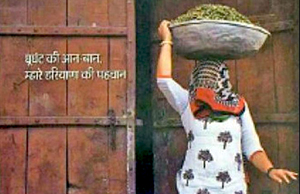
The recent issue of Krishi Samvad, a supplement of the Haryana Samvad magazine, a monthly magazine published by the State government, carries a photograph of a veiled woman.

The woman's face can be seen covered with a 'ghoongat'. The woman is seen carrying cattle feed on her head, even as the caption reads: "Ghoongat kiaan-baan, mahra Haryana kipechchan (pride of the veil is the identity of my Haryana".

The front cover of the magazine carries the photo of Chief Minister Manohar Lal Khattar.

Reacting sharply to the description, former Chief Minister Bhupinder Singh Hooda and senior Congress leader and party spokesperson Randeep Surjewala said it reflected the regressive attitude of the ruling BJP government.

"This shows regressive mindset of the BJP government. Women from Haryana are ahead in every field. Just three days back, a young woman from the state was crowned as Miss India. Girls from the state have made a mark in sports arena and other fields. India-born US astronaut late Kalpana Chawla hailed from Haryana," Hooda said.

Recently, Haryana girl Manushi Chhillar was crowned Femina Miss India 2017.

"Women wearing veil was not the original culture of Haryana. This practice started only after foreign invasions and because of the fear of invaders. In south India, there was no 'purdah' system. Therefore, what I want to say is that BJP government wants to move back in time rather than thinking ahead and taking the state forward," he said.

Surjewala said it was a "regressive mindset and objectification of women, which is part of the DNA of the BJP".

"The BJP government has failed to realise that Haryana girls and women have excelled in fields such as space science, sports and the armed forces to name just a few," Surjewala said.

Dismissing the opposition criticism, Vij told PTI over phone, "What you are seeing in a government magazine should only be seen as what was Haryana's tradition. Nowhere are we saying that we want to force veil on women. We are in favour of women empowerment and we have done a lot in this regard".

He said the sex ratio has improved from 862 to 950 as a result of the steps taken by the state government.

"We are committed to women's education and have decided to open colleges for women after every 20 km. As regards the photo in the magazine, this has been the tradition in some parts of the state, but it is not binding.

"We are not forcing anyone to wear ghoongat. It is not like burqa and only those women who want to do ghoongat, it is as per their wish," Vij said.

Comments

Fairman
 - 
Wednesday, 28 Jun 2017

It seems that the BJP in Haryana seems to be protecting of women.

Why the goongat or veil is required. Just to segregate from male intervention. When there is no gender segregation, people take it for granted. They take easy in molester of ladies.
People commit these sins or crime whenever there is easy access for it.
Better prevent from beginning. It is not against empowerment of sign of uncivilization of women.

Add new comment

  • Coastaldigest.com reserves the right to delete or block any comments.
  • Coastaldigset.com is not responsible for its readers’ comments.
  • Comments that are abusive, incendiary or irrelevant are strictly prohibited.
  • Please use a genuine email ID and provide your name to avoid reject.
News Network
January 19,2020

Bengaluru, Jan 19: The Karnataka government has given its nod to teach 'Vivekadeepini' slokhas, authored by Adi Shankaracharya, in schools across the state, Chief Minister B S Yediyurappa said on Saturday.

At an event called 'Vivekadeepini Mahasamarpane,' organised by Vedanta Bharati, Yediyurappa said, "It has been noticed that Vivekadeepini, which evolves the mind and illumines a person, has a great effect on students.

Parents and teachers have found a positive change among children who were inspired by Vivekadeepini." "Hence, the government has given its nod to allow teaching Vivekadeepini in the schools in Karnataka," he added.

According to the organisers of the event, around two lakh children from 50 schools participated in the event where they were taught to chant Vivekadeepini, comprising verses for the seekers in the spiritual journey.

Yediyurappa reminded the audience that the Indian culture and civilisation is the oldest and the best, which they should feel proud of. Likening Amit Shah to the first union home minister Sardar Vallabhbhai Patel, he said, "After Sardar Vallabh Bhai Patel if we have seen a union home minister, it is Amit Shah, who has successfully resolved many burning issues of the countries within a few months.

"Shah succeeded in finding a permanent solution to Kashmir issue," Yediyurappa said.

Comments

Add new comment

  • Coastaldigest.com reserves the right to delete or block any comments.
  • Coastaldigset.com is not responsible for its readers’ comments.
  • Comments that are abusive, incendiary or irrelevant are strictly prohibited.
  • Please use a genuine email ID and provide your name to avoid reject.
coastaldigest.com news network
July 24,2020

Bengaluru, Jul 24: A government doctor who was turned away by three private hospitals because he could not produce a coronavirus test result passed away today in Bengaluru. Dr Manjunath, who was a frontline COVID-19 doctor, was allegedly turned away by hospitals when he was extremely ill and struggling to breathe.

Dr Manjunath worked in the state Health and Family Welfare department and was based in Ramanagara district, around 50 km from Bengaluru.

D Randeep, a Special Officer with the Bengaluru municipal body BBMP, said that the hospitals that had refused to admit Dr Manjunath would be reported to the health department.

In June-end, Dr Manjunath went to Rajashekhar Hospital in JP Nagar, BGS Global Hospital in Kengeri and Sagar hospital in Kumaraswamy Layout. All three demanded to see his COVID-19 test result but those were still not in at the time, according to his family. His brother-in-law Nagendra is also a doctor with BBMP and in charge of allotting hospital beds, yet he was completely helpless when it came to his own relative.

He was finally admitted to Sagar hospital on June 25 when his family sat in protest on the footpath outside the Dayananda Sagar campus. He was placed on ventilator and later shifted to the Bangalore Medical College and Research Institute, where he died earlier today. The hospital says Dr Manjunath was discharged on July 9 because he wanted plasma therapy.

Six members of his family, including a 14-year-old, tested COVID-19 positive. Most of them have recovered.

Bengaluru has seen several cases of patients being turned away from hospitals in the city. Hospitals say they need Covid test results to know whether to admit patients in the coronavirus ICU or in the general section and to understand treatment protocol.

Mr Randeep said hospitals have been instructed to admit patients even without such a certificate. Notices have been sent to hospitals that fail to comply. The OPD of two private hospitals was sealed for 48 hours when they refused to admit a patient.

Comments

Add new comment

  • Coastaldigest.com reserves the right to delete or block any comments.
  • Coastaldigset.com is not responsible for its readers’ comments.
  • Comments that are abusive, incendiary or irrelevant are strictly prohibited.
  • Please use a genuine email ID and provide your name to avoid reject.
News Network
February 28,2020

Bengaluru, Feb 28: Historian S. Shettar, 85, breathed his last early on February 28 in Bengaluru. He was suffering from respiratory problems and was hospitalised for over a week.

Shettar was known for his multi-disciplinary work, encompassing linguistics, epigraphy, anthropology, the study of religions and art history. He had extensively worked on the Jain practice of ritual death in Karnataka and Asoka edicts. He had studied and compiled early edicts in Kannada and worked extensively on the growth of Kannada language down the ages.

Born in 1935 at Hampasagara, Ballari district, he went on to study at Cambridge University and started his career as a Professor of History at Karnatak University, Dharwad, his alma mater. He later headed the National Museum Institute of the History of Art, Conservation and Museology in 1978 and Indian Council for Historical Research in 1996. He was also a visiting professor at the National Institute of Advanced Studies, Bengaluru.

He was a bilingual historian who wrote in English for most of his career, but started writing in Kannada in later years. In the last two decades, he developed a keen interest in linguistics and wrote multiple books on classical Kannada and Prakrit. His 2007 book “Shangam Tamilagam” is considered a seminal work in the study of the early period of Dravidian languages. It won him Bhasha Samman from Central Sahitya Akademi. He later wrote two works on Halegannada, classical Kannada. His most recent work was “Prakrita Jagadvalaya” in 2018.

Comments

Add new comment

  • Coastaldigest.com reserves the right to delete or block any comments.
  • Coastaldigset.com is not responsible for its readers’ comments.
  • Comments that are abusive, incendiary or irrelevant are strictly prohibited.
  • Please use a genuine email ID and provide your name to avoid reject.