


Khandwali mourns Junaid, wears black bands during Eid namaz

Agencies
June 26, 2017

Khandawali, Jun 26: As villagers today wore black bands to protest the killing of a Muslim youth onboard a Mathura-bound train, his elder brother, Hashim, struggled to come to terms with the reality that he would be celebrating this Eid without his sibling.
band

Despair hung like a shroud over Khandawali village, lying on the outskirts of the national capital, as the family and other locals remained in a state of shock over the brutal killing of their 17-year-old "son" Junaid.

The Muslim residents, who wore black bands during the special morning namaz today, said Eid has lost all its meaning and wondered if "the spate of lynchings" would ever end.

Junaid's father Jallaludin (55) told reporters that Eid would never be the same for the family.

Though prayers were offered in the morning, no Eid celebrations were held here. The villagers gathered around Jallaludin and other family members, consoling them in their hour of grief.

Reports stated that people also wore black bands at some other places, including Mewat, as a mark of protest against the horrific killing.

Junaid's cousin, Sanovar Khan, said they had posted about the protest on social media.

Hashim (20) broke down several times as he recalled the fateful Thursday evening when he along with his other siblings boarded the train from Delhi's Sadar Bazaar after finishing Eid shopping.

"They killed him in cold blood. All of a sudden, a group of 20-25 persons who had boarded the train from Okhla station pushed my brother Junaid and he fell down," he recalled, his voice choking with emotion.

"When Junaid and I asked why they were pushing, they pointed to the skull cap on my head. They said we are Muslims, anti-nationals, Pakistanis, that we eat beef. Then they pulled my cap, threw it down and they also tried to pull my beard," he said.

Jallaludin, while trying to console Hashim, dismissed the police's claim that Junaid was killed because of a dispute over the sharing of a seat.

"Junaid had, in fact, vacated a seat for an elderly person. The seat theory is being cooked up as an excuse. The incident is purely communal in nature and my son was targeted because of his religious identity," he said.

"We offered namaaz but we won't celebrate the festival. We want those responsible for our son's death to be punished," he said when asked about the 'black Eid' in the village.

Jallaludin, when asked if anyone from the Haryana government had met family yet, said, "Not even a lower rank official of the state government has visited us, what to say about the chief minister. We have not even heard anybody from the government condemning the incident."

The also villagers who sat in protest with the grieving family.

Shakeel, a resident of Khandawli in Ballabgarh near Delhi, told reporters, "We could not have celebrated Eid with the usual sense of joy considering how Junaid was killed. So we decided to mark our protest by wearing black bands around our arms."

"When will this stop? After every such incident, the government offers some compensation and people move on. But the question is, will it ever stop?" asked a villager in his 20s.

He also questioned the efficacy of the administration in acting against the accused, wondering why only one arrest had been made in four days.

The police had yesterday announced a reward of Rs one lakh for credible information leading to the arrest of other accused in the case.

The family was yesterday given a cheque for Rs 5 lakh by the District Red Cross while Wakf Board chairman announced another Rs 5 lakh and a job to one of Jallaludin's sons.

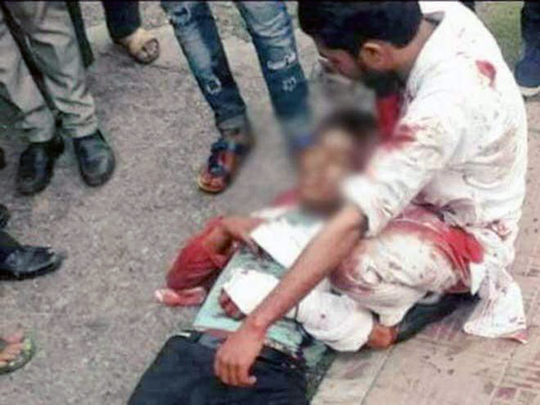
Junaid was stabbed to death while his brothers, Hashim and Sakir--were injured by a mob which also allegedly hurled slurs against them onboard the Delhi-Mathura passenger train between Ballabgarh and Mathura stations on Thursday night.

The arrested accused, before being remanded to police custody by a court in Faridabad district earlier, had told reporters that he was in an inebriated state at the time of the incident and attacked the teenager on being allegedly instigated by fellow passengers.

Also Read: Communal hate crime: Family in shock after 16-yr-old Hafiz-ul-Quran murdered on train

Comments

Mohammed Imran
 - 
Monday, 26 Jun 2017

Now time has came to unite and fight against such goons till our last breath. Will sacrifice for humanity, not be tolerate.

Unseen Baig
 - 
Tuesday, 27 Jun 2017

Suspect state sponsored actions to consolidate Hindu votes. Wondering if all Hindus accept this and throw alliance. Steadfastness and fear of Allah shall prevail against all these pseudo nationalist plans.

Ranjan shetty
 - 
Tuesday, 27 Jun 2017

what is so shocking in this ? it was a street brawl . they taunted and might have hurt hindu sentiments or eve teased Hindu women as it is in their blood .

Ahmed K.C.
 - 
Tuesday, 27 Jun 2017

Mohammed Imran, Udupi,
As soon as you start fighting against such goons, they will label you as 'Terrorist" and you know what happens after that?
According to them:-
One wearing skull cap is a Terrorist
One goes to Madrasa is a Terrorist
One reads Qur'an is a Terrorist
One with Islamic beard is a Terrorist
One who transports a cattle is a Terrorist

All come under one umbrella called "RADICAL ISLAMIC TERRORISM"

Add new comment

  • Coastaldigest.com reserves the right to delete or block any comments.
  • Coastaldigset.com is not responsible for its readers’ comments.
  • Comments that are abusive, incendiary or irrelevant are strictly prohibited.
  • Please use a genuine email ID and provide your name to avoid reject.
Media Release
February 14,2020

Veteran journalist P. Sainath has said that the nation is in a crisis. And this crisis is not limited to just the rural area. It has become a national crisis at various areas such as agriculture, education, economy, job creation etc.

He was delivering the endowment lecture on the topic ‘Indian democracy at the post-liberalization and post-truth era’ at Media Manthan 2020 organized by the PG department of journalism and mass communication at St Aloysius College (Autonomous). 

Mr Sainath said that the many policies adopted in the 90s led to India becoming unusually unequal. Referring to the speech Ambedkar had made at the Constituent Assembly while handing over the draft of the Constitution, Mr Sainath said, “Ambedkar had warned about the weakness of Indian democracy that liberty without equality allows the supremacy of a few over the multitude. Liberty, equality and fraternity must be kept together as we cannot have one without the other.” 

Mr Sainath stated that the agrarian crisis was no longer about the loss of productivity, employment or about farmer suicide; it was a societal, civilizational crisis. Commenting on the lopsided policies such as cow-slaughter ban, he explained how cow slaughter ban had adversely affected many industries due to their interdependency. While Muslims who slaughtered cows were rendered helpless, the cattle traders who were mostly OBCs lost their earnings as the cattle prices crashed. An important industry like Kolhapur sandals industry in Maharashtra went bankrupt as a result of the cow slaughter ban in Maharashtra. He said the policymakers had no idea how the rural industries were interconnected. Demonetisation too devastated the rural economy as 98 percent of rural transactions happen through cash. 

Mr Sainath also spoke about the crisis of inequality which affects the Dalits and the Adivasis far more than anyone else as 90 percent of the rural households take home less than Rs 10,000/- per month. “Women are yet another group whose labour is never counted in the gross domestic product. Women and girls globally do unpaid work which amounts to about 12.5 billion working hours per year. Monetarily speaking, this is worth 10.8 trillion dollars,” Mr Sainath added. 

Speaking about the crisis of jobs Mr Sainath said that major companies were laying off employees just to create more profits for the investors and the adoption of artificial intelligence in the industry would further destroy millions of jobs.

Rector of St Aloysius College Institutions Fr Dionysius Vaz SJ, Principal Dr (Fr) Praveen Martis SJ, HOD of Journalism and Mass Communication department Dr (Fr) Melwyn Pinto SJ were present.

‘Veerappan and Vijay Mallya’s business models are interesting!’

Addressing the gathering during his endowment lecture on Friday, Mr Sainath made an interesting comment on the so called ‘revenue model’. “Whenever I visit IIMs and IITs for lectures on my PARI project, the students there ask me what my revenue model for my project is. I tell them that I do not have a revenue model. In fact, journalism does not begin with a revenue model. Gandhiji, Ambedkar, Bhagat Singh were all great journalists. But they did not have a revenue model,” Mr Sainath said.

On a lighter note, he said that the best revenue model that he liked was that of forest brigand Veerappan and liquor baron Vijay Mallya. “Veerappan ruled the forest for forty years and from the top ministers to the villagers he could dictate terms and liver royally. Similarly, Mallya’s revenue model was to steal the banks and run away abroad and live like a king,” Mr Sainath added.

Journalism is not and can never be a business. It is a calling, he opined. While newspaper can be a business, television can be a business, journalism per se cannot be reduced to a business. “Unfortunately today, journalists are recruited on a contract basis and they have no bargaining power; and there are no unions to fight for their cause. Hence, they are at the mercy of the corporate media houses for their survival and are made to write stories that cannot be called journalism,” Mr Sainath said.

Answering a question as to the pressures he faced as a journalist, he said that external pressures from the government or others could be very well handled. It is the internal pressures from once own media house that journalists find it difficult to manage.


Comments

Add new comment

  • Coastaldigest.com reserves the right to delete or block any comments.
  • Coastaldigset.com is not responsible for its readers’ comments.
  • Comments that are abusive, incendiary or irrelevant are strictly prohibited.
  • Please use a genuine email ID and provide your name to avoid reject.
News Network
February 16,2020

Hubballi, Feb 16: Rs 72,000 crore investment proposals were received at the Invest Karnataka meet, here on Friday, for the states northern region, said an official on Saturday.

"About 50 foreign and domestic firms have proposed to invest Rs 72,000 crore in the northwest and northern regions of the state and a dozen companies signed agreements with us," state Industries Department Secretary Gaurav Gupta said.

Rajesh Exports, Bengaluru-based group, signed an agreement to set up a manufacturing unit at Dharwad to rollout electric vehicles and make lithium ion batteries.

"Rajesh Exports proposes to invest about Rs 50,000 crore for manufacturing electric cars and lithium ion batteries for the domestic and overseas markets. It will generate about 10,000 jobs," said Gupta.

Similarly, Sonali Power has signed a pact with the state nodal agency (Udyog Mitra) to set up a solar power plant at Davangere at a cost of Rs 4,800 crore, which will generate 2,100 direct jobs.

Chief Minister B.S. Yediyurappa claimed several firms had come forward to collectively invest Rs 1 lakh crore since the BJP government came into being in July 2019.

"Many Indian and foreign firms will sign agreements with the state government at the 3-day Global Investors meet in Bengaluru on November 3-5," Yediyurappa said at the 'Invest Karnataka' meet.

Noting that Karnataka was rich in natural and human resources, especially in high-tech and skilled workforce, Yediyurappa said investment opportunities were plenty in aerospace, automobiles, machine tools, electric vehicles and bio-technology besides information technology.

"About 40 global firms expressed interest to invest in the state at a roadshow held at Davos, Switzerland, on the margins of the World Economic Forum (WEF) meet on January 23," he said.

Under the new industrial policy, the state government will set up clusters to make toys at Koppal, textiles in Bellari, solar equipment at Kalaburagi and farm machinery at Bidar.

"We are committed to make North Karnataka a power house of industries for the region's development, with Hubballi-Dharwad as the growth hub," Yediyurappa said.

Comments

Add new comment

  • Coastaldigest.com reserves the right to delete or block any comments.
  • Coastaldigset.com is not responsible for its readers’ comments.
  • Comments that are abusive, incendiary or irrelevant are strictly prohibited.
  • Please use a genuine email ID and provide your name to avoid reject.
News Network
May 5,2020

Bengaluru, May 5: The Karnataka excise department booked a case against a wine shop owner in this tech city for allegedly selling more liquor than permitted under the law to a buyer on the first day of shops reopening for business after 40-day lockdown on Monday, an official said on Tuesday.

"We have booked a case against licensed shop owner S. Venkatesh for reportedly selling Indian made liquor (IML) and beer to a buyer on Monday more than he is permitted under the Karnataka Excise Act section 36," Bengaluru South Excise Deputy Commissioner A. Giri told media persons.

The alleged sale came to light when the unidentified customer posted in the social media a receipt showing he bought liquor worth Rs 52,841 from Vanilla Spirit Zone in the city''s south-eastern suburb on Monday afternoon.

"Preliminary investigation revealed that 17.4 litres of IML was sold against the permissible limit of 2.3 litres and 35.1 litres of beer against the legal limit of 18.2 litres," Giri said.

Venkatesh, however, told Giri that the buyer paid for the liquor bought by him and seven of his colleagues at the same time from the shop as they entered together.

"We are investigating to ascertain if Venkatesh violated the license conditions by paying for liquor bought by his friends with him at the same time," Giri added.

Comments

Add new comment

  • Coastaldigest.com reserves the right to delete or block any comments.
  • Coastaldigset.com is not responsible for its readers’ comments.
  • Comments that are abusive, incendiary or irrelevant are strictly prohibited.
  • Please use a genuine email ID and provide your name to avoid reject.