


Khandwali mourns Junaid, wears black bands during Eid namaz

Agencies
June 26, 2017

Khandawali, Jun 26: As villagers today wore black bands to protest the killing of a Muslim youth onboard a Mathura-bound train, his elder brother, Hashim, struggled to come to terms with the reality that he would be celebrating this Eid without his sibling.
band

Despair hung like a shroud over Khandawali village, lying on the outskirts of the national capital, as the family and other locals remained in a state of shock over the brutal killing of their 17-year-old "son" Junaid.

The Muslim residents, who wore black bands during the special morning namaz today, said Eid has lost all its meaning and wondered if "the spate of lynchings" would ever end.

Junaid's father Jallaludin (55) told reporters that Eid would never be the same for the family.

Though prayers were offered in the morning, no Eid celebrations were held here. The villagers gathered around Jallaludin and other family members, consoling them in their hour of grief.

Reports stated that people also wore black bands at some other places, including Mewat, as a mark of protest against the horrific killing.

Junaid's cousin, Sanovar Khan, said they had posted about the protest on social media.

Hashim (20) broke down several times as he recalled the fateful Thursday evening when he along with his other siblings boarded the train from Delhi's Sadar Bazaar after finishing Eid shopping.

"They killed him in cold blood. All of a sudden, a group of 20-25 persons who had boarded the train from Okhla station pushed my brother Junaid and he fell down," he recalled, his voice choking with emotion.

"When Junaid and I asked why they were pushing, they pointed to the skull cap on my head. They said we are Muslims, anti-nationals, Pakistanis, that we eat beef. Then they pulled my cap, threw it down and they also tried to pull my beard," he said.

Jallaludin, while trying to console Hashim, dismissed the police's claim that Junaid was killed because of a dispute over the sharing of a seat.

"Junaid had, in fact, vacated a seat for an elderly person. The seat theory is being cooked up as an excuse. The incident is purely communal in nature and my son was targeted because of his religious identity," he said.

"We offered namaaz but we won't celebrate the festival. We want those responsible for our son's death to be punished," he said when asked about the 'black Eid' in the village.

Jallaludin, when asked if anyone from the Haryana government had met family yet, said, "Not even a lower rank official of the state government has visited us, what to say about the chief minister. We have not even heard anybody from the government condemning the incident."

The also villagers who sat in protest with the grieving family.

Shakeel, a resident of Khandawli in Ballabgarh near Delhi, told reporters, "We could not have celebrated Eid with the usual sense of joy considering how Junaid was killed. So we decided to mark our protest by wearing black bands around our arms."

"When will this stop? After every such incident, the government offers some compensation and people move on. But the question is, will it ever stop?" asked a villager in his 20s.

He also questioned the efficacy of the administration in acting against the accused, wondering why only one arrest had been made in four days.

The police had yesterday announced a reward of Rs one lakh for credible information leading to the arrest of other accused in the case.

The family was yesterday given a cheque for Rs 5 lakh by the District Red Cross while Wakf Board chairman announced another Rs 5 lakh and a job to one of Jallaludin's sons.

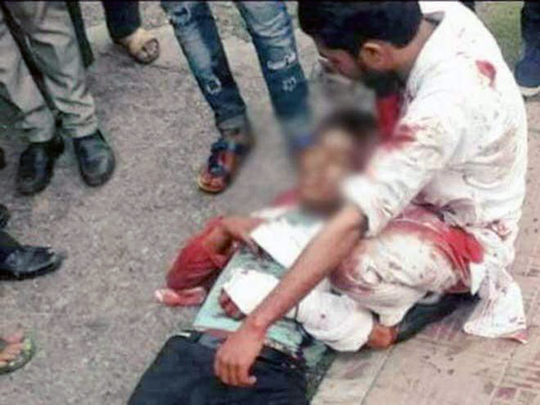
Junaid was stabbed to death while his brothers, Hashim and Sakir--were injured by a mob which also allegedly hurled slurs against them onboard the Delhi-Mathura passenger train between Ballabgarh and Mathura stations on Thursday night.

The arrested accused, before being remanded to police custody by a court in Faridabad district earlier, had told reporters that he was in an inebriated state at the time of the incident and attacked the teenager on being allegedly instigated by fellow passengers.

Also Read: Communal hate crime: Family in shock after 16-yr-old Hafiz-ul-Quran murdered on train

Comments

Mohammed Imran
 - 
Monday, 26 Jun 2017

Now time has came to unite and fight against such goons till our last breath. Will sacrifice for humanity, not be tolerate.

Unseen Baig
 - 
Tuesday, 27 Jun 2017

Suspect state sponsored actions to consolidate Hindu votes. Wondering if all Hindus accept this and throw alliance. Steadfastness and fear of Allah shall prevail against all these pseudo nationalist plans.

Ranjan shetty
 - 
Tuesday, 27 Jun 2017

what is so shocking in this ? it was a street brawl . they taunted and might have hurt hindu sentiments or eve teased Hindu women as it is in their blood .

Ahmed K.C.
 - 
Tuesday, 27 Jun 2017

Mohammed Imran, Udupi,
As soon as you start fighting against such goons, they will label you as 'Terrorist" and you know what happens after that?
According to them:-
One wearing skull cap is a Terrorist
One goes to Madrasa is a Terrorist
One reads Qur'an is a Terrorist
One with Islamic beard is a Terrorist
One who transports a cattle is a Terrorist

All come under one umbrella called "RADICAL ISLAMIC TERRORISM"

Add new comment

  • Coastaldigest.com reserves the right to delete or block any comments.
  • Coastaldigset.com is not responsible for its readers’ comments.
  • Comments that are abusive, incendiary or irrelevant are strictly prohibited.
  • Please use a genuine email ID and provide your name to avoid reject.
News Network
January 14,2020

Bengaluru, Jan 14: Days after the Reserve Bank of India (RBI) capped to Rs 35,000 the withdrawal limit of Sri Guru Raghavendra Co-operative Bank, BJP MP Tejasvi Surya on Monday reassured account holders and said Finance Minister Nirmala Sitharaman was personally monitoring the issue.

Taking to Twitter, Surya said, "I want to assure all depositors of Sri Guru Raghavendra Co-operative Bank to not panic. Hon'ble Finance Minister Nirmala Sitharaman is appraised of matter and is personally monitoring the issue. She has assured the government will protect interests of depositors. Grateful for her concern."

The Bengaluru South MP also attached a letter in his tweet where he had appraised Sitharaman of the situation.

"Finance Minister, after speaking with the RBI governor and other authorities concerned, assured Surya that the government will do everything in its capacity to protect the interests of the depositors and the long term interests of the bank," the letter read.

It said that Surya also reached out to Sitharaman "three times on January 13" after which she reassured him that the "depositors need not panic".

RBI had, on January 10, imposed certain restrictions on Sri Gururaghavendra Sahakara Bank Niyamitha.

"In particular, a sum not exceeding Rs 35,000 of the total balance in every savings bank or current account or any other deposit account may be allowed to be withdrawn subject to conditions stated in the above RBI directions," the notification said.

The regulatory body said that the bank will continue to undertake banking business with restrictions until its financial position improves.

"These directions shall remain in force for a period of six months from the close of business of January 10 and are subject to review," it said.

The bank has been restricted from granting or renewing any loans and advances, make any investment, incur any liability including borrowal of funds and acceptance of fresh deposits, disburse or agree to disburse any payment whether in discharge of its liabilities and obligations or otherwise, enter into any compromise or arrangement and sell, transfer or otherwise dispose of any of its properties or assets except.

Comments

Add new comment

  • Coastaldigest.com reserves the right to delete or block any comments.
  • Coastaldigset.com is not responsible for its readers’ comments.
  • Comments that are abusive, incendiary or irrelevant are strictly prohibited.
  • Please use a genuine email ID and provide your name to avoid reject.
News Network
June 20,2020

Bengaluru, Jun 20: The Karnataka Health Department has issued guidelines on the admission of COVID-19 patients in private hospitals after clinical assessment, mandating that the district surveillance officer (DSO) should be first informed to initiate further procedures, an official said on Friday.

"A health team sent by the DSO should visit the home or hospital where the patient is staying. The team should conduct a rapid assessment of his or her health condition," said Karnataka's Additional Chief Secretary Jawaid Akhtar.

In the rapid health condition assessment, the team should first check the patient's body temperature, followed by SpO2 (oxygen saturation) level and confirm if there are any comorbidities such as hypertension, diabetes, tuberculosis, HIV, cancer, stroke etc.

Depending on the health condition of patients, Akhtar said, two categories have been made.

"Those who have body temperature greater than 37.5 degrees Celsius, SpO2 level below 94 percent, elderly (above 60 years) and suffering from known comorbid conditions should be taken to a dedicated Covid hospital (DCH)," he said.

"All other patients, even if older but not suffering from co-morbidities, those below 60 and suffering from co-morbidities and asymptomatic cases should be taken to a dedicated Covid health centre (DCHC) or a private hospital as opted by the patient," he added.

Private hospitals have been asked to pitch in due to the rising number of cases in Karnataka. Currently, there are 2943 active cases in the state after 337 cases were reported on Friday.

"The patients are assessed clinically and evaluated at DCHCs or private hospitals with appropriate diagnostic tests. After evaluation, if the patients are asymptomatic, they are shifted to a COVID Care Centre (CCC) for further management," said Akhtar.

CCCs are expected to be equipped with ventilated rooms, pulse oximeters, handheld thermal scanners and blood pressure apparatus.

A nurse has to be present round the clock for every 50 patients and should visit each patient twice a day for assessment whereas the medical officer has to visit the CCC once a day. He should also be available on call in case of an emergency.

Staff serving food and others should wear personal protective equipment and an N-95 mask. Explaining the procedures at DCHCs, Akhtar said general examinations for medical conditions like body temperature, BP, pulse, oxygen saturation and urine output should be in place.

Investigations such as complete blood count, fasting blood sugar, random blood sugar, liver function tests, renal function tests, ECG and chest X-ray facilities should be available.

"DCHCs should ensure that above examinations are over in an orderly timeline of 24 hours and depending on the examination, the patient is continued to be lodged at the DCHC or sent to DCH or CCC," said the senior officer.

Likewise, the discharge policy should be done as per the protocols issued by the Health Department from time to time.

The Karnataka government is yet to fix an upper limit on the cost of treating COVID-19 patients in private hospitals. While reports indicated that this could be capped at Rs 5200 per day, health officials are yet to specify this is the case. Private hospitals in the state have asked the government to take a collaborative approach in deciding the fixed cap on treatment cost.

Comments

Add new comment

  • Coastaldigest.com reserves the right to delete or block any comments.
  • Coastaldigset.com is not responsible for its readers’ comments.
  • Comments that are abusive, incendiary or irrelevant are strictly prohibited.
  • Please use a genuine email ID and provide your name to avoid reject.
News Network
May 3,2020

Sirsi, May 3: A group of 19 students from the district were on Saturday safety brought back to Jawahar Navodaya Vidyalaya (JNV) at Malagi in Mundgod taluk by special buses from Madhya Pradesh.

The students were admitted to the JNV, Junapani, Bhopal district, for class 9 this academic year. They were kept at a hostel since March 22.

They could not leave for the state as train services were suspended before they were ready for the travel. Hence, they were kept at the local hostel.

Based on requests by parents, Labour Minister Shivaram Hebbar, directed the chief secretary to get in touch with the Madhya Pradesh government to bring back the students.

Hebbar, who visited the JNV, said that the students would be sent to their homes in two days after medical tests.

According to the JNV authorities, the decision was taken to bring back the students as their parents were worried. The students were safe at the JNV, Junapani and all facilities were provided to them at the hostel.

Comments

Add new comment

  • Coastaldigest.com reserves the right to delete or block any comments.
  • Coastaldigset.com is not responsible for its readers’ comments.
  • Comments that are abusive, incendiary or irrelevant are strictly prohibited.
  • Please use a genuine email ID and provide your name to avoid reject.