Eid-Round 2: Koorath followers offer prayers amidst clashes in Ullal dargah mosque

CD Network
June 26, 2017

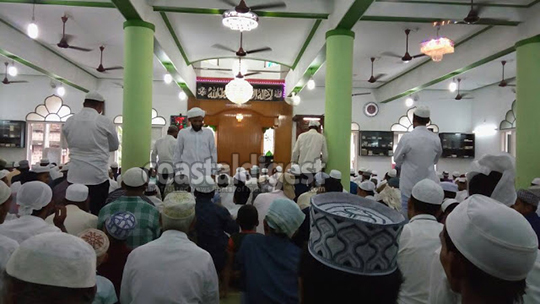
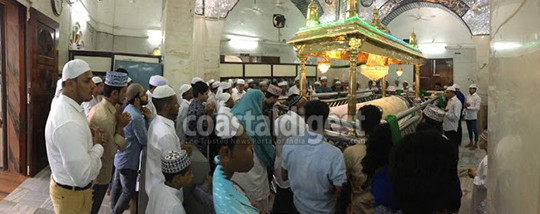
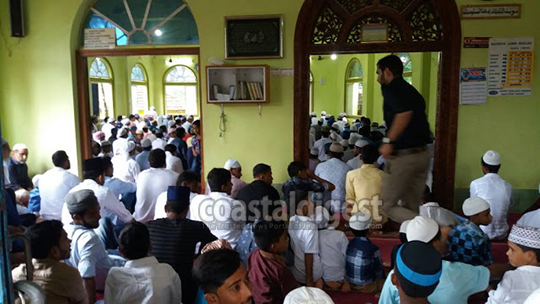
Mangaluru, Jun 26: For the first time in the history of Ullal, Muslims offered Eid al-Fitr namaz for two consecutive days in the same mosque, a development observed by Islamic scholars  as “most unfortunate and un-Islamic.”

ullals 1

With this the internal clash between two factions of Sayyid Shareeful Madani Dargah and central Juma Masjid has entered a new phase.

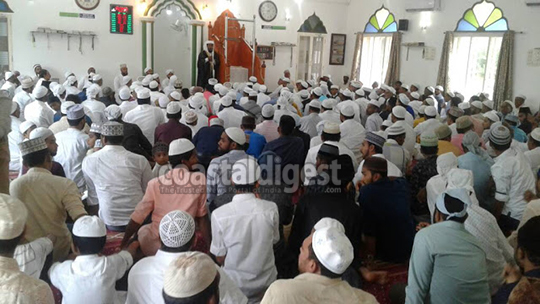
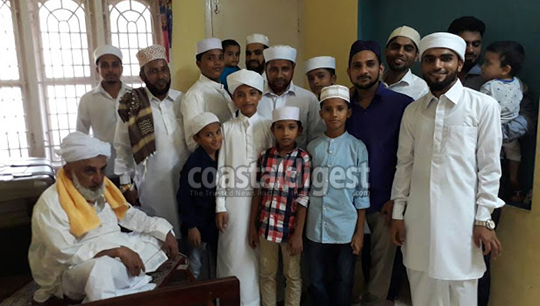
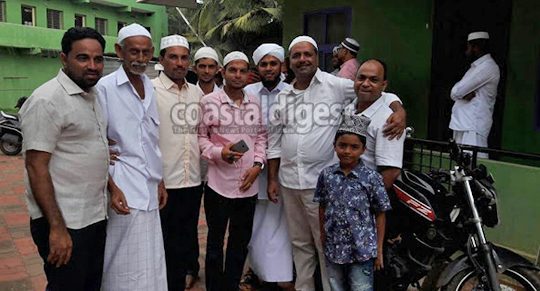
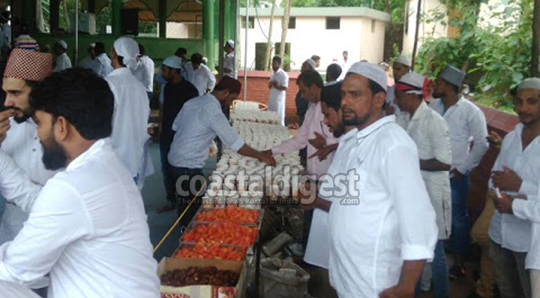
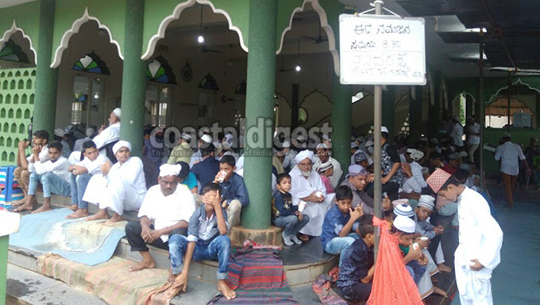
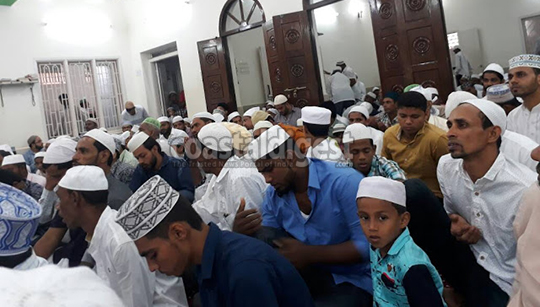
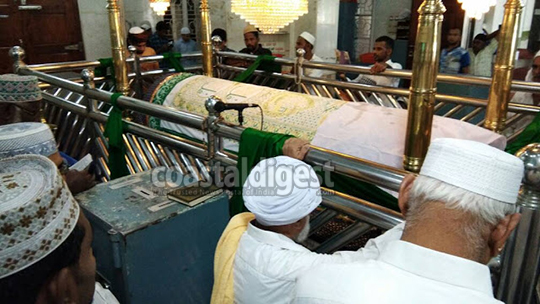
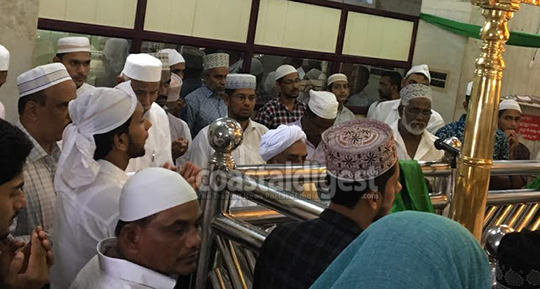
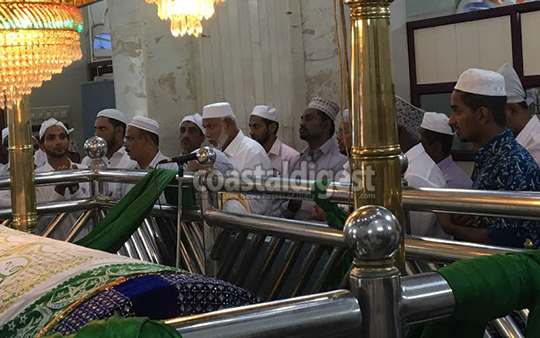
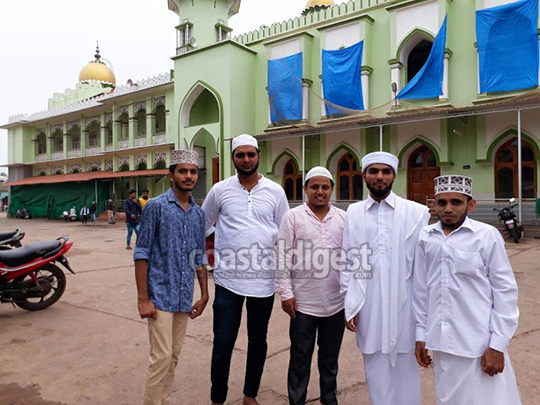
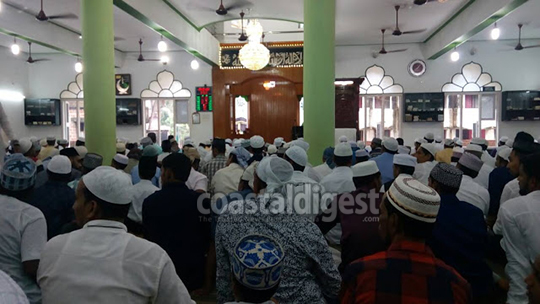
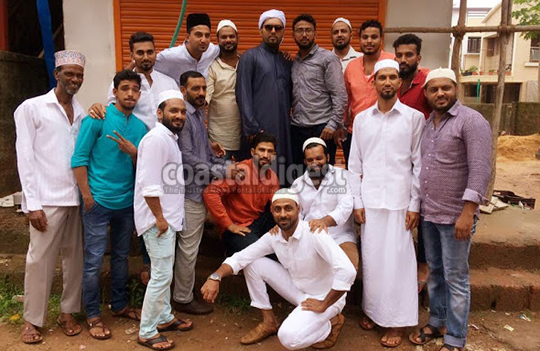
High drama prevailed, when a group of followers of beleaguered Ullal Khazi Fazal Koyamma Thangal aka Koorath Thangal, entered the premises of the mosque located adjacent to the dargah chanting takbir as part of Eid celebration on Monday noon.

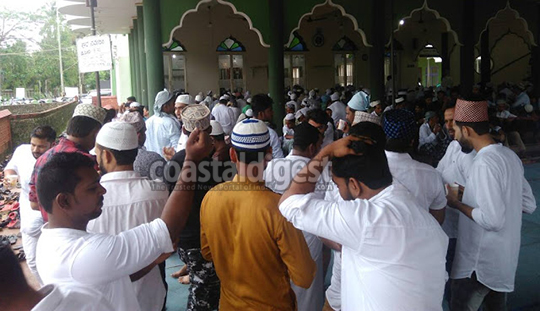
Those who were inside the mosque, locked the doors from inside in an attempt to prevent the followers of Koorth Thangal from offering Eid namaz for the second day. Police had to intervene to bring the situation under control when the verbal altercation between two group led to a physical clash.

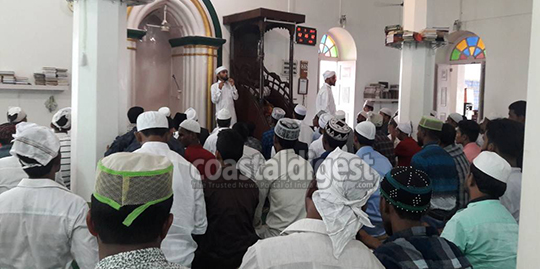
After a prolonged argument, the followers of Koorath Thangal were allowed to offer Eid namaz in congregation in the same mosque. Police had provided tight security for the namaz.

A majority of Muslims in Ullal had offered Eid namaz in juma mosque (dargah mosque) and other mosques on Sunday. However, followers of Koortha Thangal had observed fast on Sunday and postponed Eid to Monday.

Abdul Rasheed Haji, the president of the management committee of the Juma mosque and dargah had yesterday justified the decision of celebrating Eid al-Fitr on Sunday in spite of the sudden opposition by Koorath Thangal, who is not in touch with the committee for past one year.

“Dakshina Kannada Khazi Thwaka Ahmed Musliyar and Udupi Khazi Ibrahim Musliyar Bekal had already announced Eid after verifying moon-sighting reports from Bhatkal on Saturday night. Hence, in Ullal, assistant Khazi announced the Eid in the absence of Koorath Thangal,” he clarified.
Why two days?

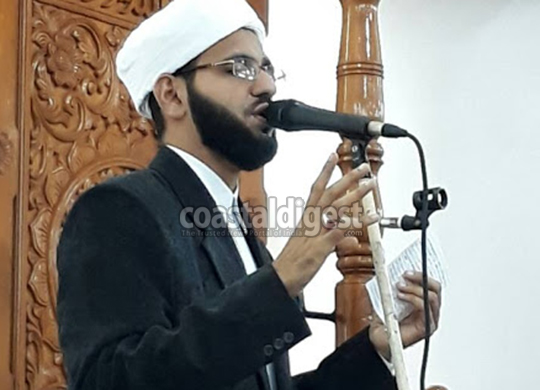
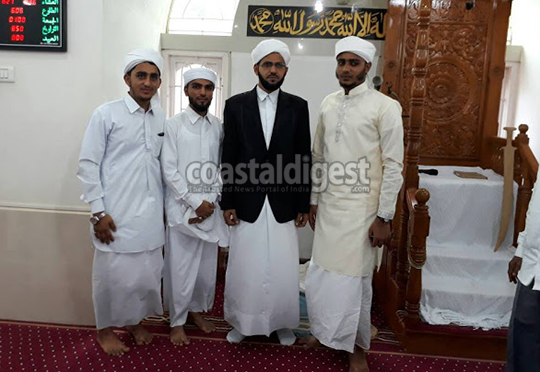
Koorath Thangal was appointed as the Khazi of Ullal in March 2014 following the demise of his father Thajul Ulama Assayyid Abdurrahman Al-Bukhari, who was the Khazi of Ullal for several decades. Koorath Thangal’s several moves had triggered controversy in last couple of years.

According to sources, the reason for fresh controversy is that management committee of the mosque did not inform Koorath Thangal before announcing the end of the Ramadan Saturday night as he was not in touch with the committee.

As soon as Koorath Thangal realized that announcement of Eid was made without his permission, he sent a voice message on social media stating that Sunday will be the 30th day of Ramadan. A few clerics reportedly tried to convince Koorath Thangal to change his decision but in vain.

ullals 2

ullals 3

ullals 4

ullals 5

ullals 6

ullals 7

ullals 8

ullals 9

ullals 10

ullals 11

ullals 12

ullals 13

ullals 14

ullals 15

ullals 16

ullals 17

ullals 18

ullals 19

Comments

MILAN
 - 
Monday, 26 Jun 2017

this is nothing but ego from koora thangal.

in middle east, if one observe moon in saudi, all gcc countries follow saudi.

sam
 - 
Monday, 26 Jun 2017

Shame on you people... ullal people are scapegoat for two kerala thangals EGO CLASH. I dont know when you people unite in the name of Allah and Rasool than these dargas and thangals.

Alam
 - 
Tuesday, 27 Jun 2017

@Milan,
I would respectfully disagree, if thats the case then all of India should celebrate Eid on one day right?
If you check moonsighting.com, you will see different methods used by different countries to declare eid. One of the method is foll

Mohammed
 - 
Tuesday, 27 Jun 2017

None of the thangal or Mullah are scared of ALLAH, all they are doing this for their own benefit. lets avoid this thangal and mullahs in this cases to be united.

koora thangal announced 30th day of ramadan Just because the committee didn't inform him about the decision, WAW endu thanga bava if this is not called EGO then what? and those who still support him should be labeled as BHAKTS.

Mohammed
 - 
Wednesday, 28 Jun 2017

Eid Clashes are only because of EGO. There are two groups EK & AP who are taking people for ride. People with no knowledge of Islam go behind these fools. Y do we need any Thangal or Mullah to follow Islam? There is Quraan & haddeeth, that is more than enough. people who are half-learned scholars are creating this rift between muslim community. Educated people will never do this. May ALLAH give Hidaya to these fools running behind MULLAH & Thangal.

Add new comment

  • Coastaldigest.com reserves the right to delete or block any comments.
  • Coastaldigset.com is not responsible for its readers’ comments.
  • Comments that are abusive, incendiary or irrelevant are strictly prohibited.
  • Please use a genuine email ID and provide your name to avoid reject.
News Network
January 22,2020

Bengaluru, Jan 22: Chief minister BS Yediyurappa has urged the business community to focus on industries that are farmers and job-oriented and promised that his government would provide all the assistance it can in setting up these industries.

“My government will go the extra mile to facilitate industries that help farmers and provide jobs for youths,” Yediyurappa said during a meeting with several investors and entrepreneurs on the first day of the World Economic Forum, which brings global industry players and government representatives face- to-face, in Davos, Switzerland, on Tuesday.

The chief minister met representatives of 2000 Watt Smart Cities Association, which is represented by sustainability professionals of Nuesch Development, a Swiss Company, and ReNew Power. Both made presentations of their projects to the state delegation.

Yediyurappa appeared impressed by the 2000 Watt’s food processing clusters (development of modern infrastructure and common facilities) projects in rural areas. While presenting their concept, company representatives said they are willing to invest in food clusters, which can provide a better remunerative price for farm produce.

“We will provide all assistance and scientific farming techniques to grow healthy food and market them with added value to the produce,” said Andreas Binkert, scientist and academician, 2000 Watts.

Madhav Bhagwat, CEO of Nuesch Development India, told the Karnataka delegation that the company specialises in carbon-neutral smart township development projects and it has already signed an MoU with the Pune Metropolitan Region Development Authority.

ReNew Power delegates expressed interest in setting up solar power plants in North Karnataka districts like Vijayapura, Kalaburagi, Koppal and Raichur. Samanth Sinha, CEO, ReNew Power, urged the Karnataka government to remove bureaucratic and legal bottlenecks in acquisition of land.

Industries minister Jagadish Shettar and chief secretary TM Vijay Bhaskar among others were present at the meeting.

Yediyurappa and members of the state’s delegation attended US president Donald Trump’s address at the meet. Union minister of commerce and industry Piyush Goel and Union minister of state for shipping Mansukh Mandaviya were also present in the audience.

Comments

Add new comment

  • Coastaldigest.com reserves the right to delete or block any comments.
  • Coastaldigset.com is not responsible for its readers’ comments.
  • Comments that are abusive, incendiary or irrelevant are strictly prohibited.
  • Please use a genuine email ID and provide your name to avoid reject.
News Network
June 10,2020

Bengaluru, June 10: The Department of Primary and Secondary Education of Government of Karnataka today ordered a ban on online classes for children from KG to class 5.

The decision was taken following a report based on the report submitted by director NIMHANS, recommending online classes only above the age of 6 years and also following the complaints from several parents about online classes conducted by private schools even for kindergarten kids.

Briefing the media soon after the meeting with department officials, S Suresh Kumar, primary and secondary education minister said, "We have taken two major decisions today. The online classes for LKG, UKG and primary classes should be stopped immediately."

Even collecting fees in the name of online classes should be stopped, said the minister. "We have already issued a circular about it insisting that schools not collect fees in the name of online classes and also requesting schools not to increase fees for the 2020-21 academic year considering financial constraints of several people due to the COVID-19 pandemic," said the minister.

The department, however, also discussed how to engage children during this period as there was no clarity over the reopening of schools for the 2020-21 academic year. "We have constituted a committee to prepare guidelines on how to engage students and increase their knowledge. The committee is headed by Prof. MK Sridhar," he said.

Before taking this decision, the department had three rounds of discussions with various experts, including Prof. MK Sridhar, Prof. VP Niranjanaradhya, Dr John Vijay Sagar and other departments, including the home and health departments.

Comments

Add new comment

  • Coastaldigest.com reserves the right to delete or block any comments.
  • Coastaldigset.com is not responsible for its readers’ comments.
  • Comments that are abusive, incendiary or irrelevant are strictly prohibited.
  • Please use a genuine email ID and provide your name to avoid reject.
Ram Puniyani
January 14,2020

In the beginning of January 2020 two very disturbing events were reported from Pakistan. One was the attack on Nankana Sahib, the holy shrine where Sant Guru Nanak was born. While one report said that the place has been desecrated, the other stated that it was a fight between two Muslim groups. Prime Minister of Pakistan Imran Khan condemned the incident and the main accused Imran Chisti was arrested. The matter related to abduction and conversion of a Sikh girl Jagjit Kaur, daughter of Pathi (One who reads Holy Guru Granth Sahib in Gurudwara) of the Gurudwara. In another incident one Sikh youth Ravinder Singh, who was out on shopping for his marriage, was shot dead in Peshawar.

While these condemnable attacks took place on the Sikh minority in Pakistan, BJP was quick enough to jump to state that it is events like this which justify the Citizenship Amendment Act (CAA). Incidentally CAA is the Act which is discriminatory and relates to citizenship with Religion, which is not as per the norms of Indian constitution. There are constant debates and propaganda that population of Hindus has come down drastically in Pakistan and Bangla Desh. Amit Shah, the Home minister stated that in Pakistan the population of Hindus has come down from 23% at the time of partition to 3.7% at present. And in Bangla Desh it has come down from 22% to present 8%.

While not denying the fact that the religious minorities are getting a rough deal in both these countries, the figures which are presented are totally off the mark. These figures don’t take into consideration the painful migrations, which took place at the time of partition and formation of Bangla Desh later. Pakistan census figures tell a different tale. Their first census was held in 1951. As per this census the overall percentage of Non Muslim in Pakistan (East and West together) was 14.2%, of this in West Pakistan (Now Pakistan) it was 3.44 and in Eat Pakistan it was 23.2. In the census held in Pakistan 1998 it became 3.72%. As far as Bangla Desh is concerned the share of Non Muslims has gone down from 23.2 (1951) to 9.6% in 2011.

The largest minority of Pakistan is Ahmadis, (https://minorityrights.org/country/pakistan/) who are close to 4 Million and are not recognised as Muslims in Pakistan. In Bangla Desh the major migrations of Hindus from Bangla Desh took place in the backdrop of Pakistan army’s atrocities in the then East Pakistan.

As far as UN data on refugees in India it went up by 17% between 2016-2019 and largest numbers were from Tibet and Sri Lanka.  (https://www.un.org/en/development/desa/population/migration/publication…)

The state of minorities is in a way the index of strength of democracy. Most South Asian Countries have not been able to sustain democratic values properly. In Pakistan, the Republic began with Jinnah’s classic speech where secularism was to be central credo of Pakistan. This 11th August speech was in a way what the state policy should be, as per which people of all faiths are free to practice their religion. Soon enough the logic of ‘Two Nation theory” and formation of Pakistan, a separate state for Muslim took over. Army stepped in and dictatorship was to reign there intermittently. Democratic elements were suppressed and the worst came when Zia Ul Haq Islamized the state in collusion with Maulanas. The army was already a strong presence in Pakistan. The popular formulation for Pakistan was that it is ruled by three A’s, Army, America and Allah (Mullah).

Bangla Desh had a different trajectory. Its very formation was a nail in the coffin of ‘two nation theory’; that religion can be the basis of a state. Bangla Desh did begin as a secular republic but communal forces and secular forces kept struggling for their dominance and in 1988 it also became Islamic republic. At another level Myanmar, in the grip of military dictatorship, with democratic elements trying to retain their presence is also seeing a hard battle. Democracy or not, the army and Sanghas (Buddhist Sang has) are strong, in Myanmar as well. The most visible result is persecution of Rohingya Muslims.

Similar phenomenon is dominating in Sri Lanka also where Budhhist Sanghas and army have strong say in the political affairs, irrespective of which Government is ruling. Muslim and Christian minorities are a big victim there, while Tamils (Hindus, Christians etc.) suffered the biggest damage as ethnic and religious minorities. India had the best prospect of democracy, pluralism and secularism flourishing here. The secular constitution, the outcome of India’s freedom struggle, the leadership of Gandhi and Nehru did ensure the rooting of democracy and secularism in a strong way.

India so far had best democratic credentials amongst all the south Asian countries. Despite that though the population of minorities rose mainly due to poverty and illiteracy, their overall marginalisation was order of the day, it went on worsening with the rise of communal forces, with communal forces resorting to identity issues, and indulging in propaganda against minorities.

While other South Asian countries should had followed India to focus more on infrastructure and political culture of liberalism, today India is following the footsteps of Pakistan. The retrograde march of India is most visible in the issues which have dominated the political space during last few years. Issues like Ram Temple, Ghar Wapasi, Love Jihad, Beef-Cow are now finding their peak in CAA.

India’s reversal towards a polity with religion’s identity dominating the political scene was nicely presented by the late Pakistani poetess Fahmida Riaz in her poem, Tum bhi Hum Jaise Nikle (You also turned out to be like us). While trying to resist communal forces has been an arduous task, it is becoming more difficult by the day. This phenomenon has been variously called, Fundamentalism, Communalism or religious nationalism among others. Surely it has nothing to do with the religion as practiced by the great Saint and Sufi traditions of India; it resorts mainly to political mobilization by using religion as a tool.


Comments

Ashi
 - 
Tuesday, 14 Jan 2020

If Malaysia implement similar NRC/CAA, India and China are the loser.

Add new comment

  • Coastaldigest.com reserves the right to delete or block any comments.
  • Coastaldigset.com is not responsible for its readers’ comments.
  • Comments that are abusive, incendiary or irrelevant are strictly prohibited.
  • Please use a genuine email ID and provide your name to avoid reject.