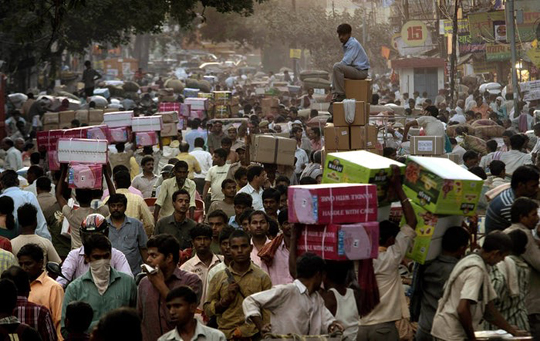
With over 1.4 bn people, India to be more populous than China by 2024: UN

Agencies
June 22, 2017

United Nations, Jun 22: India, which currently ranks as the second most populous country with 1.3 billion inhabitants, will surpass China's 1.4 billion citizens by 2024, the UN said in a report.

IndiaP

The world's total population is expected to hit 9.8 billion by 2050 despite universal lower fertility rates,the report added.

The world's population is now at least 7.6 billion, up from 7.4 billion last year, spurred by the relatively high levels of fertility in developing countries -- despite an overall drop in the number of children people have around the globe, the report World Population Prospects: The 2017 Revision revealed on Wednesday.

The concentration of global population growth is in the poorest countries, presenting a challenge as the world seeks to implement the 2030 Sustainable Development Agenda, which is aimed to end poverty and preserve the planet, according to the report.

"With roughly 83 million people being added to the world's population every year, the upward trend in population size is expected to continue, even assuming that fertility levels will continue to decline," said the UN Department of Economic and Social Affairs.

At this rate, the world population is expected to reach 8.6 billion in 2030, 9.8 billion in 2050 and surpass 11.2 billion in 2100, reports Xinhua news agency.

The growth is expected to come, in part, from the 47 least developed countries, where the fertility rate is around 4.3 births per woman, and whose population is expected to reach 1.9 billion people in 2050 from the current estimate of 1 billion.

In addition, the birth rates in African countries are likely to "at least double" by 2050, said the report.

That trend comes despite lower fertility rates in nearly all regions of the world, including in Africa, where rates fell from 5.1 births per woman up to 2005 to 4.7 births in the five years following.

In contrast, the birth rates in Europe are up to 1.6 births per woman, up from 1.4 births in 2000-2005.

The lower fertility rates are resulting in an ageing population, with the number of people aged 60 or over expected to more than double by 2050 and triple by 2100, from the current 962 million to 3.1 billion.

Africa, which has the youngest age distribution of any region, is projected to experience a rapid ageing of its population, the report noted.

By 2050, the third most populous country will be Nigeria, which currently ranks seventh, and which is poised to replace the US.

Comments

Nothing but Truth
 - 
Thursday, 22 Jun 2017

Major contribution will be from Peace Community..sadly

Add new comment

  • Coastaldigest.com reserves the right to delete or block any comments.
  • Coastaldigset.com is not responsible for its readers’ comments.
  • Comments that are abusive, incendiary or irrelevant are strictly prohibited.
  • Please use a genuine email ID and provide your name to avoid reject.
News Network
February 18,2020

Beijing, Feb 18: Police in China have arrested a prominent activist who had been a fugitive for weeks and criticised President Xi Jinping's handling of the coronavirus epidemic while in hiding, a rights group said Tuesday.

Anti-corruption activist Xu Zhiyong was arrested on Saturday after being on the run since December, according to Amnesty International.

China's ruling Communist Party has severely curtailed civil liberties since Xi took power in 2012, rounding up rights lawyers, labour activists and even Marxist students.

The death this month of a whistleblowing doctor who was reprimanded by police for raising the alarm about the deadly new virus before dying of it himself triggered rare calls for political reform and freedom of speech.

The "Chinese government's battle against the coronavirus has in no way diverted it from its ongoing general campaign to crush all dissenting voices," said Patrick Poon, China researcher at Amnesty International, in an emailed statement.

Another source, who spoke to news agency on the condition of anonymity, said Xu had been arrested in the southern city of Guangzhou.

Guangzhou police did not respond to requests for comment.

Xu went into hiding after authorities broke up a December gathering of intellectuals discussing political reform in the eastern coastal city of Xiamen in Fujian province, prior to the coronavirus crisis.

Over a dozen lawyers and activists were detained or disappeared after the Xiamen gathering, according to rights groups -- and Xu's detention appears linked to his presence at the meeting, explained Poon.

But while on the run, Xu continued to post information on Twitter about rights issues.

On February 4 Xu released an article calling on Xi to step down and criticised his leadership across a range of issues including the US-China trade war, Hong Kong's pro-democracy protests and the coronavirus epidemic, which has now killed nearly 1,900 people.

"Medical supplies are tight, hospitals are filled with patients, and a large number of infected people have no way to be diagnosed," he wrote. "It's a mess."

"The coronavirus outbreak shows just how important values like freedom of expression and transparency are -- the exact values that Xu has long advocated," Yaqiu Wang, China researcher at Human Rights Watch, told news agency.

But the disappearance of Xu illustrates how the Chinese state "persists in its old ways" by "silencing its critics", she said.

Xu -- who founded a movement calling for greater transparency among high-ranking officials -- previously served a four-year prison sentence from 2013 to 2017 for organising an "illegal gathering".

"That he was a fugitive for so many days while continuing to speak out, that in itself was... a kind of challenge to (Chinese authorities)," said Hua Ze, a long-time friend of Xu who told AFP she lost contact with the Chinese activist on Saturday morning.

Comments

Add new comment

  • Coastaldigest.com reserves the right to delete or block any comments.
  • Coastaldigset.com is not responsible for its readers’ comments.
  • Comments that are abusive, incendiary or irrelevant are strictly prohibited.
  • Please use a genuine email ID and provide your name to avoid reject.
Agencies
June 8,2020

China is aggressively pursuing a diverse range of tactics -- from cyber-attacks to recruiting insiders for economic espionage, Indian security agencies have warned. The specific alert circulated among key stakeholders suggests that Chinese operatives are not only planning to steal classified cutting-edge defense technology but also eyeing to recruit best academicians and researchers around the globe, especially from the US.

Sources said they have noticed that China has authorized an "aggressive program of stealing US science and technology information by recruiting Americans in the technology sector with access to trade secrets".

In the technology sector of the US, many Indians scientists are working at the forefront. "This is a serious matter for Indian government and security establishments," said a top source further adding that Chinese always pursue economic espionage because it suits their low cost manufacturing sector on the basis of stolen research and costly design developed by top companies across the globe.

"An alert was also issued in early January about Chinese cyber intrusion attempts at several companies where Indian researchers are working. The espionage attempt was to target UAV technology and certain top-end military equipment designs. After stealing the techniques and design, China starts producing these equipment domestically and sells at a cheaper rate, inflicting irreparable damage to the original equipment manufacturers," the sources in the security establishment observed.

Recently, the US accused China for targeting academia by sending researchers to American labs and using talent recruitment programme to steal scientific analysis. The US has also found that young recruits of the People's Liberation Army posing as students are entering into various universities across the globe to get research papers and recruit academia.

Earlier this year, the US charged a former Boston University student of visa fraud for failing to disclose the status as a lieutenant in the China's People's Liberation Army.

The US intelligence agencies have found that their "universities have become a soft target in the global espionage war with China".

In January this year, the US Department of Justice charged a leading academician at the Harvard University for hiding his alleged role in a Chinese government programme.

In July last year, the Federal Bureau of Investigation (FBI) Director Christopher Wray had revealed that the FBI is probing nearly 1,000 cases of economic espionage and attempted intellectual property theft, nearly all of them leading back to China.

Accordingly, Indian Missions have been informed about the threats being posed by Chinese spies and attempts to recruit Indian scientists and technologists working in the US and other parts of the world.

Sources further stated that security establishments in India have informed the scientist fraternity to be on alert amid threat posed by Chinese spies.

The Chinese had earlier recruited a personnel, Dongfan Chung, working at Boeing for economic espionage. Chung had stolen secret technology to benefit Chinese government and during the raid at his house more than 2.5 lakh classified pages related to Boeing were recovered.

"There has been intense debate on the international platforms regarding Chinese-sponsored theft of intellectual property. American agencies have gone on record to say that China was targeting trade secrets. In the backdrop of pandemic and global health crisis, Indian establishments in defence and technology sectors have been told to be extra cautious as China is planning to become the most advanced economy while the other countries are crippled by the highly contagious virus," the sources further added.

Comments

Add new comment

  • Coastaldigest.com reserves the right to delete or block any comments.
  • Coastaldigset.com is not responsible for its readers’ comments.
  • Comments that are abusive, incendiary or irrelevant are strictly prohibited.
  • Please use a genuine email ID and provide your name to avoid reject.
News Network
January 7,2020

Dubai/Washington, Jan 7: Iran's Supreme Leader Ayatollah Ali Khamenei wept in grief with hundreds of thousands of mourners thronging Tehran's streets on Monday for the funeral of military commander Qassem Soleimani, killed by a U.S. drone on U.S. President Donald Trump's orders.

The coffins of General Qassem Soleimani and Iraqi militia leader Abu Mahdi al-Muhandis, who also died in Friday's attack in Baghdad, were draped in their national flags and passed from hand to hand over the heads of mourners in central Tehran.

Responding to Trump's threats to hit 52 Iranian sites if Tehran retaliates for the drone strike, Iran's President Hassan Rouhani pointedly wrote on Twitter: "Never threaten the Iranian nation." And Soleimani's successor vowed to expel U.S. forces from the Middle East in revenge.

Khamenei, 80, led prayers at the funeral, pausing as his voice cracked with emotion. Soleimani, 62, was a national hero in Iran, even to many who do not consider themselves supporters of Iran's clerical rulers.

Aerial footage showed people, many clad in black, packing thoroughfares and side streets in the Iranian capital, chanting "Death to America!" - a show of national unity after anti-government protests in November in which many demonstrators were killed.

The crowd, which state media said numbered in the millions, recalled the masses of people that gathered in 1989 for the funeral of the Islamic Republic's founder, Ayatollah Ruhollah Khomeini. Soleimani, architect of Iran's drive to extend its influence across the Middle East, was widely seen as Iran's second most powerful figure behind Khamenei.

His killing of Soleimani has prompted concern around the world that a broader regional conflict could flare.

Trump on Saturday vowed to strike 52 Iranian targets, including cultural sites, if Iran retaliates with attacks on Americans or U.S. assets, and stood by his threat on Sunday, though American officials sought to downplay his reference to cultural targets. The 52 figure, Trump noted, matched the number of U.S. Embassy hostages held for 444 days after the 1979 Iranian Revolution.

Rouhani, regarded as a moderate, responded to Trump on Twitter.

"Those who refer to the number 52 should also remember the number 290. #IR655," Rouhani wrote, referring to the 1988 shooting down of an Iranian airline by a U.S. warship in which 290 were killed.

Trump also took to Twitter to reiterate the White House stance that "Iran will never have a nuclear weapon" but gave no other details.

'ACTIONS WILL BE TAKEN'

General Esmail Ghaani, Soleimani's successor as commander of the Quds Force, the elite unit of Iran's Revolutionary Guards charged with overseas operations, promised to "continue martyr Soleimani's cause as firmly as before with the help of God, and in return for his martyrdom we aim to rid the region of America."

"God the Almighty has promised to take martyr Soleimani's revenge," he told state television. "Certainly, actions will be taken."

Other political and military leaders have made similar, unspecific threats. Iran, which lies at the mouth of the key Gulf oil shipping route, has a range of proxy forces in the region through which it could act.

Iran's demand for U.S. forces to withdraw from the region gained traction on Sunday when Iraq's parliament passed a resolution calling for all foreign troops to leave the country.

Iraqi caretaker Prime Minister Abdel Abdul Mahdi told the U.S. ambassador to Baghdad on Monday that both nations needed to implement the resolution, the premier's office said in a statement. It did not give a timeline.

The United States has about 5,000 troops in Iraq.

Soleimani built a network of proxy militia that formed a crescent of influence - and a direct challenge to the United States and its regional allies led by Saudi Arabia - stretching from Lebanon through Syria and Iraq to Iran. Outside the crescent, Iran nurtured allied Palestinian and Yemeni groups.

He notably mobilised Shi'ite Muslim militia forces in Iraq that helped to crush ISIS, the Sunni militant group that had seized control of swathes of Syria and Iraq in 2014.

Washington, however, blames Soleimani for attacks on U.S. forces and their allies.

The funeral moves to Soleimani's southern home city of Kerman on Tuesday. Zeinab Soleimani, his daughter, told mourners in Tehran that the United States would face a "dark day" for her father's death, adding, "Crazy Trump, don't think that everything is over with my father's martyrdom."

NUCLEAR DEAL

Iran stoked tensions on Sunday by dropping all limitations on its uranium enrichment, another step back from commitments under a landmark deal with major powers in 2015 to curtail its nuclear programme that Trump abandoned in 2018.

In response, European signatories may launch a dispute resolution process against Iran this week that could lead to a renewal of the United Nations sanctions that were lifted as part of the deal, European diplomats said on Monday.

Diplomats said France, Britain and Germany could make a decision ahead of an EU foreign ministers' meeting on Friday that would assess whether there were any ways to salvage the deal.

After quitting the deal, the United States imposed new sanctions on Iran, saying it wanted to halt Iranian oil exports, the main source of government revenues. Iran's economy has been in freefall as the currency has plunged.

Trump adviser Kellyanne Conway said on Monday that he was still confident he could renegotiate a new nuclear agreement "if Iran wants to start behaving like a normal country."

Tehran has said Washington must return to the existing nuclear pact and lift sanctions before any talks can take place.

The United States advised American citizens in Israel and the Palestinian territories to be vigilant, citing the risk of rocket fire amid heightened tensions. As a U.S. ally against Iran, Israel is concerned about possible rocket attacks from Gaza, ruled by Iranian-backed Palestinian Islamists, or major Iran proxy Hezbollah in Lebanon.

Democratic critics of Trump have said the Republican president was reckless in authorising the strike, with some saying his threat to hit cultural sites amounted to a vow to commit war crimes. Trump also threatened sanctions against Iraq and said Baghdad would have to pay Washington for an air base in Iraq if U.S. troops were required to leave.


Comments

Add new comment

  • Coastaldigest.com reserves the right to delete or block any comments.
  • Coastaldigset.com is not responsible for its readers’ comments.
  • Comments that are abusive, incendiary or irrelevant are strictly prohibited.
  • Please use a genuine email ID and provide your name to avoid reject.