


With over 1.4 bn people, India to be more populous than China by 2024: UN

Agencies
June 22, 2017

United Nations, Jun 22: India, which currently ranks as the second most populous country with 1.3 billion inhabitants, will surpass China's 1.4 billion citizens by 2024, the UN said in a report.
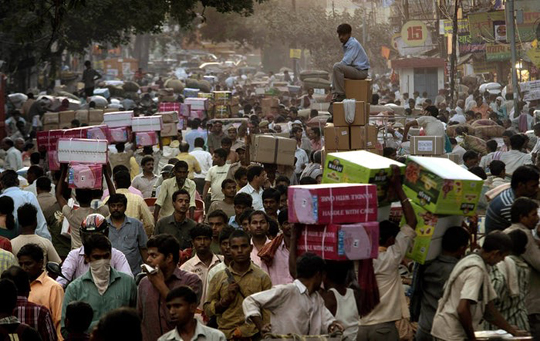
IndiaP

The world's total population is expected to hit 9.8 billion by 2050 despite universal lower fertility rates,the report added.

The world's population is now at least 7.6 billion, up from 7.4 billion last year, spurred by the relatively high levels of fertility in developing countries -- despite an overall drop in the number of children people have around the globe, the report World Population Prospects: The 2017 Revision revealed on Wednesday.

The concentration of global population growth is in the poorest countries, presenting a challenge as the world seeks to implement the 2030 Sustainable Development Agenda, which is aimed to end poverty and preserve the planet, according to the report.

"With roughly 83 million people being added to the world's population every year, the upward trend in population size is expected to continue, even assuming that fertility levels will continue to decline," said the UN Department of Economic and Social Affairs.

At this rate, the world population is expected to reach 8.6 billion in 2030, 9.8 billion in 2050 and surpass 11.2 billion in 2100, reports Xinhua news agency.

The growth is expected to come, in part, from the 47 least developed countries, where the fertility rate is around 4.3 births per woman, and whose population is expected to reach 1.9 billion people in 2050 from the current estimate of 1 billion.

In addition, the birth rates in African countries are likely to "at least double" by 2050, said the report.

That trend comes despite lower fertility rates in nearly all regions of the world, including in Africa, where rates fell from 5.1 births per woman up to 2005 to 4.7 births in the five years following.

In contrast, the birth rates in Europe are up to 1.6 births per woman, up from 1.4 births in 2000-2005.

The lower fertility rates are resulting in an ageing population, with the number of people aged 60 or over expected to more than double by 2050 and triple by 2100, from the current 962 million to 3.1 billion.

Africa, which has the youngest age distribution of any region, is projected to experience a rapid ageing of its population, the report noted.

By 2050, the third most populous country will be Nigeria, which currently ranks seventh, and which is poised to replace the US.

Comments

Nothing but Truth
 - 
Thursday, 22 Jun 2017

Major contribution will be from Peace Community..sadly

Add new comment

  • Coastaldigest.com reserves the right to delete or block any comments.
  • Coastaldigset.com is not responsible for its readers’ comments.
  • Comments that are abusive, incendiary or irrelevant are strictly prohibited.
  • Please use a genuine email ID and provide your name to avoid reject.
News Network
February 4,2020

Feb 4: Americans on Monday kicked off the first vote of the 2020 presidential race as the midwestern state of Iowa began its caucuses, the closely-watched first step in deciding which Democrat will face incumbent Donald Trump in November's election.

The two frontrunners, left-wing Senator Bernie Sanders and former Vice President Joe Biden face a key test in the sparsely populated state, with a handful of others looking to make their mark to give their campaigns momentum.

The Iowa vote is a critical early look at the viability of the 11 Democratic candidates still in the race - even though just 41 Iowa delegates are up for grabs, a fraction of the 1,991 needed to secure the party nomination in July.

Iowa Democrats filed into nearly 1,700 caucus sites - schools, libraries, churches, mosques and meeting halls with Sanders and Biden in the lead in the state, followed by former South Bend, Indiana mayor Pete Buttigieg and Senator Elizabeth Warren, who is also on the left of the party.

But polling has fluctuated and Iowa's quirky caucus system - where voting is not by secret ballot but by public declaration for a candidate - makes the night hard to predict.

Luke Elzinga, a volunteer for Sanders, appeared early at Lincoln High School in Des Moines which was converted into a caucus location.

"I think he really inspires a lot of young people, a lot of disaffected voters who might not otherwise turn out," Elzinga, 28, told AFP news agency shortly before the caucusing began.

"And so I think he's the best candidate to beat Trump."

Three candidates - Sanders, Warren and Amy Klobuchar - have faced the unprecedented scenario of spending much of the past two weeks tethered to Washington for the impeachment trial of Trump instead of on the campaign trail in Iowa.

Even as candidates sought to make 11th-hour impressions on undecided voters, the senators were obligated to return to Washington for the trial's closing arguments on Monday.

Defeating Trump

In a vote scheduled for Wednesday, Trump is almost certain to be acquitted by the Republican-led upper house on charges of abuse of power and obstruction of Congress.

For Democrats, second-tier hopefuls Klobuchar and tech entrepreneur Andrew Yang look to outpace expectations and seize momentum heading into the next contest in New Hampshire on February 11.

Earlier on Monday Biden - who still holds the lead in national polls - brought pizza to a field office in a strip mall near Des Moines to thank volunteers.

"I'm feeling good about today," he said.

Like many candidates, Biden spent the weekend crisscrossing Iowa in a final push to convince undecided voters he is best placed to accomplish Democrats' number one goal: defeating Trump.

The president has not stood idly by. On Sunday he branded Biden "Sleepy Joe" and described Sanders as "a communist," previewing a likely line of attack were Sanders to win the nomination.

Unlike secret ballot voting, caucus-goers publicly declare their presidential choice by standing together with other supporters of a candidate.

Candidates who reach 15 percent support earn delegates for the nomination race while supporters of candidates who fall short can shift their allegiance to others.

Turnout is critical, and candidates and their representatives will seek to persuade voters on issues including healthcare, taxes and ending Washington corruption.

One key candidate who has opted not to contest in Iowa is billionaire businessman Michael Bloomberg, who entered the race in November but has surged into fourth place in RealClearPolitics' national polling average.

The former New York mayor, who has spent more than $300m on advertising, according to Advertising Analytics, is focused on running a national campaign with particular emphasis on states that vote on "Super Tuesday," on March 3.

Comments

Add new comment

  • Coastaldigest.com reserves the right to delete or block any comments.
  • Coastaldigset.com is not responsible for its readers’ comments.
  • Comments that are abusive, incendiary or irrelevant are strictly prohibited.
  • Please use a genuine email ID and provide your name to avoid reject.
News Network
April 17,2020

Beijing, Apr 17: China denied Friday it had covered up the extent of its coronavirus outbreak, as it responded to growing questions from Western powers led by the United States.

A foreign ministry spokesman acknowledged that the virus's rapid spread had contributed to undercounting that resulted in China raising its death toll earlier Friday, but he added "there has never been any concealment, and we'll never allow any concealment."

The allegations China is too close to the World Health Organization (WHO), were an attempt at "smearing" Beijing, Zhao said.

US President Donald Trump has questioned China's handling of the pandemic and whether it had been completely transparent since the virus emerged in the central city of Wuhan late last year.

On Thursday, British Foreign Secretary Dominic Raab and French President Emmanuel Macron also expressed doubts about China's virus response.

These doubts were spotlighted again on Friday when authorities in Wuhan, which has borne the brunt of Chinese deaths, abruptly raised its death toll by 50 percent -- or 1,290 deaths -- to a new total of 3,869.

That also pushed the nationwide death toll up sharply to 4,632, based on official national data released earlier in the day.

Wuhan authorities cited several reasons for the missed cases, including that the city's medical staff were overwhelmed in the early days as infections climbed, leading to "late reporting, omissions or mis-reporting".

Zhao said such miscounting was to be expected in the initial stages of a major disease outbreak.

US President Donald Trump -- under fire himself for initially denying the seriousness of the pandemic -- has accused the WHO of doing the same and being too trusting of China's assurances over the outbreak.

On Tuesday he announced a suspension of US funding to the world body.

Asked about the US allegations, Zhao defended the WHO and China.

"I think they are all smearing China and cooking up stories about China," he said, without specifying which countries he was referring to.

China has largely brought the contagion under control domestically via tough measures including the unprecedented lockdown of Wuhan and tens of millions of people in surrounding areas, but not before it spread worldwide.

Comments

Add new comment

  • Coastaldigest.com reserves the right to delete or block any comments.
  • Coastaldigset.com is not responsible for its readers’ comments.
  • Comments that are abusive, incendiary or irrelevant are strictly prohibited.
  • Please use a genuine email ID and provide your name to avoid reject.
News Network
May 21,2020

Canberra, May 21: Australian Prime Minister Scott Morrison and his Indian counterpart, Narendra Modi, are looking forward to deepening the countries' strategic relationship, with both sides expected to sign a range of pacts from defence to trade in strategic sectors amid heightened tensions with China over Beijing's response to coronavirus pandemic.

During a virtual summit, scheduled to take place on June 4, both leaders are expected to ramp up efforts to diversify Australia's export markets and find trusted suppliers of vital products and components, a local newspaper, The Australian reported on Tuesday.

The new agreements will focus on reliable supply chains in key strategic sectors, including medical goods, technology and critical minerals, amid heightened tensions with China over Beijing's response to coronavirus pandemic.

The leaders will seal a new defence agreement allowing reciprocal access to bases and co-operation on military technology projects, while a new education partnership will be on the table to help overcome Australian university reliance on Chinese students.

The talks in terms of strategic convergence, now have greater significance as COVID-19 exacerbates the strategic contest between the US and China, and forces like-minded countries to seek out reliable partners.

Australian farmers could also benefit, with talks underway on expanding agricultural exports to India, including barley, as China throws up new trade barriers, media reports stated.

The virtual summit follows the cancellation of Morrison's planned state visit to India in January due to the bushfires.

Morrison said last year, ahead of his planned visit, that India was "a natural partner for Australia", referring to the countries' "shared values" -- a point of differentiation with China.

Former Department of Foreign Affairs and Trade secretary Peter Varghese, who wrote a landmark report on the bilateral relationship in 2018, was quoted by the newspaper as saying that India would be even more important to Australia in the post-COVID world. "If one of the lessons from COVID is that countries need to spread their risk, then finding new markets or building up existing markets is a crucial part of that," he added.

Varghese noted that India, a member of the Quadrilateral Security Dialogue along with Australia, Japan and the US, was a vital strategic partner to Australia in helping "constrain China's ambitions to be the predominant power".

"That shared objective between Australia and India of not wanting to see the region dominated by China is a key component of building up our geopolitical relationship," he told The Australian.

The summit also follows recent talks between Australian Foreign Minister Marise Payne and Indian counterpart Subrahmanyam Jaishankar on the pandemic response and Australia's call for an independent inquiry, which was overwhelmingly backed at the World Health Assembly on Tuesday.

Australia wants to support India to develop a domestic critical minerals processing industry, which would provide Western nations with an alternative to sourcing the materials from China.

Meanwhile, India has strong expertise as a manufacturer of drugs and medical equipment, while Australia is a centre of biomedical research, opening the possibility for closer co-operation in the key sector, the media reported further.

Comments

Add new comment

  • Coastaldigest.com reserves the right to delete or block any comments.
  • Coastaldigset.com is not responsible for its readers’ comments.
  • Comments that are abusive, incendiary or irrelevant are strictly prohibited.
  • Please use a genuine email ID and provide your name to avoid reject.