


With over 1.4 bn people, India to be more populous than China by 2024: UN

Agencies
June 22, 2017

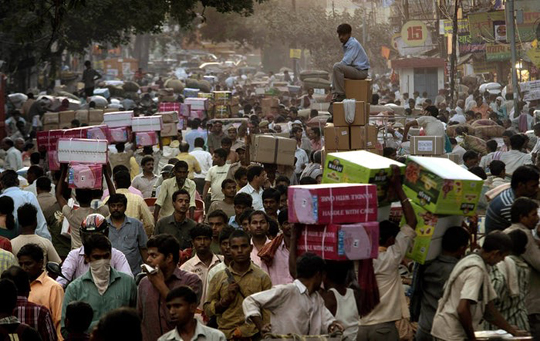
United Nations, Jun 22: India, which currently ranks as the second most populous country with 1.3 billion inhabitants, will surpass China's 1.4 billion citizens by 2024, the UN said in a report.
IndiaP

The world's total population is expected to hit 9.8 billion by 2050 despite universal lower fertility rates,the report added.

The world's population is now at least 7.6 billion, up from 7.4 billion last year, spurred by the relatively high levels of fertility in developing countries -- despite an overall drop in the number of children people have around the globe, the report World Population Prospects: The 2017 Revision revealed on Wednesday.

The concentration of global population growth is in the poorest countries, presenting a challenge as the world seeks to implement the 2030 Sustainable Development Agenda, which is aimed to end poverty and preserve the planet, according to the report.

"With roughly 83 million people being added to the world's population every year, the upward trend in population size is expected to continue, even assuming that fertility levels will continue to decline," said the UN Department of Economic and Social Affairs.

At this rate, the world population is expected to reach 8.6 billion in 2030, 9.8 billion in 2050 and surpass 11.2 billion in 2100, reports Xinhua news agency.

The growth is expected to come, in part, from the 47 least developed countries, where the fertility rate is around 4.3 births per woman, and whose population is expected to reach 1.9 billion people in 2050 from the current estimate of 1 billion.

In addition, the birth rates in African countries are likely to "at least double" by 2050, said the report.

That trend comes despite lower fertility rates in nearly all regions of the world, including in Africa, where rates fell from 5.1 births per woman up to 2005 to 4.7 births in the five years following.

In contrast, the birth rates in Europe are up to 1.6 births per woman, up from 1.4 births in 2000-2005.

The lower fertility rates are resulting in an ageing population, with the number of people aged 60 or over expected to more than double by 2050 and triple by 2100, from the current 962 million to 3.1 billion.

Africa, which has the youngest age distribution of any region, is projected to experience a rapid ageing of its population, the report noted.

By 2050, the third most populous country will be Nigeria, which currently ranks seventh, and which is poised to replace the US.

Comments

Nothing but Truth
 - 
Thursday, 22 Jun 2017

Major contribution will be from Peace Community..sadly

Add new comment

  • Coastaldigest.com reserves the right to delete or block any comments.
  • Coastaldigset.com is not responsible for its readers’ comments.
  • Comments that are abusive, incendiary or irrelevant are strictly prohibited.
  • Please use a genuine email ID and provide your name to avoid reject.
Agencies
July 7,2020

Washington, Jul 7: The US military "will continue to stand strong” in relationship to a conflict between India and China or anywhere else, a top White House official said on Monday, after the navy deployed two aircraft carriers to the South China Sea to boost its presence in the region.

"The message is clear. We're not going to stand by and let China or anyone else take the reins in terms of being the most powerful, dominant force, whether it's in that region or over here,” White House Chief of Staff Mark Meadows told Fox News.

“And the message is clear. Our military might stands strong and will continue to stand strong, whether it's in relationship to a conflict between India and China or anywhere else,” Meadows said in response to a question.

He was told that India banned Chinese apps because Indian soldiers were killed by Chinese troops last month and asked what's mission of the two aircraft carriers - the Ronald Reagan and the Nimitz - and what's America's mission.

The troops of India and China are locked in an eight-week standoff in several areas in eastern Ladakh including Pangong Tso, Galwan Valley and Gogra Hot Spring. The situation deteriorated last month following the Galwan Valley clashes that left 20 Indian Army personnel dead as the two sides significantly bolstered their deployments in most areas along the LAC.

The Chinese military on Monday began withdrawing troops from the Galwan Valley and Gogra Hot Spring after National Security Advisor Ajit Doval and Chinese Foreign Minister Wang Yi held lengthy talks on Sunday. Doval and Wang are also the special representatives on the India-China boundary talks.

The United States has sent two of its aircraft carriers to the South China Sea. “Our mission is to make sure that the world knows that we still have the preeminent fighting force on the face of the globe,” Meadows said.

President Donald Trump has invested more in the US military, more in not only the hardware, but the men and women who serve so sacrificially each and every day, he said. “He (Trump) continues to do so,” he added.

China is engaged in hotly contested territorial disputes in both the South China Sea and the East China Sea. Beijing has built up and militarised many of the islands and reefs it controls in the region. Both areas are stated to be rich in minerals, oil and other natural resources and are vital to global trade.

China claims almost all of the South China Sea. Vietnam, the Philippines, Malaysia, Brunei and Taiwan have counter claims over the area.

Appearing on the same Fox News on Monday talk show with host Brian Kilmeade, influential Republican Senator Tom Cotton said that the US aircraft carriers are headed to the South China Sea to thwart off any Chinese misadventure against Taiwan or other countries in the region.

"That's one of the reasons why we have those aircraft carrier groups in the South China Sea. I mean, look what China did in the southwest. It's essentially invaded India over the last few weeks and killed Indian soldiers,” Cotton said.

"No country on China's periphery, right now, is safe from Chinese aggression. All those countries want a close relationship with the United States. We ought to have one,” Cotton said.

Comments

Add new comment

  • Coastaldigest.com reserves the right to delete or block any comments.
  • Coastaldigset.com is not responsible for its readers’ comments.
  • Comments that are abusive, incendiary or irrelevant are strictly prohibited.
  • Please use a genuine email ID and provide your name to avoid reject.
News Network
May 14,2020

May 14: The UN’s children agency has warned that an additional 6,000 children could die daily from preventable causes over the next six months as the COVID-19 pandemic weakens the health systems and disrupts routine services, the first time that the number of children dying before their fifth birthday could increase worldwide in decades.

As the coronavirus outbreak enters its fifth month, the UN Children’s Fund (UNICEF) requested USD 1.6 billion to support its humanitarian response for children impacted by the pandemic.

The health crisis is “quickly becoming a child rights crisis. And without urgent action, a further 6,000 under-fives could die each day,” it said.

With a dramatic increase in the costs of supplies, shipment and care, the agency appeal is up from a USD 651.6 million request made in late March – reflecting the devastating socioeconomic consequences of the disease and families’ rising needs.

"Schools are closed, parents are out of work and families are under strain," UNICEF Executive Director Henrietta Fore said on Tuesday.

 “As we reimagine what a post-COVID world would look like, these funds will help us respond to the crisis, recover from its aftermath, and protect children from its knock-on effects.”

The estimate of the 6,000 additional deaths from preventable causes over the next six months is based on an analysis by researchers from the Johns Hopkins Bloomberg School of Public Health, published on Wednesday in the Lancet Global Health Journal.

UNICEF said it was based on the worst of three scenarios analysing 118 low and middle-income countries, estimating that an additional 1.2 million deaths could occur in just the next six months, due to reductions in routine health coverage, and an increase in so-called child wasting.

Around 56,700 more maternal deaths could also occur in just six months, in addition to the 144,000 likely deaths across the same group of countries. The worst case scenario, of children dying before their fifth birthdays, would represent an increase "for the first time in decades,” Fore said.

"We must not let mothers and children become collateral damage in the fight against the virus. And we must not let decades of progress on reducing preventable child and maternal deaths, be lost,” she said.

Access to essential services, like routine immunisation, has already been compromised for hundreds of millions of children and threatens a significant increase in child mortality.

According to a UNICEF analysis, some 77 per cent of children under the age of 18 worldwide are living in one of 132 countries with COVID-19 movement restrictions.

The UN agency also spotlighted that the mental health and psychosocial impact of restricted movement, school closures and subsequent isolation are likely to intensify already high levels of stress, especially for vulnerable youth.

At the same time, they maintained that children living under restricted movement and socio-economic decline are in greater jeopardy of violence and neglect. Girls and women are at increased risk of sexual and gender-based violence.

The UNICEF pointed out that in many cases, refugee, migrant and internally displaced children are experiencing reduced access to protection and services while being increasingly exposed to xenophobia and discrimination.

“We have seen what the pandemic is doing to countries with developed health systems and we are concerned about what it would do to countries with weaker systems and fewer available resources,” Fore said.

In countries suffering from humanitarian crises, UNICEF is working to prevent transmission and mitigate the collateral impacts on children, women and vulnerable populations – with a special focus on access to health, nutrition, water and sanitation, education and protection.

To date, the UN agency said it has received USD 215 million to support its pandemic response, and additional funding will help build upon already-achieved results.

Within its response, UNICEF has reached more than 1.67 billion people with COVID-19 prevention messaging around hand washing and cough and sneeze hygiene; over 12 million with critical water, sanitation and hygiene supplies; and nearly 80 million children with distance or home-based learning.

The UN agency has also shipped to 52 countries, more than 6.6 million gloves, 1.3 million surgical masks, 428,000 N95 respirators and 34,500 COVID-19 diagnostic tests, among other items.

Comments

Add new comment

  • Coastaldigest.com reserves the right to delete or block any comments.
  • Coastaldigset.com is not responsible for its readers’ comments.
  • Comments that are abusive, incendiary or irrelevant are strictly prohibited.
  • Please use a genuine email ID and provide your name to avoid reject.
News Network
January 22,2020

Davos, Jan 22: President Donald Trump has said that the US is watching the developments between India and Pakistan over Kashmir "very closely" and repeated his offer to "help" resolve the longstanding dispute between the two neighbours as he met Prime Minister Imran Khan on the sidelines of the World Economic Forum here in the Swiss ski resort.

Addressing the media with the Pakistan Prime Minister prior to their private meeting on Tuesday, President Trump asserted that trade and borders were both critical points for discussion, while Khan said that for him, Afghanistan was the top priority.

Trump told Khan, whom he referred to as "my friend", that he would speak to Prime Minister Narendra Modi about the ongoing Kashmir issue. The US president is expected to visit India in the coming weeks, marking his first visit after taking up his post in the White House.

"What's going on between Pakistan and India … if we can help, we certainly will be willing to. We have been watching it very closely and it's an honour to be here with my friend," he said.

"The Pakistan-India conflict is a very big issue for us in Pakistan and we expect the US to always play its part in deescalating the tensions, because no other country can," Khan said.

President Trump has repeatedly offered to mediate following India's August 5 decision to revoke the special status to Jammu and Kashmir and bifurcate the state into two Union Territories, evoking strong reaction from Pakistan which has been trying to internationalise the Kashmir issue.

New Delhi has defended the move, saying Jammu and Kashmir is an integral part of India and the issue was strictly internal to the country, and the special status provisions only gave rise to terrorism in Jammu and Kashmir.

"The country took the decision of abrogation of Article 370, which had only given separatism and terrorism to that state," Prime Minister Narendra Modi said at a function in October last year.

This is the third meeting between Trump and Khan since Pakistan premier assumed office in 2018 and it came against the backdrop of Pakistan Foreign Minister Shah Mehmood Qureshi's recent trip to the US, amid reports that the US and Afghan Taliban were close to striking a peace deal.

"There are issues we want to talk about. The main issue is Afghanistan because it concerns the US and Pakistan. Fortunately, we are on the same page. Both of us are interested in peace there and an orderly transition in Afghanistan with talks with Taliban and the government," Khan said.

When a reporter asked Trump if he would visit Pakistan considering he was already set to visit India, the US president said he was meeting the Pakistan premier in Davos.

"Well, we're visiting right now. So we don't really have to. I wanted to say that from a relationship standpoint, we got a great relationship. From the standpoint our two countries, we're getting along very well. I would say we've never been closer with Pakistan the way we're right now. And this is a big statement," Trump said.

Khan left for Switzerland to attend the World Economic Forum and meet the world leaders, including President Trump, on the sidelines of the annual event which kicked off at the ski resort town of Davos on Tuesday.

The four-day summit marks the 50th anniversary of the forum.

A total of 53 heads of State are on the guest list. Nearly 3,000 participants from 118 countries are expected to attend the event during which political leaders, business executives, heads of international organisations and civil society representatives are set to deliberate on contemporary economic, geopolitical, social and environmental issues.

Comments

Add new comment

  • Coastaldigest.com reserves the right to delete or block any comments.
  • Coastaldigset.com is not responsible for its readers’ comments.
  • Comments that are abusive, incendiary or irrelevant are strictly prohibited.
  • Please use a genuine email ID and provide your name to avoid reject.