Communal tension rocks Kalladka again; cops resort to baton charge

CD Network
June 21, 2017

Mangaluru, Jun 21: The murder of a local leader of Social Democratic Party of India on Wednesday at Benjanapadavu village has exacerbated communal tensions at neighboring Kalladka town in Bantwal taluk.

kalladka1 

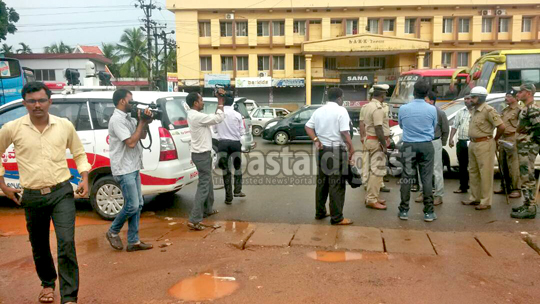
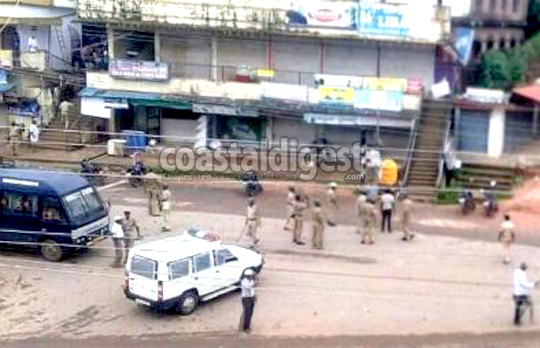
Police resorted to mild baton charge to disperse mob at Kalladka junction within an hour after armed miscreants hacked Mohammed Ashraf, SDPI’s Ammunje unit president, to death at Benjanapadavu on Wednesday morning.

As part of precautionary measures, the police asked the locals in Kalladka to shut down their shops and commercial establishments and remain at homes.

Meanwhile, RSS leader Prabhakar Bhat along with his followers reportedly forced some locals to open their shops. This led to a tense situation in the town for some time. When local residents began to gather, police intervened and canned the mob.

The local residents accused Kalladka Bhat of deliberately trying to disrupt peace in the society. Security was further tightened in the town after the murder.

Deputy Commissioner K G Jagadeesha and Inspector General of Police (Western Range) P Harishekaran also visited Kalladka to oversee the security measures.

Also Read: Bloodshed continues in Bantwal taluk: SDPI activist brutally hacked to death

kalladka2


Comments

muhammed rafique
 - 
Wednesday, 21 Jun 2017

when you know who is disturbing peace why don't you encounter him

Beedi basava
 - 
Wednesday, 21 Jun 2017

This iz peak time for business az eid is approching. Businessman invested crores of stocks for eid. Coz of bhatta they r loosing business

Add new comment

  • Coastaldigest.com reserves the right to delete or block any comments.
  • Coastaldigset.com is not responsible for its readers’ comments.
  • Comments that are abusive, incendiary or irrelevant are strictly prohibited.
  • Please use a genuine email ID and provide your name to avoid reject.
coastaldigest.com news network
June 16,2020

Newsroom, Jun 16: A 35-year-old Kannada lecturer died in a motorbike accident at Tumkuru in Karnataka.

The deceased is K N Swamy, who was a guest lecturer in Department of Kannada at Central University of Kerala located at Periya in Kasaragod district.

The accident occurred on Sunday afternoon when he was riding his motorbike.

Swamy was also a writer and poet in Kannada.

Comments

Add new comment

  • Coastaldigest.com reserves the right to delete or block any comments.
  • Coastaldigset.com is not responsible for its readers’ comments.
  • Comments that are abusive, incendiary or irrelevant are strictly prohibited.
  • Please use a genuine email ID and provide your name to avoid reject.
News Network
March 14,2020

Kalaburagi, Mar 14: Utter negligence of Kalaburagi health department officials was one of the main reasons for the death of his father, alleged family member of Kalaburagi man and India's first COVID-19 victim here on Friday.

The victim's son said 'if officials of Kalaburagi health department had advised us to admit his father in isolated ward, which was opened in Gulbarga Institute of Medical science (GIMS), my father's survival time may have been extended,' he said.

Comments

Add new comment

  • Coastaldigest.com reserves the right to delete or block any comments.
  • Coastaldigset.com is not responsible for its readers’ comments.
  • Comments that are abusive, incendiary or irrelevant are strictly prohibited.
  • Please use a genuine email ID and provide your name to avoid reject.
coastaldigest.com news network
February 14,2020

Bengaluru, Feb 14: In a major embarrassment to the police, the Karnataka High Court has termed as illegal the prohibitory orders imposed under Section 144 of CrPC by the City Police Commissioner in December 2019 in the light of the anti-Citizenship Amendment Act (CAA) protests in Bengaluru.

The orders were passed “without application of mind” and without following due procedures, the court noted. Giving reasons for upholding the arguments of the petitioners that there was no application of mind by the Police Commissioner (Bhaskar Rao) before imposing restrictions, a division bench of the High Court said he had not recorded the reasons, except reproducing the contents of letters addressed to him by the Deputy Commissioners of Police (DCPs). 

The state government had contended that prohibitory orders were passed based on reports submitted by the DCPs who expressed apprehension about anti-social elements creating law and order problems and damaging public property by taking advantage of the anti-CAA protests.  

The High Court bench said the Police Commissioner should have conducted inquiry as stated by the Supreme Court to check the reasons cited by the DCPs who submitted identical reports. Except for this, there were no facts laid out by the Police Commissioner, the court said.

“There is complete absence of reasons. If the order indicated that the Police Commissioner was satisfied by the apprehension of DCPs, it would have been another matter,” it said.  

“The apex court has held that it must record the reasons for imposition of restrictions and there has to be a formation of opinion by the district magistrate. Only then can  the extraordinary powers conferred on the district magistrate can be exercised. This procedure was not followed. Hence, exercise of power under Section 144 by the commissioner, as district magistrate, was not at all legal”, the bench said. 

“We hold that the order dated December 18, 2019 is illegal and cannot stand judicial scrutiny in terms of the apex court’s orders in the Ramlila Maidan case and Anuradha Bhasin case,” the HC bench said while upholding the arguments of Prof Ravivarma Kumar, who appeared for some of the petitioners.   

Partly allowing a batch of public interest petitions questioning the imposition of prohibitory orders and cancelling the permission granted for protesters in the city, the bench of Chief Justice Abhay Shreeniwas Oka and Justice Hemant Chandangoudar observed that, unfortunately, in the present case, there was no indication of application of mind in passing prohibitory orders.

The bench said the observation was confined to this order only and it cannot be applicable in general. If there is a similar situation (necessitating imposition of restrictions), the state is not helpless, the court said.


Comments

Add new comment

  • Coastaldigest.com reserves the right to delete or block any comments.
  • Coastaldigset.com is not responsible for its readers’ comments.
  • Comments that are abusive, incendiary or irrelevant are strictly prohibited.
  • Please use a genuine email ID and provide your name to avoid reject.