Yeddyurappa savours ‘akki rotti’ at Dalit houses in Chikkamagaluru

News Network
June 20, 2017

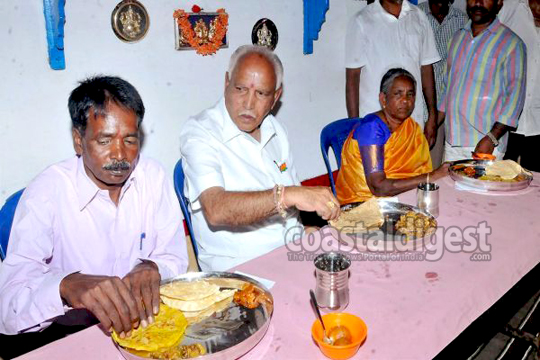
Chikkamagaluru, Jun 20: Former chief minister and BJP state unit president B S Yeddyurappa, who has been dining at Dalits’ houses, savoured indigenous menu in the district on Monday.

yeddy3

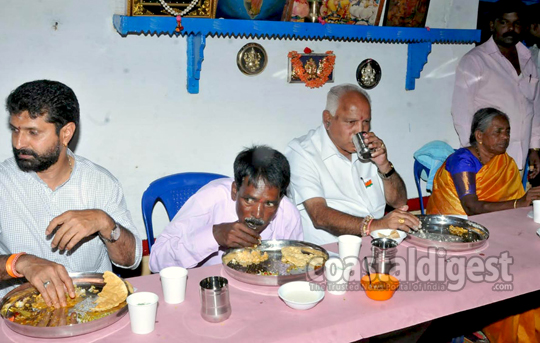
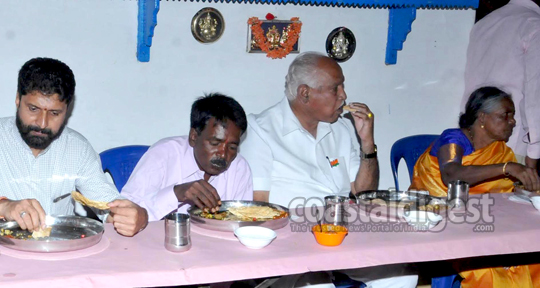
Sannathammaiah, a Dalit at Marle village, played host to the BJP heavyweight and his entourage of MP and MLAs, serving them akki rotti, palya, chutney and upma.

Lakshmi, the elated wife of Sannathammaiah, said, “It’s a matter of joy that Yeddyurappa has come to our house. I had prepared akki rotti and uppittu (local parlance for upma) for him.”

Yeddyurappa, who was accompanied by MLC Pranesh and MLAs C T Ravi and D N Jeevaraj during the time, also visited Kencharaya Temple.

He enquired a senior citizen Mahalingamma about the old age pension. Addressing a gathering during the Janasamparka Abhiyhan at the village, he said, “The opposition parties indulge in negative publicity against the BJP leaders dining at Dalits’ houses. Chief Minister Siddaramaiah though has completed four years in office, has not even called on the Dalits to enquire about their travails even for once. Similar is the attitude of ministers who don’t have time for marginalised community.

Yeddyurappa also alleged that the state government has dropped Bhagyalakshmi Scheme launched by previous BJP government.

Continuing his tirade against the Congress party, Yeddyurappa said that while the Congress has ignored the ideals espoused by Dr B R Ambedkar, Prime Minister Narendra Modi succeeded in invoking Ambekdar’s principles at Lok Sabha. The Centre has also taken measures to identify and develop five places associated with the Dalit icon as a pilgrimage centre, the former chief minister said.

Highlighting the recent decision of the governments at Uttar Pradesh and Maharashtra to waive farmer loans, Yeddyurappa said Siddaramaiah intentionally did not follow the suit, and instead pointed at the Centre to make a move.

yeddy1

yeddy2

Comments

MR
 - 
Tuesday, 20 Jun 2017

Why does the food on Yeddyurappa's plate look different ? Was his food from Resturant?

abdul
 - 
Wednesday, 21 Jun 2017

new plates , cup nd hotel food

Add new comment

  • Coastaldigest.com reserves the right to delete or block any comments.
  • Coastaldigset.com is not responsible for its readers’ comments.
  • Comments that are abusive, incendiary or irrelevant are strictly prohibited.
  • Please use a genuine email ID and provide your name to avoid reject.
News Network
August 2,2020

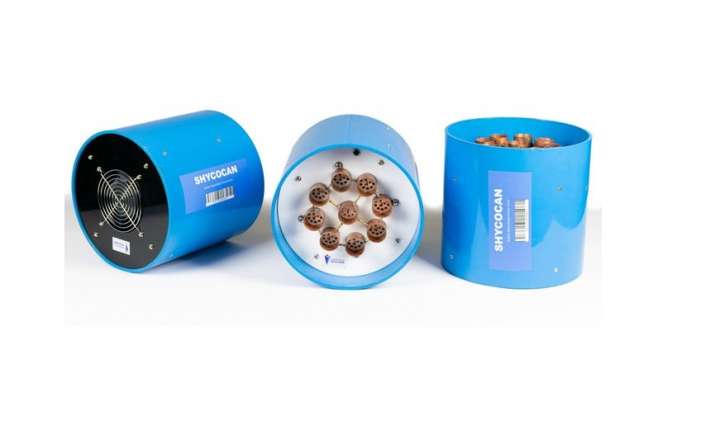
Bengaluru, Aug 2: Bengaluru based Centre for Advanced Research and Development (CARD), the research wing of organisation De scalene has come up with a device called "SHYCOCAN" (Scalene Hypercharge Corona Canon) which neutralizes the coronavirus.

Speaking to news agency Dr Rajah Vijay Kumar, Chairman, Organisation De Scalene said that the device will not kill any bacteria or fungus, however, neutralizes the coronavirus particles.

"The device was tested for its safety and efficacy and is soon going to be manufactured and marketed in the US under the Enforcement Discretion policy of USFDA and in Europe as the device is CE compliant and is CE marked," said Kumar.

He also added the device will cover a volume of 10,000 cubic feet.

The device Scalene Hypercharge Corona Canon (SHYCOCAN) is intended to be used in the residential, industrial and commercial environment and is designed for active containment by attenuation of Corona family of viruses. (Laboratories de Especialidades Immunological S.A. de C.V, Virucidal Activity concludes 99.9 per cent virus elimination), Kumar asserted.

"SHYCOCAN operates on regular 110/240V - 50/60 Hz wall socket and is a plug and play device, that delivers the necessary signals to a photon mediated electrons emitters (PMEE), that produces hypercharge high-velocity electrons by photon mediation that interacts with the negative seeking S-protein of Corona family of viruses thus reducing infectivity and prevent air and surface borne transmission of corona family of viruses," said Kumar.

The device does not use any chemicals, or any other consumables and does not produce harmful ozone gas or any other substances and is completely safe for use in any environment, he added.

"The attack mechanism of the Virus starts with the initial attachment of the virion to the host cell, it is initiated by interactions between the S-protein and its receptor on the "negative" cell membrane. The sites of receptor binding domains (RBD) within the S1 region of a coronavirus S-protein vary depending on the virus. 

The S-protein/receptor interaction is the primary determinant for a coronavirus to infect a host species and governs the tissue tropism of the virus. However, the end result is the fusion and release of the viral genome into the cytoplasm," said Kumar.

He continued saying that the counter mechanism by the device SHYCOCAN is that if negative seeking is the guidance mechanism of the S- Protein, attracted by the transmembrane potential of the host cells, then breaking this mechanism would block the Coronavirus infectivity and spread.

"The device has been in use for more than a year at the S-CARD campus, the headquarters of Scalene," said Kumar.

Comments

Add new comment

  • Coastaldigest.com reserves the right to delete or block any comments.
  • Coastaldigset.com is not responsible for its readers’ comments.
  • Comments that are abusive, incendiary or irrelevant are strictly prohibited.
  • Please use a genuine email ID and provide your name to avoid reject.
News Network
June 18,2020

Bengaluru, Jun 18: Bruhat Bengaluru Mahanagara Palike (BBMP) has deployed a COVID-19 infection control "surveillance team" to look after travellers coming from other states.

Those coming to Bengaluru Urban and Bengaluru Rural Districts must undergo a 14-day home quarantine.

The Bengaluru Mayor today inaugurated surveillance team at Dr Raj Kumar Glass House.

Deputy Mayor Ramamohan Raju, Health Standing Committee Chairman Manjunath Raju G, Special Commissioners D Randeep, Manjunath, Superintendent of Police Mr Murugan and other officials were also present in the event.

There are 7,944 coronavirus cases in Karnataka including 2,843 active cases and 4,983discharged. 114 patients have succumbed to COVID-19 in the state. 844 positive cases were reported in Bengaluru Urban and 39 in Bengaluru Rural.

Comments

Add new comment

  • Coastaldigest.com reserves the right to delete or block any comments.
  • Coastaldigset.com is not responsible for its readers’ comments.
  • Comments that are abusive, incendiary or irrelevant are strictly prohibited.
  • Please use a genuine email ID and provide your name to avoid reject.
Agencies
May 8,2020

Washington D.C., May 8: The prime time for brain development in a child's life is the first year, where the infant spends most of the time asleep. It is the time when neural connections form and sensory memories are encoded.

However, when sleep is disrupted, as occurs more often among children with autism, brain development may be affected, too.

New research led by the University of Washington finds that sleep problems in a baby's first 12 months may not only precede an autism diagnosis but also may be associated with altered growth trajectory in a key part of the brain, the hippocampus.

The study, which was published in the American Journal of Psychiatry, researchers report that in a sample of more than 400 taken of 6- to 12-month-old infants, those who were later diagnosed with autism were more likely to have had difficulty falling asleep.

It also states that this sleep difficulty was associated with altered growth trajectories in the hippocampus.

"The hippocampus is critical for learning and memory, and changes in the size of the hippocampus have been associated with poor sleep in adults and older children.

As many as 80 per cent of the children with autism spectrum disorder have sleep problems," said Annette Estes, director of the UW Autism Center and senior author of the study.

"In our clinical experience, parents have a lot of concerns about their children's sleep, and in our work on early autism intervention, we observed that sleep problems were holding children and families back," added Estes, who is also a UW professor of speech and hearing sciences.

"It could be that altered sleep is part-and-parcel of autism for some children. One clue is that behavioural interventions to improve sleep don't work for all children with autism, even when their parents are doing everything just right. This suggests that there may be a biological component to sleep problems for some children with autism," said Estes.

To consider links among sleep, brain development, and autism, researchers at the IBIS Network looked at MRI scans of 432 infants, surveyed parents about sleep patterns, and measured cognitive functioning using a standardized assessment.

At the outset of the study, infants were classified according to their risk for developing autism: Those who were at higher risk of developing autism -- about two-thirds of the study sample -- had an older sibling who had already been diagnosed.

Infant siblings of children with autism have a 20 per cent chance of developing autism spectrum disorder -- a much higher risk than children in the general population.

In the current study, 127 of the 432 infants were identified as "low risk" at the time the MRI scans were taken because they had no family history of autism.

They later evaluated all the participants at 24 months of age to determine whether they had developed autism. Of the roughly 300 children originally considered "high familial risk," 71 were diagnosed with autism spectrum disorder at that age.

Problems with sleep were more common among the infants later diagnosed with an autism spectrum disorder, as were larger hippocampi. No other subcortical brain structures were affected, including the amygdala, which is responsible for certain emotions and aspects of memory, or the thalamus, a signal transmitter from the spinal cord to the cerebral cortex.

The authors note that while parents reported more sleep difficulties among infants who developed autism compared to those who did not, the differences were very subtle and only observed when looking at group averages across hundreds of infants.

Sleep patterns in the first years of life change rapidly as infants transition from sleeping around the clock to a more adult-like sleep/wake cycle. Until further research is completed, Estes said, it is not possible to interpret challenges with sleep as an early sign of increased risk for autism.


Comments

Add new comment

  • Coastaldigest.com reserves the right to delete or block any comments.
  • Coastaldigset.com is not responsible for its readers’ comments.
  • Comments that are abusive, incendiary or irrelevant are strictly prohibited.
  • Please use a genuine email ID and provide your name to avoid reject.