


Kalladka Bhat didn’t incite the clashes; drop Ramanath Rai from Cabinet: BJP

DHNS
June 20, 2017

Bengaluru, Jun 20: The principal Opposition BJP demanded in the both Houses of the legislature that the government remove Forest Minister B Ramanath Rai from the Cabinet for “misusing” his power to “target” senior RSS leader Kalladka Prabhakar Bhat.
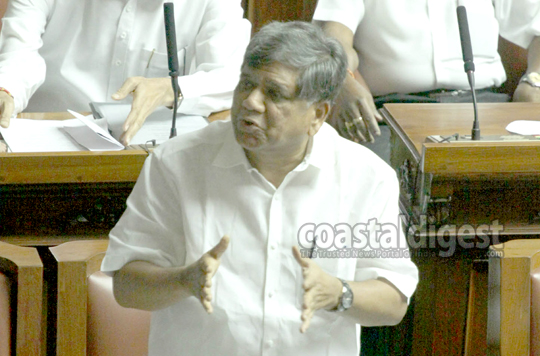
shettar

Leader of the Opposition in the Assembly Jagadish Shettar said a video had surfaced which purportedly shows Rai directing the Dakshina Kannada SP, Bhushan G Borase, to arrest the RSS leader in the wake of recent clashes at Kalladka. “The minister has been caught interfering in the police work. He has directed the officer to file a murder case against Bhat. Rai should not continue as minister (sic),” he stated.

In a recent statement to the media, the SP had held drug mafia responsible for the Kalladka clashes. Preliminary investigation has proved that Bhat has nothing to do with the clashes. Though the enquiry is still on, the minister jumped to a conclusion and tried to influence the police, Shettar said, adding that he is ready to submit the video in the form of a CD to the House.

V Sunil Kumar (BJP) accused Rai of being responsible for communal clashes in the district. “How can the minister direct the police to conduct the investigation in a particular way? It is an effort by the minister to appease the minority community by targeting pro-Hindu leaders. Rai should be removed as the in-charge minister of Dakshina Kannada district,” he demanded.

Vishweswara Hegde Kageri (BJP) said the video was a testimony to the minister’s efforts to disturb communal harmony. The entire House should admonish the minister, he said. Congress members, including Agriculture Minister Krishna Byre Gowda, Mohiudddin Bava and Abhayachandra Jain, objected to BJP members, leading to a noisy scene in the House.

Raising the issue in the Upper House, BJP’s Tara Anuradha sought Rai’s immediate resignation.

“The government is committing atrocities against BJP and Sangh Parivar leaders in the coastal belt. Rai is misusing his powers. The government is nurturing political enmity and, voices of other political parties ar¬e suppressed. Rai’s action is a new model of terrorism,” she charged.

Minister denies charge

Later, Rai denied having directed the SP to take action against any particular individual and said he had only asked the officer to act against those who make inflammatory speeches. He said some members connected to the Sangh Parivar are involved in the murder of local leaders belonging to a minority community.

“Inflammatory speeches were responsible for the recent clashes. So, I asked the police to take action against those who make such speeches...

“Some members of the Sangh Parivar were arrested in connection with the violent incidents. I have never protected a murderer in my life. I am a secular person and I vehemently oppose religious fanatics,” he stated.

Home Minister defends Rai

Home Minister G Parameshwara defended Ramanath Rai, saying that being the district in-charge minister he has responsibility to ensure law and order and communal harmony. Rai instructing the SP is not wrong. But, the police can’t arrest anybody based on a minister’s direction. The police will have to probe the matter and take action as per the law,” he added. Two people were stabbed in the recent violence at Kalladka, which took a communal colour. “Bhat had made many provocative speeches in the past. The police had arrested him several times for his involvement in violence.

Currently, there is no evidence about Bhat’s involvement in the violence. The police are probing the issue,” Parameshwara stated.

Comments

Abdul Samad
 - 
Tuesday, 20 Jun 2017

some Question need Answer.??

almost 4 years of Congress rule D.K district faced lot of communal disturbance from Facist Group, in every case RSS roam free, muslim youths at large put behind bar!?

there were many hate speech cases pending against Mr. Kalladka Bhatt, but no action was taken!?

D.K Police helpless it seems or they are also part of the R.S.S Conspiracy!?

the so called secular leaders turn their mouth & mobiles in to silent mode

Mr.Siddaramayyah & Mr.Rai openly challenged to Mr.Bhatt that once congress comes to power we will send Mr. Bhatt to jail!?

finally today the innocent voters come to the conclusion that congress never ever dare to touch RSS or its affiliate.

only the small opponent group which is working round the clock to resist RSS is the only hope for D.K. People

Holy cow
 - 
Tuesday, 20 Jun 2017

Saffron terrorists are at their peak, need to shut them down

Add new comment

  • Coastaldigest.com reserves the right to delete or block any comments.
  • Coastaldigset.com is not responsible for its readers’ comments.
  • Comments that are abusive, incendiary or irrelevant are strictly prohibited.
  • Please use a genuine email ID and provide your name to avoid reject.
News Network
June 4,2020

Bengaluru, Jun 4: The Karnataka government has tweaked quarantine requirements for people arriving from Maharashtra, raising the isolation time from a fortnight to three weeks, an official said on Wednesday.

"Returnees from Maharashtra will be sent to institutional quarantine for seven days, followed by 14 days strict home quarantine, total 21 days," tweeted Health Commissioner Pankaj Kumar Pandey.

The 21-day quarantine regimen is for all asymptomatic people returning from Maharashtra, considering most of the Covid cases in Karnataka are having domestic travel history to that state.

If any of the asymptomatic people develop symptoms during the isolation, they will be subjected to a Covid test.

However, some asymptomatic individuals from Maharashtra have been provided some exceptions from the three-week quarantine and designated as special category passengers.

Special category passengers include people who suffered a death in family, pregnant women, children below 10, elderly people above 60, individuals suffering from serious illness and human distress.

Similarly, the department has also made some provisions for business travellers from Maharashtra.

"To establish that one is a business visitor, (that) person should show confirmed return flight or train ticket which should not be more than seven days later from the date of arrival," ordered Chief Secretary T.M. Vijay Bhaskar.

Similarly, if a business visitor is arriving on road, he should provide the address proof of the person in Karnataka he intends to meet.

Additionally, such a person should also produce a Covid negative test certificate which is not more than two days old.

"One does not have a Covid negative test certificate such a person should go for institutional quarantine for two days within which Covid test should be conducted at his own cost. After the test result is negative, that person is exempted from quarantine," he said.

However, business travellers have been exempted from hand stamping.

Amending the Sunday orders, Bhaskar, has enhanced the quarantine requirements for Maharashtra returnees.

Many conditions for visitors from other states remain mostly unchanged as notified on Sunday.

Comments

Add new comment

  • Coastaldigest.com reserves the right to delete or block any comments.
  • Coastaldigset.com is not responsible for its readers’ comments.
  • Comments that are abusive, incendiary or irrelevant are strictly prohibited.
  • Please use a genuine email ID and provide your name to avoid reject.
Ram Puniyani
January 14,2020

In the beginning of January 2020 two very disturbing events were reported from Pakistan. One was the attack on Nankana Sahib, the holy shrine where Sant Guru Nanak was born. While one report said that the place has been desecrated, the other stated that it was a fight between two Muslim groups. Prime Minister of Pakistan Imran Khan condemned the incident and the main accused Imran Chisti was arrested. The matter related to abduction and conversion of a Sikh girl Jagjit Kaur, daughter of Pathi (One who reads Holy Guru Granth Sahib in Gurudwara) of the Gurudwara. In another incident one Sikh youth Ravinder Singh, who was out on shopping for his marriage, was shot dead in Peshawar.

While these condemnable attacks took place on the Sikh minority in Pakistan, BJP was quick enough to jump to state that it is events like this which justify the Citizenship Amendment Act (CAA). Incidentally CAA is the Act which is discriminatory and relates to citizenship with Religion, which is not as per the norms of Indian constitution. There are constant debates and propaganda that population of Hindus has come down drastically in Pakistan and Bangla Desh. Amit Shah, the Home minister stated that in Pakistan the population of Hindus has come down from 23% at the time of partition to 3.7% at present. And in Bangla Desh it has come down from 22% to present 8%.

While not denying the fact that the religious minorities are getting a rough deal in both these countries, the figures which are presented are totally off the mark. These figures don’t take into consideration the painful migrations, which took place at the time of partition and formation of Bangla Desh later. Pakistan census figures tell a different tale. Their first census was held in 1951. As per this census the overall percentage of Non Muslim in Pakistan (East and West together) was 14.2%, of this in West Pakistan (Now Pakistan) it was 3.44 and in Eat Pakistan it was 23.2. In the census held in Pakistan 1998 it became 3.72%. As far as Bangla Desh is concerned the share of Non Muslims has gone down from 23.2 (1951) to 9.6% in 2011.

The largest minority of Pakistan is Ahmadis, (https://minorityrights.org/country/pakistan/) who are close to 4 Million and are not recognised as Muslims in Pakistan. In Bangla Desh the major migrations of Hindus from Bangla Desh took place in the backdrop of Pakistan army’s atrocities in the then East Pakistan.

As far as UN data on refugees in India it went up by 17% between 2016-2019 and largest numbers were from Tibet and Sri Lanka.  (https://www.un.org/en/development/desa/population/migration/publication…)

The state of minorities is in a way the index of strength of democracy. Most South Asian Countries have not been able to sustain democratic values properly. In Pakistan, the Republic began with Jinnah’s classic speech where secularism was to be central credo of Pakistan. This 11th August speech was in a way what the state policy should be, as per which people of all faiths are free to practice their religion. Soon enough the logic of ‘Two Nation theory” and formation of Pakistan, a separate state for Muslim took over. Army stepped in and dictatorship was to reign there intermittently. Democratic elements were suppressed and the worst came when Zia Ul Haq Islamized the state in collusion with Maulanas. The army was already a strong presence in Pakistan. The popular formulation for Pakistan was that it is ruled by three A’s, Army, America and Allah (Mullah).

Bangla Desh had a different trajectory. Its very formation was a nail in the coffin of ‘two nation theory’; that religion can be the basis of a state. Bangla Desh did begin as a secular republic but communal forces and secular forces kept struggling for their dominance and in 1988 it also became Islamic republic. At another level Myanmar, in the grip of military dictatorship, with democratic elements trying to retain their presence is also seeing a hard battle. Democracy or not, the army and Sanghas (Buddhist Sang has) are strong, in Myanmar as well. The most visible result is persecution of Rohingya Muslims.

Similar phenomenon is dominating in Sri Lanka also where Budhhist Sanghas and army have strong say in the political affairs, irrespective of which Government is ruling. Muslim and Christian minorities are a big victim there, while Tamils (Hindus, Christians etc.) suffered the biggest damage as ethnic and religious minorities. India had the best prospect of democracy, pluralism and secularism flourishing here. The secular constitution, the outcome of India’s freedom struggle, the leadership of Gandhi and Nehru did ensure the rooting of democracy and secularism in a strong way.

India so far had best democratic credentials amongst all the south Asian countries. Despite that though the population of minorities rose mainly due to poverty and illiteracy, their overall marginalisation was order of the day, it went on worsening with the rise of communal forces, with communal forces resorting to identity issues, and indulging in propaganda against minorities.

While other South Asian countries should had followed India to focus more on infrastructure and political culture of liberalism, today India is following the footsteps of Pakistan. The retrograde march of India is most visible in the issues which have dominated the political space during last few years. Issues like Ram Temple, Ghar Wapasi, Love Jihad, Beef-Cow are now finding their peak in CAA.

India’s reversal towards a polity with religion’s identity dominating the political scene was nicely presented by the late Pakistani poetess Fahmida Riaz in her poem, Tum bhi Hum Jaise Nikle (You also turned out to be like us). While trying to resist communal forces has been an arduous task, it is becoming more difficult by the day. This phenomenon has been variously called, Fundamentalism, Communalism or religious nationalism among others. Surely it has nothing to do with the religion as practiced by the great Saint and Sufi traditions of India; it resorts mainly to political mobilization by using religion as a tool.

Comments

Ashi
 - 
Tuesday, 14 Jan 2020

If Malaysia implement similar NRC/CAA, India and China are the loser.

Add new comment

  • Coastaldigest.com reserves the right to delete or block any comments.
  • Coastaldigset.com is not responsible for its readers’ comments.
  • Comments that are abusive, incendiary or irrelevant are strictly prohibited.
  • Please use a genuine email ID and provide your name to avoid reject.
News Network
June 7,2020

New Delhi, Jun 7: The Karnataka government has asked the railways to make announcements at originating stations that it was compulsory for passengers travelling to the state to register themselves on the ‘Seva Sindhu’ portal through which they can be tracked.

In a letter to Chairman Railway Board on Saturday, Chief Secretary of the state T M Vijay Bhaskar said many passengers are not aware of this mandatory rule of the southern state.

He said thousands of passengers are coming to Karnataka from New Delhi, Bihar, Maharashtra and other states through trains everyday, but most of them are not registered under the Seva Sindhu portal of the Government of Kamataka.

"If passengers are not registered under Seva Sindhu, the state will not be able to track them. Therefore, it is necessary to create awareness among the passengers regarding registration under the portal.

"Hence, it is requested to give instructions to origin railway stations to make announcements that ‘It is compulsory for all passengers travelling to Karnataka to register in Seva Sindhu portal. Otherwise they will not be allowed for home quarantine’, and also to give passengers awareness (about this) at the time of booking tickets,” Bhaskar said in his letter to the national transporter.

Seva Sindhu portal, under the control of the Karnataka government, provides various online services to the citizens of the state.

Currently, this portal is playing an important role in helping those stranded amid the COVID-19 pandemic to fill online registration forms for availing e-passes.

Comments

Add new comment

  • Coastaldigest.com reserves the right to delete or block any comments.
  • Coastaldigset.com is not responsible for its readers’ comments.
  • Comments that are abusive, incendiary or irrelevant are strictly prohibited.
  • Please use a genuine email ID and provide your name to avoid reject.