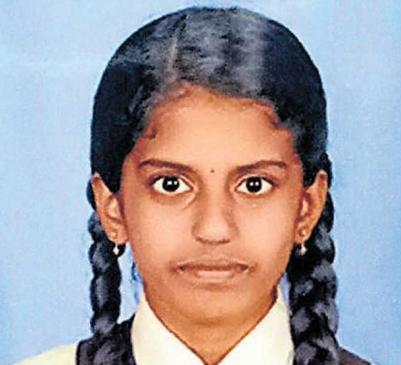
Re-evaluation gives Shivamogga girl 625/625 in SSLC, makes her state topper

CD Network
June 20, 2017

Shivamogga, Jun 20: By securing three more marks in the re-evaluation of answer scripts, Subhashini S., a student of Ramakrishna Vidyanikethana School in Shivamogga, has scored 625 out of 625 in the SSLC examination. With this four students in Karnataka have achieved full marks in SSLC this year.

Telugu

Barring Kannada, which was her first language, the Telugu speaking girl had scored full marks in the other five subjects when the results were announced in May. She had scored 122 out of 125 in Kannada.

However, according to Ms. Subhashini, after close examination of the photocopies of her evaluated Kannada answer scripts, her teachers suggested that she opt for re-evaluation as there were no spelling, grammatical or factual errors in her answer script.

The re-evaluation result proved her right. With the perfect score in Kannada, she has become one of the toppers in the SSLC exam in Karnataka. She scored a perfect centum in English, Hindi, Social Science, Science and Mathematics.

But what makes her achievement extraordinary is the fact that she had studied in a Telugu-medium school till Class 7 in Andhra Pradesh. Her parents — Srinivasulu Reddy and Sujata — hail from Kolar. She had moved to Shivamogga to live with her grandfather, Kannappa, to study SSLC.

She chose Kannada as the first language in high school. Shobha Ramakrishna, the secretary of the school management, said scoring 125 marks in Kannada was a great achievement for a student whose medium of instruction in primary school was Telugu. Subhashini initially struggled to write the Kannada alphabets, but picked up the language in just six months with the help of teachers and a little determination.

Sujata, her mother, said: “I am happy that my daughter has finally got justice. If she had obtained 625 marks last month, it would have been wonderful. Anyway, she has got the reward for hard work. She aspires to be a doctor.” Subhashini has enrolled at Narayana Guru College in Bengaluru for first-year PUC (Science).

Comments

Ashish
 - 
Wednesday, 21 Jun 2017

Congrats girl... Way to go.....
For me, even if I evaluate my own paper, it would be impossible to score out of out............

Add new comment

  • Coastaldigest.com reserves the right to delete or block any comments.
  • Coastaldigset.com is not responsible for its readers’ comments.
  • Comments that are abusive, incendiary or irrelevant are strictly prohibited.
  • Please use a genuine email ID and provide your name to avoid reject.
News Network
January 20,2020

Chamarajanagara, Jan 20: Karnataka High Court Judge P G M Patil has said that it was the responsibility of the judiciary to ensure that justice was not delayed.

He was speaking at a function marking the inauguration of the first and second floors of the district courts in Chamarajanagar town here last evening. He said that the role of the judiciary was critical in establishing justice in society and hence all efforts must be made to ensure that there was no delay in securing justice.

He observed that the district court has been provided with better amenities that should be utilized for the benefit of the public. The district is no longer backward. It has shown progress and development in recent years and has produced three HC judges, Justice Patil added.

Comments

Add new comment

  • Coastaldigest.com reserves the right to delete or block any comments.
  • Coastaldigset.com is not responsible for its readers’ comments.
  • Comments that are abusive, incendiary or irrelevant are strictly prohibited.
  • Please use a genuine email ID and provide your name to avoid reject.
coastaldigest.com web desk
June 9,2020

Mumbai, June 9: A 45-year-old doctor posted in the 108 ambulance service at Malad railway station in Mumbai died of COVID-19 after two hospitals refused admission, in spite of the fact that he was a frontline warrior against coronavirus.

The victim is Dr Shaukat Ali, who was working with the 108 ambulance service for the last four years. A few days ago, he got his blood tests done after his health deteriorated. The result stated typhoid fever following which he started getting treatment at home in Malwani.

Ali's family ran from pillar to post to get him hospitalised in either a private or government hospital, to no avail.

"On Friday, his condition worsened and he started feeling breathless. Despite us calling the 108 ambulance service, no one picked up the call. So after waiting for a while, I and uncle's colleague, Dr Nigam, rushed him to SK Patil hospital in Malad East in an auto. But they refused us stating they were admitting only COVID-19 patients.”

“Then we took him to Desai Hospital, where doctors were initially ready to admit him but later refused stating lack of beds. They said we could take him home as his condition was fine," Zubair Shaikh, Ali's nephew said.

"But his condition worsened. So, I called Dr Nigam and we managed to admit him in Shatabdi hospital. On Sunday, when his results came out stating that he had COVID-19, doctors had already put him on a ventilator, where he passed away in the evening," he added.

Zubair further said, "Had the doctors at Desai Memorial Hospital admitted him, my uncle would have been alive today. It is a matter of great regret that a doctor, who was risking his life during this pandemic, could not get help from his own government hospitals."

Ali's wife and his two children's are in UP, while he was staying with his elder daughter who had recently appeared for HSC exams and preparing for NEET.

Comments

Please don't say such words, I personally became very sad after hearing this that Warrior like Dr. Saukat Ali passes away due to mismanagement of health organization. My condolence to him and his family. Please don't divide Hindu and Muslims in such way, not only Muslims but Hindu also died due to such reasons and one more thing here in Maharashtra, BJP is not ruling party. Thanks..

Ugly Indian
 - 
Wednesday, 10 Jun 2020

VERY VERY SAD...innna lillahi wainna yelahai rajoon.
this is the lession for all INDIAN muslim doctor as well as muslims....open your ear and listen.
this is indian not italy and now current ruling government is very very bad...they want indian to be slave.
also today you help your hindu brother but tommorow they will vote for same people BJP who is giving touble to muslim..GOD given chance to develop muslim community not our enemy,
india is divided alreday, my 20 year old hindu friend become my enemy now after NRC and CAA..
we will see where it will end. may the justice and peace prevail.


Add new comment

  • Coastaldigest.com reserves the right to delete or block any comments.
  • Coastaldigset.com is not responsible for its readers’ comments.
  • Comments that are abusive, incendiary or irrelevant are strictly prohibited.
  • Please use a genuine email ID and provide your name to avoid reject.
Ram Puniyani
January 14,2020

In the beginning of January 2020 two very disturbing events were reported from Pakistan. One was the attack on Nankana Sahib, the holy shrine where Sant Guru Nanak was born. While one report said that the place has been desecrated, the other stated that it was a fight between two Muslim groups. Prime Minister of Pakistan Imran Khan condemned the incident and the main accused Imran Chisti was arrested. The matter related to abduction and conversion of a Sikh girl Jagjit Kaur, daughter of Pathi (One who reads Holy Guru Granth Sahib in Gurudwara) of the Gurudwara. In another incident one Sikh youth Ravinder Singh, who was out on shopping for his marriage, was shot dead in Peshawar.

While these condemnable attacks took place on the Sikh minority in Pakistan, BJP was quick enough to jump to state that it is events like this which justify the Citizenship Amendment Act (CAA). Incidentally CAA is the Act which is discriminatory and relates to citizenship with Religion, which is not as per the norms of Indian constitution. There are constant debates and propaganda that population of Hindus has come down drastically in Pakistan and Bangla Desh. Amit Shah, the Home minister stated that in Pakistan the population of Hindus has come down from 23% at the time of partition to 3.7% at present. And in Bangla Desh it has come down from 22% to present 8%.

While not denying the fact that the religious minorities are getting a rough deal in both these countries, the figures which are presented are totally off the mark. These figures don’t take into consideration the painful migrations, which took place at the time of partition and formation of Bangla Desh later. Pakistan census figures tell a different tale. Their first census was held in 1951. As per this census the overall percentage of Non Muslim in Pakistan (East and West together) was 14.2%, of this in West Pakistan (Now Pakistan) it was 3.44 and in Eat Pakistan it was 23.2. In the census held in Pakistan 1998 it became 3.72%. As far as Bangla Desh is concerned the share of Non Muslims has gone down from 23.2 (1951) to 9.6% in 2011.

The largest minority of Pakistan is Ahmadis, (https://minorityrights.org/country/pakistan/) who are close to 4 Million and are not recognised as Muslims in Pakistan. In Bangla Desh the major migrations of Hindus from Bangla Desh took place in the backdrop of Pakistan army’s atrocities in the then East Pakistan.

As far as UN data on refugees in India it went up by 17% between 2016-2019 and largest numbers were from Tibet and Sri Lanka.  (https://www.un.org/en/development/desa/population/migration/publication…)

The state of minorities is in a way the index of strength of democracy. Most South Asian Countries have not been able to sustain democratic values properly. In Pakistan, the Republic began with Jinnah’s classic speech where secularism was to be central credo of Pakistan. This 11th August speech was in a way what the state policy should be, as per which people of all faiths are free to practice their religion. Soon enough the logic of ‘Two Nation theory” and formation of Pakistan, a separate state for Muslim took over. Army stepped in and dictatorship was to reign there intermittently. Democratic elements were suppressed and the worst came when Zia Ul Haq Islamized the state in collusion with Maulanas. The army was already a strong presence in Pakistan. The popular formulation for Pakistan was that it is ruled by three A’s, Army, America and Allah (Mullah).

Bangla Desh had a different trajectory. Its very formation was a nail in the coffin of ‘two nation theory’; that religion can be the basis of a state. Bangla Desh did begin as a secular republic but communal forces and secular forces kept struggling for their dominance and in 1988 it also became Islamic republic. At another level Myanmar, in the grip of military dictatorship, with democratic elements trying to retain their presence is also seeing a hard battle. Democracy or not, the army and Sanghas (Buddhist Sang has) are strong, in Myanmar as well. The most visible result is persecution of Rohingya Muslims.

Similar phenomenon is dominating in Sri Lanka also where Budhhist Sanghas and army have strong say in the political affairs, irrespective of which Government is ruling. Muslim and Christian minorities are a big victim there, while Tamils (Hindus, Christians etc.) suffered the biggest damage as ethnic and religious minorities. India had the best prospect of democracy, pluralism and secularism flourishing here. The secular constitution, the outcome of India’s freedom struggle, the leadership of Gandhi and Nehru did ensure the rooting of democracy and secularism in a strong way.

India so far had best democratic credentials amongst all the south Asian countries. Despite that though the population of minorities rose mainly due to poverty and illiteracy, their overall marginalisation was order of the day, it went on worsening with the rise of communal forces, with communal forces resorting to identity issues, and indulging in propaganda against minorities.

While other South Asian countries should had followed India to focus more on infrastructure and political culture of liberalism, today India is following the footsteps of Pakistan. The retrograde march of India is most visible in the issues which have dominated the political space during last few years. Issues like Ram Temple, Ghar Wapasi, Love Jihad, Beef-Cow are now finding their peak in CAA.

India’s reversal towards a polity with religion’s identity dominating the political scene was nicely presented by the late Pakistani poetess Fahmida Riaz in her poem, Tum bhi Hum Jaise Nikle (You also turned out to be like us). While trying to resist communal forces has been an arduous task, it is becoming more difficult by the day. This phenomenon has been variously called, Fundamentalism, Communalism or religious nationalism among others. Surely it has nothing to do with the religion as practiced by the great Saint and Sufi traditions of India; it resorts mainly to political mobilization by using religion as a tool.


Comments

Ashi
 - 
Tuesday, 14 Jan 2020

If Malaysia implement similar NRC/CAA, India and China are the loser.

Add new comment

  • Coastaldigest.com reserves the right to delete or block any comments.
  • Coastaldigset.com is not responsible for its readers’ comments.
  • Comments that are abusive, incendiary or irrelevant are strictly prohibited.
  • Please use a genuine email ID and provide your name to avoid reject.