Kalladka communal clashes result of Cong-BJP ‘match fixing’, claims HDK

CD Network
June 19, 2017

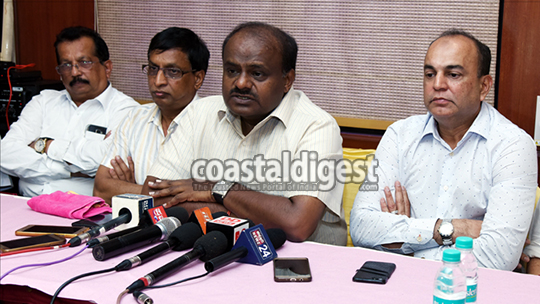
Mangaluru, Jun 19: The communal clashes that occur in Kalladka and other parts of Dakshina Kannada are a result of “match fixing” between the Congress and BJP to consolidate their voter base, according to former Chief Minister and JD(S) State president H D Kumaraswamy.

iftar koota 4

Speaking to media persons in the city on Sunday, Mr Kumaraswamy said that the Kalladka clashes were nothing but attempts by both the parties to make gains through disturbances. He said communal clashes appear to intensify in Dakshina Kannada every time an election is near.

He said the BJP and Congress might succeed in consolidating their voter base, but many innocent families and individuals suffer because of the clashes and the hatred. Instead of focussing on clashes, the national parties should have concentrated on alleviating the plight of farmers, he said.

No alliance

Mr Kumaraswamy, who had forged alliance with the Bharatiya Janata Party several times in the past, said that there was no question of partnering with the BJP or the Congress either before or after next year’s Assembly elections. “JD(S) is not in need of support from the Congress or the BJP, but they do,” he said.

Referring to the recent no-confidence motion passed by the Congress against Legislative Council Chairman D H Shankaramurthy, he said the Congress did not ask for the support of JD(S) in the beginning stage. Chief Minister Siddaramaiah wanted Shankaramurthy to step down from the post of the Chairman of Legislative Council. The Congress had thought they would pass the non-confidence motion with the support of their independent MLAs. But their plan turned upside down, Kumaraswamy said.

He said that may be Yeddyurappa also didn’t want Shankaramurthy to continue as the Chairman of the Council and that was why he did not seek the JD(S)’ support. “We do not need to learn a lesson of secularism from Siddaramaiah. He is always involved in caste-based politics which is evident in his decisions.”

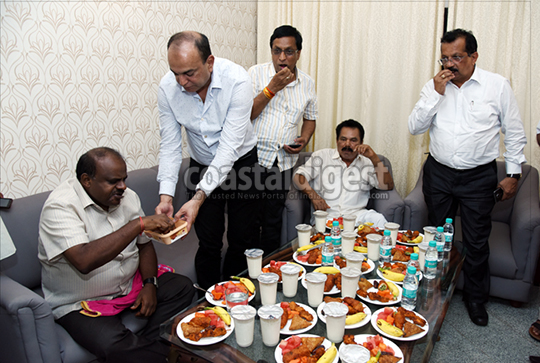
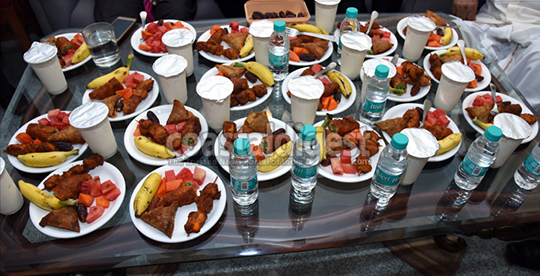
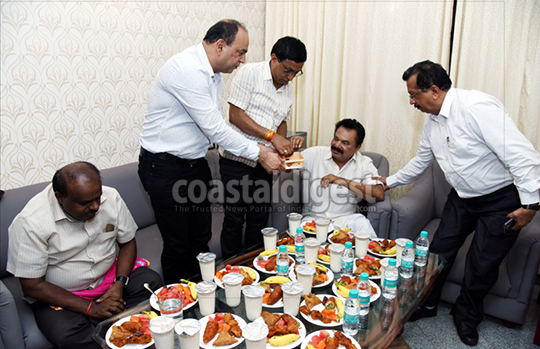
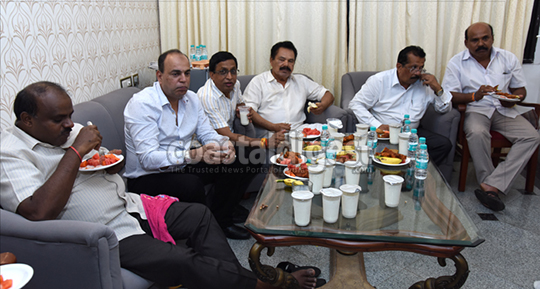
After iftar Mr Kumaraswamy does iftar with other JD(S) leaders incuding B M Farooq, Amarnath Shetty and Akshith Suvarna.

iftar koota 1

jds1

iftar koota 2

iftar koota 3

iftar koota 5

Comments

Beedi Basava
 - 
Monday, 19 Jun 2017

Y all are in sad mood. Farooq is more sad.

May b they invited too much people but there is only a few attended.

Waste of food and energy

Add new comment

  • Coastaldigest.com reserves the right to delete or block any comments.
  • Coastaldigset.com is not responsible for its readers’ comments.
  • Comments that are abusive, incendiary or irrelevant are strictly prohibited.
  • Please use a genuine email ID and provide your name to avoid reject.
News Network
March 7,2020

Mangaluru, Mar 7: Deputy Chief Minister Dr. Ashwatha Narayana said journalists are facing a challenging task of functioning with credibility while also upholding their professional ethics in this age of globalization where monetary aspects have gained great significance.

Inaugurating the 35th state-level Journalists’ Conference at the Kudmul Rangarao Town Hall on Saturday which was hosted by the DK District Working Journalists’ Union the Deputy CM also said that journalists should refrain from giving priority to political news as that does not serve any purpose for the common man.

Dharmadhikari of the Dharmasthala Temple Dr. D Veerendra Heggade was the chief guest at the event. The souvenir brought out to commemorate the occasion was released by Taranga Editor Sandhya Pai. The Deputy CM also inaugurated a cartoon exhibition organized on the occasion.

Comments

Add new comment

  • Coastaldigest.com reserves the right to delete or block any comments.
  • Coastaldigset.com is not responsible for its readers’ comments.
  • Comments that are abusive, incendiary or irrelevant are strictly prohibited.
  • Please use a genuine email ID and provide your name to avoid reject.
News Network
July 6,2020

Bengaluru, Jul 6: Karnataka government has revised quarantine norms according to which those entering the State from other states, including from Maharashtra, shall be placed in 14-days home quarantine.

Until now, the state government had issued that those returning from Maharashtra are to be placed under 7-day institutional quarantine followed by 7-day home quarantine.

A fresh state government order with the subject line "Regulation of movement of persons from other States to Karnataka" reads: "Whereas the State Government vide Order dated June 30, issued unlock 2 guidelines which permit reopening of more activities in a calibrated manner, in areas outside the Containment Zones, and to extend lockdown in Containment Zone upto July 31. The guidelines also permit unrestricted interstate movement of persons and goods adhering to the SOPs/ Guidelines issued by the Department of Health and Family Welfare and Department of Revenue (Disaster Management)".

Whereas, the Department of Health and Family Welfare issued revised SOP for the moment of persons from other State to Karnataka vide document dated June 8, this year, further, quarantine norms were modified vide Orders of even number dated June 15 and June 26.

"The quarantine norms are regularly reviewed and calibrated with the prevailing Unlock 2 guidelines and infusion of technology and community involvement to enforce the strict home quarantine. In light of the above, the quarantine norms issued vide Order dated June 26, has been further modified and is follows--Persons coming from other State to Karnataka, including Maharashtra shall be placed in 14-days Home Quarantine," the order read.

"The other conditions as specified in the Order dated June 15 and aforementioned SOP enclosed issued on June 8 by the Department of Health and Family Welfare shall continue to be in force until further orders," it added.

Comments

Add new comment

  • Coastaldigest.com reserves the right to delete or block any comments.
  • Coastaldigset.com is not responsible for its readers’ comments.
  • Comments that are abusive, incendiary or irrelevant are strictly prohibited.
  • Please use a genuine email ID and provide your name to avoid reject.
Agencies
February 20,2020

India ranked 77th on a sustainability index that takes into account per capita carbon emissions and ability of children in a nation to live healthy lives and secures 131st spot on a flourishing ranking that measures the best chance at survival and well-being for children, according to a UN-backed report.

The report was released on Wednesday by a commission of over 40 child and adolescent health experts from around the world. It was commissioned by the World Health Organization (WHO), UN Children's Fund (UNICEF) and The Lancet medical journal.

In the report assessing the capacity of 180 countries to ensure that their youngsters can survive and thrive, India ranks 77th on the Sustainability Index and 131 on the Flourishing Index, it said.

Flourishing is the geometric mean of Surviving and Thriving. For Surviving, the authors selected maternal survival, survival in children younger than 5 years old, suicide, access to maternal and child health services, basic hygiene and sanitation, and lack of extreme poverty.

For Thriving, the domains were educational achievement, growth and nutrition, reproductive freedom, and protection from violence.

Under the Sustainability Index, the authors noted that promoting today's national conditions for children to survive and thrive must not come at the cost of eroding future global conditions for children's ability to flourish.

The Sustainability Index ranks countries on excess carbon emissions compared with the 2030 target. This provides a convenient and available proxy for a country's contribution to sustainability in future.

The report noted that under realistic assumptions about possible trajectories towards sustainable greenhouse gas emissions, models predict that global carbon emissions need to be reduced from 39·7 giga­ tonnes to 22·8 gigatonnes per year by 2030 to maintain even a 66 per cent chance of keeping global warming below 1·5°C.

It said that the world's survival depended on children being able to flourish, but no country is doing enough to give them a sustainable future.

"No country in the world is currently providing the conditions we need to support every child to grow up and have a healthy future," said Anthony Costello, Professor of Global Health and Sustainability at University College London, one of the lead authors of the report.

"Especially, they're under immediate threat from climate change and from commercial marketing, which has grown hugely in the last decade," said Costello – former WHO Director of Mother, Child and Adolescent health.

Norway leads the table for survival, health, education and nutrition rates - followed by South Korea and the Netherlands. Central African Republic, Chad and Somalia come at the bottom.

However, when taking into account per capita CO2 emissions, these top countries trail behind, with Norway 156th, the Republic of Korea 166th and the Netherlands 160th.

Each of the three emits 210 per cent more CO2 per capita than their 2030 target, the data shows, while the US, Australia, and Saudi Arabia are among the 10 worst emitters. The lowest emitters are Burundi, Chad and Somalia.

According to the report, the only countries on track to beat CO2 emission per capita targets by 2030, while also performing fairly – within the top 70 – on child flourishing measures are: Albania, Armenia, Grenada, Jordan, Moldova, Sri Lanka, Tunisia, Uruguay and Vietnam.

"More than 2 billion people live in countries where development is hampered by humanitarian crises, conflicts, and natural disasters, problems increasingly linked with climate change," said Minister Awa Coll-Seck from Senegal, Co-Chair of the commission.

The report also highlights the distinct threat posed to children from harmful marketing.

Evidence suggests that children in some countries see as many as 30,000 advertisements on television alone in a single year, while youth exposure to vaping (e-cigarettes) advertisements increased by more than 250 per cent in the US over two years, reaching more than 24 million young people.

Studies in Australia, Canada, Mexico, New Zealand and the US – among many others – have shown that self-regulation has not hampered commercial ability to advertise to children.

Children's exposure to commercial marketing of junk food and sugary beverages is associated with purchase of unhealthy foods and overweight and obesity, linking predatory marketing to the alarming rise in childhood obesity, it said.

The number of obese children and adolescents increased from 11 million in 1975 to 124 million in 2016 – an 11-fold increase, with dire individual and societal costs, the report said.

To protect children, the authors call for a new global movement driven by and for children.

Specific recommendations include stopping CO2 emissions with the utmost urgency, to ensure children have a future on this planet; placing children and adolescents at the centre of global efforts to achieve sustainable development, the report said.

New policies and investment in all sectors to work towards child health and rights; incorporating children's voices into policy decisions and tightening national regulation of harmful commercial marketing, supported by a new Optional Protocol to the UN Convention on the Rights of the Child, it said.


Comments

Add new comment

  • Coastaldigest.com reserves the right to delete or block any comments.
  • Coastaldigset.com is not responsible for its readers’ comments.
  • Comments that are abusive, incendiary or irrelevant are strictly prohibited.
  • Please use a genuine email ID and provide your name to avoid reject.