Let’s eliminate 'serpent of communalism' from the beautiful garden called DK: SP

CD Network
June 17, 2017

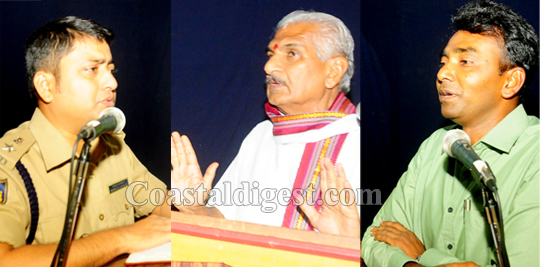
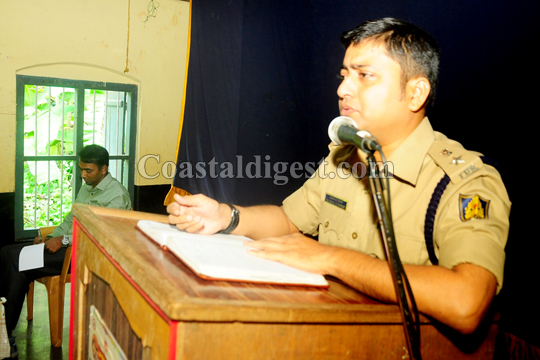
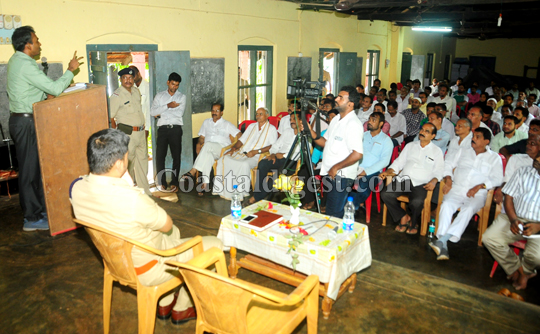
Mangaluru, Jan 17: Calling Dakshina Kannada a beautiful garden of peace-lovers, Superintendent of Police Bhushan Gulabrao Borase has urged the public to join hands with the police department to eliminate the “serpent of communalism” that has been spreading fear in the district.

prabhakar

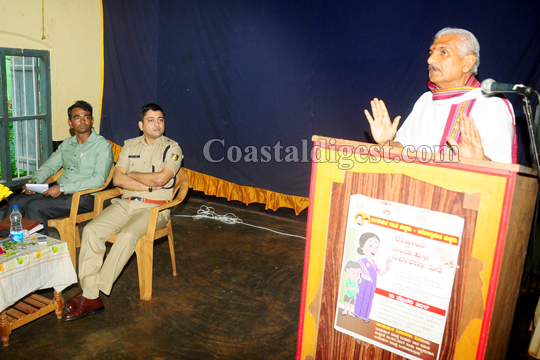
He was addressing a peace meeting organized by the district administration at the Government Higher Primary School, Kalladka, on Friday in the wake of recent communal disturbances in the region.

Holding drug menace responsible for group clashes that often snowball into communal clash in the district, the SP stressed on the need to curb such menaces in order to eliminate the serpent called communalism. “Ganja addiction must be controlled in Kalladka,” he said.

He promised said that any discrepancies committed by Police Department during and aftermath of Kalladka incident will be rectified and all the advice received during peace meeting will be taken seriously. The police outpost will be shifted to bus stand, he added.

He also asked general public to provide information about mischief mongers spreading rumours in social media platforms. "Please share screenshots of those miscreants spreading rumours with police. We will take necessary action."

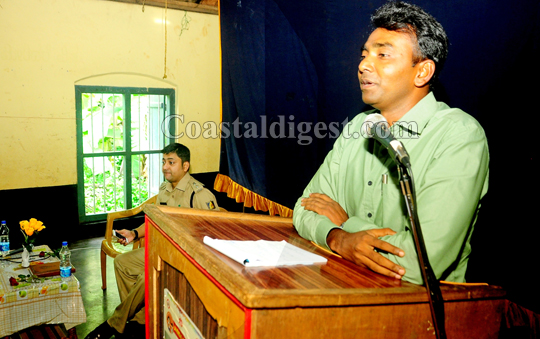
Presiding over the meeting Deputy Commissioner KG Jagadeesha lamented that Dakshina Kannada district has been infamously tagged as a communally-sensitive district due to handful miscreants. Religious leaders from both communities must strive bring them on the right path, he urged.

When people present at peace meeting raised questions in regard to arrest of innocent people after violence, he said that it may have occurred as police were politically pressurized and given deadline to arrest culprit as soon as possible. He asked them have patience till real culprits are nabbed.

As many as 70 representatives from two communities attended the meeting that went on for nearly two hours. Rastriya Swayamsevak Sangh leader Kalladka Prabhakar Bhat, who also took part in the meeting, said that it was wrong to colour entire administration as "communal" for mistake committed by two persons.

peace 1

peace 4

peace 5

peace 3

Comments

Peddaramaiah
 - 
Saturday, 17 Jun 2017

Dear Bhushan ji... serpent of communalism was also present in that meeting and he was given opportunity to address the meeting. that's ridiculous.

Azeem
 - 
Saturday, 17 Jun 2017

Kalladka bhat should shift his house to ullal then kalladka will be peace loving city.

Karthik
 - 
Saturday, 17 Jun 2017

first should eliminate bhat then everything will be solved.

Priyanka
 - 
Saturday, 17 Jun 2017

yahh exactly some two people work, should not blame all people

Bhupathi
 - 
Saturday, 17 Jun 2017

Kalladka Bhat please stop your serpent communalism, we want peace in mangalore, for your gain why r u spoiling youths life.

abdul
 - 
Saturday, 17 Jun 2017

Mr DC, SP prabakar bhat is a criminal (goonda) y u making him a hero, DK will be beautiful garden only if this goonda inside jail

Muhammed Rafique
 - 
Saturday, 17 Jun 2017

Why search serpent elsewhere....

Deport him to Nepal

Mani
 - 
Saturday, 17 Jun 2017

its so FUNNY that Kalladka Bhatta was present at the meeting ...such a hate monger ....who will burn DK with their COW politics ...and cow dung filled minds Goondas

Ali
 - 
Sunday, 18 Jun 2017

batta shoul be eliminated first

Add new comment

  • Coastaldigest.com reserves the right to delete or block any comments.
  • Coastaldigset.com is not responsible for its readers’ comments.
  • Comments that are abusive, incendiary or irrelevant are strictly prohibited.
  • Please use a genuine email ID and provide your name to avoid reject.
Ram Puniyani
January 14,2020

In the beginning of January 2020 two very disturbing events were reported from Pakistan. One was the attack on Nankana Sahib, the holy shrine where Sant Guru Nanak was born. While one report said that the place has been desecrated, the other stated that it was a fight between two Muslim groups. Prime Minister of Pakistan Imran Khan condemned the incident and the main accused Imran Chisti was arrested. The matter related to abduction and conversion of a Sikh girl Jagjit Kaur, daughter of Pathi (One who reads Holy Guru Granth Sahib in Gurudwara) of the Gurudwara. In another incident one Sikh youth Ravinder Singh, who was out on shopping for his marriage, was shot dead in Peshawar.

While these condemnable attacks took place on the Sikh minority in Pakistan, BJP was quick enough to jump to state that it is events like this which justify the Citizenship Amendment Act (CAA). Incidentally CAA is the Act which is discriminatory and relates to citizenship with Religion, which is not as per the norms of Indian constitution. There are constant debates and propaganda that population of Hindus has come down drastically in Pakistan and Bangla Desh. Amit Shah, the Home minister stated that in Pakistan the population of Hindus has come down from 23% at the time of partition to 3.7% at present. And in Bangla Desh it has come down from 22% to present 8%.

While not denying the fact that the religious minorities are getting a rough deal in both these countries, the figures which are presented are totally off the mark. These figures don’t take into consideration the painful migrations, which took place at the time of partition and formation of Bangla Desh later. Pakistan census figures tell a different tale. Their first census was held in 1951. As per this census the overall percentage of Non Muslim in Pakistan (East and West together) was 14.2%, of this in West Pakistan (Now Pakistan) it was 3.44 and in Eat Pakistan it was 23.2. In the census held in Pakistan 1998 it became 3.72%. As far as Bangla Desh is concerned the share of Non Muslims has gone down from 23.2 (1951) to 9.6% in 2011.

The largest minority of Pakistan is Ahmadis, (https://minorityrights.org/country/pakistan/) who are close to 4 Million and are not recognised as Muslims in Pakistan. In Bangla Desh the major migrations of Hindus from Bangla Desh took place in the backdrop of Pakistan army’s atrocities in the then East Pakistan.

As far as UN data on refugees in India it went up by 17% between 2016-2019 and largest numbers were from Tibet and Sri Lanka.  (https://www.un.org/en/development/desa/population/migration/publication…)

The state of minorities is in a way the index of strength of democracy. Most South Asian Countries have not been able to sustain democratic values properly. In Pakistan, the Republic began with Jinnah’s classic speech where secularism was to be central credo of Pakistan. This 11th August speech was in a way what the state policy should be, as per which people of all faiths are free to practice their religion. Soon enough the logic of ‘Two Nation theory” and formation of Pakistan, a separate state for Muslim took over. Army stepped in and dictatorship was to reign there intermittently. Democratic elements were suppressed and the worst came when Zia Ul Haq Islamized the state in collusion with Maulanas. The army was already a strong presence in Pakistan. The popular formulation for Pakistan was that it is ruled by three A’s, Army, America and Allah (Mullah).

Bangla Desh had a different trajectory. Its very formation was a nail in the coffin of ‘two nation theory’; that religion can be the basis of a state. Bangla Desh did begin as a secular republic but communal forces and secular forces kept struggling for their dominance and in 1988 it also became Islamic republic. At another level Myanmar, in the grip of military dictatorship, with democratic elements trying to retain their presence is also seeing a hard battle. Democracy or not, the army and Sanghas (Buddhist Sang has) are strong, in Myanmar as well. The most visible result is persecution of Rohingya Muslims.

Similar phenomenon is dominating in Sri Lanka also where Budhhist Sanghas and army have strong say in the political affairs, irrespective of which Government is ruling. Muslim and Christian minorities are a big victim there, while Tamils (Hindus, Christians etc.) suffered the biggest damage as ethnic and religious minorities. India had the best prospect of democracy, pluralism and secularism flourishing here. The secular constitution, the outcome of India’s freedom struggle, the leadership of Gandhi and Nehru did ensure the rooting of democracy and secularism in a strong way.

India so far had best democratic credentials amongst all the south Asian countries. Despite that though the population of minorities rose mainly due to poverty and illiteracy, their overall marginalisation was order of the day, it went on worsening with the rise of communal forces, with communal forces resorting to identity issues, and indulging in propaganda against minorities.

While other South Asian countries should had followed India to focus more on infrastructure and political culture of liberalism, today India is following the footsteps of Pakistan. The retrograde march of India is most visible in the issues which have dominated the political space during last few years. Issues like Ram Temple, Ghar Wapasi, Love Jihad, Beef-Cow are now finding their peak in CAA.

India’s reversal towards a polity with religion’s identity dominating the political scene was nicely presented by the late Pakistani poetess Fahmida Riaz in her poem, Tum bhi Hum Jaise Nikle (You also turned out to be like us). While trying to resist communal forces has been an arduous task, it is becoming more difficult by the day. This phenomenon has been variously called, Fundamentalism, Communalism or religious nationalism among others. Surely it has nothing to do with the religion as practiced by the great Saint and Sufi traditions of India; it resorts mainly to political mobilization by using religion as a tool.

Comments

Ashi
 - 
Tuesday, 14 Jan 2020

If Malaysia implement similar NRC/CAA, India and China are the loser.

Add new comment

  • Coastaldigest.com reserves the right to delete or block any comments.
  • Coastaldigset.com is not responsible for its readers’ comments.
  • Comments that are abusive, incendiary or irrelevant are strictly prohibited.
  • Please use a genuine email ID and provide your name to avoid reject.
Agencies
February 12,2020

Bengaluru, Feb 12: Karnataka Sanghatanegala Okkoota, a congregation of various pro-Kannada organisations, has called for a state-wide bandh in Karnataka on Thursday (13 February 2020) demanding reservation in jobs for Kannadigas in both government and private sectors.

The Karnataka bandh, which will begin from 6 am to 6 pm, is likely to impact life in Bengaluru as well as in other parts of the state. Interestingly, Ola and Uber drivers have also extended support to the bandh. 

In Bengaluru, some other drivers’ associations, including Jai Bharatha Vehicle Owners and Drivers Association and Adarsha Auto and Taxi Union have also supported the bandh.

It is not yet clear as to whether the Karnataka State Road Transport Corporation (KSRTC) staff and workers associations will back Thursday’s bandh.

Several other organisations like the Karnataka Film Chamber of Commerce (KFCC), Centre of Indian Trade Unions (CITU), and Lorry Owners Association have supported the February 13 bandh.

In view of the bandh call, schools, colleges and hospitals across Karnataka are likely to remain closed on Thursday.

The Sarojini Mahishi report, which in 1984 suggested that Kannadigas should be given some reservation in jobs in private companies, public sector undertakings and multinational companies, is yet to be implemented.

It is to be noted that Sarojini Mahishi, a four-time MP and Janatha party leader, was appointed by the Ramakrishna Hegde government to head the panel in 1983. The committee submitted an interim report in June 1984. However, a final report was tabled in December 1986 with 58 recommendations, of which the Karnataka government had accepted 45.

Comments

Add new comment

  • Coastaldigest.com reserves the right to delete or block any comments.
  • Coastaldigset.com is not responsible for its readers’ comments.
  • Comments that are abusive, incendiary or irrelevant are strictly prohibited.
  • Please use a genuine email ID and provide your name to avoid reject.
News Network
May 5,2020

Dubai, May 5: Tickets on repatriation flights from UAE to India, which start on May 7, could be costlier than regular airfare, and adding to the financial woes of those flying back. Nearly 200,000 Indians in the UAE have registered on the website seeking to return home.

“A one-way repatriation ticket to Delhi will cost approximately Dh1,400-Dh1,650 - this would earlier have cost between Dh600-Dh700 [during these months],” said Jamal Abdulnazar, CEO of Cozmo Travel. “A one-way repatriation flight ticket to Kerala would cost approximately Dh1,900-Dh2,300.”

This can be quite a burden, as a majority of those taking these flights have either lost their jobs or are sending back their families because of uncertainty on the work front. To now have to pay airfare that is nearly on par with those during peak summer months is quite a blow.

Sources said that officials in Indian diplomatic missions have already initiated calls to some expats, telling them about likely ticket fares and enquiring about their willingness to travel.

Although many believed repatriation would be government-sponsored, Indian authorities have clarified that customers would have to pay for the tickets themselves. Those who thought they were entitled to free repatriation might back out of travel plans for now.

Fact of life

But aviation and travel industry sources say higher rates cannot be escaped since social distancing norms have to be strictly enforced at all times. That would limit the number of passengers on each of these flights.

“One airline can carry only limited passengers - therefore, multiple airlines are likely to get the approval to operate repatriation flights,” said Abdulnazar. “Also, airports will have to maintain safe distance for passengers to queue up at immigration and security counters.

“Therefore, it is recommended that multiple carriers fly into multiple Indian airports for repatriation to be expedited.”

The Indian authorities, so far, have not taken the easy decision to get its private domestic airlines into the rescue act. Gulf News tried speaking to the leading players, but they declined to provide any official statements. So far, only Air India, the national airline, has been commissioned to operate the flights.

Air India finds itself in the driver's seat when it comes to operating India's repatriation flights. To date, there is no confirmation India's private airlines will be allowed to join in.

UAE carriers ready to help out

UAE’s Emirates airline, Etihad, flydubai and Air Arabia are likely to also operate repatriation flights to India after Air India implements the first phase of services.

“We are fully supporting governments and authorities across the flydubai network with their repatriation efforts, helping them to make arrangements for their citizens to return home,” said a flydubai spokesperson.

“We will announce repatriation flights as and when they are confirmed, recognising this is an evolving situation whilst the flight restrictions remain in place.”

An AirArabia spokesperson said the airline is ready to operate repatriation flights when the government tells them to.

Travel agencies likely to benefit

Apart from operating non-scheduled commercial flights, the Indian government is also deploying naval ships to bring expat Indians back. Sources claim the ships are to ferry passengers who cannot afford the repatriation airfares.

Even then, considering the sheer numbers who will want to get on the flights, travel agencies are likely to see a surge in bookings since airline websites alone may not cope with the demand set off in such a short span.

Learn from Gulf governments

In instances when they carried out their own repatriation flights, some GCC governments paid the ticket fares to fly in their citizens. Those citizens who did not have the ready funds could approach their diplomatic mission and aid would be given on a case-to-case basis.

Should Indians wait for normal services to resume?

Industry sources say that those Indians wanting to fly back and cannot afford the repatriation flights should wait for full services to resume once the COVID-19 pandemic settles.

But can those who lost their jobs or seen steep salary cuts stay on without adding to their costs? And is there any guarantee that when flight services resume, ticket rates would be lower than on the repatriation trips.

As such, normal travel is expected to pick up only after the repatriation exercise to several countries is completed. UAE-based travel agencies are not seeing any bookings for summer, which is traditionally the peak holiday season.

“Majority want to stay put unless full confidence is restored,” said Abdulnazar. “I expect full normalcy to be restored not until March 2021.

“People have also taken a hit to their income. Without disposable income, you will curtail your travel.”

What constitutes normalcy?

Airfares are expected to remain high, given the need to keep the middle seats empty to practise safe distance onboard.

“We expect holiday travel to resume by October or November - but, the travel sentiment will not go back to pre-COVID-19 levels anytime soon,” said Manvendra Roy, Vice-President – Commercial at holidayme, an online travel agency. “The need to keep the middle seat vacant will add 30-40 per cent pricing pressure per seat from an airline perspective.

“This will make holidays more expensive.”

As for business travel, it will take some time to recover. Corporate staff are now used to getting work done via conference calls. “Companies will also curtail their travel expenditure since their income has taken a hit,” said Abdulnazar.


Comments

Add new comment

  • Coastaldigest.com reserves the right to delete or block any comments.
  • Coastaldigset.com is not responsible for its readers’ comments.
  • Comments that are abusive, incendiary or irrelevant are strictly prohibited.
  • Please use a genuine email ID and provide your name to avoid reject.