Let’s eliminate 'serpent of communalism' from the beautiful garden called DK: SP

CD Network
June 17, 2017

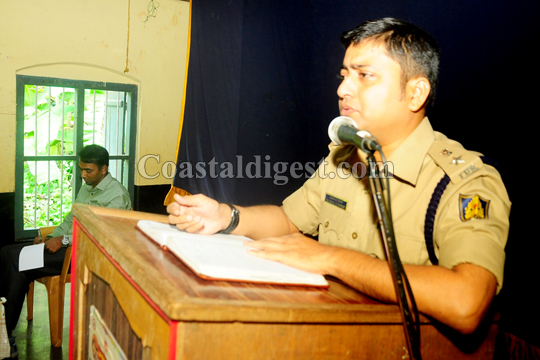
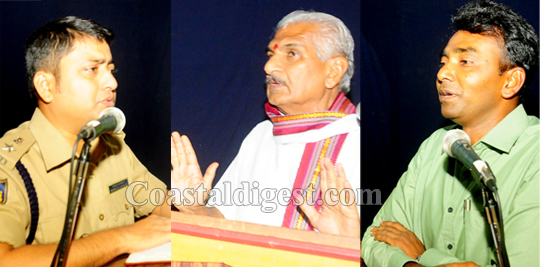
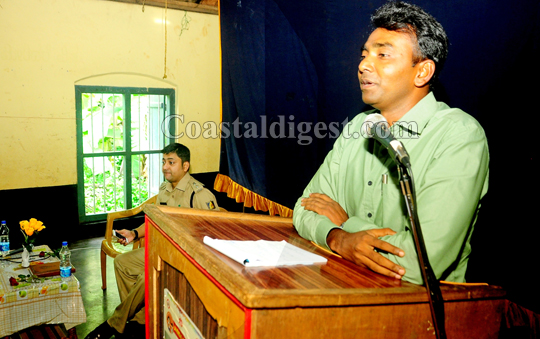
Mangaluru, Jan 17: Calling Dakshina Kannada a beautiful garden of peace-lovers, Superintendent of Police Bhushan Gulabrao Borase has urged the public to join hands with the police department to eliminate the “serpent of communalism” that has been spreading fear in the district.
prabhakar

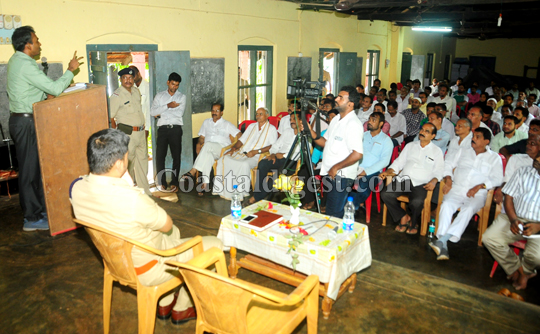
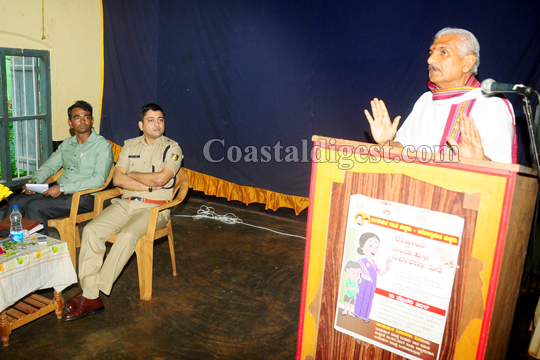
He was addressing a peace meeting organized by the district administration at the Government Higher Primary School, Kalladka, on Friday in the wake of recent communal disturbances in the region.

Holding drug menace responsible for group clashes that often snowball into communal clash in the district, the SP stressed on the need to curb such menaces in order to eliminate the serpent called communalism. “Ganja addiction must be controlled in Kalladka,” he said.

He promised said that any discrepancies committed by Police Department during and aftermath of Kalladka incident will be rectified and all the advice received during peace meeting will be taken seriously. The police outpost will be shifted to bus stand, he added.

He also asked general public to provide information about mischief mongers spreading rumours in social media platforms. "Please share screenshots of those miscreants spreading rumours with police. We will take necessary action."

Presiding over the meeting Deputy Commissioner KG Jagadeesha lamented that Dakshina Kannada district has been infamously tagged as a communally-sensitive district due to handful miscreants. Religious leaders from both communities must strive bring them on the right path, he urged.

When people present at peace meeting raised questions in regard to arrest of innocent people after violence, he said that it may have occurred as police were politically pressurized and given deadline to arrest culprit as soon as possible. He asked them have patience till real culprits are nabbed.

As many as 70 representatives from two communities attended the meeting that went on for nearly two hours. Rastriya Swayamsevak Sangh leader Kalladka Prabhakar Bhat, who also took part in the meeting, said that it was wrong to colour entire administration as "communal" for mistake committed by two persons.
peace 1

peace 4

peace 5

peace 3

Comments

Peddaramaiah
 - 
Saturday, 17 Jun 2017

Dear Bhushan ji... serpent of communalism was also present in that meeting and he was given opportunity to address the meeting. that's ridiculous.

Azeem
 - 
Saturday, 17 Jun 2017

Kalladka bhat should shift his house to ullal then kalladka will be peace loving city.

Karthik
 - 
Saturday, 17 Jun 2017

first should eliminate bhat then everything will be solved.

Priyanka
 - 
Saturday, 17 Jun 2017

yahh exactly some two people work, should not blame all people

Bhupathi
 - 
Saturday, 17 Jun 2017

Kalladka Bhat please stop your serpent communalism, we want peace in mangalore, for your gain why r u spoiling youths life.

abdul
 - 
Saturday, 17 Jun 2017

Mr DC, SP prabakar bhat is a criminal (goonda) y u making him a hero, DK will be beautiful garden only if this goonda inside jail

Muhammed Rafique
 - 
Saturday, 17 Jun 2017

Why search serpent elsewhere....

Deport him to Nepal

Mani
 - 
Saturday, 17 Jun 2017

its so FUNNY that Kalladka Bhatta was present at the meeting ...such a hate monger ....who will burn DK with their COW politics ...and cow dung filled minds Goondas

Ali
 - 
Sunday, 18 Jun 2017

batta shoul be eliminated first

Add new comment

  • Coastaldigest.com reserves the right to delete or block any comments.
  • Coastaldigset.com is not responsible for its readers’ comments.
  • Comments that are abusive, incendiary or irrelevant are strictly prohibited.
  • Please use a genuine email ID and provide your name to avoid reject.
coastaldigest.com news network
May 7,2020

Kolar, May 7: A 38-year-old man has been arrested for biting a snake and peeling off its skin at Mustur village in Kolar district of Karnataka.

Mulbagal range forest officer KN Ravikeerthi said forest officials nabbed Kumar, a construction worker, at Mustur on Wednesday and booked him under the Wildlife Protection Act. He was under the influence of alcohol.

Ravikeerthi said Kumar's offence is non-bailable and attracts a jail term of up to three years. The remains of the snake were collected and sent to a lab to ascertain its species. Forest officials said the snake Kumar bit was not a viper as was reported earlier but a rat snake.

On Tuesday, Kumar was riding back home after buying liquor when the snake ca me under his bike's wheels. He tossed the injured snake around his neck, bit it and peeled off its skin. Kumar said the snake had troubled him in the past.

Comments

abdul
 - 
Thursday, 7 May 2020

Ask talibans and Jehadis who has killed and killing innocent people, they will have the better answer for ur question,  CD dont filter and post the messages ...  accept the fact and post 

Abdul
 - 
Thursday, 7 May 2020

That u should ask taliban ... and other organistaion , who killes innocent civilians in the name of jehad.  


abdullah
 - 
Thursday, 7 May 2020

for killing humans there is no jail in India!

Add new comment

  • Coastaldigest.com reserves the right to delete or block any comments.
  • Coastaldigset.com is not responsible for its readers’ comments.
  • Comments that are abusive, incendiary or irrelevant are strictly prohibited.
  • Please use a genuine email ID and provide your name to avoid reject.
News Network
January 27,2020

New Delhi, Jan 27: Non-Muslim refugees from Pakistan, Bangladesh and Afghanistan will have to provide proofs of their religious beliefs while applying for Indian citizenship under the controversial Citizenship Amendment Bill (CAA), officials said on Monday.

The applicants belonging to Hindu, Sikh, Christian, Buddhist, Jain or Parsi faiths will also have to furnish documents to prove that they entered India on or before December 31, 2014.

Those who will seek Indian citizenship under the CAA will have to provide proofs of their religious beliefs and this will be mentioned in the rules to be issued under the CAA, a government official said.

According to the CAA, members of Hindu, Sikh, Buddhist, Jain, Parsi and Christian communities who have come from Pakistan, Bangladesh and Afghanistan till December 31, 2014, due to religious persecution there will not be treated as illegal immigrants and will be given Indian citizenship.

The central government is also likely to give a relatively smaller window of just three months to those who want to apply for Indian citizenship in Assam under the CAA, another official said.

Some Assam-specific provisions are expected to be incorporated in the rules to be issued for the implementation of the CAA.

Assam chief minister Sarbananda Sonowal and his finance minister Himanta Biswa Sarma had made a request about a fortnight ago to keep a limited period window for applying under the CAA and also incorporate some other Assam-specific provisions in the CAA rules.

The move comes in view of continuing protests against the CAA in Assam that have been going on since the legislation was passed by Parliament in December last year.

There has been a growing feeling among the indigenous people of Assam that the newly enacted legislation will hurt their interests politically, culturally as well as socially.

The Assam Accord provides for detection and deportation of all illegal immigrants who have entered the country after 1971 and are living in the state, irrespective of their religion.

The protesters in Assam say that the CAA violates the provisions of the Assam Accord.

Comments

Add new comment

  • Coastaldigest.com reserves the right to delete or block any comments.
  • Coastaldigset.com is not responsible for its readers’ comments.
  • Comments that are abusive, incendiary or irrelevant are strictly prohibited.
  • Please use a genuine email ID and provide your name to avoid reject.
Wafa Sultana
April 4,2020

Over the last couple of days when the world was occupied with unifying efforts to fight the deadly Covid19 pandemic, sections of Indian media provided viewers a familiar scapegoat – the Indian Muslims – who are often stereotyped as a community being constantly at loggerheads with the citizenry and the State. Biased media channels were quick to resort to blaming the entire Muslim community for the spread of the disease in the country, thanks to an ill-timed Tablighi Jamaat gathering at its international headquarters in Delhi’s Nizamuddin. Unsurprisingly, the opprobrium was also marked by a sudden spike in WhatsApp forwards of videos with people wearing skullcaps licking spoons and performing Sufi breathing rituals, suggesting some sort of wild conspiracy on the part of the community to spread the virus.  Some media channels were quick to formulate, hypothesize and provide loose definitions of a newly discovered form of Jihad i.e. ‘Corona Jihad ’ thereby vilifying the Islamic faith and its followers.

While the investigation on the culpability of the organizers of the Nizamuddin event is still ongoing, there is enough information to suggest that the meeting was held before any lockdown was in force, and the problem began when there was no way of getting people out once the curfew was announced. Be that as it may, there is little doubt that organizing a meet of such a scale when there is a global pandemic smacks of gross misjudgment, and definitely the organizers should be held accountable if laws or public orders were defied. Attendees who attempt to defy quarantine measures must be dealt with strictly. However, what is alarming is that the focus and narrative have now shifted from the unfortunate event at Nizamuddin to the Tablighi Jamaat itself.

For those not familiar with the Tablighi Jamaat, the organization was founded in 1926 in Mewat by scholar Maulana Mohammad Ilyas. The Jamaat’s main objective was to get Muslim youth to learn and practice pristine Islam shorn of external influences. This is achieved through individuals dedicating time for moral and spiritual upliftment secluded from the rest of the world for a brief period of time. There is no formal membership process. More senior and experienced participants typically travel from one mosque to other delivering talks on religious topics, inviting local youth to attend and then volunteer for a spiritual retreat for a fixed number of days to a mosque in a nearby town or village to present the message to their co-religionists. Contrary to ongoing Islamophobic rhetoric, the movement does not actively proselytize. The focus is rather on getting Muslims to learn the teachings and practices of Islam.  This grassroots India-based movement has now grown to almost all countries with substantial Muslim populations. Its annual meets, or ‘ijtemas’ are among the largest Islamic congregations in the world after the annual Haj. One of the reasons for its popularity and wide network in the subcontinent and wordwide is the fact that it has eschewed the need for scholarly intervention, focusing on peer learning of fundamental beliefs and practice rather than high-falutin ideological debates. The Tablighi Jamaat also distinguishes itself from other Islamic movements through its strictly apolitical nature, with a focus on individual self-improvement rather than political mobilization. Hardships and difficulty in the world are expected to be face through ‘sabr’ (patience) and ‘dua’ (supplication),  than through quest for political power or influence. In terms of ideology, it is very much based on mainstream Sunni Islamic principles derived from the Deobandi school.

So, why is all this background important in the current context? While biased media entities have expectedly brought out their Islamophobic paraphernalia out for full display, more neutral commentators have tried to paint the Tablighi Jamaat as a fringe group and have tried to distance it from 'mainstream Muslims'. While the intent is no doubt innocent, this is a trap we must not fall into. This narrative, unfortunately, is also gaining ground due to apathy some Muslims have for the group, accusing it of being “disconnected from the realities of the world”. Unlike other Muslim organizations and movements, the Tablighi Jamat, by virtue of its political indifference, does not boast of high-profile advocates and savvy spokespersons who can defend it in mainstream or social media.  The use of adjectives such as 'outdated' and 'orthodox' by liberal columnists to describe the Jamaat feeds into the malignant attempt to change the narrative from the control of the spread of the pandemic due to the Nizamuddin gathering to 'raison d'etre' of the organization itself.

A large mainstream religious group like the Tablighi Jamaat with nearly a hundred-year history, normally considered to be peaceful, apolitical and minding its own business is now suddenly being villainized owing to unfortunate circumstances. Biased media reactions filled with disgust and hate seem to feed the Indian public conscience with a danngerous misconception - to be a nominal Muslim is okay but being a practicing one is not.  For those committed to the truth and fighting the spread of Islamophobia, the temptation to throw the entire Tablighi Jamaat under the bus must be resisted.

The writer is a lawyer and research scholar at Qatar University. Her research interests include Islamic law and politics.

Comments

zahoorahmed
 - 
Saturday, 4 Apr 2020

great article! provides a great perspective on tableeg jamat

Add new comment

  • Coastaldigest.com reserves the right to delete or block any comments.
  • Coastaldigset.com is not responsible for its readers’ comments.
  • Comments that are abusive, incendiary or irrelevant are strictly prohibited.
  • Please use a genuine email ID and provide your name to avoid reject.