


President, Sonia express concern over lynching incidents

Agencies
July 2, 2017

New Delhi, Jul 2: President Pranab Mukherjee joined Congress president Sonia Gandhi in expressing serious concern over growing number of mob lynching cases in India, wondering whether the society is vigilant enough to save the basic tenets of the country.
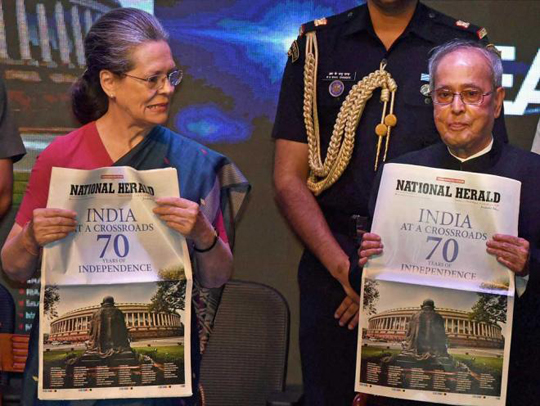
sonia

“When mob lynching becomes so high and uncontrollable, we have to pause and reflect, are we vigilant enough?,” Mukherjee said at the release of commemorative publication of relaunched National Herald here.

Sonia Gandhi, who spoke at the function, said, "It is being encouraged by a culture of vigilante violence, actively supported by those who are supposed to enforce the law."

Later, Priyanka Gandhi Vadra, daughter of the Congress president, told reporters that "It (incident of lynching) makes my blood boil. It should make blood of every Indian boil."

Mukherjee's comment and Sonia Gandhi's criticism came in the wake of reports about the spiralling violence over beef.

Mukherjee, who retires later this month, said, "When mob frenzy becomes so high, irrational and uncontrollable, we have to pause and reflect. I am not talking of vigilantism, I am talking of are we vigilant enough, proactively to save the basic tenets of our country.”

He said, "I do believe that citizens' and media vigilance can act as the biggest deterrent to forces of darkness and backwardness."

Congress president Sonia Gandhi said India is being marked by increasing threats of 'authoritarianism.'

She said, "Today the tried and tested idea of India has been thrown fundamentally into question by rising intolerance, by malevolent forces. It is being encouraged by a culture of vigilantive violence, actively supported by those who are supposed to enforce the law."

Gandhi further said that National Herald newspaper, which has been revived, is a testament to unity and justice and "not the division and hate that the present times are witnessing.

She said, "We are in a war of ideas, we have reached this war to preserve our ideas, which have built India as a model of democracy diversity and coexistence.if we don't raise our voices, if we do not speak up, our voices will be taken as consent."

A day after nationwide protests against lynchings spilt onto the streets, Modi had on Thursday broke his silence at Sabarmati Ashram in Gujarat and said killing people in the name of gau bhakti (devotion to the cow) is not acceptable.

The PM also said Mahatma Gandhi would not have approved of it and that no person in the country has the right to take the law into his own hands.

However, Modi's warning seemed to have had a little effect as just hours after his speech, Alimuddin, a meat trader, was lynched in Jharkhand’s Ramgarh.

Many cities witnessed protests across various locations under the tagline “Not in My Name” to protest against the lynching of 15-year-old Junaid Khan in a Mathura-bound train last week.

Comments

AK
 - 
Thursday, 6 Jul 2017

Thats VERY VERY GOOD .. Many families will give blessing to siddaramaiah...

Only Drunkards will not be happy with the closer.

Abdullah
 - 
Sunday, 2 Jul 2017

Worst President and opposition party ever faced in India.

Add new comment

  • Coastaldigest.com reserves the right to delete or block any comments.
  • Coastaldigset.com is not responsible for its readers’ comments.
  • Comments that are abusive, incendiary or irrelevant are strictly prohibited.
  • Please use a genuine email ID and provide your name to avoid reject.
Agencies
June 30,2020

Seventy-seven per cent children below five years of age in Jammu and Kashmir were not able to access basic healthcare services like immunisation during the lockdown imposed to curb the spread of COVID-19, CRY said on Monday citing a study.

The 'Rapid Online Perception Study about the Effects of COVID-19 on Children' was conducted during the first and second phases of the lockdown based on responses of parents and primary caregivers from all across the country, including Jammu and Kashmir, the NGO said in a statement.

It said a total of 387 respondents from Jammu and Kashmir participated in the study.

"Seventy-seven per cent children of age 0-5 years were not able to access basic healthcare services such as immunisation during lockdown - necessarily imposed to curb the spread of COVID-19 pandemic in Jammu and Kashmir," Child Rights and You (CRY) said.

It said as immunisation programmes witnessed a major setback during the lockdown across the country, the results of the survey across 23 states and Union Territories found nearly 50 per cent of parents with children below five years of age unable to access immunisation services.

"Worryingly, the figure was considerably high in Jammu and Kashmir with 77.14 per cent children below five years unable to get immunisation services," it added.

According to the study, in Jammu and Kashmir, nearly 35 per cent of the respondents said their children did not receive medical help during the lockdown, resulting in difficulties to cope with their children's illnesses and health hazards.

The study also talks about more systemic arrangements and logistical preparedness to ensure that children with no or compromised digital reach are not deprived from their Right to Education.

With online classes introduced as a substitute of schools during the lockdown, access to education for children remained a major issue of concern, as many of them, especially the ones from marginalised and financially poorer backgrounds found it difficult without smartphones and internet access.

The survey's findings revealed that nationally only 41 per cent households with children of school-going age could access online classes on a regular basis.

"Almost 90 per cent parents and primary caregivers reported that the lockdown has increased the screen time of their child to great or some extent. About half of the households recorded an increase of children's exposure to online activities during lockdown," it said.

The NGO said around 76 per cent parents agreed that they could keep a watch of their children's online activity to some extent.

Comments

Add new comment

  • Coastaldigest.com reserves the right to delete or block any comments.
  • Coastaldigset.com is not responsible for its readers’ comments.
  • Comments that are abusive, incendiary or irrelevant are strictly prohibited.
  • Please use a genuine email ID and provide your name to avoid reject.
News Network
May 20,2020

May 20: Prime Minister K P Sharma Oli on Tuesday asserted that Lipulekh, Kalapani and Limpiyadhura belong to Nepal and vowed to "reclaim" them from India through political and diplomatic efforts, as his Cabinet endorsed a new political map showing the three areas as Nepalese territory.

Addressing Parliament, Oli said the territories belong to Nepal “but India has made it a disputed area by keeping its Army there”. “Nepalis were blocked from going there after India stationed its Army,” he said.

“India has deployed its troops in Kalapani since 1962 and our rulers in the past hesitated to raise the issue,” he said, asserting, “We will reclaim and get them back.”

The prime minister asserted that the Nepal government will make political and diplomatic efforts to reclaim the territory.

Oli also expressed the hope that India will “follow the path of truth, shown by Satya Meva Jayate, which is mentioned in the Ashoka Chakra, the national symbol of India”.

The prime minister’s remarks came a day after the Cabinet headed by him endorsed a new political map showing Lipulekh, Kalapani and Limpiyadhura under Nepal’s territory.

Foreign Minister Pradeep Kumar Gyawali said the official map of Nepal will soon be made public by the Ministry of Land Management. The move announced by Gyawali came weeks after he said that efforts were on to resolve the border issue with India through diplomatic initiatives.

Nepal''s ruling Nepal Communist Party lawmakers have also tabled a special resolution in Parliament demanding return of Kalapani, Limpiyadhura and Lipulekh to Nepal.

The Lipulekh pass is a far western point near Kalapani, a disputed border area between Nepal and India. Both India and Nepal claim Kalapani as an integral part of their territory - India as part of Uttarakhand’s Pithoragarh district and Nepal as part of Dharchula district.

Gyawali last week summoned the Indian Ambassador Vinay Mohan Kwatra and handed over a diplomatic note to him to protest against the construction of a key road connecting the Lipulekh pass with Dharchula in Uttarakhand.

India has said that the recently-inaugurated road section in Pithoragarh district in Uttarakhand lies completely within its territory. Indian Army chief Gen MM Naravane last week said that there were reasons to believe that Nepal objected to India''s newly-inaugurated road linking Lipulekh Pass with Dharchula in Uttarakhand at the behest of "someone else", in an apparent reference to a possible role by China on the matter.

He said there was no dispute whatsoever between India and Nepal in the area and road laid was very much within the Indian side.

The 80-KM-long strategically crucial road at a height of 17,000 KM along the border with China in Uttarakhand was thrown open by Defence Minister Rajnath Singh earlier this month.

Nepal has raised objection to the inauguration of the road, saying the "unilateral act" was against the understanding reached between the two countries on resolving the border issues. China on Tuesday said the Kalapani border issue is between India and Nepal as it hoped that the two neighbours could refrain from "unilateral actions" and properly resolve their disputes through friendly consultations.

After the endorsement of Nepal’s new map senior ruling party leader and member of Nepal Communist Party Standing Committee Ganesh Shah said the new move may escalate unnecessary tension between Nepal and India at a time when the country is fighting the coronavirus.

"The Nepal government should soon start a dialogue with India to resolve the matter through political and diplomatic moves," he said.

The new map includes 335-km land area including Limpiyadhura in the Nepalese territory.

The new map was drawn on the basis of the Sugauli Treaty of 1816 signed between Nepal and then the British India government and other relevant documents, which suggests Limpiyadhura, from where the Kali river originated, is Nepal''s border with India, The Kathmandu Post quoted an official at the Ministry of Land Reform and Management as saying.

India and Nepal are at a row after the Indian side issued a new political map incorporating Kalapani and Lipulekh on its side of the border in October last year.

The tension further escalated after India inaugurated the road link connecting Kailash Mansarovar, a holy pilgrimage site situated at Tibet, China, that passes through the territory belonging to Nepal.

Comments

Add new comment

  • Coastaldigest.com reserves the right to delete or block any comments.
  • Coastaldigset.com is not responsible for its readers’ comments.
  • Comments that are abusive, incendiary or irrelevant are strictly prohibited.
  • Please use a genuine email ID and provide your name to avoid reject.
Agencies
July 30,2020

New Delhi, Jul 30: Preparing for a long haul in the Eastern Ladakh sector in extreme winters, the Indian Army has an edge over the Chinese as it has deployed 35,000 troops there who have already done tenures in high altitude and cold conditions.

The Indian troops deployed there are mentally prepared for tackling the weather and terrain.
In contrast, the Chinese troops deployed along the Line of Actual Control (LAC) are not used to these conditions as they have been brought from mainland China and are not accustomed to high altitude extreme cold weather conditions.

"We are preparing to provide extreme cold weather portable cabins for around 35,000 troops that have been deployed in the Eastern Ladakh sector," government sources said.

"Our soldiers deployed there have already done a tenure or two in Siachen, Eastern Ladakh or Northeast and they are physically and mentally prepared for a longer deployment there," they said.

The Chinese soldiers deployed on the Indian front include mainly conscripts who join the PLA for a period of 2-3 years and then return to their normal lives, sources said.

Indian and Chinese troops are engaged in a standoff situation all along the LAC in Eastern Ladakh from sub-sector north with both sides having deployed around 40,000 troops against each other over there.

The two sides have disengaged at three friction points including Patrolling Point 14, PP-15 and PP-17 and PP-17A.

At PP-17 and 17A, the Chinese have now maintained a small element of close to 50 troops and the remaining elements have gone back into their permanent locations.

The sources said the Army is also not much bothered about the Chinese build-up along the LAC as it has got more than two additional divisions from outside Ladakh sector.

India Army has more troops than what the Chinese have brought there, they said.

For the winter deployment, the Army already has a sizeable stock of clothes and habitat for troops as the Indian army deploys troops at the world's highest battlefield Siachen glacier and is prepared.

For additional requirements, the force is in the process of placing orders for additional tents and shelters from indigenous as well as foreign vendors.

The time for summer stocking is on and we are going to get the additional cabins and tents by that time, the sources.

Months of June, July, and August are considered to be the best time for stocking winter rations and ammunition. The snowfall is expected to start soon in the Eastern Ladakh area where the temperature is already low.

Prime Minister Narendra Modi's government has given financial powers of Rs 500 crore per procurement to the defence forces to address any type of shortages of weapons, ammunition, and habitat.

Comments

Add new comment

  • Coastaldigest.com reserves the right to delete or block any comments.
  • Coastaldigset.com is not responsible for its readers’ comments.
  • Comments that are abusive, incendiary or irrelevant are strictly prohibited.
  • Please use a genuine email ID and provide your name to avoid reject.