


President, Sonia express concern over lynching incidents

Agencies
July 2, 2017

New Delhi, Jul 2: President Pranab Mukherjee joined Congress president Sonia Gandhi in expressing serious concern over growing number of mob lynching cases in India, wondering whether the society is vigilant enough to save the basic tenets of the country.
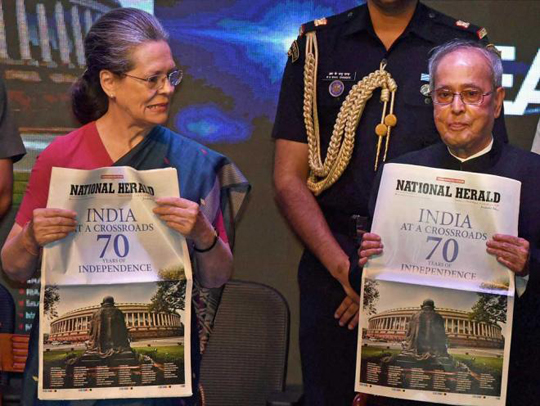
sonia

“When mob lynching becomes so high and uncontrollable, we have to pause and reflect, are we vigilant enough?,” Mukherjee said at the release of commemorative publication of relaunched National Herald here.

Sonia Gandhi, who spoke at the function, said, "It is being encouraged by a culture of vigilante violence, actively supported by those who are supposed to enforce the law."

Later, Priyanka Gandhi Vadra, daughter of the Congress president, told reporters that "It (incident of lynching) makes my blood boil. It should make blood of every Indian boil."

Mukherjee's comment and Sonia Gandhi's criticism came in the wake of reports about the spiralling violence over beef.

Mukherjee, who retires later this month, said, "When mob frenzy becomes so high, irrational and uncontrollable, we have to pause and reflect. I am not talking of vigilantism, I am talking of are we vigilant enough, proactively to save the basic tenets of our country.”

He said, "I do believe that citizens' and media vigilance can act as the biggest deterrent to forces of darkness and backwardness."

Congress president Sonia Gandhi said India is being marked by increasing threats of 'authoritarianism.'

She said, "Today the tried and tested idea of India has been thrown fundamentally into question by rising intolerance, by malevolent forces. It is being encouraged by a culture of vigilantive violence, actively supported by those who are supposed to enforce the law."

Gandhi further said that National Herald newspaper, which has been revived, is a testament to unity and justice and "not the division and hate that the present times are witnessing.

She said, "We are in a war of ideas, we have reached this war to preserve our ideas, which have built India as a model of democracy diversity and coexistence.if we don't raise our voices, if we do not speak up, our voices will be taken as consent."

A day after nationwide protests against lynchings spilt onto the streets, Modi had on Thursday broke his silence at Sabarmati Ashram in Gujarat and said killing people in the name of gau bhakti (devotion to the cow) is not acceptable.

The PM also said Mahatma Gandhi would not have approved of it and that no person in the country has the right to take the law into his own hands.

However, Modi's warning seemed to have had a little effect as just hours after his speech, Alimuddin, a meat trader, was lynched in Jharkhand’s Ramgarh.

Many cities witnessed protests across various locations under the tagline “Not in My Name” to protest against the lynching of 15-year-old Junaid Khan in a Mathura-bound train last week.

Comments

AK
 - 
Thursday, 6 Jul 2017

Thats VERY VERY GOOD .. Many families will give blessing to siddaramaiah...

Only Drunkards will not be happy with the closer.

Abdullah
 - 
Sunday, 2 Jul 2017

Worst President and opposition party ever faced in India.

Add new comment

  • Coastaldigest.com reserves the right to delete or block any comments.
  • Coastaldigset.com is not responsible for its readers’ comments.
  • Comments that are abusive, incendiary or irrelevant are strictly prohibited.
  • Please use a genuine email ID and provide your name to avoid reject.
Agencies
February 10,2020

New Delhi, Fevb 10: Of the countries most at risk of importing coronavirus cases, India ranks 17th, researchers have found on the basis of a mathematical model for the expected global spread of the virus that originated in China's Wuhan area in December 2019.

So far, India has reported three coronavirus positive cases -- all from Kerala.

Among the airports in India, the Indira Gandhi International Airport in New Delhi is most at risk, followed by airports in Mumbai, Kolkata, Bengaluru, Chennai, Hyderabad and Kochi, according to the model.

The new model for predicting global novel coronavirus cases has been developed by researchers from Humboldt University and Robert Koch Institute in Germany.

"The spread of the virus on an international scale is dominated by air travel," said the study.

"Wuhan, the seventh largest city in China with 11 million residents, was the relevant major domestic air transportation hub with many connecting international flights before the city was effectively quarantined on January 23, 2020, and the Wuhan airport was closed. By then the virus had already spread to other Chinese provinces as well as other countries," it added.

The researchers said that it is possible to estimate how likely it is that the virus spreads to other areas by looking at air travel passenger numbers.

"The busier a flight route, the more probable it is that an infected passenger travels this route. Using these probabilistic concepts, we calculate the relative import risk to other airports. When calculating the import risk, we also take into account connecting flights and travel routes that involve multiple destinations," said the study.

The top 10 countries and regions at risk of importing coronavirus cases are: Thailand, Japan, South Korea, Hong Kong, Taiwan, USA, Vietnam, Malaysia, Singapore and Cambodia, according to the model.

While Thailand's national import risk is 2.1%, it is 0.2% for India, found the research.

The foundation of the model is the worldwide air transportation network (WAN) that connects approximately 4,000 airports with more than 25,000 direct connections.

The model accounts for both, the current distribution of confirmed cases in mainland China as well as airport closures that were implemented as a mitigation strategy.

This network theoretic model is based on the concept of effective distance and is an extension of a model introduced in the 2013 paper "The Hidden Geometry of Complex, Network-Driven Contagion Phenomena" published in the journal Science.

The current outbreak of the 2019-nCoV virus started in Wuhan city, Hubei province, China. While the first cases were reported as early as December 8, 2019, the outbreak gained global attention on December 31, 2019, when the World Health Organization was alerted to "several cases of pneumonia" by an unknown virus.

The new virus was soon identified as a novel coronavirus and named 2019-nCOV. It belongs to the family of viruses that include the common cold and viruses such as SARS and MERS. On January 20, 2020, it was confirmed that the coronavirus can be transmitted between humans, greatly increasing the risk of a global spread.

The death toll due to the novel coronavirus outbreak in China has increased to 811 on Sunday, surpassing that of the Severe Acute Respiratory Syndrome (SARS) epidemic in 2003.

Although about 20 countries have confirmed cases, China has accounted for about 99 per cent of those infected. The first foreign victims of the virus both died on Saturday in Wuhan.

Comments

Add new comment

  • Coastaldigest.com reserves the right to delete or block any comments.
  • Coastaldigset.com is not responsible for its readers’ comments.
  • Comments that are abusive, incendiary or irrelevant are strictly prohibited.
  • Please use a genuine email ID and provide your name to avoid reject.
News Network
February 19,2020

London, Feb 19: Indian universities had a good performance year within the emerging economies of the world as a record 11 made it to the top 100 Times Higher Education's (THE) Emerging Economies University Rankings 2020.

Only China has more universities than India in the top 100 at 30 from a total of 47 countries and territories included in the analysis released in London on Tuesday evening.

A total of 56 Indian universities appear in the full ranking of a total of 533 universities across emerging economies of the world.

The Indian Institute of Science (IISc), ranked 16th, is India’s top-ranked institution followed by the Indian Institute of Technologies (IITs).

"There has long been a debate about the success of Indian universities in world rankings, and for too long they have been seen as underperforming on the global stage," notes Phil Baty, Chief Knowledge Officer for the THE.

"The Emerging Economies University Rankings 2020 suggests that real progress is being made by a number of institutions in a number of metrics across our robust methodology, and could mark an exciting turning point for Indian higher education, enabled in part by the Institutes of Eminence scheme," he said.

The Indian government’s Institutes of Eminence scheme was established in 2017 and one of its participating universities, Amrita Vishwa Vidyapeetham, has entered the top 100 for the first time, moving up a huge 51 places from joint 141st in 2019.

The other universities included in the Institutes of Eminence scheme that appear in the top 100 mark the biggest improvers in the ranking with IIT Kharagpur moving up 23 places to 32nd, IIT Delhi improving by 28 places to joint 38th and IIT Madras climbing 12 places to joint 63rd.

The Institutes of Eminence scheme provides participating universities with government funding and greater autonomy with the aim of moving them into the top 100 of the world university rankings, including Times Higher Education’s World University Ranking, over time.

The expectation is that this will be achieved through a number of changes including an increase in foreign students and staff, offering online courses and encouraging academic collaboration with other top universities around the world.

This year marks only the second time that 11 Indian institutions have held top 100 positions since the ranking began in 2014, when much fewer universities took part in the ranking globally.

Comments

Add new comment

  • Coastaldigest.com reserves the right to delete or block any comments.
  • Coastaldigset.com is not responsible for its readers’ comments.
  • Comments that are abusive, incendiary or irrelevant are strictly prohibited.
  • Please use a genuine email ID and provide your name to avoid reject.
News Network
July 19,2020

Lucknow, Jul 19: The animal markets, which are usually bustling with activity ahead of Bakrid, are desolate this year.

The Covid-19 pandemic has shorn all festivals of public celebrations, and people are apprehensive that the tradition of animal sacrifice may be affected due to social distancing norms.

Also there is a massive drop in demand for sacrificial animals due to the financial impact of the crisis.

Chairman of All India Jamiat-ul-Quresh Sirajuddin Qureshi urged the government to come out with guidelines for carrying out the celebrations in the traditional way.

The festival will fall on July 31 or August 1. Buyers and sellers start thronging the animal markets almost two weeks ahead of the festival. But this year only a negligible number of buyers have turned up in animal markets in old Lucknow areas including Nakkhas, according to traders.

"It is very difficult to say as to what the government is thinking. 'Qurbani' is a matter of faith for the Muslims. We appeal to the government to deliberate and find a solution. This is a national problem, and our office bearers are speaking to different state governments," Qureshi said.

In the absence of guidelines, not many madrassas are buying animals for sacrifice, he said.

"The madrasas where collective 'qurbani' is done, are also not coming forward. In Bakrid, along with goats, buffaloes are also sacrificed. The government should ensure that people who are transporting the animals are not harassed by the police," Qureshi said.

Prominent Muslim cleric Khalid Rasheed Farang Mahali said he had raised the issue with the Uttar Pradesh chief minister.

"I have recently met Chief Minister Yogi Adityanath requesting him to issue guidelines for Bakrid. I am hopeful that the guidelines will be released soon," he said.

Rahat Ali, a goat trader from Rajasthan said, thousands of people will be affected due to the reduced demand for animals.

"The animal trade works in a chain involving farmers who rear animals, small traders and big traders.

"The traders buy the animals from the farmers. These are then sent to various states like Maharashtra, Gujarat and Uttar Pradesh. In the absence of demand, I did not purchase animals this year," he said.

Sajid, who supplies goats to various districts in western Uttar Pradesh, said the lockdown has affected the livelihood of people and not many have the money to buy animals for sacrifice.

"The lockdown has drained the people of their money. As a result, the animals are not getting sold," he said.

The Maharashtra government has come out with guidelines for Eid al-Adha, also known as Bakrid or Id-ul-Zuha, noting that there is a ban in place on all religious programmes and people should offer "namaz" in their homes and not in mosques.

It also said sacrificial animals should be bought online or over the phone as markets dealing with them will be closed, adding that "qurbani" should preferably be symbolic.

There will be no relaxation in restrictions for Eid in containment zones, and people are directed not to congregate in public places on the day of the festival, it added. 

Comments

Add new comment

  • Coastaldigest.com reserves the right to delete or block any comments.
  • Coastaldigset.com is not responsible for its readers’ comments.
  • Comments that are abusive, incendiary or irrelevant are strictly prohibited.
  • Please use a genuine email ID and provide your name to avoid reject.