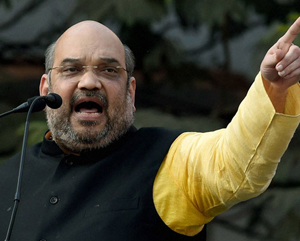
More lynching incidents happened under previous govts: Shah

Agencies
July 2, 2017

Panaji, Jul 2: BJP president Amit Shah has said that more incidents of lynching had occurred during the previous governments than during the three years of NDA rule, but no one had raised questions then.amitt

"I do not want to compare and undermine the current incidents of lynching. I am also serious about it. But there have been more lynching incidents in 2011, 2012 and 2013," Shah told a gathering of professionals in Goa last evening.

"There have been more lynchings each year in the past, compared to the total lynching incidents that have happened during our three-year-long tenure," the BJP leader said. The BJP-led government came to power at the Centre in May 2014.

Responding to a question about fears over the lynching incidents, he said there was no apprehension anywhere in the country.

"Do you know of any such incident where arrests have not been made? I do not have any answer to apprehensions. There is no apprehension anywhere in the country," he said.

Maintaining that law and order was a state subject, Shah said when Mohammad Akhlaq died, the Samajwadi Party-led government was in power in Uttar Pradesh, and it was its responsibility.

"But protests are held in Delhi in front of the Narendra Modi government. What is this fashion," he asked.

In September 2015, Akhlaq was dragged out of his house and killed by a mob at Dadri in UP on suspicion of storing and consuming beef.

Following several such lynching incidents, including those in Jharkhand, Haryana and UP, protests were held late last month at several cities across the country.

Comments

Ranjan shetty
 - 
Thursday, 6 Jul 2017

Chutiya bangladeshisare attacking Hindus in WB, where are those SOB's who did rally in the name of #notin my name ?

Umar Ashfaq
 - 
Thursday, 6 Jul 2017

Please qidmat k mauka de guzarish hogi

ABDUL AZIZ
 - 
Thursday, 6 Jul 2017

hang them till death , sharia law

Abdullah
 - 
Sunday, 2 Jul 2017

But who killed them????
You and your goons only.

Rikaz
 - 
Sunday, 2 Jul 2017

do not compare with previous government, it is your job to eliminate all sort of lynching around....take action on all who committed it as of now and make sure that it will not happen again....why it is happening only on muslims....there are people eating beef from other community.... and beef export factories exporting beef everyday basis with no problems...if you have guts stop it....

Thoushi
 - 
Sunday, 2 Jul 2017

True lynching was happening in previous government also and before since Gandhi's assassination , but Mr. Cha most all lynching was carried out by your OWN associated party(BJP) and wings (RSS)

Add new comment

  • Coastaldigest.com reserves the right to delete or block any comments.
  • Coastaldigset.com is not responsible for its readers’ comments.
  • Comments that are abusive, incendiary or irrelevant are strictly prohibited.
  • Please use a genuine email ID and provide your name to avoid reject.
News Network
May 6,2020

New Delhi, May 6: Taking a cue from states, the Centre announced one of the steepest hikes in duties on petrol and diesel in the recent past, by raising it by Rs 10 and Rs 13 per litre, respectively, in a notification issued late on Tuesday.

Retail prices, however, will see no change as the price hike will be absorbed by oil marketing companies against the fall in crude prices.

Road and infrastructure cess was hiked by Rs 8 for petrol and diesel and the special additional excise duty (SAED) was hiked by Rs 2 per litre and Rs 5 per litre, respectively. While the road cess will only go into the Centre’s coffers, the hike on account of SAED will be passed on to states via devolution at 42 per cent. Hence, the states will get only Rs 0.84 per litre in case of petrol and Rs 2.1 in case of diesel.

The decision comes after several states increased the value added tax (VAT) on petrol and diesel making use of the lower price regime. The Delhi government on Tuesday increased VAT on petrol and diesel to 30 per cent each, from 27 and 16.75, respectively. As a result, the price of petrol in Delhi increased by Rs 1.67 to Rs 71.26 a litre and diesel by Rs 7.10 to Rs 69.29 in Delhi on Tuesday.

Amid falling international crude oil prices, the Centre introduced an enabling provision in March to raise excise duty on petrol and diesel by Rs 8 per litre in the Finance Act. The government had on March 14 raised excise duty on petrol and diesel by? 3 per litre each, which was to help raise an additional ?39,000 crore in revenue annually.

This duty hike included Rs 2 a litre increase in SAED and Rs 1 in road and infrastructure cess. It raised SAED to Rs 10 for petrol and Rs 4 for diesel. The limit has now been increased to Rs 18 a litre in case of petrol and Rs 12 in case of diesel by way of amendment of the Eighth Schedule of the Finance Act.

Economists said the move would impact retail inflation by over half a percentage point at least. “With lower consumption, there was loss of revenue for Centre and states, who earn Rs 6 trillion annually or Rs 50,000 crore monthly from fuel. Amid lockdown in April, the collection must have come down to just Rs 5,000 crore, and this will hold for May.

This means that Centre and states have lost 20 per cent of annual revenue from fuel. Hence, they have hiked duties to recover losses,” said Madan Sabnavis, chief economist, CARE Ratings. He added that the hike will impact inflation by at least 0.6-0.7 percentage points.

According to industry experts, an estimate of the additional government revenue cannot be made as the consumption of petrol and diesel has dropped to 40 per cent of what it was before the lockdown. The duty hike comes following a drop in international crude oil prices in April, owing to lower consumption figures globally. At 11.50 pm on Tuesday, Brent was priced at $30.67 a barrel, while West Texas Intermediate (WTI) crude was seen at $24.36 a barrel. On Monday, the Indian basket of crude oil was priced at $23.38 a barrel, after touching a 15-year low last month.

Comments

Add new comment

  • Coastaldigest.com reserves the right to delete or block any comments.
  • Coastaldigset.com is not responsible for its readers’ comments.
  • Comments that are abusive, incendiary or irrelevant are strictly prohibited.
  • Please use a genuine email ID and provide your name to avoid reject.
News Network
February 1,2020

New Delhi, Feb 1: Finance Minister Nirmala Sitharaman promised to make India a higher education destination, as she unveiled the government’s plan to invest in the education sector in her Budget speech.

“We propose Rs 99,300 crore for education sector in 2020-21 and Rs 3,000 crore for skill development,” said Sitharaman. While there is an increase of 4.6 per cent in the education spending than last year, the budget for skill development remains almost unchanged. Sitharaman also announced holding IND-SAT exam in African and Asian countries, for foreign candidates who wish to study in India.

The Finance Minister had listed three themes of the Union Budget 2020 while presenting the financial statement of the government in Parliament: Aspirational India to boost the standard of living, economic development for all, and building a humane and compassionate society. The spend under education is being done under aspirational India, “which focusses on focussed on skills, education, and agriculture” said Sitharaman.

“A degree-level full-fledged online education programme will be offered by institutes in top 100 in National Institutional Ranking Framework,” said Sitharaman, adding that Centre will announce a new education policy soon. “The government has received over 2 lakh suggestions on it.”

Further giving boost to India’s import of skilled human capital, Sitharaman said, “I propose special bridge course for nurses and medical professional for labour export to countries who open their door for such jobs.”

“Steps will be be taken to attract external commercial borrowing and Foreign Direct Investment (FDI) in the education sector,” the finance minister added.

She further said the government plans to start a programme for urban local bodies to provide opportunities for internship to young engineers.

The Finance Minister also said National Police University and National Forensic University are being proposed.

The government has also proposed to attach medical colleges with district hospitals on PPP model to deal with shortage of doctors, Sitharaman added.

Comments

Add new comment

  • Coastaldigest.com reserves the right to delete or block any comments.
  • Coastaldigset.com is not responsible for its readers’ comments.
  • Comments that are abusive, incendiary or irrelevant are strictly prohibited.
  • Please use a genuine email ID and provide your name to avoid reject.
News Network
March 6,2020

New Delhi, Mar 6: Shares of YES Bank and State Bank of India came under huge selling pressure on Friday as developments unfolded regarding SBI picking stake in the private lender. Shares of the lender hit record low of Rs 5.55, plunging 85 per cent, and were trading below its previous low of Rs 8.16 hit on March 9, 2009.

SBI, on the other hand, slumped 11 per cent to Rs 257.35 on the BSE. The benchmark S&P BSE Sensex was trading with a cut of over 3 per cent at 37,251.37 level.

In the past three months, share price of the private lender has plunged 41 per cent, while the state-owned lender has slipped 14 per cent. In comparison, the S&P BSE Sensex has dipped 5.6 per cent till Thursday.

On Thursday, the Reserve Bank of India superseded the board of troubled private sector lender YES Bank and imposed a 30-day moratorium on it “in the absence of a credible revival plan” amid a “serious deterioration” in its financial health.

During the moratorium, which came into effect from 6 pm on Thursday, YES Bank will not be allowed to grant or renew any loans, and “incur any liability”, except for payment towards employees’ salaries, rent, taxes and legal expenses, among others.

This is the first time that a bank of this size will be put under a moratorium by the RBI.

“The financial position of YES Bank had undergone a steady decline “largely due to inability of the bank to raise capital to address potential loan losses and resultant downgrades, triggering invocation of bond covenants by investors, and withdrawal of deposits,” RBI said in a statement.

“After the moratorium, the next step will be to infuse to money and keep the bank afloat. So from shareholders’ point of view, the future is certainly hazy as the capital requirement is huge. The good part, however, is that the RBI has stepped in and depositors don't have to worry,” says Siddharth Purohit, a research analyst at SMC Securities.

Meanwhile, analysts at Nomura believe that placing the Bank under moratorium implies that equity value in the bank would be negligible, and that the chances of private capital participating in future capital raising plan are near zero.

"Any resolution for Yes Bank is more proposed from the perspective of deposit holders and systemic stability, and not from the perspective of Yes Bank equity investors or even perpetual bond holders," they wrote in a note dated March 6.

In another development, SBI’s Board Thursday gave in-principle approval to consider an “investment opportunity” in YES Bank, even as it said “no decision had yet been taken to pick up stake in the bank”.

According to a  report, highly-placed sources indicated a rescue plan involving SBI and Life Insurance Corporation of India (LIC) was being discussed and an announcement in this regard might be made soon.

“While the finer details of the deal are being worked out, it is anticipated that both SBI and LIC together will take a 51 per cent stake in the bank, with a one-year lock-in period,” the report said.

Most analysts believe it is a positive step for the Indian financial sector as the government has tried to avoid a repeat of IL&FS-like crisis.

“The move is a positive step for the financial sector as a whole. By this, the government has tried to avoid a repeat of IL&FS-like crisis and has saved the depositors,” said AK Prabhakar, Head of Research at IDBI Capital. While we know that YES Bank has a huge pile of bad loans, SBI is the only bank that has the capacity to absorb it, he added.

However, the valuation at which YES bank would be taken over remains a cause of concern.

Global brokerage firm JP Morgan Thursday cut its target price for YES Bank on Thursday to Rs 1 per share, taking into account the potential fall in the lender’s net worth due to stressed assets.

“We believe forced bailout investors will likely want the bank to be acquired at near-zero value to account for risks associated with the stress book and likely loss of deposits. We think the bank will need to be recapitalised at nominal equity value and could test dilution of additional tier 1 (AT1) capital. We remain underweight and cut our target price to Rs 1 as we believe net worth is largely impaired,” JP Morgan said in a note.

Global brokerage firm Nomura estimates a need of Rs 25,000-44,000 crore and adjusted for Rs 7,400 crore of current coverage, if the current stress of Rs 65,000-70,000 crore faces 70 per cent loss given default (LGD).

"It implies Rs 18,000-37,000 crore needed for provisioning against the current net worth of Rs 25,700 crore Also, to run as going concern, the bank would require over Rs 20,000 crore of CET-1 capital as well," the note said.

YES Bank has registered slippages of Rs 12,000 crore so far in FY20, while it has placed Rs 30,000 crore of loan assets under the watch list. Its deposits stood at Rs 2.09 trillion on September 30, 2019, while its advances totalled Rs 2.24 trillion. The bank has delayed publishing its December quarter results by a month to March 14.


Comments

Add new comment

  • Coastaldigest.com reserves the right to delete or block any comments.
  • Coastaldigset.com is not responsible for its readers’ comments.
  • Comments that are abusive, incendiary or irrelevant are strictly prohibited.
  • Please use a genuine email ID and provide your name to avoid reject.