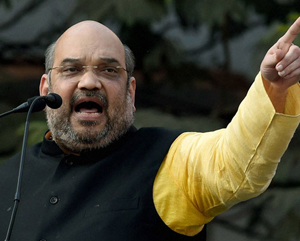
More lynching incidents happened under previous govts: Shah

Agencies
July 2, 2017

Panaji, Jul 2: BJP president Amit Shah has said that more incidents of lynching had occurred during the previous governments than during the three years of NDA rule, but no one had raised questions then.amitt

"I do not want to compare and undermine the current incidents of lynching. I am also serious about it. But there have been more lynching incidents in 2011, 2012 and 2013," Shah told a gathering of professionals in Goa last evening.

"There have been more lynchings each year in the past, compared to the total lynching incidents that have happened during our three-year-long tenure," the BJP leader said. The BJP-led government came to power at the Centre in May 2014.

Responding to a question about fears over the lynching incidents, he said there was no apprehension anywhere in the country.

"Do you know of any such incident where arrests have not been made? I do not have any answer to apprehensions. There is no apprehension anywhere in the country," he said.

Maintaining that law and order was a state subject, Shah said when Mohammad Akhlaq died, the Samajwadi Party-led government was in power in Uttar Pradesh, and it was its responsibility.

"But protests are held in Delhi in front of the Narendra Modi government. What is this fashion," he asked.

In September 2015, Akhlaq was dragged out of his house and killed by a mob at Dadri in UP on suspicion of storing and consuming beef.

Following several such lynching incidents, including those in Jharkhand, Haryana and UP, protests were held late last month at several cities across the country.

Comments

Ranjan shetty
 - 
Thursday, 6 Jul 2017

Chutiya bangladeshisare attacking Hindus in WB, where are those SOB's who did rally in the name of #notin my name ?

Umar Ashfaq
 - 
Thursday, 6 Jul 2017

Please qidmat k mauka de guzarish hogi

ABDUL AZIZ
 - 
Thursday, 6 Jul 2017

hang them till death , sharia law

Abdullah
 - 
Sunday, 2 Jul 2017

But who killed them????
You and your goons only.

Rikaz
 - 
Sunday, 2 Jul 2017

do not compare with previous government, it is your job to eliminate all sort of lynching around....take action on all who committed it as of now and make sure that it will not happen again....why it is happening only on muslims....there are people eating beef from other community.... and beef export factories exporting beef everyday basis with no problems...if you have guts stop it....

Thoushi
 - 
Sunday, 2 Jul 2017

True lynching was happening in previous government also and before since Gandhi's assassination , but Mr. Cha most all lynching was carried out by your OWN associated party(BJP) and wings (RSS)

Add new comment

  • Coastaldigest.com reserves the right to delete or block any comments.
  • Coastaldigset.com is not responsible for its readers’ comments.
  • Comments that are abusive, incendiary or irrelevant are strictly prohibited.
  • Please use a genuine email ID and provide your name to avoid reject.
Agencies
January 9,2020

The World Bank says that a lack of credit and drop in private consumption have led to a gloomy growth outlook for India with a steep cut in growth rate for the current fiscal year and only a modest gain projected for the next year.

India's growth rate is forecast to be only 5 per cent for the current fiscal year, weighed down by a growth of only 4.5 per cent in the July-September quarter, according to the 2020 Global Economic Prospects report released on Wednesday.

"In India, [economic] activity was constrained by insufficient credit availability, as well as by subdued private consumption," the Bank said.

The growth rate is forecast by the Bank to pick up to 5.8 per cent in the next fiscal year and to 6.1 per cent in 2021-22.

India's growth rate was 6.8 per cent in 2018-19.

The 5 per cent growth rate projection for the current financial year is a sharp cut of 2.5 per cent from the 7.5 per cent forecast made by the Bank in January last year, toppling it from the rank of the world's fastest growing economy.

India's performance follows a global trend of lowered growth weighed down by developed economies.

The report estimated world economic growth rate to be only 2.4 per cent last year and forecast it to edge up 0.1 per cent to 2.5 per cent in the current year.

Even with the lower growth rate of 5 per cent in the current fiscal year and 5.8 per cent forecast for the next, India holds the second rank among large economies, behind only China with an estimated growth rate of 6.1 per cent for 2019 and 5.9 per cent this year.

The report blamed "weak confidence, liquidity issues in the financial sector" and "weakness in credit from non-bank financial companies" for India's slowdown.

The Bank predicated India's recovery to 5.8 per cent in the coming financial year for India but "on the monetary policy stance remaining accommodative" and the assumption that "the stimulative fiscal and structural measures already taken will begin to pay off."

It also warned that sharper-than-expected slowdown in major external markets such as United States and Europe, would affect South Asia through trade, financial, and confidence channels, especially for countries with strong trade links to these economies."

The Bank said that the growth of advanced economies was 1.6 per cent last year and "is anticipated to slip to 1.4 per cent in 2020 in part due to continued softness in manufacturing."

In contrast the growth of emerging market and developing countries is expected to accelerate from 3.5 per cent last year to 4.1 per cent this year, the report said.

In South Asia, Bangladesh is estimated to have the highest growth rate of 7.2 per cent in the current fiscal year, although down from 8.1 per cent last fiscal year.

But its higher regional growth rates are coming off a lower base with a per capital gross domestic product of $1,698 compared to $2,010 for India.

Bangladesh is expected to grow by 7.3 per cent in the next financial year.

Pakistan's growth rate is estimated at only 2.4 per cent in the current fiscal year and is projected to rise to 3 per cent in the next, according to the Bank.

The Bank blamed monetary tightening in Pakistan for a sharp deceleration in fixed investment and a considerable softening in private consumption for the fall in growth rate from 3.3 per cent in the 2018-19 fiscal year.

Sri Lanka's growth rate was estimated to be 2.7 per cent last year and forecast to grow to 3.3 per cent this year.

Nepal grew by an estimated 6.4 per cent in the current fiscal year and will rise to 6.5 per cent in the next.


Comments

Add new comment

  • Coastaldigest.com reserves the right to delete or block any comments.
  • Coastaldigset.com is not responsible for its readers’ comments.
  • Comments that are abusive, incendiary or irrelevant are strictly prohibited.
  • Please use a genuine email ID and provide your name to avoid reject.
News Network
April 3,2020

New Delhi, Apr 3: Prime Minister Narendra Modi on Friday urged people to gather together for a unique exercise on April 5 at 9 pm to show they were together in the fight against coronavirus.

"On this Sunday, April 5, we will challenge the darkness of coronavirus threat together. On April 5, at 9 pm, I need your 9 minutes. At 9 pm, turn off all the lights in your houses and light a Diya, candle, torch or flashlight for 9 minutes at your doors, or balcony," Modi said.

The Prime Minister further said that this will send out a message that nobody among the 130 crore Indians is alone in this fight against the deadly infection.

"I have one more prayer to all of you, nobody has to gather at any place during this event. Everyone will light a Diya only at their doors, windows or balconies. The Laxman Rekha of social distancing must be followed," Modi said.
Earlier, the Prime Minister had said that 130 crore Indians are together in this fight against coronavirus and praised the countrymen for following the lockdown.

"Today when crores of people are inside homes, then some of us may think how will they fight this battle against COVID-19 alone. Such questions might come up in your mind? But please remember, none of us is alone. The strength of 130 crores of Indians is with each one of us," he said.

He also expressed gratitude towards countrymen for participating in 'Janata curfew' on March 22 and said it has become "an example for all countries" today as they are following it.

In his address to the nation on March 24, the Prime Minister had announced a 21-day lockdown in the country to contain the spread of novel coronavirus, which has infected over 2,000 people in the country.

During the last "Mann Ki Baat" on COVID-19 related issue, the Prime Minister had apologised to the countrymen for taking the tough decision of enforcing complete lockdown in the nation. "My conscience says you will forgive me," he had said.

Comments

Add new comment

  • Coastaldigest.com reserves the right to delete or block any comments.
  • Coastaldigset.com is not responsible for its readers’ comments.
  • Comments that are abusive, incendiary or irrelevant are strictly prohibited.
  • Please use a genuine email ID and provide your name to avoid reject.
News Network
May 11,2020

New Delhi, May 11: Prime Minister Narendra Modi on Monday chaired a fresh round of consultation with chief ministers on ways to strengthen the COVID-19 containment strategy and stepping up of economic activities in a calibrated manner as the 54-day nationwide lockdown nears an end.

Large-scale movement of migrant workers from urban to rural India and the problems their return to home states may cause in restarting the economy will also be among the focus areas during the fifth virtual interaction between the prime minister and chief ministers since the outbreak of the deadly virus in the country.

There will be an effort to ensure that all participating chief ministers get an opportunity to air their views during the interaction, as some of the CMs had complaint that they were not allowed to put forth their views during the last interaction on April 27.

At a meeting on Sunday with Cabinet Secretary Rajiv Gauba, state chief secretaries told him that "while protection is required from COVID-19, economic activities also need to be stepped up in a calibrated manner", according to an official statement.       

With thousands of migrant workers taking special trains to go back to their home states, the restarting of industrial activities will prove to be a challenge for states though several relaxations have been made in labour laws to increase factory output.    

The meet is also likely to discuss efforts to convert 'red' zones with high COVID-19 case load into 'orange' or 'green' zones.       The prime minister interacted with the chief ministers last on April 27. Days after the meeting, the central government had extended the lockdown by two more weeks till May 17 to arrest the spread of the virus, but gave several relaxations in economic activities and movement of people.

The nationwide lockdown has been in force since March 25 to contain the spread of the virus, which has killed more than 2200 people, and afflicted more than 67,000 in the country.

Comments

Add new comment

  • Coastaldigest.com reserves the right to delete or block any comments.
  • Coastaldigset.com is not responsible for its readers’ comments.
  • Comments that are abusive, incendiary or irrelevant are strictly prohibited.
  • Please use a genuine email ID and provide your name to avoid reject.