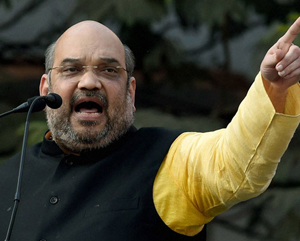
More lynching incidents happened under previous govts: Shah

Agencies
July 2, 2017

Panaji, Jul 2: BJP president Amit Shah has said that more incidents of lynching had occurred during the previous governments than during the three years of NDA rule, but no one had raised questions then.amitt

"I do not want to compare and undermine the current incidents of lynching. I am also serious about it. But there have been more lynching incidents in 2011, 2012 and 2013," Shah told a gathering of professionals in Goa last evening.

"There have been more lynchings each year in the past, compared to the total lynching incidents that have happened during our three-year-long tenure," the BJP leader said. The BJP-led government came to power at the Centre in May 2014.

Responding to a question about fears over the lynching incidents, he said there was no apprehension anywhere in the country.

"Do you know of any such incident where arrests have not been made? I do not have any answer to apprehensions. There is no apprehension anywhere in the country," he said.

Maintaining that law and order was a state subject, Shah said when Mohammad Akhlaq died, the Samajwadi Party-led government was in power in Uttar Pradesh, and it was its responsibility.

"But protests are held in Delhi in front of the Narendra Modi government. What is this fashion," he asked.

In September 2015, Akhlaq was dragged out of his house and killed by a mob at Dadri in UP on suspicion of storing and consuming beef.

Following several such lynching incidents, including those in Jharkhand, Haryana and UP, protests were held late last month at several cities across the country.

Comments

Ranjan shetty
 - 
Thursday, 6 Jul 2017

Chutiya bangladeshisare attacking Hindus in WB, where are those SOB's who did rally in the name of #notin my name ?

Umar Ashfaq
 - 
Thursday, 6 Jul 2017

Please qidmat k mauka de guzarish hogi

ABDUL AZIZ
 - 
Thursday, 6 Jul 2017

hang them till death , sharia law

Abdullah
 - 
Sunday, 2 Jul 2017

But who killed them????
You and your goons only.

Rikaz
 - 
Sunday, 2 Jul 2017

do not compare with previous government, it is your job to eliminate all sort of lynching around....take action on all who committed it as of now and make sure that it will not happen again....why it is happening only on muslims....there are people eating beef from other community.... and beef export factories exporting beef everyday basis with no problems...if you have guts stop it....

Thoushi
 - 
Sunday, 2 Jul 2017

True lynching was happening in previous government also and before since Gandhi's assassination , but Mr. Cha most all lynching was carried out by your OWN associated party(BJP) and wings (RSS)

Add new comment

  • Coastaldigest.com reserves the right to delete or block any comments.
  • Coastaldigset.com is not responsible for its readers’ comments.
  • Comments that are abusive, incendiary or irrelevant are strictly prohibited.
  • Please use a genuine email ID and provide your name to avoid reject.
News Network
January 21,2020

Jan 21: Indian policymakers may make it easier for companies to tap foreign funding, as a prolonged cash squeeze makes it tough for firms to borrow at home.

Investors are speculating about potential steps Finance Minister Nirmala Sitharaman could unveil when she presents the nation’s budget on Feb. 1. These measures may include freeing up firms to borrow at higher rates and offering tax breaks to global funds.

“The government will need to relax local rules to make it easier for Indian companies to raise debt overseas and tide over the funding crunch in the onshore market,” said Raj Kothari, London-based head of trading at Jay Capital Ltd. “At the same time, they need to ensure that the borrowers tapping offshore markets abide with stricter corporate governance so as to avoid further defaults.”

A prolonged crisis in India’s shadow bank sector and a pile of bad loans at traditional lenders is making it expensive for Indian companies, other than the best-rated firms, to access funding. The government has tried a series of measures to spur domestic credit, including providing so-called credit enhancement and allowing tiny firms to restructure debt.

Here are some steps Sitharaman may consider to spur foreign borrowing:

• She could raise the cap of 450 basis points above Libor, which limits overall foreign debt costs for Indian companies

• This could help lower-rated firms sell bonds abroad. Indian companies rated BBB currently borrow at more than 10%, about 3.8 percentage points more than their top-rated peers;

• Sitharaman could waive the withholding tax foreign investors need to pay on holdings of rupee-denominated debt sold by Indian companies abroad

• The waiver was offered between September 2018 to March 2019, but wasn’t extended as the highest global interest rates since the financial crisis deterred Indian borrowers. Since then, the three-month Libor has dropped by about 1 percentage point

• She could permit Indian property developers and housing finance lenders to sell overseas bonds for reasons beyond affordable housing projects

• New funding lines to the real estate sector, arguably ground zero of India’s economic slowdown, could help kickstart consumption and investment as the industry is the nation’s biggest job-creator.

Comments

Add new comment

  • Coastaldigest.com reserves the right to delete or block any comments.
  • Coastaldigset.com is not responsible for its readers’ comments.
  • Comments that are abusive, incendiary or irrelevant are strictly prohibited.
  • Please use a genuine email ID and provide your name to avoid reject.
Agencies
May 17,2020

New Delhi, May 17: Following the COVID-19-induced economic disruptions, up to 135 million jobs could be lost and 120 million people might be pushed back into poverty in India, all of which will have a hit on consumer income, spending and savings, says a report.

According to a new report by international management consulting firm Arthur D Little, the worst of COVID-19's impact will be felt by India's most vulnerable in terms of job loss, poverty increase and reduced per-capita income, which in turn will result in a steep decline in the Gross Domestic Product (GDP).

"Given the continued rise of COVID-19 cases, we believe that a W-shaped recovery is the most likely scenario for India. This implies a GDP contraction of 10.8 per cent in FY 2020-21 and GDP growth of 0.8 per cent in FY 2021-22," the report said.

India's COVID-19 tally has crossed 90,000 and the nationwide death toll has touched nearly 2,800 so far.

The report titled "India: Surmounting the economic challenges posed by COVID-19: A 10-point programme to revive and power India's post-COVID economy" said the 'collateral damage' of the forecasted GDP slowdown, will be felt most acutely in employment, poverty alleviation, per-capita income and overall nominal GDP.

"Unemployment may rise to 35 per cent from 7.6 per cent resulting in 136 million jobs lost and a total of 174 million unemployed. Poverty alleviation will receive a set-back, significantly changing the fortunes of many, putting 120 million people into poverty and 40 million into abject poverty," the report said.

"India is headed towards a W-shaped economic recovery with a potential GDP contraction of 10.8 per cent in FY21. An opportunity loss of USD 1 trillion is staring India in its face," said Barnik Chitran Maitra, lead author of the report and Managing Partner & CEO of Arthur D Little, India and South Asia.

Maitra further said "for its USD 5 trillion vision, a radical economic approach is needed, centred on an immediate stimulus and structural reforms. The Prime Minister's visionary 'Atma Nirbhar Bharat Abhiyan' is a good start to this new approach."

The report lauded the steps taken by the government and the Reserve Bank of India, but said a far more assertive approach may be required given the magnitude of the adverse economic output.

The report suggested a 10-point programme to accelerate the recovery which include strengthening the 'safety net' significantly for the most vulnerable, enable survival of small and medium businesses, restarting the rural economy and providing targeted assistance to at-risk sectors.

It further said the government should launch "Make in India 2.0" to capture global opportunities, build 'Modern India', accelerate Digital India and Innovation, strengthen global investment corridors with the US, UAE, Saudi Arabia, Japan and the UK, debottleneck land and labour and transform banking and financial markets in a bid to secure a sustainable economic future for 1.3 billion Indians. 

Comments

Add new comment

  • Coastaldigest.com reserves the right to delete or block any comments.
  • Coastaldigset.com is not responsible for its readers’ comments.
  • Comments that are abusive, incendiary or irrelevant are strictly prohibited.
  • Please use a genuine email ID and provide your name to avoid reject.
News Network
April 24,2020

New Delhi, Apr 24: The trajectory of COVID-19 cases could have plateaued and might even fall for some weeks after the lockdown is lifted but India is likely to see a second wave in late July or August with a surge in the number of cases during the monsoon, say scientists.

The timing of the peak will depend on how India is able to control physical distancing and on the level of infection spreads after restrictions are relaxed, they said.

It looks apparent that the trajectory of daily new cases has reached a plateau and eventually it will take a downward fall, maybe for some weeks or even months, Samit Bhattacharya, associate professor at the Department of Mathematics, Shiv Nadar University, said.

Still, we may get a surge of new cases of the same coronavirus and this will be considered a second wave, Bhattacharya explained.

The second epidemic may come back in late July or August in the monsoon, although the peak timing will depend on how we control social distancing during that time, he said.

Rajesh Sundaresan, professor at Bengaluru's Indian Institute of Science (IISc), agreed.

“Once we return to normal activity levels, there is a chance that infection may begin to rise again. China is seeing this to some extent post easing of some restrictions on travel,” Sundaresan, corresponding author of a working paper by researchers at IISc and the Tata Institute of Fundamental Research (TIFR) in Mumbai, said.

On March 25, when the number of coronavirus cases was 618 with 13 deaths, the government announced a nationwide lockdown that was later extended to May 3.

On Friday, the death toll due to COVID-19 rose to 718 and the number of cases to 23,077, according to the Union Health Ministry.

In good news, officials said this week that the doubling rate of cases has slowed down in the period, going from 3.4 days before lockdown to 7.5 days, with 18 states doing better than the national average. The recovery rate has also almost doubled in the last 10 days.

"Looking at the new cases in the past few days, it seems the growth of new daily infection is much slower than earlier. This apparently indicates that we might have reached at the plateau of the growth curve, Bhattacharya said.

He noted that recent studies in China and Europe observed that the infection might relapse in those people who have already recovered from earlier phases.

So, there is no evidence that the earlier infection may help acquire immunity against the second infection. And in that way, the entire population may be vulnerable to the second wave to some extent, said the scientist.

In their study unveiled this week, IISc and TIFR researchers analysed the impact of strategies such as case isolation, home quarantine, social distancing and various post-lockdown restrictions on COVID-19 that might remain in force for some time.

The study modelled on Bengaluru and Mumbai suggests the infection is likely to have a second wave and the public health threat will remain, unless steps are taken to aggressively trace, localise, isolate the cases, and prevent influx of new infections.

The new levels and the peaking times for healthcare demand depend on the levels of infection spreads in each city at the time of relaxation of restrictions, they said.

The lockdown is currently upon us. It has given us valuable time. Let us test, trace, quarantine, isolate, practice better hygiene, search for a vaccine, etc. We should do these anyway, and these are being done. When and how to lift the lockdown is going to be a difficult decision to make, said Sundaresan.

It's clear that it's going to be phased. What our team is focusing on is to come up with tools to help the decision makers assess the public health impact of various choices, he said.

According to the experts, infectious diseases spread via contact between infectious and susceptible people. In the absence of any control measures, an outbreak will grow as long as the average number of people infected by each infectious person is more than one.

Once enough people are immune there will be fewer people susceptible to the infection and the outbreak will die.

However, when an outbreak is brought under control by social distancing and other interventions, it is possible only a small proportion of the population will have been infected and gained immunity, they said.

This means enough susceptible people may remain to fuel a second wave if controls are relaxed and infection is reintroduced.

Until the vaccine comes on the market, we have to remain alert Once sporadic cases occur here and there in the country, we immediately need to implement quarantine or social distancing locally for the people in that region, and also need to perform tests to identify positive cases irrespective of showing symptoms, Bhattacharya explained.

Note that these monsoon months are also flu season in many places of India. So, we should not ignore the early signs of the flu symptoms. Irrespective of symptoms, we need to increase tests in the hotspots to identify people and contain the surge, he said.

Sundaresan added that the timeline for a second wave will depend on a lot of circumstances which may change as the time passes.

Significant testing may have been underway, there may be behavioural changes with people becoming more careful about their hygiene, wearing masks may become more common, etc. All these responses may help restrict the second wave, he said.

A study published in The Lancet journal earlier this month modelled the potential adverse consequences of premature relaxation of interventions, and found it might lead to a second wave of infections.

The finding is critical to governments globally, because it warns against premature relaxation of strict interventions, the researchers said.

While interventions to control the spread of SARS-CoV-2 are in place, countries will need to work toward returning to normalcy; thus, knowledge of the effect of each intervention is urgently required, they said in the study.

According to a recent analysis by the Harvard Chan School of Public Health, the best strategy to ease the critical care burden and loss of life from COVID-19 might be on-again, off-again social distancing.

In the absence of such interventions, surveillance and intermittent distancing may need to be maintained into 2022, which would present a substantial social and economic burden, the researchers wrote.p


Comments

Add new comment

  • Coastaldigest.com reserves the right to delete or block any comments.
  • Coastaldigset.com is not responsible for its readers’ comments.
  • Comments that are abusive, incendiary or irrelevant are strictly prohibited.
  • Please use a genuine email ID and provide your name to avoid reject.