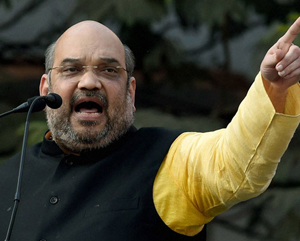
More lynching incidents happened under previous govts: Shah

Agencies
July 2, 2017

Panaji, Jul 2: BJP president Amit Shah has said that more incidents of lynching had occurred during the previous governments than during the three years of NDA rule, but no one had raised questions then.amitt

"I do not want to compare and undermine the current incidents of lynching. I am also serious about it. But there have been more lynching incidents in 2011, 2012 and 2013," Shah told a gathering of professionals in Goa last evening.

"There have been more lynchings each year in the past, compared to the total lynching incidents that have happened during our three-year-long tenure," the BJP leader said. The BJP-led government came to power at the Centre in May 2014.

Responding to a question about fears over the lynching incidents, he said there was no apprehension anywhere in the country.

"Do you know of any such incident where arrests have not been made? I do not have any answer to apprehensions. There is no apprehension anywhere in the country," he said.

Maintaining that law and order was a state subject, Shah said when Mohammad Akhlaq died, the Samajwadi Party-led government was in power in Uttar Pradesh, and it was its responsibility.

"But protests are held in Delhi in front of the Narendra Modi government. What is this fashion," he asked.

In September 2015, Akhlaq was dragged out of his house and killed by a mob at Dadri in UP on suspicion of storing and consuming beef.

Following several such lynching incidents, including those in Jharkhand, Haryana and UP, protests were held late last month at several cities across the country.

Comments

Ranjan shetty
 - 
Thursday, 6 Jul 2017

Chutiya bangladeshisare attacking Hindus in WB, where are those SOB's who did rally in the name of #notin my name ?

Umar Ashfaq
 - 
Thursday, 6 Jul 2017

Please qidmat k mauka de guzarish hogi

ABDUL AZIZ
 - 
Thursday, 6 Jul 2017

hang them till death , sharia law

Abdullah
 - 
Sunday, 2 Jul 2017

But who killed them????
You and your goons only.

Rikaz
 - 
Sunday, 2 Jul 2017

do not compare with previous government, it is your job to eliminate all sort of lynching around....take action on all who committed it as of now and make sure that it will not happen again....why it is happening only on muslims....there are people eating beef from other community.... and beef export factories exporting beef everyday basis with no problems...if you have guts stop it....

Thoushi
 - 
Sunday, 2 Jul 2017

True lynching was happening in previous government also and before since Gandhi's assassination , but Mr. Cha most all lynching was carried out by your OWN associated party(BJP) and wings (RSS)

Add new comment

  • Coastaldigest.com reserves the right to delete or block any comments.
  • Coastaldigset.com is not responsible for its readers’ comments.
  • Comments that are abusive, incendiary or irrelevant are strictly prohibited.
  • Please use a genuine email ID and provide your name to avoid reject.
News Network
May 26,2020

New Delhi, May 26: With India now in the bracket of top 10 nations worst hit by the novel coronavirus, experts have attributed the surge in cases to easing of travel restrictions and movement of migrants besides enhanced testing capacity.

According to AIIMS Director, Randeep Guleria, the present rise in cases has been reported predominantly from hotspot areas but there is a possibility of further rise in the number of COVID-19 cases in the coming few days due to increased travel.

"Those who are asymptomatic or are in presymptomatic stage will pass through screening mechanisms and may reach areas where there have been minimal or less cases," Guleria said.

He said there was a need for more intense surveillance and monitoring in areas where migrants have returned to contain the spread of the disease.

If proper social distancing and hand hygiene is not maintained at a time when people are out on roads, the coronavirus infection will transmit much faster, he said.

Guleria also noted that testing capacity has been significantly ramped up which is reflecting in the increasing number of cases being detected.

Commenting on the partial resumption of rail and road transport services and migrants returning to their native places, Dr Chandrakant S Pandav, former president of the Indian Public Health Association and Indian Association of Preventive and social medicine, said the floodgates have been opened.

"This is a classic case of creating an enabling environment for coronavirus to spread like wildfire. In the coming few days, the number will rise dramatically. While it is true that lockdown cannot go on forever, the opening up should have been in a measured, calibrated and informed manner," he said.

"Travelling leads to spread of the infection. Now, the government will have to ensure even stronger surveillance to curb the infection but if that will be done is something to be observed," he said.

The death toll due to COVID-19 rose to 4,167 and the number of cases climbed to 1, 45,380 in the country, registering an increase of 146 deaths and 6,535 cases since Monday 8 am, according to the Union Health Ministry.

Dr K K Aggarwal, President of the Confederation of Medical Association of Asia and Oceania (CMAAO), and former IMA President, said there will be a further surge in cases in the coming days if migration continues without any proper social distancing.

"Within the next ten days, the cases will cross two lakh. The very fact that number of cases was rising before the end of the third lockdown and continuing during the fourth lockdown means that people are not following physical distancing as required," he said.

"Even in the last week of May when the temperature is very high, the rising number of cases would mean that human-to-human transmission is more important than surface-to-human transmission. Normally in heat the surface-to-human transmission should have reduced the new cases by half which has not happened," Aggarwal said.

However, Professor K Srinath Reddy, president of the Public Health Foundation of India, said an increase in the number of cases reflects both an increase in testing rates and an increase in spread.

"What we need to see is the number of new tests performed per day and the number of new cases that were identified from them. That gives a better idea of the rate of spread than the total number of new cases alone.

"We also have to see if the testing criteria has remained the same between the two periods of comparison.We may open up gradually but will have to continue case detection, contact tracing and follow personal protection measures as vigorously as possible," he added.

A total of 31,26,119 samples have been tested as on May 26, 9 am and 92,528 samples have been tested in the last 24 hours, ICMR officials said.

India is the tenth most affected nation by the pandemic after the US, Russia, UK, Spain, Italy, Brazil, Germany, Turkey and France, as per the John Hopkins University data.

The country has recorded 6,088, 6,654, 6,767 and 6977 cases on May 22, 23, 24 and 25 respectively. Also, the number of RT-PCR tests for detection of COVID-19 in the country crossed the 30-lakh mark on Monday.

The first two phases of the lockdown led to 14-29 lakh COVID-19 cases being averted, while the number of lives saved in that period was between 37,000 and 78,000, the government said last Friday, citing various studies, and asserted that the unprecedented shutdown has paid "rich dividends" in the fight against the pandemic.


Comments

Add new comment

  • Coastaldigest.com reserves the right to delete or block any comments.
  • Coastaldigset.com is not responsible for its readers’ comments.
  • Comments that are abusive, incendiary or irrelevant are strictly prohibited.
  • Please use a genuine email ID and provide your name to avoid reject.
Agencies
March 22,2020

New Delhi, Mar 22: The total number of novel coronavirus cases in India rose to 341 on Sunday after fresh cases were reported from various parts of the country, the Union Health Ministry said.

The total includes 41 foreign nationals and five deaths, the latest being reported from Maharashtra, taking the death toll in the state to two.

Delhi, Karnataka and Punjab have reported one death each so far. Twenty-four others have been cured/discharged/migrated.

The figure of 341 cases include 63 cases in Maharashtra, which has reported the highest number of COVID-19 cases, including three foreigners.

Kerala has reported 52 cases, including seven foreign nationals.

Delhi has reported 27 positive cases, including a foreigner, while Uttar Pradesh has recorded 25 cases, including a foreigner.

Telangana has reported 21 cases, including 11 foreigners. Rajasthan has reported 24 cases, including two foreigners.

In Haryana, there are 17 cases, which include 14 foreigners.

Karnataka has 20 coronavirus patients. Punjab and Ladakh have 13 cases each. Gujarat has 14 cases while Tamil Nadu has 6 cases, which includes 2 foreigners. Chandigarh has five cases.

Madhya Pradesh, Jammu and Kashmir, and West Bengal reported four cases each. Andhra Pradesh and Uttarakhand have reported three cases each. Odisha and Himachal Pradesh reported 2 cases each.

Puducherry and Chhattisgarh have reported one case each.

Comments

Add new comment

  • Coastaldigest.com reserves the right to delete or block any comments.
  • Coastaldigset.com is not responsible for its readers’ comments.
  • Comments that are abusive, incendiary or irrelevant are strictly prohibited.
  • Please use a genuine email ID and provide your name to avoid reject.
News Network
January 2,2020

United Nations, Jan 2: Nearly 400,000 babies were born around the world on New Year's Day with India recording the highest number of these births worldwide at 67,385, the UN children's agency said.

An estimated 392,078 babies were born around the world on New Year's Day, according to UNICEF. Of this, an estimated 67,385 babies were born in India, the most globally. China comes in second with 46,299 births.

The beginning of a new year and a new decade is an opportunity to reflect on our hopes and aspirations not only for our future, but the future of those who will come after us,” UNICEF Executive Director Henrietta Fore said.

As the calendar flips each January, we are reminded of all the possibility and potential of each child embarking on her or his life's journey—if they are just given that chance.”

Fiji in the Pacific most likely delivered 2020's first baby, while the US, the last of the New Year's Day. Globally, over half of these births were estimated to have taken place in eight countries - India (67,385), China (46,299), Nigeria (26,039), Pakistan (16,787), Indonesia (13,020), United States of America (10,452), Democratic Republic of Congo (10,247) and Ethiopia (8,493).

Each January, UNICEF celebrates babies born on New Year's Day, an auspicious day for child birth around the world, it said. However, for millions of newborns around the world, the day of their birth is far less auspicious.

In 2018, 2.5 million newborns died in just their first month of life; about a third of them on the first day of life. Among those children, most died from preventable causes such as premature birth, complications during delivery, and infections like sepsis. In addition, more than 2.5 million babies are born dead each year.

UNICEF said over the past three decades, the world has seen remarkable progress in child survival, cutting the number of children worldwide who die before their fifth birthday by more than half. But there has been slower progress for newborns. Babies dying in the first month accounted for 47 per cent of all deaths among children under five in 2018, up from 40 per cent in 1990.

UNICEF's Every Child Alive campaign calls for immediate investment in health workers with the right training, who are equipped with the right medicines to ensure every mother and newborn is cared for by a safe pair of hands to prevent and treat complications during pregnancy, delivery and birth.

Too many mothers and newborns are not being cared for by a trained and equipped midwife or nurse, and the results are devastating,” said Fore. “We can ensure that millions of babies survive their first day and live into this decade and beyond if every one of them is born into a safe pair of hands.”

India is projected to surpass China as the world's most populous country around 2027. According to UN estimates, India is expected to add nearly 273 million people between 2019 and 2050, while the population of Nigeria is projected to grow by 200 million. Together, these two countries could account for 23 per cent of the global population increase to 2050.

China, with 1.43 billion people in 2019, and India, with 1.37 billion, have long been the two most populous countries of the world, comprising 19 and 18 per cent, respectively, of the global total in 2019. Through the end of the century, India is estimated to remain the world's most populous country with nearly 1.5 billion inhabitants, followed by China with just under 1.1 billion, Nigeria with 733 million, the US with 434 million, and Pakistan with 403 million inhabitants.

Comments

Add new comment

  • Coastaldigest.com reserves the right to delete or block any comments.
  • Coastaldigset.com is not responsible for its readers’ comments.
  • Comments that are abusive, incendiary or irrelevant are strictly prohibited.
  • Please use a genuine email ID and provide your name to avoid reject.