


Modi to get US President-like reception in Israel; terrorism, economic ties on agenda

Agencies
July 4, 2017

New Delhi, Jul 4: Prime Minister Narendra Modi's historic visit to Israel, beginning on Tuesday, will see discussions between him and his Israeli counterpart Benjamin Netanyahu exploring ways to enhance cooperation in key strategic areas.
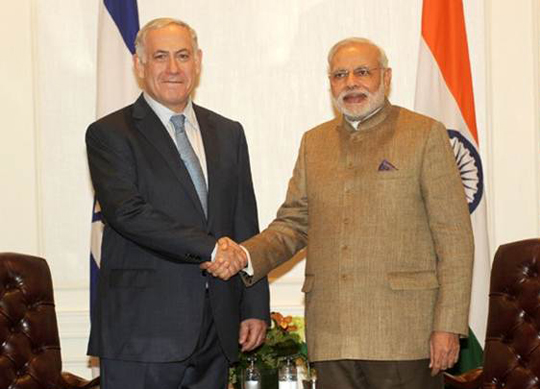
netanyahu

His visit will be the first by an Indian PM to Israel.

This year, India and Israel are marking 25 years of their diplomatic relations.

The two sides are expected to sign number of agreements in the field of innovation, development, science and technology and space.

Apart from boosting cooperation in the water and agriculture sectors, India and Israel will also discuss ways to strengthen people-to-people contact, air connectivity and investments.

During the visit, a deal with the Uttar Pradesh government is also likely to be signed to clean-up a patch of river Ganges apart from setting up of industrial research and development fund of USD 40 million.

Before the visit, the Ministry of External Affairs ministry in New Delhi said it will provide an impetus for deeper bilateral engagement in areas of mutual interest, as per news agency.

PM Modi's schedule:

PM Modi will be received by Netanyahu at the airport. This is a special gesture only accorded to the Pope or the US president.

The Israeli PM will also host a dinner for PM Modi.

Netanyahu will accompany him to most of the events, including the community reception on July 5.

PM Modi will pay homage to Indian soldiers at the Indian Cemetery in Haifa.

He will meet 26/11 Mumbai terror attack survivor Holtzberg Moshe, who was only two when he was saved by his Indian nanny Sandra Samuel.

Moshe's father Rabbi Gavriel and mother Rivkah were among eight Israeli nationals killed in the 2008 terror strike.

On the eve of his visit to Israel, PM Modi on Monday said he will discuss with Netanyahu common challenges like terrorism and ways to boost the economic ties.

"Tomorrow, I begin a historic visit to Israel, a very special partner of India's. As the first Indian PM to do so, I am greatly looking forward to this unprecedented visit that will bring our two countries and people closer," he said in a statement.

"I look forward to holding extensive talks with my friend, Israeli PM Netanyahu, who shares a commitment for vibrant India-Israel ties," he tweeted.

The PM said he will have 'in-depth talks' with Netanyahu "on the full spectrum of our partnership and strengthening it in diverse fields for mutual benefit. We will also have the chance to discuss major common challenges like terrorism."

"My programme during the visit gives me an opportunity to engage with a cross-section of Israeli society. I am particularly looking forward to interacting with the large vibrant Indian diaspora in Israel that represents an enduring link between our two peoples," PM Modi added.

On the economic side, he said, "I will join with leading Indian and Israeli CEOs and start-ups to discuss our shared priority of expanding business and investment collaboration on the ground."

In addition, he said, "I hope to get insights into Israel's accomplishments in technology and innovation through on-site visits."

On July 6, PM Modi will travel to Hamburg for the G-20 Summit being hosted by Germany on July 7-8.

Netanyahu hails PM Modi's visit to Israel as a 'very significant step'

Earlier, the Israeli premier had hailed PM Modi's visit as a "very significant step" in strengthening bilateral relations that are on a "constant upswing".

"Next week, the Indian Prime Minister, my friend, Narendra Modi will arrive in Israel, This is a historic visit to Israel. In the 70 years of the country's existence, no Indian Prime Minister has ever visited and this is further expression of the state of Israel's military, economic and diplomatic strength," Netanyahu had said.

"This is a very significant step in strengthening relations between the two countries," he had added.

The two leaders have already met twice on foreign soil on the sidelines of UN-related events and are said to be constantly in touch with each other over the phone.

PM Modi would also be meeting Israeli President Reuven Rivlin and the leader of Opposition Isaac Herzog on July 5.

He will not travelling to neighbouring Palestine during the visit, a clear signal of de-hyphenation of its ties with the two West Asian nations.

President Pranab Mukherjee in 2015 and External Affairs Minister Sushma Swaraj in 2016 visited both the countries.

Israeli Prime Minister Ariel Sharon and President Ezer Weizman visited India in 2003 and 1997 respectively.

Israeli President Reuven Rivlin had also paid a visit to India in November last year.

Comments

Muhammed Rafique
 - 
Friday, 7 Jul 2017

Viren, Your comments doesn't even deserve any response

but the matter of fact is you are such a sick and communal person who encourage riot and disrupt peace.The current situation in DK is bcos of people like u, instigated by Padil and Kalladka

Viren Kotian
 - 
Friday, 7 Jul 2017

RIP Sharat. Your blood will not be wasted. nationalist forces will soon eliminate anti-national forces, fanatics and terrorists.

Hara Hara Mahaadev!

Abdul
 - 
Friday, 7 Jul 2017

So called nationalists, breaking section , ohh DK & Udupi MPs spotted again , they will disappear when real culprits get caught ( like Karthik raj case)

Mohammad Beary
 - 
Tuesday, 4 Jul 2017

Lynchist with terrorist...

NOOR
 - 
Tuesday, 4 Jul 2017

For a muslims, Everything happens with the will of ALLAH...
ALLAH the creator of all that exists, Knows well of all that is happening around the globe...
ALLAH is the best of Planners...
ALhamudllillah.. Thanks to ALLAH for making us Muslims.

Fear ALLAH, the creator..
and Never Fear the Creations of ALLAH. U will be successful

abdul
 - 
Tuesday, 4 Jul 2017

both from the same creed & creature-anti human

Add new comment

  • Coastaldigest.com reserves the right to delete or block any comments.
  • Coastaldigset.com is not responsible for its readers’ comments.
  • Comments that are abusive, incendiary or irrelevant are strictly prohibited.
  • Please use a genuine email ID and provide your name to avoid reject.
News Network
July 21,2020

New Delhi, Jul 21: The Enforcement Directorate is understood to have initiated a process to freeze over 60 bank accounts in the country on the request of the Brazilian government in connection with a money laundering case in that country, offiicials said on Monday.

They said the agency has undertaken the action under the provision of the Prevention of Money Laundering Act (PMLA) in pursuance of a mutual agreement between the two nations to combat financial crimes.

The over 60 bank accounts are held by some individuals and businessmen based in the country, they said.

The probe, they said, is linked to some high profile people of Brazil.

The suspected accounts sought to be frozen by the Enforcement Directorate (ED), on behalf of the Brazilian government, are stated to be of banks in Delhi and Mumbai, they added.

Comments

Add new comment

  • Coastaldigest.com reserves the right to delete or block any comments.
  • Coastaldigset.com is not responsible for its readers’ comments.
  • Comments that are abusive, incendiary or irrelevant are strictly prohibited.
  • Please use a genuine email ID and provide your name to avoid reject.
News Network
June 3,2020

New Delhi, Jun 3: Seasoned diplomat and former spokesperson of the External Affairs Ministry Raveesh Kumar has been appointed as India's next Ambassador to Finland, the government announced on Wednesday.

Raveesh Kumar, a 1995-batch Indian Foreign Service officer, served as the spokesperson of the MEA from July 2017 to April 2020 during which he deftly articulated India's position on a number of sensitive issues including last year's Balakot strike, reorganisation of Jammu and Kashmir and the controversy surrounding the National Register of Citizens.

"He is expected to take up the assignment shortly," the MEA said.

Before becoming the MEA spokesperson, Kumar was serving as Consul General of India in Frankfurt.

Kumar started his career at the Indian Mission in Jakarta and it was followed by his postings in Thimpu and London.

In his nearly 25-year career, Kumar also looked after the East Asia desk in the headquarters of the MEA in Delhi and served as Deputy Chief of Mission in Jakarta followed by his posting as Consul General in Frankfurt from August 2013 to July 2017.

In Finland, he succeeds Vani Rao.

Finland is an important country for India in Europe, and bilateral trade has been on an upswing in the last few years.

Around 35 Indian companies have invested in Finland in IT, healthcare, hospitality and automotive sectors while over 100 Finnish companies have operations in India in energy, textiles, power plants and electronics sectors.

Comments

Add new comment

  • Coastaldigest.com reserves the right to delete or block any comments.
  • Coastaldigset.com is not responsible for its readers’ comments.
  • Comments that are abusive, incendiary or irrelevant are strictly prohibited.
  • Please use a genuine email ID and provide your name to avoid reject.
Agencies
June 15,2020

New Delhi, Jun 15: Average temperature of India experienced a rise of 0.7 degree Celsius, along with decline in rainfall, significant increase in frequency of very severe cyclonic storms and droughts in over a decade due to human activities, the Ministry of Earth Sciences in its research report said.

The contentions were made in a report issued by the ministry on the impact of climate change. It will be published by Union Minister Harsh Vardhan on June 19.

According to the report, "Since the middle of the twentieth century, India witnessed rise in temperature; decrease in monsoon; rise in extreme temperature and rainfall, droughts, and sea levels; and increase intensity of severe cyclones.

The report, prepared by researchers of the Centre for Climate Change Research, a cell under The Ministry's Indian Institute of Tropical Meteorology, Pune, further stated that there is compelling scientific evidence that human activities have influenced these changes in regional climate.

India's average temperature has risen by around 0.7 degrees Celsius during 1901-2018, it said, adding that the rise is largely on account of GHG-induced warming and partially offset by forcing due to anthropogenic aerosols.

It states that the average temperature over India is projected to rise by 4.4 degrees Celsius, while the intensity of heat waves is likely to increase by 3-4 times by the end of the century.

In the 30-year period between 1986 and 2015, temperatures of the warmest day and the coldest night of the year have risen by about 0.63 degrees Celsius and 0.4 degree Celsius.

According to the report, by the end of the century, the temperatures of the warmest day and the coldest night are projected to rise by approximately 4.7 degrees Celsius and 5.5 degrees Celsius, respectively.

Alarmingly, sea surface temperature of the tropical Indian Ocean has also risen by one degrees Celsius on average during 1951-2015.

"The frequency of very severe cyclonic storms during the post-monsoon season has increased significantly (+1 event per decade) during the last two decades (2000-2018)," it added.

This came in the backdrop of Cyclone 'Amphan' and 'Nisarga' which made landfalls on May 20 and June 3 and killed several people, flattened villages, and destroyed farms.

"This is the first-ever climate change assessment report for India. This report will be very useful for policy makers, researchers, social scientists, economists, and students," said M. Rajeevan, secretary, the Ministry of Earth Sciences.

Besides this, the report also highlighted various other unnerving data on climate change in the country. Both the frequency and extent of droughts have increased significantly during 1951-2016.

The overall decrease of seasonal "summer monsoon rainfall" during the last 6-7 decades has led to an increased propensity for droughts over India.

"In particular, areas over central India, southwest coast, southern peninsula and north-eastern India have experienced more than 2 droughts per decade, on average, during this period. The area affected by drought has also increased by 1.3 per cent per decade over the same period."

The Hindu Kush Himalayas (HKH) also experienced a temperature rise of about 1.3 degree Celsius during 1951-2014.

Several areas of the Himalayas have experienced a declining trend in snowfall and also retreat of glaciers in recent decades. By the end of the twenty-first century, its annual mean surface temperature is projected to increase by about 5.2 degree Celsius.

The summer monsoon precipitation from June to September over India has also declined by around 6 per cent from 1951 to 2015, with notable decreases over the Indo-Gangetic Plains and the Western Ghats, the report further states.

Comments

Add new comment

  • Coastaldigest.com reserves the right to delete or block any comments.
  • Coastaldigset.com is not responsible for its readers’ comments.
  • Comments that are abusive, incendiary or irrelevant are strictly prohibited.
  • Please use a genuine email ID and provide your name to avoid reject.