


Modi to get US President-like reception in Israel; terrorism, economic ties on agenda

Agencies
July 4, 2017

New Delhi, Jul 4: Prime Minister Narendra Modi's historic visit to Israel, beginning on Tuesday, will see discussions between him and his Israeli counterpart Benjamin Netanyahu exploring ways to enhance cooperation in key strategic areas.
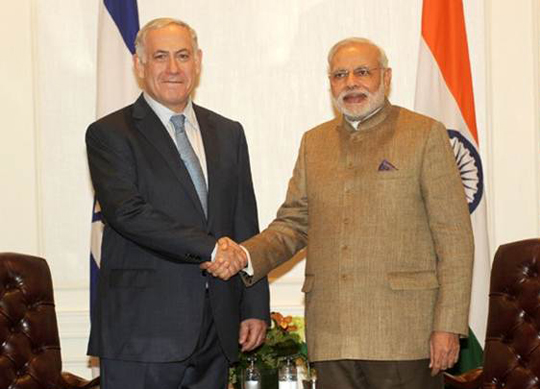
netanyahu

His visit will be the first by an Indian PM to Israel.

This year, India and Israel are marking 25 years of their diplomatic relations.

The two sides are expected to sign number of agreements in the field of innovation, development, science and technology and space.

Apart from boosting cooperation in the water and agriculture sectors, India and Israel will also discuss ways to strengthen people-to-people contact, air connectivity and investments.

During the visit, a deal with the Uttar Pradesh government is also likely to be signed to clean-up a patch of river Ganges apart from setting up of industrial research and development fund of USD 40 million.

Before the visit, the Ministry of External Affairs ministry in New Delhi said it will provide an impetus for deeper bilateral engagement in areas of mutual interest, as per news agency.

PM Modi's schedule:

PM Modi will be received by Netanyahu at the airport. This is a special gesture only accorded to the Pope or the US president.

The Israeli PM will also host a dinner for PM Modi.

Netanyahu will accompany him to most of the events, including the community reception on July 5.

PM Modi will pay homage to Indian soldiers at the Indian Cemetery in Haifa.

He will meet 26/11 Mumbai terror attack survivor Holtzberg Moshe, who was only two when he was saved by his Indian nanny Sandra Samuel.

Moshe's father Rabbi Gavriel and mother Rivkah were among eight Israeli nationals killed in the 2008 terror strike.

On the eve of his visit to Israel, PM Modi on Monday said he will discuss with Netanyahu common challenges like terrorism and ways to boost the economic ties.

"Tomorrow, I begin a historic visit to Israel, a very special partner of India's. As the first Indian PM to do so, I am greatly looking forward to this unprecedented visit that will bring our two countries and people closer," he said in a statement.

"I look forward to holding extensive talks with my friend, Israeli PM Netanyahu, who shares a commitment for vibrant India-Israel ties," he tweeted.

The PM said he will have 'in-depth talks' with Netanyahu "on the full spectrum of our partnership and strengthening it in diverse fields for mutual benefit. We will also have the chance to discuss major common challenges like terrorism."

"My programme during the visit gives me an opportunity to engage with a cross-section of Israeli society. I am particularly looking forward to interacting with the large vibrant Indian diaspora in Israel that represents an enduring link between our two peoples," PM Modi added.

On the economic side, he said, "I will join with leading Indian and Israeli CEOs and start-ups to discuss our shared priority of expanding business and investment collaboration on the ground."

In addition, he said, "I hope to get insights into Israel's accomplishments in technology and innovation through on-site visits."

On July 6, PM Modi will travel to Hamburg for the G-20 Summit being hosted by Germany on July 7-8.

Netanyahu hails PM Modi's visit to Israel as a 'very significant step'

Earlier, the Israeli premier had hailed PM Modi's visit as a "very significant step" in strengthening bilateral relations that are on a "constant upswing".

"Next week, the Indian Prime Minister, my friend, Narendra Modi will arrive in Israel, This is a historic visit to Israel. In the 70 years of the country's existence, no Indian Prime Minister has ever visited and this is further expression of the state of Israel's military, economic and diplomatic strength," Netanyahu had said.

"This is a very significant step in strengthening relations between the two countries," he had added.

The two leaders have already met twice on foreign soil on the sidelines of UN-related events and are said to be constantly in touch with each other over the phone.

PM Modi would also be meeting Israeli President Reuven Rivlin and the leader of Opposition Isaac Herzog on July 5.

He will not travelling to neighbouring Palestine during the visit, a clear signal of de-hyphenation of its ties with the two West Asian nations.

President Pranab Mukherjee in 2015 and External Affairs Minister Sushma Swaraj in 2016 visited both the countries.

Israeli Prime Minister Ariel Sharon and President Ezer Weizman visited India in 2003 and 1997 respectively.

Israeli President Reuven Rivlin had also paid a visit to India in November last year.

Comments

Muhammed Rafique
 - 
Friday, 7 Jul 2017

Viren, Your comments doesn't even deserve any response

but the matter of fact is you are such a sick and communal person who encourage riot and disrupt peace.The current situation in DK is bcos of people like u, instigated by Padil and Kalladka

Viren Kotian
 - 
Friday, 7 Jul 2017

RIP Sharat. Your blood will not be wasted. nationalist forces will soon eliminate anti-national forces, fanatics and terrorists.

Hara Hara Mahaadev!

Abdul
 - 
Friday, 7 Jul 2017

So called nationalists, breaking section , ohh DK & Udupi MPs spotted again , they will disappear when real culprits get caught ( like Karthik raj case)

Mohammad Beary
 - 
Tuesday, 4 Jul 2017

Lynchist with terrorist...

NOOR
 - 
Tuesday, 4 Jul 2017

For a muslims, Everything happens with the will of ALLAH...
ALLAH the creator of all that exists, Knows well of all that is happening around the globe...
ALLAH is the best of Planners...
ALhamudllillah.. Thanks to ALLAH for making us Muslims.

Fear ALLAH, the creator..
and Never Fear the Creations of ALLAH. U will be successful

abdul
 - 
Tuesday, 4 Jul 2017

both from the same creed & creature-anti human

Add new comment

  • Coastaldigest.com reserves the right to delete or block any comments.
  • Coastaldigset.com is not responsible for its readers’ comments.
  • Comments that are abusive, incendiary or irrelevant are strictly prohibited.
  • Please use a genuine email ID and provide your name to avoid reject.
News Network
April 25,2020

New Delhi, Apr 25: Neighbourhood and standalone shops, including those selling garments, mobile phones, hardware and stationery items have been allowed to open but those located in market places, malls and COVID-19 hotspots and containment zones, will continue to remain shut till May 3.

In rural areas, all shops, except those in single and multi-brand shopping malls, are allowed to open.

However, a Home Ministry official said the final decision of whether to allow the additional shops to open or not will be taken by the state governments and Union Territory administrations depending on their respective COVID-19 situation.
 
While allowing opening of more shops, a move seen as a relief to people who have been under lockdown since March 24, the government order issued on Friday night said the shops will be functioning with 50 per cent of workforce and after adhering strictly to precautions which include social distancing and wearing of masks.

The Union Home Ministry also said malls, liquor and cigarette shops, sale of non-essential items through e-commerce platforms continue to remain shut.

Restaurants, hair salons and barber shops will not be allowed to open as these render services and do not fall under the shop category.

Amending its April 15 order, Union Home Secretary Ajay Bhalla said in the Friday night order that "all shops, including neighbourhood shops and standalone shops, shops in residential complexes, within the limits of municipal corporations and municipalities, registered under the the Shops and Establishment Act of the respective State and UT" will be allowed to open during the lockdown.

The ministry also said shops located in registered markets located outside the municipal corporations and municipalities can open after following the drill of social distancing and wearing of masks but with 50 per cent of strength.

However, single and multi-brands shall continue to remain closed in these areas also.

"All shops registered under the the Shops and Establishment Act of the respective State/UT, including shops in residential complexes and market complexes, except shops in multi-brand and single brand malls, outside the limits of municipal corporations and municipalities, with 50 per cent strength of workers with wearing of masks and social distancing being mandatory" will be allowed to function, the order said.

In a statement on Saturday, the Home Ministry said the order implies that in rural areas, all shops, except those in shopping malls are allowed to open.

In urban areas, all standalone shops, neighbourhood shops and shops in residential complexes are allowed to open.

Shops in markets and market complexes and shopping malls are not allowed to open.

"It is clarified that sale by e-commerce companies will continue to be permitted for essential goods only," the order said and also added that sale of liquor and other items continues to be prohibited as specified in the national directives for COVID-19 management.

The ministry said that liquor shops were given licence under the Excise Act of the states and the establishments thrown open from Saturday were covered under the Shops and Establishment Act of the states.

Sale of cigarettes, gutka are continue to be prohibited during the lockdown.

"As specified in the consolidated revised guidelines, these shops will not be permitted to open in areas, whether rural or urban, which are declared as containment zones by respective States and Union Territories," the statement said.

The lockdown was first announced by Prime Minister Narendra Modi on March 24 in a bid to combat the coronavirus pandemic. It was further extended till May 3.

Comments

Add new comment

  • Coastaldigest.com reserves the right to delete or block any comments.
  • Coastaldigset.com is not responsible for its readers’ comments.
  • Comments that are abusive, incendiary or irrelevant are strictly prohibited.
  • Please use a genuine email ID and provide your name to avoid reject.
Agencies
January 16,2020

New Delhi, Jan 16: Chief of Defence Staff (CDS) General Bipin Rawat on Thursday said that he supported a negotiated peace deal between the US and Taliban in Afghanistan.

Gen. Rawat was speaking along with other world leaders at Raisina dialogue organised by India's influential think-tank Observer Research Foundation (ORF).

Arguing that terrorism was going to stay in the world as long as states were going to use it against other states, he said it was important to prevent states from using terrorism as a "proxy war".

"The only way to deal with it was what the US did post 9/11," he said, adding that the war against terror was necessary.

However, now a peace deal with Taliban is required, Gen. Rawat said.

"It must be a negotiated peace deal so that the Taliban stops using terrorism," he added. Hinting that the US should maintain its presence in Afghanistan, the CDS said that though Afghan security forces are now equipped to fight back terror groups in Afghanistan but they still need support.

The newly appointed CDS officially confirmed that India has shifted its stance on Taliban. India has traditionally been opposed to the Pakistan-backed Taliban in Afghanistan. Thousands of Afghans were given refuge in India when they fled the country due to oppression and terrorism of the Taliban regime. India is in alignment with the democratically elected government in Kabul that the Taliban remains supported by Pakistan.

Comments

Add new comment

  • Coastaldigest.com reserves the right to delete or block any comments.
  • Coastaldigset.com is not responsible for its readers’ comments.
  • Comments that are abusive, incendiary or irrelevant are strictly prohibited.
  • Please use a genuine email ID and provide your name to avoid reject.
News Network
June 30,2020

Srinagar, Jun 30: On the deadly attack at Karachi Stock Exchange on Monday morning, a Kashmiri social activist and journalist warned that the incident is a stark reminder to all those in Pakistan supporting Jihad and attacked Pakistan prime minister Imran Khan for ignoring development agenda in Balochistan.

Yana Mir, the editor-in-chief of The Real Kashmir News, said, "Karachi Stock Exchange attack is a reminder to all those in Pakistan supporting Jihad. Remember @imrankhan that Youth is restless and they want development agenda. These young boys of BLA are also looking for a life which is settled and peaceful. Wake up Imran Khan and you Kashmiris also. Pakistan is going to finish you. Open your eyes."
Four heavily armed terrorists attacked the busy Pakistan Stock Exchange building in Karachi with grenades today, killing four security guards and a police officer before being shot dead in an exchange of fire, authorities said.

The terrorists, who arrived in a car, stormed the Karachi Stock Exchange building by firing indiscriminately and lobbed grenades at the main gate of the multi-storey building situated in the city's high-security commercial hub.

Balochistan is a well-known region rich in natural resources but the Balochis have always been deprived of basic facilities. No hospitals are available in Balochistan. If there are some then medical facilities and equipment are not available in hospitals. The education system is pathetic and similar is the case with the infrastructure: the roads, water system, agriculture and almost all fields of life.

It is pertinent to mention that enforced disappearances and abductions by the Pakistani military establishment have also been carried out regularly and for innumerable times in Balochistan. Leaders, activists, and vocal members of various student organizations have been detained by the security forces and kept in confinement. While others have been shot dead.

This crime against humanity has been going on for so long and so systematically in Balochistan that it has come to be considered as a normal state of affairs in the province. Many social and human rights activists have flagged the issue of oppression by the Pakistani establishment before the United Nations and other international agencies.

According to the Commission of Inquiry on Enforced Disappearances, an entity established by the Pakistani government, about 5,000 cases of enforced disappearances have been registered since 2014. Most of them are still unresolved.

Independent local and international human rights organisations put the numbers much higher. Around 20,000 have reportedly been abducted only from Balochistan, out of which more than 2,500 have turned up dead as bullet-riddled dead bodies, bearing signs of extreme torture.

Before being elected as Prime Minister, Imran Khan had admitted in multiple interviews about the involvement of Pakistan's intelligence agencies in enforced disappearances as well as extrajudicial killings and vowed to resign if he was unable to put an end to the practice, holding those involved responsible. But times have passed and only reports are available to narrate the true story.

Comments

Add new comment

  • Coastaldigest.com reserves the right to delete or block any comments.
  • Coastaldigset.com is not responsible for its readers’ comments.
  • Comments that are abusive, incendiary or irrelevant are strictly prohibited.
  • Please use a genuine email ID and provide your name to avoid reject.