


Modi to get US President-like reception in Israel; terrorism, economic ties on agenda

Agencies
July 4, 2017

New Delhi, Jul 4: Prime Minister Narendra Modi's historic visit to Israel, beginning on Tuesday, will see discussions between him and his Israeli counterpart Benjamin Netanyahu exploring ways to enhance cooperation in key strategic areas.
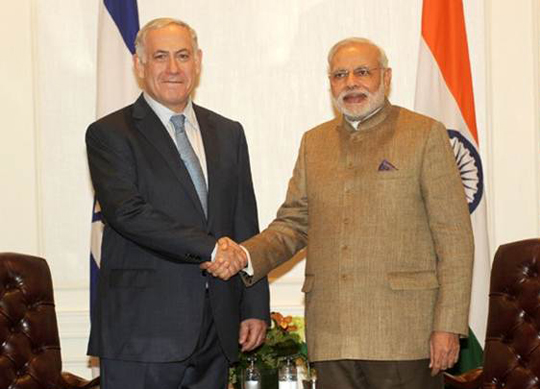
netanyahu

His visit will be the first by an Indian PM to Israel.

This year, India and Israel are marking 25 years of their diplomatic relations.

The two sides are expected to sign number of agreements in the field of innovation, development, science and technology and space.

Apart from boosting cooperation in the water and agriculture sectors, India and Israel will also discuss ways to strengthen people-to-people contact, air connectivity and investments.

During the visit, a deal with the Uttar Pradesh government is also likely to be signed to clean-up a patch of river Ganges apart from setting up of industrial research and development fund of USD 40 million.

Before the visit, the Ministry of External Affairs ministry in New Delhi said it will provide an impetus for deeper bilateral engagement in areas of mutual interest, as per news agency.

PM Modi's schedule:

PM Modi will be received by Netanyahu at the airport. This is a special gesture only accorded to the Pope or the US president.

The Israeli PM will also host a dinner for PM Modi.

Netanyahu will accompany him to most of the events, including the community reception on July 5.

PM Modi will pay homage to Indian soldiers at the Indian Cemetery in Haifa.

He will meet 26/11 Mumbai terror attack survivor Holtzberg Moshe, who was only two when he was saved by his Indian nanny Sandra Samuel.

Moshe's father Rabbi Gavriel and mother Rivkah were among eight Israeli nationals killed in the 2008 terror strike.

On the eve of his visit to Israel, PM Modi on Monday said he will discuss with Netanyahu common challenges like terrorism and ways to boost the economic ties.

"Tomorrow, I begin a historic visit to Israel, a very special partner of India's. As the first Indian PM to do so, I am greatly looking forward to this unprecedented visit that will bring our two countries and people closer," he said in a statement.

"I look forward to holding extensive talks with my friend, Israeli PM Netanyahu, who shares a commitment for vibrant India-Israel ties," he tweeted.

The PM said he will have 'in-depth talks' with Netanyahu "on the full spectrum of our partnership and strengthening it in diverse fields for mutual benefit. We will also have the chance to discuss major common challenges like terrorism."

"My programme during the visit gives me an opportunity to engage with a cross-section of Israeli society. I am particularly looking forward to interacting with the large vibrant Indian diaspora in Israel that represents an enduring link between our two peoples," PM Modi added.

On the economic side, he said, "I will join with leading Indian and Israeli CEOs and start-ups to discuss our shared priority of expanding business and investment collaboration on the ground."

In addition, he said, "I hope to get insights into Israel's accomplishments in technology and innovation through on-site visits."

On July 6, PM Modi will travel to Hamburg for the G-20 Summit being hosted by Germany on July 7-8.

Netanyahu hails PM Modi's visit to Israel as a 'very significant step'

Earlier, the Israeli premier had hailed PM Modi's visit as a "very significant step" in strengthening bilateral relations that are on a "constant upswing".

"Next week, the Indian Prime Minister, my friend, Narendra Modi will arrive in Israel, This is a historic visit to Israel. In the 70 years of the country's existence, no Indian Prime Minister has ever visited and this is further expression of the state of Israel's military, economic and diplomatic strength," Netanyahu had said.

"This is a very significant step in strengthening relations between the two countries," he had added.

The two leaders have already met twice on foreign soil on the sidelines of UN-related events and are said to be constantly in touch with each other over the phone.

PM Modi would also be meeting Israeli President Reuven Rivlin and the leader of Opposition Isaac Herzog on July 5.

He will not travelling to neighbouring Palestine during the visit, a clear signal of de-hyphenation of its ties with the two West Asian nations.

President Pranab Mukherjee in 2015 and External Affairs Minister Sushma Swaraj in 2016 visited both the countries.

Israeli Prime Minister Ariel Sharon and President Ezer Weizman visited India in 2003 and 1997 respectively.

Israeli President Reuven Rivlin had also paid a visit to India in November last year.

Comments

Muhammed Rafique
 - 
Friday, 7 Jul 2017

Viren, Your comments doesn't even deserve any response

but the matter of fact is you are such a sick and communal person who encourage riot and disrupt peace.The current situation in DK is bcos of people like u, instigated by Padil and Kalladka

Viren Kotian
 - 
Friday, 7 Jul 2017

RIP Sharat. Your blood will not be wasted. nationalist forces will soon eliminate anti-national forces, fanatics and terrorists.

Hara Hara Mahaadev!

Abdul
 - 
Friday, 7 Jul 2017

So called nationalists, breaking section , ohh DK & Udupi MPs spotted again , they will disappear when real culprits get caught ( like Karthik raj case)

Mohammad Beary
 - 
Tuesday, 4 Jul 2017

Lynchist with terrorist...

NOOR
 - 
Tuesday, 4 Jul 2017

For a muslims, Everything happens with the will of ALLAH...
ALLAH the creator of all that exists, Knows well of all that is happening around the globe...
ALLAH is the best of Planners...
ALhamudllillah.. Thanks to ALLAH for making us Muslims.

Fear ALLAH, the creator..
and Never Fear the Creations of ALLAH. U will be successful

abdul
 - 
Tuesday, 4 Jul 2017

both from the same creed & creature-anti human

Add new comment

  • Coastaldigest.com reserves the right to delete or block any comments.
  • Coastaldigset.com is not responsible for its readers’ comments.
  • Comments that are abusive, incendiary or irrelevant are strictly prohibited.
  • Please use a genuine email ID and provide your name to avoid reject.
News Network
April 28,2020

New Delhi, Apr 28: Outstanding loans amounting to Rs 68,607 crore of top 50 wilful bank loan defaulters in the country including firms of Mehul Choksi and Vijay Mallya have been technically written off till September 30, 2019, the Reserve Bank of India said in a RTI reply.

Absconding dimantaire Choksi's company Gitanjali Gems tops the list of these defaulters with a whopping amount of Rs 5,492 crore, according to the list.

This is followed by REI Agro with Rs 4,314 crore and Winsome Diamonds with Rs 4,076 crore.

Rotomac Global Private Limited has funded advances of Rs 2,850 crore which have been technically written off and Kudos Chemie Ltd with Rs 2,326 crore, Ruchi Soya Industries Limited, now owned by Ramdev's Patanjali, with Rs 2,212 crore and Zoom Developers Pvt Ltd with Rs 2,012 crore being the other companies.

Mallya's Kingfisher Airlines figures in the list at number 9, with outstanding of Rs 1943 crore which have been technically written off by the banks.

Forever Precious Jewellery and Diamonds Private Limited has loans of Rs 1,962 crore written off while Deccan Chronicle Holdings Limited have Rs 1915 crore written off loans.

Choksi's other firms Gili India and Nakshatra Brands also have loans of Rs 1,447 and Rs 1109 crore respectively written off.

REI Agro of Jhunjhunwala brothers is already under the scanner of ED. The CBI and ED are also probing alleged fraud by the owners of Winsome Diamonds.

Vikram Kothari's Rotomac is the fourth in the list. He and his son Rahul Kothari were arrested by the CBI for bank loan default.

In the last Parliament session, Rahul Gandhi had asked the government to provide a list of top 50 bank loans defaulters in the country, leading to sharp exchanges and uproar in the Lok Sabha.

"The information on top 50 wilful defaulters and their sum of funded amount outstanding and amount technically/prudentially written off as on September 30, 2019 reported in CRILC by banks, is provided," the RBI said in its written response dated April 24.

In his application, RTI activist Saket Gokhale had sought the list of defaulters as on February 16, but the RBI said the requested information is not available.

The RBI said that according to section 8 (1)(a) of RTI Act 2005 read with para 77 of Supreme Court judgement of December 16, 2015 in Jayantilal N Mistry case, information on overseas borrowers is exempted from public disclosure.

"Data is as reported by banks and RBI will not be held responsibly or accountable for any misreporting and/or incorrect reporting by the reporting entities," the RBI said in the written reply to the RTI query.

Comments

Add new comment

  • Coastaldigest.com reserves the right to delete or block any comments.
  • Coastaldigset.com is not responsible for its readers’ comments.
  • Comments that are abusive, incendiary or irrelevant are strictly prohibited.
  • Please use a genuine email ID and provide your name to avoid reject.
News Network
February 24,2020

New Delhi, Feb 24: They hail from vastly different backgrounds — Donald Trump is the son of a property tycoon while Narendra Modi is a descendant of a poor tea-seller.

Yet the two teetotallers, loved by right-wing nationalists in their home countries, share striking similarities that have seen them forge a close personal bond, analysts say.

Ahead of the American leader's first official visit to India, which begins in Modi's home state of Gujarat on Monday, the world's biggest democracy has gone out of its way to showcase the chemistry between them.

In Gujarat's capital Ahmedabad, large billboards with the words "two dynamic personalities, one momentous occasion" and "two strong nations, one great friendship" have gone up across the city.

"There's a lot that Trump and Modi share in common, and not surprisingly these convergences have translated into a warm chemistry between the two," Michael Kugelman of the Washington-based Wilson Center said.

"Personality politics are a major part of international diplomacy today. The idea of closed-door dialogue between top leaders has often taken a backseat to very public and spectacle-laden summitry."

Since assuming the top political office in their respective countries — Modi in 2014 and Trump in 2017 — the two men have been regularly compared to each other.

Trump, 73, and Modi, 69, both command crowds of adoring flag-waving supporters at rallies. A virtual cult of personality has emerged around them, with their faces and names at the centre of their political parties' campaigns.

A focus of Trump's administration has been his crackdown on migrants, including a travel ban that affects several Muslim-majority nations, among others, while critics charge that Modi has sought to differentiate Muslims from other immigrants through a contentious citizenship law that has sparked protests.

Both promote their countries' nationalist and trade protectionist movements — Trump with his "America First" clarion call and Modi with his "Make in India" mantra.

And while they head the world's largest democracies, critics have described the pair as part of a global club of strongmen that includes Russia's Vladimir Putin and Brazil's Jair Bolsonaro.

"There are many qualities that Trump and Modi share — a love for political grandstanding and an unshakable conviction that they can achieve the best solutions or deals," former Indian diplomat Rakesh Sood said.

Modi and Trump have sought to use their friendship to forge closer bonds between the two nations, even as they grapple with ongoing tensions over trade and defence.

Despite sharing many similarities in style and substance, analysts say there are some notable differences between the pair.

Modi is an insider who rose through the ranks of the Bharatiya Janata Party after starting out as a cadre in Rashtriya Swayamsevak Sangh.

Trump is a businessman and a political outsider who has in some sense taken over the Republican Party.

"Modi is a more conventional leader than is Trump in that he hasn't sought to revolutionise the office he holds in the way that Trump has," said Kugelman, a longtime observer of South Asian politics.

He added that genuine personal connections between leaders of both countries have helped to grow the partnership.

"George Bush and Manmohan Singh, Barack Obama and Singh, Obama and Modi, now Modi and Trump — there has been a strong chemistry in all these pairings that has clearly helped the relationship move forward," he added.

Trump has also stood by the Indian leader during controversial decisions, including his revocation of autonomy for Kashmir and his order for jets to enter Pakistani territory following a suicide bombing.

Analysts said the leaders would use the visit to bolster their image with voters.

A mega "Namaste Trump" rally in Ahmedabad on Monday will be modelled after the "Howdy, Modi" Houston extravaganza last year when the Indian leader visited the US and the two leaders appeared before tens of thousands of Indian-Americans at a football stadium.

"The success of this visit... will have a positive impact on his (Trump's) re-election campaign and the people of Indian origin who are voters in the US — a majority of them are from Gujarat," former Indian diplomat Surendra Kumar said.

"On the Indian side, the fact that Prime Minister Modi... (shares) such warmth, bonhomie and informality with the most powerful man on Earth adds to his stature... as well as with hardcore supporters."

Comments

Add new comment

  • Coastaldigest.com reserves the right to delete or block any comments.
  • Coastaldigset.com is not responsible for its readers’ comments.
  • Comments that are abusive, incendiary or irrelevant are strictly prohibited.
  • Please use a genuine email ID and provide your name to avoid reject.
Agencies
June 30,2020

Seventy-seven per cent children below five years of age in Jammu and Kashmir were not able to access basic healthcare services like immunisation during the lockdown imposed to curb the spread of COVID-19, CRY said on Monday citing a study.

The 'Rapid Online Perception Study about the Effects of COVID-19 on Children' was conducted during the first and second phases of the lockdown based on responses of parents and primary caregivers from all across the country, including Jammu and Kashmir, the NGO said in a statement.

It said a total of 387 respondents from Jammu and Kashmir participated in the study.

"Seventy-seven per cent children of age 0-5 years were not able to access basic healthcare services such as immunisation during lockdown - necessarily imposed to curb the spread of COVID-19 pandemic in Jammu and Kashmir," Child Rights and You (CRY) said.

It said as immunisation programmes witnessed a major setback during the lockdown across the country, the results of the survey across 23 states and Union Territories found nearly 50 per cent of parents with children below five years of age unable to access immunisation services.

"Worryingly, the figure was considerably high in Jammu and Kashmir with 77.14 per cent children below five years unable to get immunisation services," it added.

According to the study, in Jammu and Kashmir, nearly 35 per cent of the respondents said their children did not receive medical help during the lockdown, resulting in difficulties to cope with their children's illnesses and health hazards.

The study also talks about more systemic arrangements and logistical preparedness to ensure that children with no or compromised digital reach are not deprived from their Right to Education.

With online classes introduced as a substitute of schools during the lockdown, access to education for children remained a major issue of concern, as many of them, especially the ones from marginalised and financially poorer backgrounds found it difficult without smartphones and internet access.

The survey's findings revealed that nationally only 41 per cent households with children of school-going age could access online classes on a regular basis.

"Almost 90 per cent parents and primary caregivers reported that the lockdown has increased the screen time of their child to great or some extent. About half of the households recorded an increase of children's exposure to online activities during lockdown," it said.

The NGO said around 76 per cent parents agreed that they could keep a watch of their children's online activity to some extent.

Comments

Add new comment

  • Coastaldigest.com reserves the right to delete or block any comments.
  • Coastaldigset.com is not responsible for its readers’ comments.
  • Comments that are abusive, incendiary or irrelevant are strictly prohibited.
  • Please use a genuine email ID and provide your name to avoid reject.