



Will have to take military way if India doesn't listen, warns China

Agencies
July 4, 2017

Beijing, Jul 4: China would be forced to use a "military way" to end the standoff in the Sikkim sector if India "refuses to listen" to it, a Chinese expert has warned.
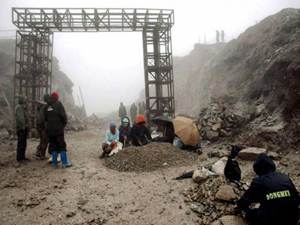
china copy copyAs the standoff at the Doklam area continued for the third week, the longest between the two countries, the official media and the think-tanks here have said that "war is possible if the conflict between India and China is not handled properly".

"China is trying its best to use historical lessons to reason with India and show sincerity in peacefully solving the problem, but if India refuses to listen, then China would have no other choice than to use a military way of solving the problem," Hu Zhiyong, a research fellow at the Shanghai Academy of Social Sciences, told the state-run Global Times.

Hu claimed that India is provoking China because it wanted to prove to the US that it could contain China while Prime Minister Narendra Modi was in the US.

But Hu said Trump was not like his predecessor Barack Obama.

"Obama believes India is important only because they share the same values, but Trump is very pragmatic, and he doesn't treat India as a valuable ally because New Delhi is too weak to confront Beijing," Hu opined.

Although India always treats China as its biggest rival, China does not think so as India lags far behind China, Song Zhongping, a Beijing-based military expert, was quoted as saying by the daily.

"Experts also scoffed at India's military threat after Indian Defense Minister Arun Jaitely asserted on Friday that the India of 2017 is different from what it was in 1962," said the report in the daily, known for its nationalist stance.

"The gap between the militaries of China and India today is even bigger than in 1962, and I hope India can keep calm for its own good," Hu said.

Since the standoff on June 6, when the People's Liberation Army (PLA) destroyed bunkers of the India Army claiming the area belonged to China, Chinese media have carried several pieces warning India for escalating border tension and "reminding" the Indian Army about the 1962 war.

Of the 3,488-km-long India-China border from Jammu and Kashmir to Arunachal Pradesh, a 220-km section falls in Sikkim.

Comments

Salman sheikh
 - 
Friday, 7 Jul 2017

There is a name of the film in tulu which have been released recently which suites them \AREYMARLER\"
This bloody goon is disturbing peace in DK ...only becoz of him innocent ppl has to lose their lives.."

Add new comment

  • Coastaldigest.com reserves the right to delete or block any comments.
  • Coastaldigset.com is not responsible for its readers’ comments.
  • Comments that are abusive, incendiary or irrelevant are strictly prohibited.
  • Please use a genuine email ID and provide your name to avoid reject.
News Network
June 2,2020

Jun 2: A new female billionaire has emerged from one of Asia's most-expensive breakups.

Du Weimin, the chairman of Shenzhen Kangtai Biological Products Co., transferred 161.3 million shares of the vaccine maker to his ex-wife, Yuan Liping, according to a May 29 filing, immediately catapulting her into the ranks of the world's richest.

The stock was worth $3.2 billion as of Monday's close.

Yuan, 49 this year, owns the shares directly, but signed an agreement delegating the voting rights to her ex-husband, the filing shows. The Canadian citizen, who resides in Shenzhen, served as a director of Kangtai between May 2011 and August 2018. She's now the vice general manager of subsidiary Beijing Minhai Biotechnology Co. Yuan holds a bachelor's degree in economics from Beijing's University of International Business and Economics.

Kangtai shares have more than doubled in the past year and have continued their ascent since February, when the company announced a plan to develop a vaccine to fight the coronavirus. They slipped for a second day Tuesday following news of the divorce terms, losing 3.1% as of 9:43 a.m. in Hong Kong and bringing the company's market value to $12.9 billion.

Du's net worth has now dropped to about $3.1 billion from $6.5 billion before the split, excluding his pledged shares.

The 56-year-old was born into a farming family in China's Jiangxi province. After studying chemistry in college, he began working in a clinic in 1987 and became a sales manager for a biotech company in 1995, according to the prospectus of Kangtai's 2017 initial public offering. In 2009, Kangtai acquired Minhai, the company Du founded in 2004, and he became the chairman of the combined entity.

China's rapidly growing economy has been an engine for the country's richest, and Du is not the only tycoon who's had to pay a steep price for a divorce. In 2012, Wu Yajun, at one point the nation's richest woman, transferred a stake worth about $2.3 billion to her ex-husband, Cai Kui, who co-founded developer Longfor Group Holdings Ltd. In 2016, tech billionaire Zhou Yahui gave $1.1 billion of shares in his online gaming company, Beijing Kunlun Tech Co., to ex-wife Li Qiong after a civil court settlement.

Sometimes, a goodbye can be time-consuming too. South Korean tycoon Chey Tae-won's wife filed a lawsuit in December asking for a 42.3% stake in SK Holdings Co. valued at $1.2 billion. That would make her the second-largest shareholder of the company should she win the case, which is still ongoing.

The most expensive divorce in history is that of Jeff and MacKenzie Bezos. The Amazon.com Inc. founder gave 4% of the online retailer to Mackenzie, who now has a $48 billion fortune and is the world's fourth-richest woman.

Comments

Add new comment

  • Coastaldigest.com reserves the right to delete or block any comments.
  • Coastaldigset.com is not responsible for its readers’ comments.
  • Comments that are abusive, incendiary or irrelevant are strictly prohibited.
  • Please use a genuine email ID and provide your name to avoid reject.
Agencies
July 24,2020

Chengdu, Jul 24: China on Friday asked the US to close down its Consulate in Chengdu in retaliation to Washington's decision to shut the Chinese Consulate in Houston.

A statement by the Chinese Foreign Ministry said China has informed the US Embassy of its decision to withdraw its consent for the establishment and operation of the US Consulate General in Chengdu.

This was in response to "unilateral" decision by the US to shut the Houston Consulate. China's decision is legitimate and necessary response to the unreasonable actions of the US, it said.

The US on Wednesday ordered the closure of the Chinese consulate in Houston, a move it said was aimed "to protect American intellectual property and private information."

Reacting strongly to the US move, Chinese Foreign Ministry spokesman Wang Wenbin termed it as an "unprecedented escalation and warned retaliatory measures.

China on Thursday said that "malicious slander" is behind an order by the US government to close its consulate in Houston, Texas, and maintained that its officials have never operated outside ordinary diplomatic norms.

Wang said the order to close the consulate violates international law and basic norms governing international relations, and seriously undermines China-US relations.

This is breaking down the bridge of friendship between the Chinese and American people, Wang said.

Comments

Add new comment

  • Coastaldigest.com reserves the right to delete or block any comments.
  • Coastaldigset.com is not responsible for its readers’ comments.
  • Comments that are abusive, incendiary or irrelevant are strictly prohibited.
  • Please use a genuine email ID and provide your name to avoid reject.
News Network
June 15,2020

Stockholm, Jun 15: Nuclear powers continue to modernise their arsenals, researchers said Monday, warning that tensions were rising and the outlook for arms control was "bleak".

"The loss of key channels of communication between Russia and the USA... could potentially lead to a new nuclear arms race," said Shannon Kile, director of the nuclear arms control programme at the Stockholm International Peace Research Institute (SIPRI) and co-author of the report.

Russia and the US account for more than 90 percent of the world's nuclear weapons.

Kile was referring to the future of the New START treaty between the US and Russia, which is set to expire in February 2021.

It is the final nuclear deal still in force between the two superpowers, aimed at maintaining their nuclear arsenals below Cold War levels.

"Discussions to extend New START or to negotiate a new treaty made no progress in 2019," the SIPRI researchers noted.

At the same time, nuclear powers continue to modernise their weapons while China and India are increasing the size of their arsenals.

"China is in the middle of a significant modernisation of its nuclear arsenal. It is developing a so-called nuclear triad for the first time, made up of new land- and sea-based missiles and nuclear-capable aircraft," SIPRI said.

The country has repeatedly rejected Washington's insistence that it join any future nuclear arms reduction talks.

The number of nuclear warheads declined in the past year.

At the start of 2020, the United States, Russia, Britain, China, India, Pakistan, Israel and North Korea together had 13,400 nuclear arms, according to SIPRI's estimates, 465 fewer than at the start of 2019.

The decline was attributed mainly to the United States and Russia.

While the future of the New START treaty remains uncertain, Washington and Moscow have continued to respect their obligations under the accord.

"In 2019, the forces of both countries remained below the limits specified by the treaty," the report said. But both nations "have extensive and expensive programmes underway to replace and modernise their nuclear warheads, missile and aircraft delivery systems, and nuclear weapon production facilities," it added.

"Both countries have also given new or expanded roles to nuclear weapons in their military plans and doctrines, which marks a significant reversal of the post-Cold War trend towards the gradual marginalisation of nuclear weapons."

The Treaty on the Non-Proliferation of Nuclear Weapons (NPT), a cornerstone of the global nuclear non-proliferation regime, celebrates its 50th anniversary this year.

The number of nuclear arms worldwide has declined since hitting a peak of almost 70,000 in the mid-1980s.

The five original nuclear powers -- Washington, Beijing, Moscow, Paris and London -- in March reiterated their commitment to the treaty.

Comments

Add new comment

  • Coastaldigest.com reserves the right to delete or block any comments.
  • Coastaldigset.com is not responsible for its readers’ comments.
  • Comments that are abusive, incendiary or irrelevant are strictly prohibited.
  • Please use a genuine email ID and provide your name to avoid reject.