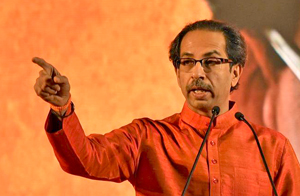
Killing in name of cow against Hindutva; need national policy on beef: Shiv Sena

Agencies
July 4, 2017

New Delhi, Jul 4: Days after Prime Minister Narendra Modi strongly decried violence in the name of cow protection, BJP ally Shiv Sena too has spoken out against incidents of lynching in the name of cow.shivsena

The Sena said said lynching people in the name of cow protection is against Hindutva and urged PM Modi to come up with a national policy on beef.

The Maharashtra-focused party's comments were published in its mouthpiece 'Saamana' today and come after a number of a incidents of lynching over either alleged transport of cow for slaughter or beef consumption in parts of India.

The incidents, also reported from several Bharatiya Janata Party-ruled states including Jharkhand, Haryana and Uttar Pradesh, have promoted protests, most notably the #NotInMyName rallies that took place in several cities across the country.

Commenting in an editorial in 'Saamana' today, the Shiv Sena said, "The issue of beef is related to eating habits, business and employment. Hence, there should be a national policy over the issue." "Those who were safeguarding cows were Hindus till yesterday. Today, they have become murderers."

Shiv Sena welcomed the prime minister's comments from last week, when a visible charged up Modi admonished the so-called 'gau rakshaks' and said that killing in the name of cow is not acceptable.

"We welcome the stand taken by the prime minister over the issue. Nobody has the right to take law in his hands in the name of cow protection. Lynching people is against the principles of Hindutva," the Sena said in its editorial.

"We thank him (Modi) for clearly defining Hindutva. He should now come up with a national policy on beef to ease tensions," the Sena said.

Previously, BJP chief Amit Shah and Rashtriya Swayamsevak Sangh head Mohan Bhagwat have both hit out at cow vigilante violence. Bhagwat, while demanding a national law to ban cow slaughter, said killing someone in the name of cow protection is wrong.

Shah has struck a more subdued note. The BJP chief recently termed incidents of lynching as "serious", but claimed more of these happened under the previous governments than the three years of NDA rule.

Modi's comments last week followed the lynching of a teenager, Junaid Khan, who was stabbed to death by a group of men on a train when he was returning home to Ballabhgarh in Haryana after shopping for Eid. His assailants termed Junaid, his brother and friends as "beef eaters".

In Jharkhand's Ramgarh, a Muslim meat trader was beaten to death last week by cow vigilantes who alleged he was carrying beef in his vehicle. Nityanand Mahto, a local BJP leader is among those arrested in connection with the incident.

Earlier this year, a cattle farmer - Pehlu Khan - died after being attacked by so-called gau rakshaks who suspected him of illegally ferrying cattle for the purpose of slaughter in Rajasthan's Alwar.

In September 2015, Mohammad Akhlaq was beaten to death at Dadri in Uttar Pradesh over suspicion of storing and consuming beef. Modi had spoken up against cow-related violence even then, but did not explicitly mention the Dadri incident.

Comments

Abdullah
 - 
Saturday, 8 Jul 2017

Only barking like Modi.
What action you people have taken against BD, RSS goons from these many years???

Add new comment

  • Coastaldigest.com reserves the right to delete or block any comments.
  • Coastaldigset.com is not responsible for its readers’ comments.
  • Comments that are abusive, incendiary or irrelevant are strictly prohibited.
  • Please use a genuine email ID and provide your name to avoid reject.
Ram Puniyani
February 10,2020

Noam Chomsky is one of the leading peace workers in the world. In the wake of America’s attack on Vietnam, he brought out his classic formulation, ‘manufacturing consent’. The phrase explains the state manipulating public opinion to have the public approve of it policies—in this case, the attack of the American state on Vietnam, which was then struggling to free itself from French colonial rule.

In India, we are witness to manufactured hate against religious minorities. This hatred serves to enhance polarisation in society, which undermines India’s democracy and Constitution and promotes support for a Hindu nation. Hate is being manufactured through multiple mechanisms. For example, it manifests in violence against religious minorities. Some recent ghastly expressions of this manufactured hate was the massive communal violence witnessed in Mumbai (1992-93), Gujarat (2002), Kandhamal (2008) and Muzaffarnagar (2013). Its other manifestation was in the form of lynching of those accused of having killed a cow or consumed beef. A parallel phenomenon is the brutal flogging, often to death, of Dalits who deal with animal carcasses or leather.

Yet another form of this was seen when Shambhulal Regar, indoctrinated by the propaganda of Hindu nationalists, burned alive Afrazul Khan and shot the video of the heinous act. For his brutality, he was praised by many. Regar was incited into the act by the propaganda around love jihad. Lately, we have the same phenomenon of manufactured hate taking on even more dastardly proportions as youth related to Hindu nationalist organisations have been caught using pistols, while police authorities look on.

Anurag Thakur, a BJP minster in the central government recently incited a crowd in Delhi to complete his chant of what should happen to ‘traitors of the country...” with a “they should be shot”. Just two days later, a youth brought a pistol to the site of a protest at Jamia Millia Islamia university and shouted “take Azaadi!” and fired it. One bullet hit a student of Jamia. This happened on 30 January, the day Nathuram Godse had shot Mahatma Gandhi in 1948. A few days later, another youth fired near the site of protests against the CAA and NRC at Shaheen Bagh. Soon after, he said that in India, “only Hindus will rule”.

What is very obvious is that the shootings by those associated with Hindu nationalist organisations are the culmination of a long campaign of spreading hate against religious minorities in India in general and against Muslims in particular. The present phase is the outcome of a long and sustained hate campaign, the beginning of which lies in nationalism in the name of religion; Muslim nationalism and Hindu nationalism. This sectarian nationalism picked up the communal view of history and the communal historiography which the British introduced in order to pursue their ‘divide and rule’ policy.

In India what became part of “social common sense” was that Muslim kings had destroyed Hindu temples, that Islam was spread by force, and that it is a foreign religion, and so on. Campaigns, such as the one for a temple dedicated to the Hindu god Rama to be built at the site where the Babri masjid once stood, further deepened the idea of a Muslim as a “temple-destroyer”. Aurangzeb, Tipu Sultan and other Muslim kings were tarnished as the ones who spread Islam by force in the subcontinent. The tragic Partition, which was primarily due to British policies, and was well-supported by communal streams also, was entirely attributed to Muslims. The Kashmir conflict, which is the outcome of regional, ethnic and other historical issues, coupled with the American policy of supporting Pakistan’s ambitions of regional hegemony, (which also fostered the birth of Al-Qaeda), was also attributed to the Muslims.

With recurring incidents of communal violence, these falsehoods went on going deeper into the social thinking. Violence itself led to ghettoisation of Muslims and further broke inter-community social bonds. On the one hand, a ghettoised community is cut off from others and on the other hand the victims come to be presented as culprits. The percolation of this hate through word-of-mouth propaganda, media and re-writing of school curricula, had a strong impact on social attitudes towards the minorities.

In the last couple of decades, the process of manufacturing hate has been intensified by the social media platforms which are being cleverly used by the communal forces. Swati Chaturvedi’s book, I Am a Troll: Inside the Secret World of the BJP’s Digital Army, tells us how the BJP used social media to spread hate. Whatapp University became the source of understanding for large sections of society and hate for the ‘Other’, went up by leaps and bounds. To add on to this process, the phenomenon of fake news was shrewdly deployed to intensify divisiveness.

Currently, the Shaheen Bagh movement is a big uniting force for the country; but it is being demonised as a gathering of ‘anti-nationals’. Another BJP leader has said that these protesters will indulge in crimes like rape. This has intensified the prevalent hate.

While there is a general dominance of hate, the likes of Shambhulal Regar and the Jamia shooter do get taken in by the incitement and act out the violence that is constantly hinted at. The deeper issue involved is the prevalence of hate, misconceptions and biases, which have become the part of social thinking.

These misconceptions are undoing the amity between different religious communities which was built during the freedom movement. They are undoing the fraternity which emerged with the process of India as a nation in the making. The processes which brought these communities together broadly drew from Gandhi, Bhagat Singh and Ambedkar. It is these values which need to be rooted again in the society. The communal forces have resorted to false propaganda against the minorities, and that needs to be undone with sincerity.

Combating those foundational misconceptions which create hatred is a massive task which needs to be taken up by the social organisations and political parties which have faith in the Indian Constitution and values of freedom movement. It needs to be done right away as a priority issue in with a focus on cultivating Indian fraternity yet again.


Comments

Add new comment

  • Coastaldigest.com reserves the right to delete or block any comments.
  • Coastaldigset.com is not responsible for its readers’ comments.
  • Comments that are abusive, incendiary or irrelevant are strictly prohibited.
  • Please use a genuine email ID and provide your name to avoid reject.
coastaldigest.com news network
August 2,2020

Bengaluru, Aug 2: All the seven Airports in Karnataka have seen poor traffic even after the restoration of domestic flight services post covid-19 lockdown. Interestingly, Mangaluru International Airport, the second biggest in the state, has slipped to third position in number of number of passengers and flights. 

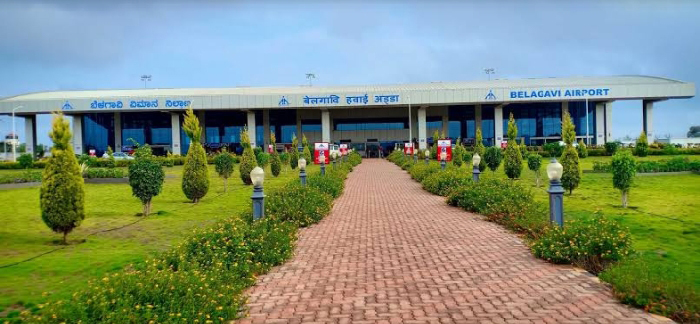
Of all the seven airports in State-- Bengaluru, Mangaluru, Hubballi, Belagavi, Mysuru, Kalaburagi and Vijaynagara (Hosapete)-- it was the Sambra (Belagavi) airport which saw the highest number of passengers and flights after Bengaluru. 

According to Airports Authority of India report released on their website recently, the Sambra airport outperformed the Managluru international airport in June. 

As many 10,224 passengers travelled to or from Belagavi airport in June, whereas Mangaluru airport saw a footfall of only 8,608 passengers including 3,726 international and 4,882 domestic passengers. Belagavi airport handled 391 flights whereas Mangaluru airport handled 190 flights.

Even the Bengaluru international airport saw a decline in the number of passengers and flights in June. Only 3.69 lakh domestic and 10,654 international passengers arrived or departed from Kempegowda International Airport, Bengaluru in June as against 27.59 lakh total passengers in June 2019. 

Between April-June 2020 the Bengaluru airport saw only 4.54 lakh total passengers (domestic and international) as against 84.11 lakh total passenger during the same period last year. The number of flights to and from Bengaluru also saw a huge dip in June with only 731 international (2,582 in June 2019) and 4290 domestic (16,216 in June 2019) flights.

Though the Mysuru domestic airport handled a higher number of flights compared to last June, the number of passengers either arriving or departing saw a decline. Last year June 4,775 passengers travelled in 96 flights, whereas in June 2020 the airport handled 3,158 passengers and 330 flights.

Hubballi airport saw the least number of passengers or flights among the seven airports in Karnataka in June. It saw only 55 passengers either arriving or departing from the city's airport in 14 flights in the month of June. In the same month last year, Hubballi airport, which was third busiest before the pandemic, had facilitated 45,973 passengers and handled 604 flights.

Since April 2020 to June, the Hubballi airport has handled only 18 flights (as against 1,958 during the same period last year) and 122 passengers (1,50,416 between April-June 2019).

Comments

Add new comment

  • Coastaldigest.com reserves the right to delete or block any comments.
  • Coastaldigset.com is not responsible for its readers’ comments.
  • Comments that are abusive, incendiary or irrelevant are strictly prohibited.
  • Please use a genuine email ID and provide your name to avoid reject.
coastaldigest.com news network
July 8,2020

Mangaluru, Jul 8: A seven-day-old baby from Kallapu near Permannur village, within Ullal town limits in Mangaluru taluk has tested positive for COVID-19.

The baby’s mother, while pregnant, was admitted to a private hospital in the town on June 30. 

Her samples, which were sent for testing before delivery, reported positive, doctor said.

On Wednesday, the baby’s tests too reported positive for COVID-19.

Comments

Add new comment

  • Coastaldigest.com reserves the right to delete or block any comments.
  • Coastaldigset.com is not responsible for its readers’ comments.
  • Comments that are abusive, incendiary or irrelevant are strictly prohibited.
  • Please use a genuine email ID and provide your name to avoid reject.