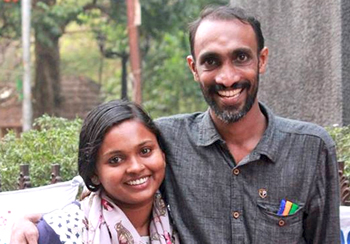
Hindu-Muslim married couple denied room in Bengaluru Hotel

Agencies
July 5, 2017

Bengaluru, Jul 5: A married Hindu-Muslim couple were allegedly denied a room at Olive Residency on Annipuram Main Road in Sudhama Nagar.couple

Shafeek Subaida Hakkim and Divya DV, who hail from Kerala, had visited Bengaluru for some work. However, when they were looking for an accommodation at Olive Residency, the staff allegedly refused to provide a room as they belonged to different religions.

Shafeek has alleged that the receptionist categorically told them since he was a Muslim and his wife Divya a Hindu, they can't be given a room on rent.

However, while speaking to news agency, the receptionist denied the accusation saying, there was a problem of luggage and ID proofs, and the couple wasn't refused a room because of religion.

The hotel owner claimed that Shafeeq and Divya didn't tell us that they were married.

"They initially demanded a room for half-an-hour, when we refused, they demanded for a day," the owner said.

Comments

Anwar
 - 
Saturday, 8 Jul 2017

RSS was allowed to carry a long procession, and vandalise property and resort to violence at will. In contrast, SDPI wasn't allowed to take out a procession after Ashraf Kalai's death. Why the partiality?

Add new comment

  • Coastaldigest.com reserves the right to delete or block any comments.
  • Coastaldigset.com is not responsible for its readers’ comments.
  • Comments that are abusive, incendiary or irrelevant are strictly prohibited.
  • Please use a genuine email ID and provide your name to avoid reject.
News Network
April 22,2020

Bengaluru, Apr 22: The Karnataka government has announced partial relaxation of COVID-19 lockdown norms in the state allowing certain construction activities, manufacturing of packaging materials, courier services, among others, from April 23.

The activities will be permitted only outside the COVID-19 containment zones identified by the government.

Service provided by self-employed people like electrician, IT repair, plumbers, motor mechanics, and carpenters in local areas have also been given exemption.

Tea, coffee and rubber plantation have been allowed to work with 50 per cent workforce, and a similar exemption have been given to processing, packaging, sale and marketing of these produce.

“To mitigate hardship to the public, select additional activities have been allowed,which will come into effect from 00.00 hours of April 23,” Chief Secretary TM Vijay Bhaskar said in an order on Wednesday.

However, these additional activities will be operationalised by District Administrations and BBMP (city corporation in the case of Bengaluru city) based on strict compliance to the guidelines on lockdown measures, it said.

Before operating these relaxations, district administrations and BBMP (city corporation) shall ensure that all the preparatory arrangements on social distancing in offices, work place establishments as also sectoral requirements are in place, it said, adding that relaxations will not apply in containment zones.

Facing a financial crunch, the state government has been eager to kick-start economic activities in the state that had come to halt due to the coronavirus lockdown.

While hospitality services, bars, malls, theatres, shopping complexes, religious and places of worship among others will continue to remain shut, relaxation of norms has been for activities that are linked to essential services such as health, infrastructure and agriculture.

As per the order, while, public transportation will continue to remain suspended till May 3,private vehicles with passes for emergency services and personnel commuting with passes to places of work and back will be allowed.

Activities permitted include construction of roads, irrigation projects, buildings and all kinds of industrial projects, including MSMEs, in rural areas and all kinds of projects in industrial estates, where workers are available on site and no one is required to be brought in from outside.

Also permitted to function are manufacturing units of essential goods – drugs, pharmaceuticals, medical devices, their raw materials and intermediates;

food processing industries in rural areas, coal production (mines and mineral production and activities incidental to mining) besides manufacturing units of packaging materials.

Comments

Add new comment

  • Coastaldigest.com reserves the right to delete or block any comments.
  • Coastaldigset.com is not responsible for its readers’ comments.
  • Comments that are abusive, incendiary or irrelevant are strictly prohibited.
  • Please use a genuine email ID and provide your name to avoid reject.
News Network
June 25,2020

New Delhi, Jun 25: The Central government submitted before the Supreme Court on Thursday that the remaining class 10 and 12 CBSE exams, which were earlier rescheduled to be held between July 1 to July 15 in view of the COVID-19 pandemic, have been cancelled.

Solicitor General Tushar Mehta, appearing for the Centre and Central Board of Secondary Education (CBSE), informed a three-judge bench headed by Justice AM Khanwilkar that the remaining class 10 and 12 CBSE exams scheduled to be held in July have been cancelled.

Delhi, Maharashtra, and Tamil Nadu have conveyed their inability to conduct the examinations, Mehta said.

The bench asked whether class 12 students were being given the option to either get marks on the internal assessment basis or appear for an exam later, to which the Mehta responded in the affirmative.

CBSE exams for class 10 students stand cancelled, Mehta said and added that they don't have to give any examinations. Mehta further submitted that as soon as conditions are conducive, CBSE exams for class 12 students, who opt for it, will be conducted.

The apex court was hearing a petition, filed by advocate Rishi Malhotra, seeking directions to cancel the remaining CBSE exams in view of the health risk of coronavirus infection. The apex court was also hearing a similar petition regarding the ICSE exams.

Indian Certificate of Secondary Education (ICSE), through its counsel Jaideep Gupta, also informed the court that it will also cancel the class 10 and 12 board exams. However, it submitted that it does not agree to give the option to students to give the exam later.

Comments

Add new comment

  • Coastaldigest.com reserves the right to delete or block any comments.
  • Coastaldigset.com is not responsible for its readers’ comments.
  • Comments that are abusive, incendiary or irrelevant are strictly prohibited.
  • Please use a genuine email ID and provide your name to avoid reject.
News Network
April 16,2020

New Delhi, Apr 16: Minority Affairs Minister Mukhtar Abbas Naqvi on Thursday directed state waqf boards to ensure strict implementation of lockdown and social distancing guidelines during the holy month of Ramzan starting next week amid the coronavirus pandemic.

At a meeting via video conferencing, Naqvi asked the state waqf boards' officials to create awareness among people to offer prayers and perform other religious rituals like "iftar (breaking of fast)" during Ramzan, which begins on April 24 or 25, staying inside their homes.

More than seven lakh registered mosques, eidgahs, imambadas, dargahs and other religious and social institutions come under state waqf boards across the country. The Central Waqf Council is the regulatory body of state waqf boards in India.

"We should cooperate with health workers, security forces, administrative officers, sanitation workers. They are working for our safety and well-being even putting their own lives at risk in this coronavirus pandemic," Naqvi said.

"We should also demolish rumours and misinformation being spread about quarantine and isolation centres by creating awareness among people that such centres are only meant to protect people, their families and the society from the pandemic," the minister said.

Naqvi told all the state waqf boards and religious and social organisations that everyone should remain cautious of any type of fake news and conspiracies aimed at creating misinformation. 

"Authorities have been working for safety and well-being of all citizens of the country without any discrimination. Such type of rumours and conspiracies are a nefarious design to weaken the fight against coronavirus," he said.

"We should work united to win this fight against corona by defeating any type of rumour, misinformation and conspiracy," the minister said.

Naqvi asked officials of all the state waqf boards to play an active and effective role in ensuring that people follow the guidelines of the Union Home Ministry, state governments and the Central Waqf Council while fulfilling religious responsibilities during Ramzan.

In view of the challenges of the COVID-19 pandemic, all religious and social activities and mass gatherings in all the temples, gurdwaras, churches and other religious and social places of the country have been stopped, he said. 

Similarly, any mass gatherings in mosques and other Muslim religious places of the country has also been stopped, Naqvi said.

He said that due to the COVID-19 threat, religious leaders as well as religious and social organisations from all regions of the country, have appealed to people to offer prayers and perform all other religious rituals staying inside their homes during Ramzan. 

Most of the Muslim nations of the world have also banned mass gatherings at mosques and other religious places during the holy month, he pointed out.

Prime Minister Narendra Modi, in cooperation with all the state governments, has been working effectively for the safety and well-being of the people, he said.

The cooperation of the people has brought great relief to India in the war against COVID-19 Naqvi said, adding that several challenges are still there before the country. 

"We can defeat these challenges of the coronavirus pandemic by following all the guidelines of the central and state governments strictly," he asserted.

Chairman and senior officials from state waqf boards such as Uttar Pradesh (Shia & Sunni), Andhra Pradesh, Bihar (Shia & Sunni), Dadra & Nagar Haveli, Haryana, Karnataka, Kerala, Madhya Pradesh, Punjab, West Bengal, Andaman & Nicobar, Assam, Manipur, among others participated in the meeting.

State waqf boards from Rajasthan, Telangana, Delhi, Chhattisgarh, Gujarat, Himachal Pradesh, Jammu and Kashmir, Jharkhand, Maharashtra, Odisha, Puducherry, Tamil Nadu, Tripura and Uttarakhand also participated.


Comments

Add new comment

  • Coastaldigest.com reserves the right to delete or block any comments.
  • Coastaldigset.com is not responsible for its readers’ comments.
  • Comments that are abusive, incendiary or irrelevant are strictly prohibited.
  • Please use a genuine email ID and provide your name to avoid reject.