


'People of Indian origin in Israel to get OCI card despite their army training'

Agencies
July 6, 2017

Tel Aviv, Jul 6: People of Indian origin in Israel will get the Overseas Citizen of India (OCI) cards even if they have undergone the compulsory army service here, Prime Minister Narendra Modi announced tonight.modi3
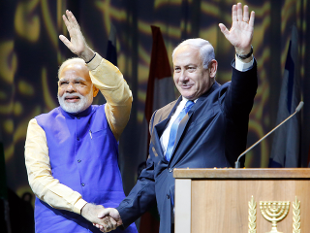
Addressing the Indian diaspora here at an event which was also attended by Israeli Prime Minister Benjamin Netanyahu, Modi also said that direct flights would be launched between Delhi, Mumbai and Tel Aviv to encourage people-to-people contacts.

He said an Indian cultural centre would also be opened in Israel, fulfilling a long-pending demand of the Indian diaspora here.

He said he had heard about problems being faced by the people of Indian origin in getting the OCI cards.

The Indian government has simplified the rules and even those who have undergone the compulsory military service in Israel will get the OCI cards, the prime minister said to the cheering by the crowd.

Modi said the Jewish nation had links with India dating back to centuries but the fact that no Indian prime minister had travelled here in 70 years "raises questions", an apparent swipe at the previous governments of India.

"For the first time in 70 years, an Indian prime minister has landed here to seek your blessings," he said amid chants of "Modi, Modi".

Describing Netanyahu as "my friend", Modi said the kind of welcome extended to him since his arrival here yesterday cannot be forgotten by anyone.

Hailing Israel, particularly its innovations and scientific advancements, he said the country has demonstrated that the number and size does not matter but it is the spirit that matters.

Modi said there were about 600 Indian students in Israel who can contribute to the future of the relationship.

He remembered former Israeli prime minister Shimon Peres, saying he had worked tirelessly for the humanity.

Referring to Moshe Holtzberg, an 11-year-old Israeli who was saved by an Indian nanny during the Mumbai terror attack of 2008, Modi said it had shown how life succeeds over terrorism. He had met Moshe earlier in the day.

Modi also recalled the contribution of the Indian army in liberation of Jerusalem and Haifa during the World War-I. He will be travelling to Haifa tomorrow to pay his tributes to them.

In his 60-minute speech, Modi talked about various programmes initiated by his government and said these were aimed at the betterment of the common people.

Netanyahu, who spoke before Modi said the partnership between India and Israel was "made in heaven and was happening here now."

He said he and Modi had decided on a vast programme and the Indian diaspora was "a bridge". "We love you," he added.

"We have decided to cooperate in so many areas.... We are building this future today, between two democracies," the Israeli prime minister said.

Comments

Raees
 - 
Sunday, 9 Jul 2017

Where is the proof that ram born in ayodhya. Those who have born and death is not god.
Tomm they will say. The first cow on earth was born in kankanady.

What if ram was born in Japan. Will they attack japan.

ali
 - 
Saturday, 8 Jul 2017

why procession for terrorist ???? only his terrorist mates will do that...

Add new comment

  • Coastaldigest.com reserves the right to delete or block any comments.
  • Coastaldigset.com is not responsible for its readers’ comments.
  • Comments that are abusive, incendiary or irrelevant are strictly prohibited.
  • Please use a genuine email ID and provide your name to avoid reject.
Agencies
July 29,2020

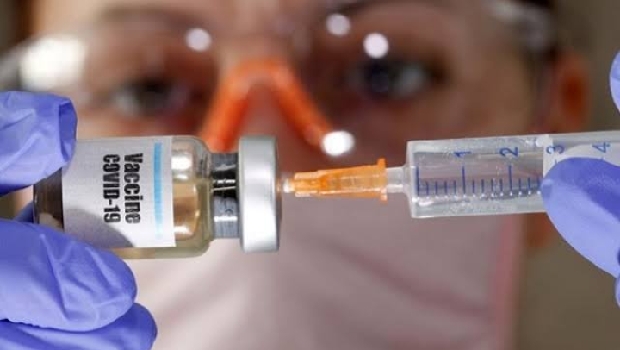
If everything goes as Russia’s expectation, it will be world’s first country to approve a coronavirus vaccine for widespread in the second week of August despite safety and efficacy concerns, according to a report. The adenoviral vector-based vaccine developed by Russian military and government researchers is currently in phase 2 trials.

According to a report from CNN, Russian officials are hoping to get approval for the COVID-19 vaccine developed by the Moscow-based Gamaleya Institute on Agust 10 or even before that. The officials told the outlet that the vaccine will be approved for public use with frontline healthcare workers receiving it first.

“It’s a Sputnik moment,” said Kirill Dmitriev, head of Russia’s sovereign wealth fund, which is financing Russian vaccine research, referring to the successful 1957 launch of the world’s first satellite by the Soviet Union, according to CNN.

“Americans were surprised when they heard Sputnik’s beeping. It’s the same with this vaccine. Russia will have got there first,” he was quoted as saying.

However, Russia is yet to release the scientific data on its coronavirus vaccine trials, hence, questions remain about the safety and efficacy of the vaccine, said the report. The vaccine is in the second phase of testing with developers planning to launch the phase 3 trials sometime after August 3.

Earlier, Interfax reported, citing Health Minister Mikhail Murashko, that the vaccine will be widely used in parallel with phase 3 trials. He said the country plans to vaccinate medics who are at high-risk for COVID-19 next month before clinical trials are completed.

Murashko added that individuals at higher risk of getting infected with the coronavirus such as older people or those with health conditions will also be prioritised for the vaccine, although he did not estimate or reveal when that would happen. The minister added 800 people will be recruited for the phase 3 trials.

Meanwhile, health officials were more cautious considering the fact that human testing of the vaccine is incomplete, and the state registration is expected to begin after August 3, reported The Moscow Times.

On Monday, Moderna and Pfizer announced the commencement of the final phase 3 trials of their candidate vaccines against the SARS-CoV-2 virus, which has so far claimed at least 654,477 lives and infected 16,514,500 people worldwide. 

Researchers will recruit up to 30,000 volunteers in separate trials both backed by the US government. India's first indigenous coronavirus vaccine, COVAXIN, is undergoing phase 1 human clinical trials across the country. More than 150 COVID-19 vaccines are being developed all over the world with at least six candidates already in late-stage clinical trials.

Comments

Add new comment

  • Coastaldigest.com reserves the right to delete or block any comments.
  • Coastaldigset.com is not responsible for its readers’ comments.
  • Comments that are abusive, incendiary or irrelevant are strictly prohibited.
  • Please use a genuine email ID and provide your name to avoid reject.
News Network
February 1,2020

Washington, Feb 1: The Indian economy experienced some abrupt slowdown in 2019 due to turbulence in non-banking financial institutions and major reform measures such as GST and demonetisation, but it is not in a recession, IMF Managing Director Kristalina Georgieva has said.

"The Indian economy indeed has experienced an abrupt slowdown in 2019. We had to revise our growth projections, downwards to four percent for last year. We are expecting 5.8 per cent (growth rate) in 2020 and then an upward trajectory to 6.5 percent in 2021," Georgieva told a group of foreign journalists here on Friday.

"It appears that the main reason for this slowdown was the non-banking financial institutions experiencing a turbulence," she said on the eve of Union Finance Minister Nirmala Sitharaman presenting the annual budget in Parliament on Saturday.

She said India had undertaken some important reforms that over the longer term would be beneficial for the country, but they do have some short-term impact.

"For example, coming with the unified tax system, and the demonetisation that took place. These are steps that over time are beneficial, but of course they might, might be somewhat disruptive over short term," Georgieva said in response to a question.

The International Monetary Fund (IMF) Managing Director said that there is not a lot of fiscal space in India. “But we also recognise that the policies of the government on that side, on the fiscal side have been prudent. We will see how the reading of the budget, the submission of the budget goes, tomorrow,” she said.

In the medium-term, she said, the IMF remains optimistic about India. “This is why we see that upswing potential for the growth in the country,” she said.

Georgieva said that the current economic slowdown cannot be described as a recession. "No.... You're far from that. But it is a significant slowdown, not the recession," she said.

The IMF managing Director noted that the consumption in India also slowed down and that contributed to the overall slowdown in the economy. The IMF would be keen to see what India does to get relatively sound macroeconomic fundamentals to pay off in terms of better growth trajectory, she said ahead of the budget.

One thing that is important for India is that budgetary revenue have been below target. "The country knows that. The finance minister knows it. They need to increase budgetary revenue collection so they can improve their fiscal position. I said it's tight on the spending side, but I also want to stress that there is room to improve collection on the revenue side," she said.

Comments

Add new comment

  • Coastaldigest.com reserves the right to delete or block any comments.
  • Coastaldigset.com is not responsible for its readers’ comments.
  • Comments that are abusive, incendiary or irrelevant are strictly prohibited.
  • Please use a genuine email ID and provide your name to avoid reject.
News Network
June 4,2020

Jun 4: A malaria drug President Donald Trump took to try to prevent COVID-19 proved ineffective for that in the first large, high-quality study to test it in people in close contact with someone with the disease.

Results published Wednesday by the New England Journal of Medicine show that hydroxychloroquine was no better than placebo pills at preventing illness from the coronavirus.

The drug did not seem to cause serious harm, though -- about 40% on it had side effects, mostly mild stomach problems.

 “We were disappointed. We would have liked for this to work,” said the study leader, Dr. David Boulware, an infectious disease specialist at the University of Minnesota.

“But our objective was to answer the question and to conduct a high-quality study,” because the evidence on the drug so far has been inconclusive, he said.

Hydroxychloroquine and a similar drug, chloroquine, have been the subject of much debate since Trump started promoting them in March.

Hydroxychloroquine has long been used for malaria, lupus, and rheumatoid arthritis, but no large studies have shown it or chloroquine to be safe or effective for much sicker patients with coronavirus, and some studies have suggested the drugs may do harm.

Trump took a two-week course of hydroxychloroquine, along with zinc and Vitamin D, after two staffers tested positive for COVID-19, and had no ill effects, according to results of his latest physical released by his doctor Wednesday.

Federal regulators have warned against hydroxychloroquine's use except in hospitals and formal studies because of the risk of side effects, especially heart rhythm problems.

Boulware's study involved 821 people in the United States and Canada living with someone diagnosed with COVID-19 or at high risk of getting it because of their job -- doctors, nurses, ambulance workers who had significant exposure to a sick patient while not wearing full protective gear.

They were randomly assigned to get either the nutrient folate as a placebo or hydroxychloroquine for five days, starting within four days of their exposure. Neither they nor others involved in the research knew who was getting which pills.

After 14 days in the study, 12 per cent on the drug developed COVID-19 symptoms versus 14 per cent in the placebo group, but the difference is so small it could have occurred by chance, Boulware said.

“There's basically no effect. It does not prevent infection,” he said of the drug. Even if it were to give some slim advantage, “we'd want a much larger effect” to justify its use and risk of side effects for preventing illness, he said.

Results were no different among a subgroup of participants who were taking zinc or vitamin C, which some people believe might help make hydroxychloroquine more effective or fight the coronavirus.

There are some big caveats: The study enrolled people through the Internet and social media, relying on them to report their own symptoms rather than having them tracked in a formal way by doctors.

Participants were not all tested for the coronavirus but were diagnosed as COVID-19 cases based on symptoms in many cases. And not all took their medicines as directed.

The results “are more provocative than definitive,” and the drug may yet have prevention benefits if tried sooner or in a different way, Dr. Myron Cohen of the University of North Carolina at Chapel Hill wrote in a commentary in the journal.

Others were glad to see a study that had a comparison group and good scientific methods after so many weaker reports on hydroxychloroquine.

“This fits with everything else we've seen so far which suggests that it's not beneficial," said Dr. Peter Bach, director of a health policy center at Memorial Sloan Kettering Cancer Center in New York.

This study was in younger relatively healthy people, but the results “would make me very discouraged about trying to use this in older people” who are most vulnerable to serious illness from the coronavirus, Bach said.

“If it does work, it doesn't work very well.” Dr. Dan Culver, a lung specialist at the Cleveland Clinic, said there's still a chance that giving the drug sooner than four days after someone's exposure to the virus may help prevent illness.

But the study “takes 'home run' off the table” as far as hopes for the drug, he said.

The study was mostly funded by David Baszucki, founder of Roblox, a California-based game software company, and other private donors and the Minnesota university.

Boulware also is leading a study testing hydroxychloroquine for treating COVID-19. The study is finished and results are being analyzed now.

On Tuesday, the journal Lancet posted an “expression of concern” about a study it published earlier this month of nearly 15,000 COVID-19 patients on the malaria drugs that tied their use to a higher risk of dying in the hospital or developing a heartbeat problem.

Scientists have raised serious questions about the database used for that study, and its authors have launched an independent audit.

That work had a big impact: the World Health Organization suspended use of hydroxychloroquine in a study it is leading, and French officials stopped the drug's use in hospitals. On Wednesday, the WHO said experts who reviewed safety information decided that its study could resume.

Comments

Add new comment

  • Coastaldigest.com reserves the right to delete or block any comments.
  • Coastaldigset.com is not responsible for its readers’ comments.
  • Comments that are abusive, incendiary or irrelevant are strictly prohibited.
  • Please use a genuine email ID and provide your name to avoid reject.