


'People of Indian origin in Israel to get OCI card despite their army training'

Agencies
July 6, 2017

Tel Aviv, Jul 6: People of Indian origin in Israel will get the Overseas Citizen of India (OCI) cards even if they have undergone the compulsory army service here, Prime Minister Narendra Modi announced tonight.modi3
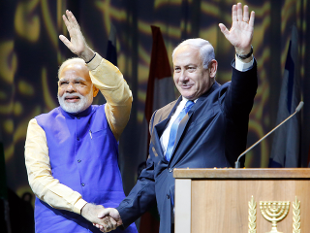
Addressing the Indian diaspora here at an event which was also attended by Israeli Prime Minister Benjamin Netanyahu, Modi also said that direct flights would be launched between Delhi, Mumbai and Tel Aviv to encourage people-to-people contacts.

He said an Indian cultural centre would also be opened in Israel, fulfilling a long-pending demand of the Indian diaspora here.

He said he had heard about problems being faced by the people of Indian origin in getting the OCI cards.

The Indian government has simplified the rules and even those who have undergone the compulsory military service in Israel will get the OCI cards, the prime minister said to the cheering by the crowd.

Modi said the Jewish nation had links with India dating back to centuries but the fact that no Indian prime minister had travelled here in 70 years "raises questions", an apparent swipe at the previous governments of India.

"For the first time in 70 years, an Indian prime minister has landed here to seek your blessings," he said amid chants of "Modi, Modi".

Describing Netanyahu as "my friend", Modi said the kind of welcome extended to him since his arrival here yesterday cannot be forgotten by anyone.

Hailing Israel, particularly its innovations and scientific advancements, he said the country has demonstrated that the number and size does not matter but it is the spirit that matters.

Modi said there were about 600 Indian students in Israel who can contribute to the future of the relationship.

He remembered former Israeli prime minister Shimon Peres, saying he had worked tirelessly for the humanity.

Referring to Moshe Holtzberg, an 11-year-old Israeli who was saved by an Indian nanny during the Mumbai terror attack of 2008, Modi said it had shown how life succeeds over terrorism. He had met Moshe earlier in the day.

Modi also recalled the contribution of the Indian army in liberation of Jerusalem and Haifa during the World War-I. He will be travelling to Haifa tomorrow to pay his tributes to them.

In his 60-minute speech, Modi talked about various programmes initiated by his government and said these were aimed at the betterment of the common people.

Netanyahu, who spoke before Modi said the partnership between India and Israel was "made in heaven and was happening here now."

He said he and Modi had decided on a vast programme and the Indian diaspora was "a bridge". "We love you," he added.

"We have decided to cooperate in so many areas.... We are building this future today, between two democracies," the Israeli prime minister said.

Comments

Raees
 - 
Sunday, 9 Jul 2017

Where is the proof that ram born in ayodhya. Those who have born and death is not god.
Tomm they will say. The first cow on earth was born in kankanady.

What if ram was born in Japan. Will they attack japan.

ali
 - 
Saturday, 8 Jul 2017

why procession for terrorist ???? only his terrorist mates will do that...

Add new comment

  • Coastaldigest.com reserves the right to delete or block any comments.
  • Coastaldigset.com is not responsible for its readers’ comments.
  • Comments that are abusive, incendiary or irrelevant are strictly prohibited.
  • Please use a genuine email ID and provide your name to avoid reject.
Agencies
July 18,2020

Days after Twitter accounts of several billionaires were hacked to engineer a crypto scam, Twitter on Saturday said it is embarrassed, disappointed and, more than anything, sorry for what happened with some of its high-profile users as attackers successfully manipulated its employees and used their credentials to access internal systems, including getting through the two-factor protections.

In the first detailed summary of the "social engineering attack" via a crypto scam that hit at least 130 users this week, Twitter said for 45 of those accounts, the attackers were able to initiate a password reset, login to the account and send Tweets.

"We are continuing our forensic review of all of the accounts to confirm all actions that may have been taken. In addition, we believe they may have attempted to sell some of the usernames," the micro-blogging platform said in a statement.

For up to eight of the Twitter accounts involved, the attackers took the additional step of downloading the account's information via "Your Twitter Data" tool.

This is a tool that is meant to provide an account owner with a summary of their Twitter account details and activity.

"We are reaching out directly to any account owner where we know this to be true. None of the eight were verified accounts," said Twitter.

The company said the attackers were not able to view previous account passwords, as those are not stored in plain text or available through the tools used in the attack.

"Attackers were able to view personal information including email addresses and phone numbers, which are displayed to some users of our internal support tools," informed Twitter.

In cases where an account was taken over by the attacker, they may have been able to view additional information, Twitter added, saying its forensic investigation of these activities was still ongoing.

"We are actively working on communicating directly with the account-holders that were impacted".

The company said it will soon restore access for all account owners who may still be locked out as a result of the remediation efforts.

The New York Times reported on Friday that the Twitter crypto scam can be traced back to a group of hackers who congregate online at OGusers.com, a username-swapping community where people buy and sell coveted online handles.

The report said that the Twitter hack is not from Russian, Chinese or North Korean hackers but was done by a group of young people, "one of whom says he lives at home with his mother".

Comments

Add new comment

  • Coastaldigest.com reserves the right to delete or block any comments.
  • Coastaldigset.com is not responsible for its readers’ comments.
  • Comments that are abusive, incendiary or irrelevant are strictly prohibited.
  • Please use a genuine email ID and provide your name to avoid reject.
Agencies
January 20,2020

For the first time in the 15 years of the Global Risks Report, the climate change and environment risk has occupied all the top five slots.

According to the 15th edition of the World Economic Forum's (WEF) Global Risks Report, the top five risks in terms of likelihood are extreme weather, climate action failure, natural disasters, biodiversity loss and human-made environmental disasters. They all fall in the one category of climate change and related environmental disasters.

WEF President Borge Brende said the world was feeling long-mounting and interconnected risks.

The report also points to how citizens are protesting across the world as discontent rises with failed systems that are creating inequality. The citizens' discontent had hardened with systems that had failed to promote advancement, it said.

"Disapproval of how governments are addressing profound economic and social issues has sparked protests throughout the world, potentially weakening the ability of governments to take decisive action should a downturn occur. Without economic and social stability, countries could lack the financial resources, fiscal margin, political capital or social support needed to confront key global risks," it said.

Listing the grim scenario, Borge said the global economy was faced with "synchronised slowdown", the past five years had been the warmest on record and cyber attacks were expected to increase this year.

The report warns that while the myriad risks were rising, time was running out on how to prevent them.

Borge said the growing palpability of shared economic, environmental and societal risks indicated that the horizon had shortened for preventing "or even mitigating" some of the direst consequences of global risks.

"It's sobering that in the face of this development, when the challenges before us demand immediate collective action, fractures within the global community appear to only be widening," he said.

The report points to grave concern about the consequences of continued environmental degradation, including the record pace of species decline.

Pointing to an unsettled geopolitical environment, the report said today's risk landscape was one in which new centres of power and influence were forming and old alliance structures and global institutions were being tested.

"While these changes can create openings for new partnership structures in the immediate term, they are putting stress on systems of coordination and challenging norms around shared responsibility. Unless stakeholders adapt multilateral mechanisms for this turbulent period, the risks that were once on the horizon will continue to arrive," it said.

Calling it a "an unsettled world", the WEF report notes that powerful economic, demographic and technological forces were shaping a new balance of power. "The result is an unsettled geopolitical landscape in which states are increasingly viewing opportunities and challenges through unilateral lenses," it said.

"What were once givens regarding alliance structures and multilateral systems no longer hold as states question the value of long-standing frameworks, adopt more nationalist postures in pursuit of individual agendas and weigh the potential geopolitical consequences of economic decoupling. Beyond the risk of conflict, if stakeholders concentrate on immediate geo-strategic advantage and fail to re-imagine or adapt mechanisms for coordination during this unsettled period, opportunities for action on key priorities may slip away," the WEF said.

In a chapter on risks to economic stability and social cohesion, it said a challenging economic climate might persist this year and members of the multi-stakeholder community saw "economic confrontations" and "domestic political polarisation" as the top risks in 2020.

The report also warned of downward pressure on the global economy from macroeconomic fragilities and financial inequality. These pressures continued to intensify in 2019, increasing the risk of economic stagnation.

Low trade barriers, fiscal prudence and strong global investment, once seen as fundamentals for economic growth, are fraying as leaders advance nationalist policies. The margins for monetary and fiscal stimuli are also narrower than before the 2008-2009 financial crisis, creating uncertainty about how well countercyclical policies will work.

The strategic partners for the WEF report included Marsh & McLennan and Zurich Insurance Group. The academic advisers were National University of Singapore, Oxford Martin School, University of Oxford and Wharton Risk Management and Decision Processes Center, University of Pennsylvania.

Comments

Add new comment

  • Coastaldigest.com reserves the right to delete or block any comments.
  • Coastaldigset.com is not responsible for its readers’ comments.
  • Comments that are abusive, incendiary or irrelevant are strictly prohibited.
  • Please use a genuine email ID and provide your name to avoid reject.
News Network
April 26,2020

Islamabad, Apr 26: Pakistan Prime Minister Imran Khan has been trumped by the country's powerful military yet again, this time over his government's inadequate steps and its poor response in curbing the coronavirus outbreak in the country, even as cases soared over 12,500.

In his address to the nation on March 22, Khan explained the reasons for not imposing a countrywide lockdown, asserting that millions would lose their jobs and affect families, who are below the poverty line, struggling to find enough food to eat. However, less than 24 hours later, Pakistan Army spokesperson Major General Babar Iftikhar announced the implementation of lockdown in the country having a population of over 200 million, contradicting the statements made by Imran Khan.

As lockdown was imposed, the military has deployed troops across Pakistan and is orchestrating the COVID-19 response through the National Core Committee, a body set up to coordinate policy between the national and provincial governments.

"The government left a big gap in its handling of the coronavirus. The army has tried to fill that gap, there was no choice," an unnamed retired general was quoted by Financial Times as saying.

The virus crisis in Pakistan has once again made things crystal clear about who is calling the shots -- the military, widely believed to bring Imran Khan to power in 2018.

The armymen have taken over the COVID-19 crisis as an opportunity to prove their competency in contrast to Imran Khan, who was mocked after urging youth to come forward and join Corona Relief Tigers Force, a volunteer body to wage "jihad" against the virus.

According to analysts, the military's seizure of the coronavirus response marks yet another policy failure for Imran Khan in the eyes of the generals, as per the Financial Times report.

The 67-year-old cricketer-turned-politician has repeatedly failed to gain international traction over the Kashmir issue and has struggled to convince the Financial Action Task Force (FATF) in getting his country removed from 'grey list' for terror funding.

In times of emergency, one has to take clear decisions and take them through. You can't dither. The whole world is advising strong lockdown. If the prime minister does not show that he is decisive, somebody else will," said Nafisa Shah, a Member of Parliament from the opposition Pakistan Peoples Party (PPP).

Even after the lockdown was imposed, Imran Khan continued to question the need for its implementation, raising eyebrows over the country's response in tackling the virus, as cases continue to rise. This comes even as such drastic measures are in place in many countries across the world, including neighbouring India.

According to The Dawn, the country has 12,657 confirmed cases of COVID-19, which includes 2,755 recoveries and 265 deaths. Punjab has the highest number of cases -- 5,326 --, followed by 4,232 in Sindh.

However, experts suggest that the actual numbers could be more given the low testing rates and inadequate supply of testing kits.

Doctors and nurses across the country have staged protests over the lack of personal protective equipment, as increasing numbers of health workers contract COVID-19.

"Because of the lack of resources, there is chaos among the doctors and healthcare workers. They know people are dying, they know the severity of the illness and they have to work without PPE," Shoaib Hasan Tarar, a doctor working in Rawalpindi, was quoted as saying.

As the coronavirus crisis continues to ravage Pakistan, the country's overwhelming health infrastructure has put a toll on its already floundering economy. The IMF said that the GDP will shrink 1.5 per cent in 2020. The cash-strapped nation is set to be the first major emerging economy to apply to a G-20 initiative to request debt repayment relief, according to Financial Times.

In early March, Pakistan saw a surge in coronavirus cases, when infected pilgrims and workers crossed the border from Qom, a religious city in Iran, which is a hotspot.

Pakistan's limited resources were exposed when quarantined pilgrims agitated against unhealthy conditions at Taftan camp on Pakistan-Iran border, where five people were living in a tent with no access to toilets.

While the lockdown is in place, authorities have been confronted by hardline clerics who have defied social distancing terms and downplayed the threat of the virus. During Friday prayers every week, worshippers violate the restrictions by gathering at various mosques.

Last week, Islamabad inked an agreement allowing mosques to stay open for Ramzan. It stipulated that people should follow 20 rules, including maintaining a six feet distance from each other.

"There is little consistency in terms of how the lockdown is being approached. Coronavirus has shown the disconnect between the national government, regional governments and the military. Imran Khan has been left behind as the cheerleader for keeping Pakistan's morale high. I think people are starting to ask, 'How long is he going to last?'", said Sajjan Gohel, South Asia expert and guest teacher at the London School of Economics.

Comments

Add new comment

  • Coastaldigest.com reserves the right to delete or block any comments.
  • Coastaldigset.com is not responsible for its readers’ comments.
  • Comments that are abusive, incendiary or irrelevant are strictly prohibited.
  • Please use a genuine email ID and provide your name to avoid reject.