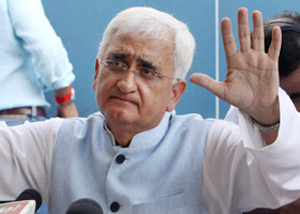
There are RSS people in Congress; but they don’t know they are RSS: Salman Khurshid

coastaldigest.com web desk
July 9, 2017

New Delhi, Jul 9: Former Union Minister Salman Khurshid has said that infiltration of the RSS into the Congress would continue to haunt the party for a long time.Salman copy

In an interview with a national English daily, the 64-year-old leader said that he came to know about such infiltration after the demolition of Babri mosque.

“The funny thing is that they do not even know that they are RSS. They are good RSS people by instinct but they do not know. The first time we got an idea was after the Babri demolition when some leaders began saying that we should not use the word ‘secular’ because it sent out a wrong message,” Khurshid said.

The former minister claims that he had singled out the people who would join BJP three years ago. “I had named Jagadambika Pal, the Bahugunas etc but I was silenced. I was told they were good party workers. I should not bring personal differences to the table. But they are still there in the party. And I know who are going to desert the party and switch sides next,” he added.

The former minister also said that the recent incidents of lynching are a worrying sign for the society and minorities can’t even speak about it.

"From streets being unsafe, we now have homes which are unsafe. Police stations have become the last place where you can get refuge. The mindset that allows lynching will not stop at targeting Muslims alone. It will spread to other sections, Dalits, Christians, Adivasis, intellectuals,” he told National Herald in an interview.

The Congress leader said the minorities had accused the UPA government of not doing enough for them but haven’t said anything to the present NDA dispensation. “I am not suggesting that they were always or even completely unfair. But in 2014 they followed a poor, self-denying strategy that eventually proved lethal for themselves,” he said.

Comments

Ahmed Ali K
 - 
Tuesday, 11 Jul 2017

We have to watch the DK Police that how they will tackle with this Goons Challenge
It seems that we are not in India - We are in Somalia
No Govt, No Police - everything is from Safron group

Add new comment

  • Coastaldigest.com reserves the right to delete or block any comments.
  • Coastaldigset.com is not responsible for its readers’ comments.
  • Comments that are abusive, incendiary or irrelevant are strictly prohibited.
  • Please use a genuine email ID and provide your name to avoid reject.
coastaldigest.com news network
June 14,2020

Newsroom, Jun 14: Bollywood star Sushant Singh Rajput, who was found dead in his house in Mumbai’s Bandra today, was heartbroken after the death of his former manager Disha Salian.

34-year-old actor had posted a heartfelt note after her death: “It’s such devastating news. My deepest condolences to Disha’s family and friends. May your soul rest in peace.” 

The police are considering 28-year-old Disha’s death as an accidental one and the investigation is on to find if it was a suicide. She died after falling off the 14th floor of a building in Malad, Mumbai on June 8.

It is not yet known if there is any connection between the two deaths. Sushant’s house help reportedly found him hanging inside his room on Sunday and cops are investigating the case. He was recently seen in Nitesh Tiwari’s Chhichhore and more recently on Netflix opposite Jacqueline Fernandez in Drive.

Who is Disha Salian?

Disha Salian hails from Karnataka’s coastal district of Udupi. She was born in 1992 into a business family background. She reportedly migrated to Mumbai with her family at an early age. 

After completing her education, she worked in the Times of India Group for more than three years. She went on to become the celebrity manager at Media Vantage.

Apart from Sushant, she had great links with many popular celebrities like Bharti Singh, Alisha Panwar, and others.

Comments

Add new comment

  • Coastaldigest.com reserves the right to delete or block any comments.
  • Coastaldigset.com is not responsible for its readers’ comments.
  • Comments that are abusive, incendiary or irrelevant are strictly prohibited.
  • Please use a genuine email ID and provide your name to avoid reject.
coastaldigest.com news network
June 25,2020

Mangaluru, Jun 25: In a shocking development, as many as five post-graduate (PG) doctors have tested positive for coronavirus in Mangaluru. 

The one male and four female doctors – all aged around 28 years – are asymptomatic and are being treated at the designated covid hospital in the city.

All the five PG doctors of Kasturba Medical College were deputed at Govt. Lady Goschen Hospital and District Wenlock Hospital (Covid Hospital).

Meanwhile, around 30 medicos have been quarantined.

According to sources, the five doctors were staying in a residential apartment in the city. The apartment is likely to be sealed.

Comments

Add new comment

  • Coastaldigest.com reserves the right to delete or block any comments.
  • Coastaldigset.com is not responsible for its readers’ comments.
  • Comments that are abusive, incendiary or irrelevant are strictly prohibited.
  • Please use a genuine email ID and provide your name to avoid reject.
Agencies
May 8,2020

Washington D.C., May 8: The prime time for brain development in a child's life is the first year, where the infant spends most of the time asleep. It is the time when neural connections form and sensory memories are encoded.

However, when sleep is disrupted, as occurs more often among children with autism, brain development may be affected, too.

New research led by the University of Washington finds that sleep problems in a baby's first 12 months may not only precede an autism diagnosis but also may be associated with altered growth trajectory in a key part of the brain, the hippocampus.

The study, which was published in the American Journal of Psychiatry, researchers report that in a sample of more than 400 taken of 6- to 12-month-old infants, those who were later diagnosed with autism were more likely to have had difficulty falling asleep.

It also states that this sleep difficulty was associated with altered growth trajectories in the hippocampus.

"The hippocampus is critical for learning and memory, and changes in the size of the hippocampus have been associated with poor sleep in adults and older children.

As many as 80 per cent of the children with autism spectrum disorder have sleep problems," said Annette Estes, director of the UW Autism Center and senior author of the study.

"In our clinical experience, parents have a lot of concerns about their children's sleep, and in our work on early autism intervention, we observed that sleep problems were holding children and families back," added Estes, who is also a UW professor of speech and hearing sciences.

"It could be that altered sleep is part-and-parcel of autism for some children. One clue is that behavioural interventions to improve sleep don't work for all children with autism, even when their parents are doing everything just right. This suggests that there may be a biological component to sleep problems for some children with autism," said Estes.

To consider links among sleep, brain development, and autism, researchers at the IBIS Network looked at MRI scans of 432 infants, surveyed parents about sleep patterns, and measured cognitive functioning using a standardized assessment.

At the outset of the study, infants were classified according to their risk for developing autism: Those who were at higher risk of developing autism -- about two-thirds of the study sample -- had an older sibling who had already been diagnosed.

Infant siblings of children with autism have a 20 per cent chance of developing autism spectrum disorder -- a much higher risk than children in the general population.

In the current study, 127 of the 432 infants were identified as "low risk" at the time the MRI scans were taken because they had no family history of autism.

They later evaluated all the participants at 24 months of age to determine whether they had developed autism. Of the roughly 300 children originally considered "high familial risk," 71 were diagnosed with autism spectrum disorder at that age.

Problems with sleep were more common among the infants later diagnosed with an autism spectrum disorder, as were larger hippocampi. No other subcortical brain structures were affected, including the amygdala, which is responsible for certain emotions and aspects of memory, or the thalamus, a signal transmitter from the spinal cord to the cerebral cortex.

The authors note that while parents reported more sleep difficulties among infants who developed autism compared to those who did not, the differences were very subtle and only observed when looking at group averages across hundreds of infants.

Sleep patterns in the first years of life change rapidly as infants transition from sleeping around the clock to a more adult-like sleep/wake cycle. Until further research is completed, Estes said, it is not possible to interpret challenges with sleep as an early sign of increased risk for autism.


Comments

Add new comment

  • Coastaldigest.com reserves the right to delete or block any comments.
  • Coastaldigset.com is not responsible for its readers’ comments.
  • Comments that are abusive, incendiary or irrelevant are strictly prohibited.
  • Please use a genuine email ID and provide your name to avoid reject.