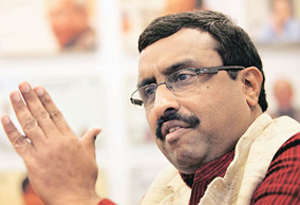
Cow is no more ‘mother’? Human life more valuable than cow, says BJP leader

coastaldigest.com web desk
July 10, 2017

Benglauru, Jul 10: A senior BJP leaders has strongly condemned human killings on the pretext of cow protection in the country and urged the ‘gou rakshaks’ to give priority to human beings over animals.

ram“Nobody should kill human beings in the name of protection of cows. The protection of cow is a holy act, but we shouldn’t forget the fact that human life is more important than cow,” said, BJP national general secretary V Ram Madhav.

He was delivering a lecture on “The Principle of Integral Humanism—Permanent and Universal Thinking” at an event organised by Awareness in Action.

“Indians consider every object of nature as pious and rever the nature. Cow is a holy animal for Indians and they consider cow protection a holy act. However, human life is more important than the cow,” he said.

Both communism and capitalism failed to fulfill aspirations of the people. The failure of these two theories led to the birth of the ‘the principle of integral humanism.’ Jacques Maritain, a French Catholic philosopher for the first time came out with ‘Universal Declaration of Human Rights’ when Europe was facing a political crisis during the initial period of the 20th century, Madhav said.

Maritain stressed the importance of humanism as his theories are human-centric. He wanted renaissance of democracy. He was of the opinion that democracy and Christianity were needed for shaping good human beings.

Bharatiya Jan Sangh ideologue Deendayal Upadhyay too stressed humanity, but he transcended humanity and highlighted the importance of community, nature and spirituality. Upadhyay’s views are like the 20th chapter of Hinduism. “Pride, independence and unity are the three pillars of integral humanism,” he stated.

Senior BJP leader and former Union minister D Purandeshwari said the Indian culture withstood external onslaught and was going stronger. There was a need to promote Indian culture, tradition and values, she added.

Comments

EVERYBODY
 - 
Wednesday, 12 Jul 2017

After all this happening... The authorities and the hindus should not fear the MUSLIMS rather they have to fear the Culprits who are expert in disrupting the society ... They have Phd in deception and the Police and most of the indians know that the real trouble makers are Cheddis... who put fear in public...

In the past most of the cases were done by the cheddis and blamed the muslims and dalits... The police know very well about such activities..

Even if the cheddis are trained by the Zionist , they still lack in deceiving the public. In india authorities are smarter alwz, caught the cheddis game which is done thru back door.... They get away only cos of the 60% handling the power.

Abdullah
 - 
Wednesday, 12 Jul 2017

Mai Hafiz hu or U.P board se 10th pass kiya hu or Arabic 5th tk Aalim course kiya hu math science English bhi padha hu mujhe admission Lena hai Shaheen college me kya mera admission ho jaayega

Shuaib
 - 
Wednesday, 12 Jul 2017

He must have been arrested & punished.

Raees
 - 
Wednesday, 12 Jul 2017

Sorry... even sangi channels published it. Porbu news not published this news yet.....

syed laiq uddin
 - 
Tuesday, 11 Jul 2017

assalamyalakum i know the languages english hindi urdu telugu arabic already i did 3 umrah

Cow and the politics
 - 
Tuesday, 11 Jul 2017

Break his a**

Fairman
 - 
Tuesday, 11 Jul 2017

Whatever they write for other's religion it is printing error.
But for Hinduism, printing error does not happen.

Even while lying not thinking, how to sell it to others.
Fooling others.

Whatever they do, Islam is expanding and they can not propagate their Hinduism. If not now, one time will come Hindu culture will extinct in India and all over. Because they don't have any proof to defend its story to make others believe.
Again, there are many good thinking Hindus, it is definitely not for all.

shamshuddin Mohammed
 - 
Tuesday, 11 Jul 2017

He will be future BJP Candidate soon.

Abdullah
 - 
Tuesday, 11 Jul 2017

Great Human Service. God Bless.

Add new comment

  • Coastaldigest.com reserves the right to delete or block any comments.
  • Coastaldigset.com is not responsible for its readers’ comments.
  • Comments that are abusive, incendiary or irrelevant are strictly prohibited.
  • Please use a genuine email ID and provide your name to avoid reject.
News Network
June 26,2020

Bengaluru, Jun 26: The National Restaurant Association of India (NRAI) on Thursday came up with a Standard Operating Procedure (SOP) for restaurants whereby among other physical distancing norms, it has suggested a 2-metre gap between tables.

Formulated in partnership with Releski, a Bengaluru based skill-tech company, the SoP suggests that in case of back-to-back seating, people sitting with their backs towards each other will have their seats divided by 'Plexiglass' divider raised up to 2 meters from the ground.

"In a typical restaurant, the improvised seating plan should have a minimum distance of 2 metres between tables. The distance of 2 metres (6 feet) between tables should measure from one edge of the table to the other table's edge," it said.

In case of loose or free seating such as in banquet style or food court style seating, a minimum 2 meters of distance should be maintained between tables.

The guidelines noted that, to encourage physical distancing, restaurants have to sacrifice their seating capacity, to promote health and safety, and also to gain trust from their patrons.

"In order to perform this, divide your restaurants under different sectors. Pull out your restaurant's floor plan and colour code different sections red and yellow. Red sections are potential areas where maximum footfall or traffic is observed. Yellow sections are areas where the footfalls are average," it said.

All the red sections are encircled or bordered by placing barricades or Q manager and will open at specific points to access the yellow section and all the opening points will have hand sanitisers and sprays, and every guest who walks from red zones to yellow zones will sanitise himself/herself to reduce the chances of contamination.

For air conditioning, the guidelines of CPWD shall be followed which inter alia emphasises that the temperature setting of all air conditioning devices should be in the range of 24-30 degree Celsius, relative humidity should be in the range of 40- 65 per cent, intake of fresh air should be as much as possible and cross ventilation should be adequate, the guidelines suggested.

The industry body has also suggested appointment of a COVID-free Ambassador who would operate as the Chief Health Officer within the restaurant team, preferably from the management team in each shift.

The ambassador's would put the new daily work routines into practice, to monitor compliance with good practice and to lead the preventative measures, adapt to health & safety recommendations and requirements of the restaurant and oversee the implementation of the norms.

Anurag Katriar, President of NRAI and CEO & Executive Director of deGustibus Hospitality, said: "Every restaurant cutting across formats is facing the harsh reality of subdued to shut business volumes in the present and the uncertainty of business environment in the future. One thing is certain that hygiene and safety will be a key differentiator in the post-pandemic restaurant operations."

Comments

Add new comment

  • Coastaldigest.com reserves the right to delete or block any comments.
  • Coastaldigset.com is not responsible for its readers’ comments.
  • Comments that are abusive, incendiary or irrelevant are strictly prohibited.
  • Please use a genuine email ID and provide your name to avoid reject.
News Network
June 10,2020

Bengaluru, June 10: The Department of Primary and Secondary Education of Government of Karnataka today ordered a ban on online classes for children from KG to class 5.

The decision was taken following a report based on the report submitted by director NIMHANS, recommending online classes only above the age of 6 years and also following the complaints from several parents about online classes conducted by private schools even for kindergarten kids.

Briefing the media soon after the meeting with department officials, S Suresh Kumar, primary and secondary education minister said, "We have taken two major decisions today. The online classes for LKG, UKG and primary classes should be stopped immediately."

Even collecting fees in the name of online classes should be stopped, said the minister. "We have already issued a circular about it insisting that schools not collect fees in the name of online classes and also requesting schools not to increase fees for the 2020-21 academic year considering financial constraints of several people due to the COVID-19 pandemic," said the minister.

The department, however, also discussed how to engage children during this period as there was no clarity over the reopening of schools for the 2020-21 academic year. "We have constituted a committee to prepare guidelines on how to engage students and increase their knowledge. The committee is headed by Prof. MK Sridhar," he said.

Before taking this decision, the department had three rounds of discussions with various experts, including Prof. MK Sridhar, Prof. VP Niranjanaradhya, Dr John Vijay Sagar and other departments, including the home and health departments.

Comments

Add new comment

  • Coastaldigest.com reserves the right to delete or block any comments.
  • Coastaldigset.com is not responsible for its readers’ comments.
  • Comments that are abusive, incendiary or irrelevant are strictly prohibited.
  • Please use a genuine email ID and provide your name to avoid reject.
News Network
July 28,2020

Hounde, Jul 28: Coronavirus and its restrictions are pushing already hungry communities over the edge, killing an estimated 10,000 more young children a month as meager farms are cut off from markets and villages are isolated from food and medical aid, the United Nations warned Monday.

In the call to action shared with The Associated Press ahead of publication, four UN agencies warned that growing malnutrition would have long-term consequences, transforming individual tragedies into a generational catastrophe.

Hunger is already stalking Haboue Solange Boue, an infant from Burkina Faso who lost half her former body weight of 5.5 pounds (2.5 kilograms) in just a month. Coronavirus restrictions closed the markets, and her family sold fewer vegetables. Her mother was too malnourished to nurse.

“My child,” Danssanin Lanizou whispered, choking back tears as she unwrapped a blanket to reveal her baby's protruding ribs.

More than 550,000 additional children each month are being struck by what is called wasting, according to the UN — malnutrition that manifests in spindly limbs and distended bellies. Over a year, that's up 6.7 million from last year's total of 47 million. Wasting and stunting can permanently damage children physically and mentally.

“The food security effects of the COVID crisis are going to reflect many years from now,” said Dr. Francesco Branca, the WHO head of nutrition. “There is going to be a societal effect.”

From Latin America to South Asia to sub-Saharan Africa, more poor families than ever are staring down a future without enough food.

In April, World Food Program head David Beasley warned that the coronavirus economy would cause global famines “of biblical proportions” this year. There are different stages of what is known as food insecurity; famine is officially declared when, along with other measures, 30% of the population suffers from wasting.

The World Food Program estimated in February that one Venezuelan in three was already going hungry, as inflation rendered salaries nearly worthless and forced millions to flee abroad. Then the virus arrived.

“Every day we receive a malnourished child,” said Dr. Francisco Nieto, who works in a hospital in the border state of Tachira.

In May, Nieto recalled, after two months of quarantine, 18-month-old twins arrived with bodies bloated from malnutrition. The children's mother was jobless and living with her own mother. She told the doctor she fed them only a simple drink made with boiled bananas.

“Not even a cracker? Some chicken?” he asked.

“Nothing,” the children's grandmother responded. By the time the doctor saw them, it was too late: One boy died eight days later.

The leaders of four international agencies — the World Health Organization, UNICEF, the World Food Program and the Food and Agriculture Organization — have called for at least dollar 2.4 billion immediately to address global hunger.

But even more than lack of money, restrictions on movement have prevented families from seeking treatment, said Victor Aguayo, the head of UNICEF's nutrition program.

“By having schools closed, by having primary health care services disrupted, by having nutritional programs dysfunctional, we are also creating harm,” Aguayo said. He cited as an example the near-global suspension of Vitamin A supplements, which are a crucial way to bolster developing immune systems.

In Afghanistan, movement restrictions prevent families from bringing their malnourished children to hospitals for food and aid just when they need it most. The Indira Gandhi hospital in the capital, Kabul, has seen only three or four malnourished children, said specialist Nematullah Amiri. Last year, there were 10 times as many.

Because the children don't come in, there's no way to know for certain the scale of the problem, but a recent study by Johns Hopkins University indicated an additional 13,000 Afghans younger than 5 could die.

Afghanistan is now in a red zone of hunger, with severe childhood malnutrition spiking from 690,000 in January to 780,000 — a 13% increase, according to UNICEF.

In Yemen, restrictions on movement have blocked aid distribution, along with the stalling of salaries and price hikes. The Arab world's poorest country is suffering further from a fall in remittances and a drop in funding from humanitarian agencies.

Yemen is now on the brink of famine, according to the Famine Early Warning Systems Network, which uses surveys, satellite data and weather mapping to pinpoint places most in need.

Some of the worst hunger still occurs in sub-Saharan Africa. In Sudan, 9.6 million people live from one meal to the next — a 65% increase from the same time last year.

Lockdowns across Sudanese provinces, as around the world, have dried up work and incomes for millions. With inflation hitting 136%, prices for basic goods have more than tripled.

“It has never been easy but now we are starving, eating grass, weeds, just plants from the earth,” said Ibrahim Youssef, director of the Kalma camp for internally displaced people in war-ravaged south Darfur.

Adam Haroun, an official in the Krinding camp in west Darfur, recorded nine deaths linked with malnutrition, otherwise a rare occurrence, over the past two months — five newborns and four older adults, he said.

Before the pandemic and lockdown, the Abdullah family ate three meals a day, sometimes with bread, or they'd add butter to porridge. Now they are down to just one meal of “millet porridge” — water mixed with grain. Zakaria Yehia Abdullah, a farmer now at Krinding, said the hunger is showing “in my children's faces.”

“I don't have the basics I need to survive,” said the 67-year-old, who who hasn't worked the fields since April. “That means the 10 people counting on me can't survive either.”


Comments

Add new comment

  • Coastaldigest.com reserves the right to delete or block any comments.
  • Coastaldigset.com is not responsible for its readers’ comments.
  • Comments that are abusive, incendiary or irrelevant are strictly prohibited.
  • Please use a genuine email ID and provide your name to avoid reject.